What if the high monthly quotes you’ve seen for local senior living don’t tell the whole story? It’s common to feel a sense of sticker shock when researching memory care costs Los Angeles families are facing in 2026. You might worry about hidden fees or feel frustrated because Medicare doesn’t cover the specialized support your loved one needs. It’s a heavy emotional weight, and it’s one you shouldn’t have to carry alone. We understand that finding a safe, supportive environment that fits your family’s budget feels like an overwhelming task.
We agree that your focus should be on your loved one’s well-being, not just the bottom line. This guide provides a clear path through the current pricing landscape, offering expert strategies to help you manage expenses while maintaining peace of mind. You’ll learn about the different price tiers across neighborhoods like the San Fernando Valley, how to spot hidden costs before they appear on a bill, and which local financial assistance programs, such as VA benefits or the Medi-Cal Assisted Living Waiver, can help bridge the gap.
Key Takeaways
- Get a clear breakdown of memory care costs Los Angeles families can expect in 2026, helping you plan for your loved one’s future with confidence.
- Learn how to identify hidden “Level of Care” adjustments and one-time community fees so you can avoid unexpected surprises on your monthly statement.
- Discover how neighborhood choice impacts your budget, specifically why the San Fernando Valley offers high-quality specialized care at more manageable price points.
- Explore practical financial strategies, including how to unlock VA Aid and Attendance benefits to make specialized dementia care more affordable for veterans.
- Find out how a local senior living advisor identifies unadvertised rate reductions and move-in specials to help you find the best value for your family.
Understanding Memory Care Costs in Los Angeles for 2026
Memory care is a specialized type of support designed for seniors living with Alzheimer’s or other forms of dementia. In California, these communities are licensed as Residential Care Facilities for the Elderly (RCFE). To understand the pricing, it helps to first look at what is assisted living in a broader sense. While standard assisted living provides help with daily tasks, memory care is a secure, high-service tier within that category that offers 24-hour supervision and cognitive programming. When researching memory care costs Los Angeles families often find that prices here are significantly higher than the national average.
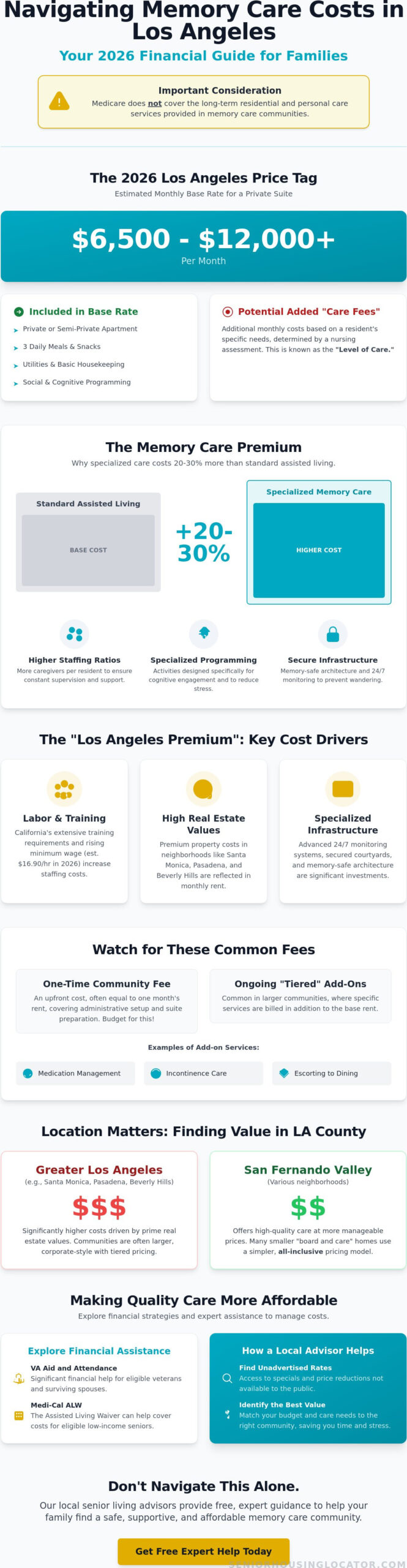
For 2026, the estimated base rate for a private suite in Los Angeles County typically ranges from $6,500 to $12,000 per month. It’s vital to distinguish between “room and board” and your actual care fees. The base rate usually covers your apartment, utilities, meals, and basic housekeeping. However, most facilities use a “level of care” or “care points” system. This means that as a resident’s needs increase, such as requiring more help with mobility or medication management, additional fees are added to that base price. Understanding this distinction early on can help you avoid unexpected budget changes as your loved one’s condition progresses.
What Drives the “Los Angeles Premium” in 2026?
Why does Los Angeles carry such a high price tag? Several local factors push these costs upward. First, California labor laws require extensive specialized training for memory care staff. With the statewide minimum wage rising to $16.90 per hour in early 2026, facilities must invest more in their caregiving teams to maintain high standards of support. Second, real estate values in neighborhoods like Santa Monica, Pasadena, and Beverly Hills are among the highest in the country. These costs are naturally reflected in the monthly rent. Finally, memory care requires specific infrastructure. You aren’t just paying for a room; you’re paying for specialized “memory-safe” architecture, secured outdoor courtyards, and advanced 24/7 monitoring systems designed to prevent wandering.
Memory Care vs. Standard Assisted Living Costs
You can generally expect a 20% to 30% price premium for memory care compared to standard assisted living. This extra cost is directly tied to higher staffing ratios and specialized programming that isn’t found in traditional senior housing. While you can explore general assisted living costs Los Angeles families often find the added security of a dedicated memory care wing is essential for their peace of mind. The specialized environment reduces stress for the resident and ensures they receive the specific cognitive engagement they need to thrive.
Breakdown of Monthly Memory Care Fees and Hidden Costs
When you look at the initial quote for a community, it’s easy to assume that number covers everything. However, understanding the full scope of memory care costs Los Angeles families encounter requires a closer look at the fine print. Most communities begin the relationship with a one-time “Community Fee” or “Move-in Fee.” This is an upfront cost, often equal to one month’s rent, which covers the administrative work of processing the move and preparing the suite. It’s a standard practice in the LA market, but it’s one you should budget for early.
Beyond the move-in fee, you’ll likely choose between two different pricing structures. In areas like the San Fernando Valley, many residential board and care homes favor an “all-inclusive” model. This means your monthly rate stays the same regardless of how much help your loved one needs. Larger, corporate-style communities typically use a “tiered” or “point-based” model. In this setup, the base rent covers the room and meals, while additional fees are added for specific services. These add-ons often include:
- Medication management and administration.
- Incontinence care and supplies.
- Escorting to and from the dining room.
The “Level of Care” Assessment: What to Expect
Before your loved one moves in, a Registered Nurse (RN) will perform a detailed assessment. This evaluation determines the final monthly invoice based on the resident’s physical and cognitive needs. It’s helpful to understand the difference between skilled nursing vs assisted living levels, as memory care sits in a specialized middle ground. We recommend asking how often these assessments happen. Some communities re-evaluate every six months, while others do so only after a health change. You should also ask if there’s a “cap” on care fees to help you plan for the long term.
Ancillary Costs Often Overlooked
Even with a clear level of care, smaller “ancillary” costs can add up. These are the daily life extras that aren’t always part of the care plan. You might see separate charges for personal laundry, beauty shop visits, or specialized transportation to medical appointments. If a resident experiences significant behavioral challenges, some facilities might even require temporary “companion care” or 1-on-1 supervision, which can be an expensive addition. Proper financial planning for memory care involves looking at these possibilities before they become urgent needs. If you’re feeling overwhelmed by these numbers, our team can help you compare local options that fit your budget.
Regional Price Variance: San Fernando Valley vs. Greater LA
When you start your search, it’s helpful to remember that Los Angeles isn’t a single, uniform market. Where you choose to look is just as important as the type of facility you select. A common mistake is looking at a single average for the entire city. In reality, memory care costs Los Angeles families encounter can vary by thousands of dollars depending on the neighborhood. For instance, the price of a luxury suite on the Westside often reflects the high real estate values of the area rather than just the medical care provided.
The San Fernando Valley is often considered a “sweet spot” for families seeking specialized support. In the Valley, you’ll find a wide range of options that offer a high standard of care at more moderate price points than Santa Monica or Beverly Hills. Whether you’re looking for a large community with many amenities or a smaller, more intimate setting, this region provides a diverse landscape that fits many different budgets. Finding a location that feels like home shouldn’t mean sacrificing your financial stability. Families who are concerned about affordability may also benefit from reviewing the available senior housing options for limited budget in the Los Angeles area, which outlines HUD income limits and other cost-saving strategies for 2026.
Cost Tiers by Neighborhood
To help organize your search, we’ve categorized the local market into three general pricing tiers. This allows you to focus your efforts on neighborhoods that align with your family’s long-term financial goals.
- Tier 1 (Premium): This includes coastal and high-prestige areas like Santa Monica, Pacific Palisades, and Brentwood. These communities often feature resort-style amenities and premium views.
- Tier 2 (Mid-Range): Neighborhoods like Sherman Oaks, Encino, and Pasadena offer a balance of excellent care and accessibility, serving as a middle ground for many families.
- Tier 3 (Value-Focused): Areas such as Northridge, Granada Hills, and Sylmar often provide the most competitive rates in the county, making them ideal for families focused on high-quality, essential care.
The Board and Care Advantage for Memory Care
If a large, hotel-like community feels overwhelming, a residential board and care home might be the right solution. These are licensed RCFEs located in traditional houses within quiet residential neighborhoods. Because these homes typically only serve six residents, they offer a much higher staff-to-resident ratio. Many families find significant value by exploring board and care homes Woodland Hills families have used for years to find a calm, home-like environment.
One of the biggest financial benefits of these smaller homes is their “all-inclusive” nature. Unlike larger communities that might add fees for every extra service, most residential homes offer a flat monthly rate. This transparency helps you avoid the “fee creep” that can happen as a resident’s needs change. Families comparing their options should review the full breakdown of board and care home costs Los Angeles families are encountering in 2026, which details how this model stacks up against larger corporate communities. You can research the standards for these homes through California Department of Aging Programs. For a closer look at options in your specific area, see our guide on memory care placement San Fernando Valley. Choosing a neighborhood slightly further inland can often provide the same high-quality care while making your resources go much further.
Financial Strategies: How to Pay for Memory Care in 2026
One of the most common surprises families face is the realization that Medicare does not cover the monthly room and board for memory care. While Medicare is excellent for hospital stays or short-term rehabilitation, it isn’t designed for long-term residential support. This gap in coverage often leaves families feeling anxious about how to manage memory care costs Los Angeles communities require. Fortunately, there are several local and federal programs designed to help you bridge this gap and protect your family’s financial health.
If your loved one is a veteran or the surviving spouse of a veteran, you have access to one of the most helpful resources available. The VA Aid and Attendance benefit provides a monthly, tax-free pension that can be applied directly to care costs. In 2026, the maximum monthly benefit for a single veteran is $2,424. A married veteran can receive up to $2,874, and a surviving spouse may be eligible for up to $1,558 per month. These funds can be used in both large assisted living communities and smaller residential board-and-care homes throughout Southern California.
For those with Long-Term Care Insurance (LTCI), a formal diagnosis of Alzheimer’s or dementia typically acts as a “trigger” for benefits. Most policies begin paying out when a resident requires help with two or more activities of daily living or needs constant supervision for safety. If you don’t have insurance, you might consider a “bridge loan.” These are short-term loans designed specifically for seniors who need to move into care quickly while they wait for a home to sell or for other benefits to begin. Given the high property values in Los Angeles, leveraging home equity is a common and effective strategy for many local homeowners. For families working with tighter financial constraints, our comprehensive guide to senior housing options for limited budget in Los Angeles covers additional programs and strategies that can help make care more accessible.
Maximizing VA Benefits in Southern California
Eligibility for VA benefits in 2026 depends on both clinical need and financial status. To qualify for the “pension with housebound or aid and attendance” status, the veteran’s net worth must be below $163,699. It’s important to know that your primary residence and one vehicle are usually excluded from this calculation. Because the application process can be lengthy, we recommend starting as early as possible to ensure the funds are ready when you need them.
Asset Conversion and Life Settlements
Another option is converting an existing life insurance policy into a “long-term care benefit plan.” This allows you to receive a portion of the death benefit immediately to pay for care. Additionally, many families find relief through tax deductions. According to IRS Publication 502, memory care expenses can be tax-deductible if the resident is considered “chronically ill” and the care is provided according to a prescribed plan. If you’re feeling stuck, our team can help you explore memory care placement options that work alongside these financial tools.
Finding the Best Value: How a Senior Living Advisor Helps
Searching for the right facility can feel like a full-time job. You’re likely balancing doctor visits, legal paperwork, and the emotional weight of your loved one’s diagnosis. This is where we step in as your trusted local ally. Our placement services are 100% free for families. We’re paid by the communities, which means you get our expertise and support without adding a single penny to your expenses. We focus on finding the most competitive memory care costs Los Angeles providers offer while ensuring your loved one receives the dignity and care they deserve.
Local knowledge is your greatest asset in this journey. We maintain close relationships with providers throughout the San Fernando Valley, allowing us to identify unadvertised rate reductions and “move-in specials” that you won’t find on a public website. Our vetting process goes far beyond just looking at the price tag. We examine state citations, staffing stability, and overall “culture fit” to ensure the community is a safe and joyful environment. For example, our expertise in senior living placement Sherman Oaks families rely on helps us pinpoint homes that balance high-quality care with local convenience.
The Negotiation Advantage
A senior living advisor Los Angeles families trust has significantly more leverage than a single family. We understand the current occupancy rates and seasonal trends of local communities. This knowledge allows us to help you negotiate the one-time community fee or even lock in a monthly rate for 12 to 24 months. We aim to create financial predictability for your family, ensuring that the care plan you choose today remains sustainable for years to come. Our goal is to lower the stakes and provide a clear, manageable path forward.
Your Next Steps to Peace of Mind
You don’t have to make these difficult decisions in a vacuum. We invite you to schedule a free consultation to “crunch the numbers” and explore the specific options available in your preferred neighborhood. Whether you’re looking for a large community with extensive amenities or a quiet residential home, quality care is possible on a budget with the right guide by your side. Let us do the heavy lifting so you can focus on being a supportive family member rather than a stressed researcher. Schedule your free memory care cost consultation today.
Take the Next Step Toward Secure Care
Finding the right path for your loved one doesn’t have to be a lonely journey. We’ve covered the essential details of memory care costs Los Angeles families encounter, from hidden fees to the significant savings found in San Fernando Valley neighborhoods. You now have the tools to look beyond the initial sticker shock and identify the financial strategies that work for your specific situation. Whether it’s leveraging VA benefits or choosing a residential board and care home, quality care is within reach.
With over 15 years of local San Fernando Valley expertise, our team is ready to guide you through every step of this process. We offer a 100% free service for families and provide insider access to unadvertised move-in specials that you won’t find anywhere else. Let us help you find a community that fits both your heart and your budget. Get Free Expert Help Finding Affordable Memory Care in Los Angeles today. You’ve done the hard work of researching; now let us handle the details so you can focus on being there for your family.
Frequently Asked Questions
Does Medicare pay for memory care in Los Angeles?
Medicare does not pay for the room and board portion of memory care in Los Angeles. It only covers specific medical expenses like doctor visits, hospital stays, and short-term rehabilitative care. Families must rely on private funds, long-term care insurance, or specific state programs to cover the residential costs of a memory care community. It’s best to plan for these expenses using other financial strategies as early as possible.
What is the average monthly cost of memory care in the San Fernando Valley?
The average monthly cost for memory care in the San Fernando Valley is approximately $5,736 as of 2026. This region is often more affordable than the broader Los Angeles average, which typically ranges from $6,400 to over $9,800. Choosing a location in the Valley can provide a high standard of specialized care while helping your family’s budget go further. Prices vary based on the specific neighborhood and the size of the home.
Are board and care homes cheaper than memory care communities in LA?
Board and care homes often provide better overall value because they typically use an all-inclusive pricing model. While the base rate might appear similar to a large community, you won’t see the “fee creep” associated with extra care points as a resident’s needs increase. These six-bed homes offer a higher staff-to-resident ratio and a calm, home-like environment. This makes them a cost-effective alternative for families looking to avoid the tiered pricing models. For a detailed comparison of what to expect to pay, see our complete guide to board and care home costs Los Angeles families are navigating in 2026.
How do I qualify for VA Aid and Attendance for a parent in memory care?
To qualify for VA Aid and Attendance, a parent must be a veteran or surviving spouse who served during a period of war and requires help with daily activities. In 2026, the net worth limit for eligibility is $163,699, which excludes their primary home and one vehicle. This benefit can provide up to $2,874 per month for a married veteran. It’s a vital resource that helps many families manage memory care costs Los Angeles providers charge.
Can I negotiate the monthly rate at a memory care facility?
Yes, you can often negotiate certain aspects of the pricing at a memory care facility. While the monthly care fees are usually set based on a clinical assessment, the one-time community or move-in fee is frequently negotiable. We often help families identify unadvertised move-in specials or lock in rates for a specific period. Having a local ally who understands the current occupancy trends in Los Angeles gives you much more leverage during these conversations.
What happens if my parent runs out of money while in a memory care community?
If a resident runs out of money, the primary option in California is the Assisted Living Waiver (ALW) program through Medi-Cal. However, it’s important to know that this program had a waitlist of 18,000 individuals in 2026. Not all facilities participate in this waiver, so we recommend identifying “waiver-friendly” communities early in your search. Planning ahead and exploring bridge loans or asset conversion can help prevent a crisis if funds become low.
Is memory care tax-deductible in California?
Memory care is often tax-deductible as a medical expense in California and at the federal level. According to IRS standards, if a resident is considered “chronically ill” and requires substantial supervision for safety, their room and board may qualify. This can significantly lower the effective memory care costs Los Angeles families pay each year. We always suggest consulting with a tax professional to see how IRS Publication 502 applies to your specific situation.
How much extra are “level of care” fees usually in LA?
Level of care fees in Los Angeles typically add an extra $200 to $600 per month to the base rent, though high-needs tiers can be more. These fees cover specific services like incontinence care, medication management, or escorting to meals. Some communities use a point system where costs increase as the resident’s dementia progresses. Understanding how these tiers are structured during your initial tour helps you predict how your monthly invoice might change over time.