
7 out of 10 people will require long-term care in their lifetime, yet most families wait until a hospital discharge or a safety crisis to research skilled nursing vs assisted living. It’s completely normal to feel overwhelmed by the technical jargon and the rising costs of care here in Los Angeles. You want your loved one to be safe, but you also want them to maintain their dignity and independence for as long as possible.
We understand the weight of this decision. That’s why we’ve created this guide to provide clear, empathetic guidance on the medical, financial, and lifestyle differences between these two vital care options. You deserve to feel confident that you’re choosing a path that can handle your loved one’s needs today and any health declines in the future.
We’ll walk you through the 2026 costs, explain the crucial difference between medical and custodial care, and simplify the latest Medi-Cal asset limits. By the end of this guide, you’ll have a clear path forward and a better understanding of how to pay for the care your family deserves.
Key Takeaways
- Understand the fundamental difference between a social-first residential model and a clinical environment with 24/7 physician supervision.
- Recognize the five specific warning signs that tell you when a loved one requires medical-first care versus daily support.
- Compare 2026 cost projections for Los Angeles care options to create a realistic and manageable financial plan for your family.
- Gain confidence in choosing between skilled nursing vs assisted living by focusing on your loved one’s medical necessity and personal lifestyle.
- Learn how local expertise can streamline your transition and help you find the right community in neighborhoods like Woodland Hills and Sherman Oaks.
Defining the Terms: What is Assisted Living vs. Skilled Nursing?
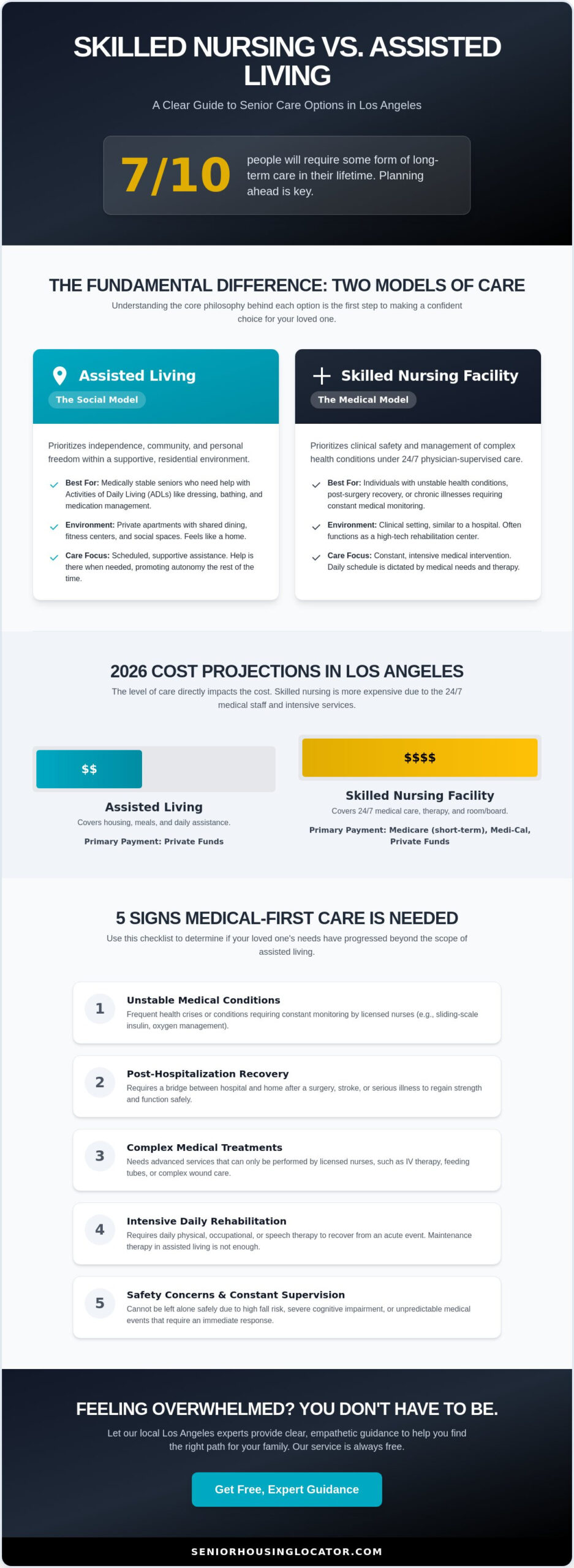
Choosing the right care for a parent often feels like learning a new language. At the heart of this journey is the comparison of skilled nursing vs assisted living. While both options provide a safe environment, they serve very different purposes. One is designed to support a person’s lifestyle, while the other is designed to manage their medical health. Understanding this distinction is the first step toward finding peace of mind for your family.
The core differentiator is the frequency and type of medical intervention. In an assisted living community, help is typically scheduled and supportive. A caregiver might arrive at a specific time to help with a morning routine or escort a resident to dinner. In contrast, skilled nursing provides constant, physician-supervised care. It’s a clinical setting where medical needs dictate the daily schedule, ensuring that licensed professionals are always within reach for complex health issues.
It’s also helpful to address the “nursing home” stigma that many families carry. You might feel a sense of hesitation or even guilt, but modern skilled nursing has evolved. Many of these facilities function as high-tech rehabilitation centers. They act as a vital bridge for seniors recovering from surgery or a stroke, providing intensive therapy that helps them return home. It’s a medical tool for recovery and safety, not just a long-term residence.
The Social Model of Assisted Living
Assisted living is built on a “social model” that prioritizes independence and community. Residents usually live in private apartments and have access to shared dining rooms, fitness centers, and gardens. The primary focus is helping with “Activities of Daily Living,” often called ADLs. These include tasks like dressing, bathing, and managing medications. For a foundational look at this residential style, you can explore What is Assisted Living? to see how it balances personal freedom with a helping hand. It’s ideal for seniors who are medically stable but find it difficult to manage a household alone.
The Clinical Focus of Skilled Nursing Facilities
Skilled nursing facilities operate on a “medical model.” These environments are equipped to handle unstable or complex health conditions that require 24/7 monitoring. You’ll find a high ratio of Registered Nurses (RNs) and Licensed Vocational Nurses (LVNs) on-site at all times. They provide essential services like IV therapy, advanced wound care, and specialized respiratory support. Whether a stay is short-term for physical therapy or long-term for chronic illness, the priority is always clinical safety and professional medical oversight.
Comparing Care Levels: Medical Needs vs. Daily Support
Evaluating the care levels for skilled nursing vs assisted living begins with a simple question: How often does your loved one need someone by their side? In an assisted living community, help is typically scheduled. A caregiver might assist with a morning shower, a med-tech provides prescriptions at lunch, and a staff member helps with the evening meal. This structure allows for a balance of independence, safety, and community. Skilled nursing, however, is built for constant monitoring. It is designed for those who cannot be left alone due to unstable medical conditions or the need for frequent clinical intervention.
Staffing and Supervision Requirements
The expertise of the staff is a major difference between these two paths. In California, assisted living facilities (officially called RCFEs) must have enough staff to meet the needs of all residents, but they aren’t required to have a nurse on-site 24/7. Instead, they rely on trained caregivers and medication technicians. Skilled nursing facilities are different. They must provide a minimum of 3.48 hours of nursing care per resident day, a national standard established to ensure safety. These clinical settings are led by a Medical Director and staffed by Registered Nurses (RNs) who can manage complex treatments around the clock.
Therapeutic and Rehabilitative Services
Therapy is another area where the models diverge. If your parent is recovering from a hip replacement or a stroke, skilled nursing is the standard for intensive rehabilitation. They provide daily physical, occupational, and speech therapy sessions aimed at recovery. Assisted living focuses more on maintenance and longevity. Their wellness programs often include low-impact exercise and fall prevention classes to keep residents mobile. With projected long-term care costs rising across the country, choosing the right level of therapy early on is vital for both health and financial planning.
For families in Los Angeles, you might also consider “Board and Care” homes. These are smaller, residential houses that offer assisted living services in a more intimate setting. They can be a wonderful middle ground for someone who needs more eyes-on care than a large community provides but doesn’t yet require a clinical nursing home. Memory care also acts as a specialized bridge. It offers the residential feel of assisted living but provides the high-security environment and specialized staffing needed for those with dementia. This ensures safety without the clinical feel of a hospital ward, which is a key part of comparing skilled nursing vs assisted living for long-term planning. Families navigating this path should also review the memory care costs Los Angeles families are facing in 2026 to understand how specialized dementia care fits into your overall financial plan. If you’re feeling unsure about which environment is safest, our team can help you explore senior care options that fit your family’s specific needs and budget.
Cost Breakdown and Financial Planning for 2026
Discussing the financial side of senior care is often the hardest part of the journey. When comparing skilled nursing vs assisted living, you’ll notice two very different billing models. Assisted living typically functions like an apartment lease with a base monthly rent. Skilled nursing, however, usually charges a clinical per-diem rate. In Los Angeles, these costs are notably higher than the national average due to our local real estate and staffing requirements. For a detailed look at what to expect in our area, you can review our assisted living costs Los Angeles guide.
Don’t be fooled by the “all-inclusive” label sometimes used by communities. Most assisted living facilities use tiered care levels. This means the base rent covers your apartment, meals, and basic housekeeping, but you’ll pay extra for things like medication management or help with bathing. In contrast, skilled nursing rates are more inclusive of medical supplies and nursing care, but the daily cost is significantly higher. In 2026, a semi-private room in a Los Angeles nursing home has a median cost of $10,706 to $11,695 per month. Assisted living in the same area ranges from $6,281 to $7,350.
Medicare, Medi-Cal, and Private Insurance
Understanding what insurance covers is essential for long-term planning. Medicare is designed for recovery, not residence. It covers up to 100 days in a skilled nursing facility after a qualifying hospital stay, but it pays $0 for assisted living. For those 100 days, you’ll face a daily coinsurance of $217.00 starting on day 21. If your loved one needs long-term clinical care, Medi-Cal is the primary government payer in California. As of January 1, 2026, the asset limits for Medi-Cal are $130,000 for an individual and $195,000 for a married couple. Keep in mind that California now applies a 30-month look-back period for any asset transfers.
Private Pay Strategies for LA Families
Many families in the San Fernando Valley use home equity to bridge the gap. If your loved one is a veteran, the VA Aid and Attendance benefit can provide a monthly stipend to help cover costs. If a large community feels too expensive, “Board and Care” homes often serve as a middle-ground cost option. These residential homes offer a more predictable price point while providing high levels of personal care. For families concerned about affordability, our guide to senior housing options for limited budget outlines practical strategies for finding quality care in Los Angeles without exceeding your financial means. Always plan for a 3% to 7% annual cost-of-living increase. Being proactive about these numbers today helps you avoid a financial crisis tomorrow.
Making the Choice: 5 Signs to Determine the Right Level of Care
Deciding between skilled nursing vs assisted living often comes down to five key indicators. You might feel like you’re guessing, but there are clear signals that help point the way. These signs aren’t just about medical charts; they’re about the daily reality of your loved one’s safety and happiness. If you notice these patterns, it’s time to take a closer look at your options.
- Frequent ER visits: If there have been multiple hospitalizations or emergency room trips in the last six months, your loved one likely needs the clinical oversight of skilled nursing.
- ADL struggles: When a senior is medically stable but can no longer manage a shower, get dressed, or cook safely, assisted living is usually the best fit.
- Complex medical needs: Requirements like daily professional wound care, IV therapy, or respiratory support are indicators for a skilled nursing environment.
- Unsafe wandering: Cognitive decline that leads to leaving the stove on or getting lost in the neighborhood often requires the security of memory care.
- Deep social isolation: If a senior is withdrawing, losing weight, or skipping meals because they’re lonely, the social model of assisted living can provide a vital boost to their physical health.
The Physical Assessment
Mobility is one of the most practical ways to measure care needs. We often look at the “Two-Person Assist” rule. In many California assisted living communities, if a resident needs two people to help them transfer from a bed to a wheelchair, the facility may not be licensed to care for them. This is a critical threshold. While assisted living can manage chronic conditions like well-controlled diabetes, an unstable condition that requires frequent nursing intervention will point you toward skilled nursing.
The Cognitive and Emotional Assessment
It’s important to distinguish between “normal forgetfulness” and unsafe behaviors. Simple memory lapses can often be managed in a residential setting with a little extra help. However, if dementia has progressed to a point where a senior is a danger to themselves or others, a specialized memory care or skilled nursing wing becomes necessary. For many, a residential assisted living setting provides much better emotional outcomes than a clinical one. The sense of living in a home, rather than a facility, can reduce anxiety and improve overall well-being. If your family is weighing memory care as an option, our detailed breakdown of memory care costs in Los Angeles for 2026 can help you understand the pricing tiers and financial strategies available across the San Fernando Valley. If you’re struggling to assess these signs on your own, you can request a personalized care assessment to help find the right fit for your family.
Navigating Senior Care Transitions in Los Angeles
Finding the right care in a city as sprawling as Los Angeles is a daunting task. Neighborhoods like Woodland Hills and Sherman Oaks offer a wide variety of options, but the sheer volume can lead to decision fatigue. Local expertise is essential because every community has a different “personality” and care specialty. One facility might excel at post-stroke rehabilitation, while another provides the best social environment for active seniors. You don’t have to visit every building in the San Fernando Valley to find the right fit.
Working with a senior living advisor Los Angeles allows you to filter these options based on your specific needs. We help you look past the “fancy lobby” and the modern décor to see the things that actually matter. When you tour a facility, pay attention to the staff’s interactions with residents, the cleanliness of the dining areas, and the overall “vibe” of the community. A beautiful building means very little if the care doesn’t match the environment. For families focusing on the south side of the Valley, our guide to senior living placement Sherman Oaks provides neighborhood-specific advice to help you narrow your search.
The Benefit of a Local Referral Service
Senior Housing Locator provides a free, personalized search that simplifies the entire process. We do the heavy lifting by vetting facilities for state citations and quality of care. We know which communities in the San Fernando Valley have stable management and which ones have recently struggled with staffing. This local knowledge can reduce your search time from several weeks to just a few days. Our goal is to act as your “Trusted Local Ally,” ensuring you have all the facts before you sign a contract. Whether you are deciding between skilled nursing vs assisted living or exploring memory care, we provide the transparency you need to make an informed choice.
Next Steps for Your Family
Once you’ve identified a few potential communities, it’s time to prepare for the move. Start by gathering medical records and requesting a physician’s report, which is known as Form 602 in California. This document is required for any residential care placement. We suggest scheduling a consultation to discuss your budget, preferred location, and the specific care levels required. Transitioning a loved one is an emotional journey, but it doesn’t have to be a chaotic one. We’re committed to helping your family move forward with peace of mind, knowing your loved one is in the best possible hands. Choosing between skilled nursing vs assisted living is a major life event, and we’re here to guide you every step of the way.
Moving Forward with Confidence and Peace of Mind
Deciding between skilled nursing vs assisted living is one of the most significant choices your family will ever make. It’s about more than just a medical diagnosis; it’s about ensuring your loved one feels safe, respected, and truly at home. By understanding the clinical requirements of skilled care and the residential benefits of assisted living, you’ve already taken the hardest step toward a clear resolution.
You don’t have to navigate the complex Los Angeles care landscape alone. Our team provides a free placement service for families, offering expert knowledge of facilities in Woodland Hills and across the San Fernando Valley. We pride ourselves on compassionate, integrity-driven guidance that puts your peace of mind first. We’ve done the hard work of vetting communities so you can focus on being a supportive family member instead of a full-time researcher.
Let our local experts find the perfect care for your loved one; start your free search today.
Take a deep breath. You now have the tools and the local support needed to make a choice that honors your loved one’s health and happiness.
Frequently Asked Questions
Does Medicare pay for assisted living in California?
No, Medicare does not pay for the room and board or personal care costs associated with assisted living. It is strictly a medical insurance program. While it may cover doctor visits, physical therapy, or medications for a resident, the monthly cost of the community itself is typically paid for through private funds or long-term care insurance.
Can a person move from assisted living to skilled nursing later?
Yes, many seniors transition between these levels as their health needs change. If a medical crisis occurs or a chronic condition becomes unstable, a resident may move from a residential setting to a clinical one. This is a common part of the skilled nursing vs assisted living journey, and we help families manage these transitions to ensure continuous safety.
What is the average cost of skilled nursing in Los Angeles for 2026?
For a semi-private room in a Los Angeles nursing home, the median cost in 2026 ranges from $10,706 to $11,695 per month. If you prefer a private room, costs typically fall between $11,832 and $15,178 per month. These clinical rates reflect the 24/7 medical supervision and professional nursing care provided in these facilities.
Is skilled nursing the same as a nursing home?
Yes, these terms are often used interchangeably. “Skilled nursing facility” is the formal clinical name used by doctors and insurance companies, while “nursing home” is the traditional term most families recognize. Both refer to a licensed medical environment that provides 24-hour nursing care and physician oversight for residents with complex health needs.
How do I know if my parent needs memory care or skilled nursing?
The choice depends on whether the primary need is safety or medical care. Memory care is a specialized form of assisted living designed for those with dementia who are medically stable but need a secure environment. Skilled nursing is necessary if your parent requires constant medical intervention, such as complex wound care or ventilator support, regardless of their cognitive status.
Are there board and care homes in Woodland Hills that offer skilled nursing?
No, board and care homes in Woodland Hills are licensed as residential care facilities, which falls under the assisted living umbrella. They provide an intimate, home-like setting with high caregiver ratios, but they are not clinical environments. If your loved one needs 24/7 licensed nursing care, a dedicated skilled nursing facility is the appropriate choice.
What happens if my loved one runs out of money in assisted living?
Most assisted living communities in Los Angeles are private pay, meaning they don’t accept government assistance. If funds are depleted, you may need to look into a “spend-down” process to qualify for Medi-Cal. This often requires moving to a skilled nursing facility that accepts Medi-Cal, as California’s program primarily covers clinical long-term care rather than residential assisted living. Families who are concerned about affordability from the outset may benefit from reviewing our resource on senior housing options for limited budget in Los Angeles, which covers HUD income limits and lower-cost care alternatives available in 2026.
How quickly can we arrange a placement in the San Fernando Valley?
In an emergency, such as a sudden hospital discharge, a placement can often be arranged within 24 to 48 hours. For a typical move, the process usually takes one to two weeks to allow for facility tours and the completion of the required physician’s report. Understanding the nuances of skilled nursing vs assisted living early helps speed up this timeline significantly.