
Did you know that the average monthly cost for senior care in our city is now roughly 59% higher than the national average? If you feel a sense of sticker shock while researching assisted living costs Los Angeles, you aren’t alone. It’s perfectly normal to feel overwhelmed by high real estate prices and the confusing distinction between base rent and care levels. Many families worry that hidden fees will appear the moment a loved one moves in, making a stressful transition feel even more heavy.
We believe you deserve a clear, honest look at the numbers so you can plan with confidence. This guide provides a transparent breakdown of what to expect in 2026, from the $5,500 monthly starts in the San Gabriel Valley to the premium communities in West LA. We will explore how neighborhood choices impact your bill, explain the latest 2026 Medi-Cal asset test changes, and share strategic ways to manage monthly expenses. Our goal is to provide a reliable budget framework and the peace of mind that comes from being truly prepared. You don’t have to navigate these complex financial waters by yourself.
Key Takeaways
- Get a clear breakdown of the projected 2026 assisted living costs Los Angeles so you can build a realistic and sustainable family budget.
- Understand the vital difference between base rent and care levels to ensure you only pay for the specific support your loved one needs.
- Compare pricing across different neighborhoods, from the San Fernando Valley to the Westside, to find a community that fits your financial comfort zone.
- Learn which funding sources actually cover senior housing and how to spot potential hidden fees before you sign a contract.
- Discover how a local advisor can help you negotiate move-in fees and navigate the placement process at no cost to your family.
Understanding the Average Cost of Assisted Living in Los Angeles for 2026
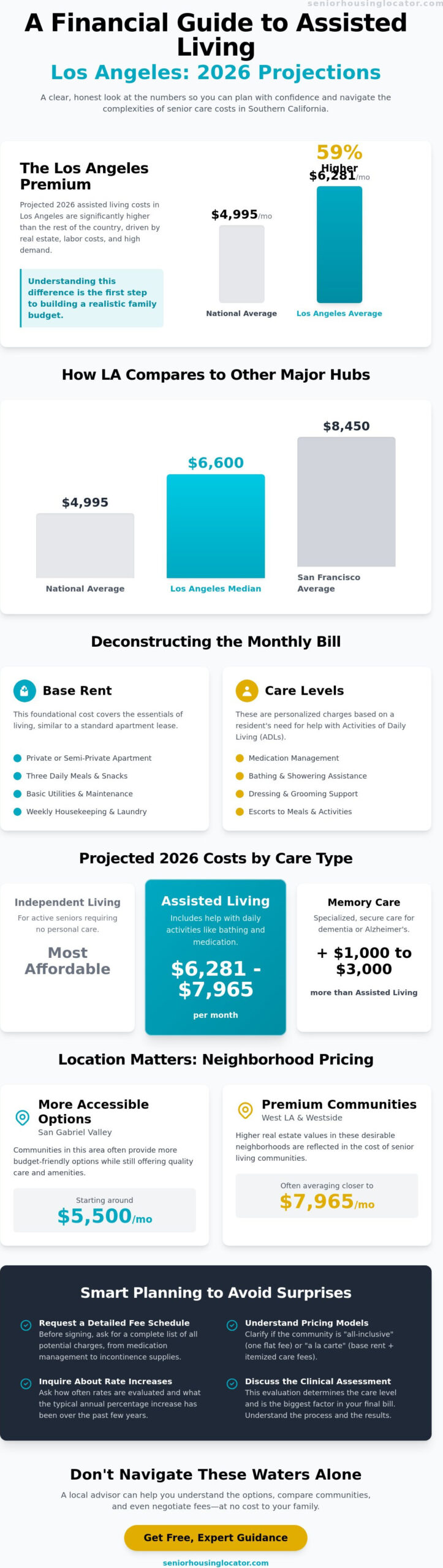
When you begin looking into senior care for a family member, the numbers can feel quite staggering. In our experience helping local families, we’ve seen that the projected average for assisted living costs Los Angeles in 2026 is approximately $6,281 per month. While this is the baseline, higher-end communities often average closer to $7,965. To put this in perspective, these rates are roughly 59% higher than the national average of $4,995. Even though Los Angeles is more expensive than the rest of the country, it’s interesting to see that our local median of $6,600 actually sits below other major hubs like San Francisco, which averages $8,450.
To understand why these numbers vary so much, it helps to start with the basics of What is Assisted Living and the specific services it provides. Most facilities use one of two pricing structures. An “all-inclusive” model bundles your rent, meals, and basic care into one predictable monthly check. Conversely, many Los Angeles communities prefer an “a la carte” or “fee-for-service” model. In these cases, you pay a base rent for the apartment and then add specific fees for medication management, bathing assistance, or grooming. We always recommend asking for a detailed fee schedule early on so you don’t face surprises later.
Projected 2026 Monthly Averages by Care Type
The type of support your loved one needs is the biggest driver of the final bill. Independent living is usually the most affordable option, as it’s designed for active seniors who don’t require medical or personal care. Standard assisted living covers help with daily activities and typically falls within that $6,281 to $6,600 range. Memory care is the most significant investment, often costing $1,000 to $3,000 more than standard care. This premium covers the specialized staffing, secured environments, and therapeutic programming required for those living with Alzheimer’s or dementia. Families navigating this decision can benefit from reviewing a detailed breakdown of memory care costs Los Angeles families are facing in 2026, including neighborhood pricing tiers and strategies to manage expenses.
Why 2026 Costs Differ from Previous Years
You might wonder why prices continue to climb each year. In Southern California, local labor laws and recent caregiver wage increases have significantly impacted facility operating budgets. Beyond staffing, communities are also grappling with rising insurance premiums and property taxes across Los Angeles County. Finally, we’re seeing the impact of the “Silver Tsunami.” With over 533,000 seniors living in Los Angeles, the high demand for quality housing allows facilities to maintain higher price points. It’s a complex market, but knowing these factors helps you understand the value behind the care provided.
Breaking Down the Monthly Bill: Base Rent vs. Care Levels
Understanding the monthly bill for senior living often feels like solving a puzzle. Most facilities in our area split the invoice into two main categories: base rent and care levels. The base rent functions much like a traditional apartment lease. It typically covers your loved one’s private or semi-private accommodation, three daily meals, basic utilities, and weekly housekeeping. While the base rent provides the foundation for assisted living costs Los Angeles, it rarely tells the whole story of the final monthly expense.
The second part of the bill is based on personal care services, often called “care levels.” These charges are determined by how much help a resident needs with Activities of Daily Living (ADLs). Common triggers for additional care fees include:
- Medication management and administration
- Assistance with bathing or showering
- Help with dressing and grooming
- Escorts to and from the dining room
Before a resident moves in, the facility’s nurse will perform a clinical assessment. This evaluation is the most important factor in your bill because it determines the specific care tier required. According to the annual Cost of Care Survey, these tiered services allow families to pay only for the support they actually use, rather than a flat rate for medical care they may not need yet. It’s a fair system, but it requires clear communication during the initial tour.
The Three-Tiered Care Model
While every community is different, most Los Angeles facilities follow a three-tiered structure. Level 1 is designed for seniors who are mostly independent but need simple medication reminders or occasional check-ins. Level 2 offers moderate assistance with several daily tasks, such as help getting dressed in the morning. Level 3 represents the highest level of support, often including full physical assistance with mobility, incontinence care, or specialized behavioral support. These tiers ensure that as a resident’s needs change, their care plan adjusts accordingly. If you’re unsure whether your loved one’s medical needs require a higher level of care, our skilled nursing vs assisted living comparison guide can help clarify the key differences between these two care settings.
Hidden Costs and One-Time Fees
It is helpful to look beyond the monthly recurring charges to avoid surprises. Almost every community charges a one-time “community fee” at the time of signing. This fee, which often equals one month’s rent, covers the administrative costs of the move-in and apartment preparation. You should also ask about smaller surcharges that can add up, such as pharmacy delivery fees, incontinence supply management, or transportation to medical appointments outside of the facility’s standard schedule. If you feel unsure about these line items, speaking with a local placement expert can help you identify which fees are standard and which might be negotiable.
Location Matters: Comparing Costs Across the San Fernando Valley and Westside
In Los Angeles, your choice of neighborhood is the primary factor in the price you pay for senior housing. Just as residential real estate varies by zip code, assisted living costs Los Angeles are heavily influenced by local property values. Families looking at coastal communities like Santa Monica or Pacific Palisades often encounter the “Westside Premium.” In these areas, monthly rates frequently exceed $10,000 or $12,000. By comparison, moving inland to the San Gabriel Valley can bring those costs down to a range of $5,500 to $6,500, offering significant relief for the family budget without moving too far from home.
By looking outside the most expensive zip codes, you can often find assisted living costs Los Angeles that fit your family’s budget more comfortably. The city’s layout means that a twenty-minute drive can sometimes result in a monthly savings of several thousand dollars. We always encourage families to define their “search radius” based on both convenience and financial sustainability.
San Fernando Valley Pricing Trends
The San Fernando Valley serves as a diverse hub with options for every price point. Neighborhoods like Sherman Oaks and Encino are favorites because they offer luxury amenities at a better value than the Westside. Typically, SFV communities range from $6,500 to $9,500 per month. If you’re looking for more competitive rates, areas like Northridge, Granada Hills, or Burbank are excellent places to start your search. You can find more specific local data by looking into senior living placement Sherman Oaks to see how these facilities compare in terms of both price and service quality.
Board and Care Homes: The Budget-Friendly Secret
Smaller residential board and care homes are often the best-kept secret for managing care expenses. These are standard houses in quiet neighborhoods that have been licensed to provide care for up to six seniors. Because they don’t have the massive overhead of a “resort-style” community, they can offer more predictable, flat-rate pricing. They also provide a high 1:3 staff-to-resident ratio, ensuring your loved one gets plenty of individual attention. According to the Assisted Living Facts & Figures report, these smaller settings are a vital part of the care landscape for those who prefer a home-like environment. For families on a tighter budget, board and care homes Woodland Hills often provide a high-quality, affordable alternative to the larger institutions nearby.
Strategic Ways to Pay for Senior Care and Avoid Hidden Fees
Many families start this journey with the hope that Medicare will cover the monthly bill. We have to clear up this common misunderstanding right away: Medicare does not pay for room and board in an assisted living community. It generally only covers short-term medical stays or rehabilitation in a skilled nursing facility. To better understand the distinction between what Medicare covers in each setting, reviewing a detailed skilled nursing vs assisted living breakdown can help you make more informed financial decisions. To manage assisted living costs Los Angeles, most families look toward a combination of private funds and specialized benefits. Long-term care insurance is a powerful tool, though you usually need to show a need for help with at least two activities of daily living to trigger those benefits. Veterans and their spouses should also explore the “Aid and Attendance” benefit, which provides a monthly tax-free pension specifically to help cover care expenses. If you need immediate funding while waiting for a home sale or an insurance payout, bridge loans or life settlement options can provide a necessary financial cushion for a few months.
When you are looking at the total cost, it’s also vital to watch for “move-in specials” that might hide future increases. Some communities offer a lower rate for the first six months but then raise the care level fees significantly. We always suggest asking for a three-year history of their annual rate increases. This transparency helps you see if the community remains affordable over the long haul. If you’re feeling stuck on the numbers, a senior living placement service can help you find communities that work with your specific financial strategy and help negotiate those initial fees.
Leveraging Los Angeles Real Estate
In our local market, the family home is often the most significant asset available to fund senior care. Selling a property in the San Fernando Valley can often generate enough capital to cover many years of high-quality care. If one spouse needs assisted living while the other stays home, a reverse mortgage might be a sensible way to access equity without a full move. We recommend speaking with a tax professional to understand the implications of a sale, as capital gains can impact your overall budget. Using these local real estate values wisely allows many families to afford a much higher level of service than they initially thought possible.
Medi-Cal and the Assisted Living Waiver (ALW)
The Assisted Living Waiver (ALW) is a California program designed to help Medi-Cal recipients pay for care in a residential setting. While it’s available in Los Angeles County, the reality is that waitlists are often long and many private facilities don’t accept the waiver due to low reimbursement rates. It’s also important to remember that as of January 1, 2026, California has reinstated the asset test for Medi-Cal eligibility. This means you must meet specific income and asset thresholds to qualify for state assistance. Generally, for 2026, single applicants must have a monthly income below a specific state-determined limit to qualify for full aged and disabled federal poverty level programs.
Navigating Los Angeles Senior Housing with a Professional Ally
Searching for the right care setting can feel like a full-time job at a time when you already have too much on your plate. Because assisted living costs Los Angeles are a major investment, you deserve more than just a list of names from a search engine. You need a partner who understands the local landscape and the nuances of each neighborhood. A dedicated placement advisor acts as your eyes and ears, helping you filter out options that don’t meet your standards for care or budget.
One of the biggest concerns for families is the cost of professional help. You’ll be glad to know that our placement services are entirely free for families. We operate on a referral commission model, which means the senior living communities pay us for finding them a great resident. This allows us to offer you expert guidance without adding another line item to your monthly bill. It’s a “helping hand” approach that prioritizes your peace of mind and ensures you aren’t paying for advice during an already expensive transition.
A senior living advisor Los Angeles also brings professional negotiation skills to the table. We know which facilities are currently offering move-in incentives or which ones might be willing to waive a community fee to fill a specific unit. Beyond the numbers, we provide insider knowledge regarding staffing stability and state citations. If a home has had recent issues with the Department of Social Services, we’ll know about it before you ever step foot on the property. This is especially helpful during a “crisis move” when you need a safe, pre-vetted option in a hurry.
Personalized Matching vs. Online Directories
Generic online directories often sell your contact information to dozens of facilities, leading to a flood of high-pressure sales calls. We take a different path. We physically tour every home and community we recommend in the San Fernando Valley and surrounding areas. By understanding your specific care needs, budget, and preferred location, we create a tailored list that actually makes sense for your family. You won’t waste time touring places that are too expensive or unable to provide the level of care your loved one requires.
Next Steps for Your Family
We’re here to make this transition as smooth as possible. You can start by scheduling a free consultation where we’ll listen to your story and discuss your goals. To make our first meeting most productive, it’s helpful to have a general idea of your loved one’s care needs, a monthly budget range, and your preferred geographic areas. This information allows us to hit the ground running. Let us help you find the perfect care fit at no cost to you. We’ve already done the hard work of vetting the local options, so you can focus on being a supportive family member.
Plan Your Next Steps with Confidence
Finding the right care for your loved one is a journey that requires both heart and a clear head. By understanding the 2026 projections for assisted living costs Los Angeles, you’ve already taken the first step toward a sustainable plan. You now know how to distinguish between base rent and care tiers; additionally, you’ve seen how looking into neighborhoods like Woodland Hills or the wider San Fernando Valley can make a significant difference for your budget. You don’t have to manage these complex decisions or negotiate move-in fees on your own.
At Senior Housing Locator, we offer a free local referral service for families built on integrity and deep local expertise. We’ve personally vetted facilities throughout the San Fernando Valley to ensure they meet our high standards for care and value. Our goal is to provide an integrity-driven placement tailored to your specific budget and care needs. Find the best assisted living value in Los Angeles today. We are here to help you move forward with peace of mind and the support you deserve.
Frequently Asked Questions
Does Medicare pay for assisted living in Los Angeles?
Medicare does not pay for the room and board associated with assisted living. It is a health insurance program designed to cover medical expenses, doctor visits, and short-term stays in skilled nursing facilities for rehabilitation. While it may cover some medical services provided within a community, the monthly rent and personal care fees are almost always paid through private funds, long-term care insurance, or specific veteran benefits.
What is the average cost of assisted living in the San Fernando Valley?
Assisted living costs in the San Fernando Valley typically range between $6,500 and $9,500 per month. This area is often seen as a middle ground for families, offering more space and luxury than some central city options while remaining more affordable than the Westside. Specific prices depend on the neighborhood; for instance, communities in Sherman Oaks or Encino might sit at the higher end of that spectrum compared to Granada Hills.
Are there low-income assisted living options in Los Angeles County?
Yes, there are programs like the Assisted Living Waiver (ALW) that help low-income seniors, but they often come with significant waitlists. Many smaller board and care homes also offer more competitive rates than larger, resort-style communities. It’s vital to remember that as of January 1, 2026, Medi-Cal has reinstated an asset test. This makes it important to review your financial eligibility early if you plan to seek state assistance for assisted living costs Los Angeles.
How much extra does memory care cost compared to standard assisted living?
Memory care typically costs between $1,000 and $3,000 more per month than standard care. This higher price covers the increased staffing ratios, specialized safety features, and therapeutic activities designed for those with cognitive challenges. These costs ensure that residents living with Alzheimer’s or dementia receive 24-hour supervision in a secure environment. For a comprehensive look at what drives these expenses and how to plan for them, our guide to memory care costs Los Angeles families face in 2026 offers detailed pricing strategies and neighborhood comparisons. We recommend asking for a specific care-level breakdown to see exactly what the premium includes.
What is a community fee and is it negotiable?
A community fee is a one-time, non-refundable charge paid upon move-in that often equals one month’s rent. It covers the administrative costs of the transition and the preparation of the apartment. While these fees are standard, they are often negotiable. Facilities may be willing to reduce or waive this fee during certain times of the year or if they have specific vacancies they are eager to fill.
Can I use VA benefits to pay for a board and care home in Woodland Hills?
You can use the VA “Aid and Attendance” benefit to help pay for a licensed board and care home. This tax-free pension is available to eligible veterans and their surviving spouses who require help with daily activities. Since board and care homes in Woodland Hills provide the necessary level of supervision, they qualify as a valid residential setting for these funds. This benefit can significantly lower your out-of-pocket monthly expenses.
What happens if my loved one runs out of money while in assisted living?
If a resident’s funds are depleted, the family typically looks into moving them to a community that accepts Medi-Cal or a more affordable board and care home. Some facilities have a “spend-down” policy where they allow a resident to stay after their private funds are gone, provided they have been there for a certain number of years. It’s best to discuss this scenario with the facility director before signing a long-term contract.
How much does in-home care cost compared to assisted living in LA?
In-home care in Los Angeles is projected to cost about $38 to $39 per hour in 2026. If your loved one needs 40 hours of help per week, you could pay over $6,200 monthly, which is comparable to assisted living costs Los Angeles. However, if they require 24-hour care at home, the cost can exceed $25,000 per month. In these cases, assisted living usually provides a much more cost-effective solution for comprehensive support.