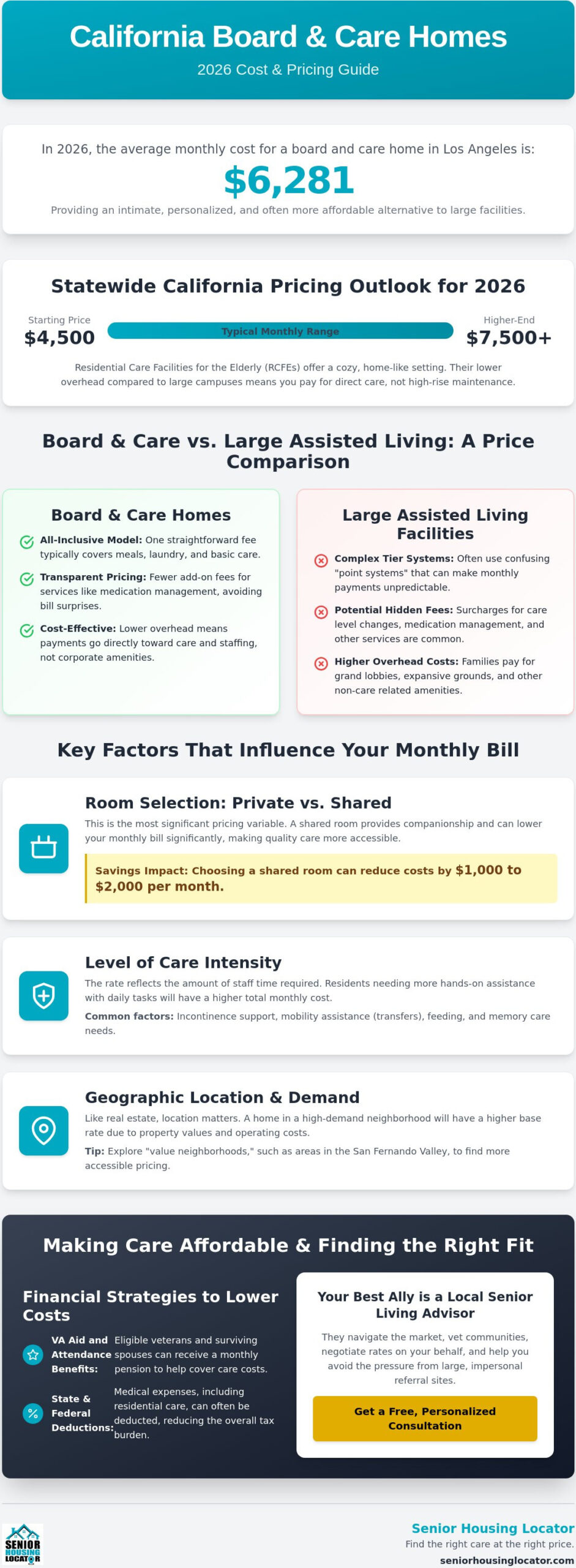
What if the most personalized care for your loved one actually costs less than the massive facility down the street? If you’ve spent any time looking at large senior living campuses, you’ve likely felt a heavy sense of sticker shock. It’s frustrating to feel like quality care is out of reach, especially when you’re trying to decode the difference between traditional assisted living and a residential board and care home. In 2026, the average board and care home costs Los Angeles families are encountering sit around $6,281 per month. This model often provides a much more intimate and affordable alternative to big corporate settings without sacrificing the support your family needs.
We understand that you need clear numbers and honest answers to plan for your family’s future. You deserve to know exactly what you’re paying for without the fear of hidden fees or unexpected care level surcharges. This guide simplifies the process by providing the latest 2026 pricing data and local California insights. We’ll explore how shared rooms can lower your expenses, explain the role of benefits like VA Aid and Attendance, and show you how to find a local expert to filter your options. You can find a path that offers peace of mind, professional care, and a budget that actually works.
Key Takeaways
- Establish the 2026 pricing benchmarks for residential care across California to help you set a realistic and manageable monthly budget.
- Identify how choosing between private and shared rooms, along with specific care levels, can impact your final bill by up to $2,000.
- Compare high-demand areas with “value neighborhoods” in the San Fernando Valley to find more accessible board and care home costs Los Angeles families can rely on.
- Uncover practical financial strategies, including VA benefits and state deductions, that can significantly lower the out-of-pocket burden for your family.
- Learn why a local senior living advisor is your best ally for navigating the market, negotiating rates, and avoiding the pressure of large referral sites.
What is the Average Cost of a Board and Care Home in California for 2026?
Residential Care Facilities for the Elderly, or RCFEs, provide a cozy, house-like environment for seniors who need help with daily tasks. For families looking into board and care home costs Los Angeles provides a unique market where these smaller settings often offer a better value than massive institutions. In 2026, the median price range for these homes across California typically falls between $4,500 and $7,500 per month. While this might seem higher than the national average, it reflects the state’s high standards for care, staffing, and safety. Understanding What is Assisted Living in a residential context is the first step toward making a confident choice. These homes are often more cost-effective because they have lower overhead than large campuses with grand lobbies and expansive grounds. You pay for the care your loved one receives, not the high-rise maintenance.
The 2026 Pricing Outlook for California Families
Planning for the future means looking at the reality of inflation and rising labor costs. In 2026, many homes have adjusted their rates to keep pace with the cost of living and the higher wages required for skilled caregivers. A Residential Care Facility for the Elderly (RCFE) is a licensed, neighborhood-based home that provides housing and non-medical care to six or fewer seniors. When you review a quote, it’s vital to distinguish between the “base rate” for room and board and the “total monthly cost.” The total cost includes your loved one’s specific care needs. Most families find that these rates remain more stable than the fluctuating costs of in-home care agencies. It’s a way to secure safety, socialization, and support in one predictable monthly payment.
Board and Care vs. Assisted Living: A Price Comparison
One of the biggest advantages of a small home is the simplicity of the bill. Large communities often use complex “point systems” or care tiers that can make your monthly payment feel like a moving target. In contrast, board and care homes often use an all-inclusive model. This covers meals, laundry, and basic care in one straightforward fee. If you’re also considering larger facilities, you can see how these figures stack up in our guide to Assisted Living Costs in Los Angeles: Your Complete 2026 Pricing Guide. Choosing a smaller home often means fewer add-on fees for things like medication management or mobility assistance. This transparency helps families avoid the stress of hidden surcharges. It’s a simpler approach that prioritizes your peace of mind and your loved one’s comfort.
Key Factors That Influence Residential Care Pricing
Every family’s journey is unique, and the price you pay for care reflects your loved one’s specific needs and preferences. While we’ve discussed broad averages, several distinct factors drive the final monthly bill. Understanding these variables helps you avoid surprises and plan a sustainable budget. According to California’s Residential Care Facilities guidelines, these homes provide housing, meal services, and 24-hour supervision. However, the intensity of that supervision and the physical environment of the home are the primary reasons board and care home costs Los Angeles families see can vary so significantly.
- Room Selection: Choosing between a private sanctuary and a shared living space is often the quickest way to adjust your monthly rate.
- Care Intensity: Residents who require help with incontinence, mobility, or feeding usually pay a higher rate to cover additional staffing hours.
- Geographic Demand: Just like traditional real estate, a home in a high-prestige neighborhood will have a higher base rate due to property values and local operating costs.
Private vs. Shared Rooms: Making the Budget Work
For many seniors, a shared room is more than just a financial choice; it’s a social one. Sharing a space can reduce feelings of isolation and provide a built-in “buddy system” during the transition. Financially, a shared room often costs $1,000 to $2,000 less per month than a private one. This difference can make high-quality care accessible even on a tighter budget. If your loved one highly values solitude or has a sleep schedule that might disturb others, investing in board and care homes with private rooms in Los Angeles is likely the right move. We often suggest private rooms for residents with early-stage dementia who may become easily overstimulated by others.
Understanding Care Tiers and “Add-Ons”
Most small homes use a “Level of Care” (LOC) assessment to determine your final rate. A manager will visit your loved one to evaluate their physical and cognitive needs. This assessment ensures the home can safely provide the right amount of help. Beyond the monthly care, you should prepare for a one-time move-in fee. These “community fees” typically range from $1,000 to $5,000 and cover administrative costs and room preparation. To keep your budget clear, ensure your agreement includes these standard services:
- Three nutritious meals and daily snacks.
- Weekly laundry and housekeeping services.
- Basic medication management and 24-hour supervision.
If you’re feeling overwhelmed by these different tiers, you might find it helpful to speak with a local placement expert who can explain how specific homes in your target neighborhood handle these fees. Specialized care, such as memory care for advanced Alzheimer’s or hospice waivers, will typically carry a premium because they require specialized training and higher staffing ratios. Being transparent about your loved one’s needs today helps ensure their care remains stable tomorrow.
Regional Breakdown: Los Angeles and San Fernando Valley Costs
Location is often the single biggest factor in determining your monthly rate. While state-wide data provides a starting point, it doesn’t always reflect the reality of our local neighborhoods. For example, CareScout’s 2025 Cost of Care Survey highlights how regional demand shifts pricing significantly across California. In high-demand coastal areas like Santa Monica or historic pockets like Pasadena, property values are exceptionally high. This naturally pushes up the base rates for residential care. If you find that board and care home costs Los Angeles quotes in these beachside or mountain-view areas are stretching your budget, looking just a few miles north into the San Fernando Valley can provide immediate relief.
Premium neighborhoods like Woodland Hills or Sherman Oaks still command a higher price point because of their central location and upscale amenities. If you’re specifically looking in these sought-after pockets, our guide on Senior Living Placement in Sherman Oaks can help you navigate those specific local options. However, even in these premium spots, you often get more physical space and personalized attention for your money than you would on the Westside. It’s all about knowing where the value is hidden.
The San Fernando Valley Value Proposition
The San Fernando Valley is home to one of the highest densities of quality residential care homes in the country. This concentration is a major win for local families. When there are many homes in one area, providers must compete on both quality and price to attract residents. This healthy competition keeps rates more stable and predictable. Neighborhoods like Northridge, Granada Hills, and Burbank are excellent “value neighborhoods.” They offer quiet, tree-lined streets and proximity to top-tier medical centers. Seniors in the Valley also enjoy being near local landmarks like Lake Balboa Park, which makes family outings simple, frequent, and enjoyable.
West LA vs. The Valley: What You Get for Your Money
When you compare a home in West LA to one in the Valley, the difference in physical space is often striking. In neighborhoods like Encino or Tarzana, you’ll find “hidden gem” homes that were originally large ranch-style estates. These properties offer larger bedrooms, wider hallways, and expansive backyard gardens for a similar price to a much smaller room in Santa Monica. Beyond the physical space, the care remains incredibly focused. San Fernando Valley board and care homes often provide a 1:3 staff-to-resident ratio. This means your loved one receives attentive, personalized care in a setting that feels like a real home. It’s the perfect balance of safety, comfort, and local accessibility.
Financial Strategies: How to Pay for Board and Care
Finding the right home is only half the battle; figuring out how to fund it’s often the part that keeps families up at night. While board and care home costs Los Angeles families face are significant, you don’t have to carry the entire weight alone. Most families use a blend of personal savings, home equity, and specific government benefits to create a sustainable plan. By understanding the available deductions and programs, you can often bridge the gap between your current income and the monthly rate of a high-quality home.
One often overlooked strategy is the “Board and Care Medi-Cal Deduction.” This isn’t a direct payment from the state, but rather a way to help seniors with slightly higher incomes qualify for Medi-Cal while living in a residential care home. It allows you to deduct a portion of the care costs from your countable income. Additionally, if your loved one has a long-term care insurance policy, it’s vital to check their “Elimination Period.” This is the waiting period, typically 30 to 90 days, where you must pay out-of-pocket before benefits start. If you need immediate funding while waiting for a home sale or an insurance claim, bridge loans or life settlement options can provide a necessary financial cushion.
Navigating Medi-Cal and SSI in Residential Care
It’s a common misconception that Medi-Cal pays for room and board in a residential setting. In reality, most board and care homes are private pay. However, for those with very limited resources, some homes accept the Supplemental Security Income (SSI) and State Supplementary Payment (SSP) rate. For 2026, this rate for Non-Medical Out-of-Home Care is $1,626.07 per month. Under California rules, residents in these facilities are also entitled to a “maintenance need” allowance, typically around $600, to cover personal expenses like clothing and toiletries. If you’re working with a tighter monthly limit, you can explore more details in our guide to Senior Housing Options for Limited Budget.
VA Benefits for Board and Care
Veterans and their surviving spouses have access to a powerful tool called the VA Aid and Attendance benefit. In 2026, this program can provide over $2,400 per month to help cover the cost of care. These funds are tax-free and are paid directly to the veteran or spouse, making it much easier to afford the monthly rates at a local board and care home. To qualify, the veteran must have served during a period of war and require assistance with daily living tasks. We always recommend speaking with a VA-accredited representative to ensure your application is handled correctly. If you’re ready to see how these benefits apply to specific homes in your area, you can request a personalized list of board and care referrals today.
Finding the Right Match with a Senior Living Advisor
One of the most significant advantages of working with a local expert is their ability to negotiate on your behalf. Because they have deep relationships with providers across the region, they can often find flexibility in board and care home costs Los Angeles homeowners might not offer to the general public. They know which homes are looking to fill a vacancy and where you might find a break on move-in fees. Our model is entirely free to families. We operate on referral commissions from the facilities, which means our priority is simply finding the safest and most comfortable match for your budget.
Why Local Expertise Matters in the San Fernando Valley
In the San Fernando Valley, the quality of care can vary from one street to the next. A dedicated Senior Living Advisor Los Angeles families trust will have “insider knowledge” that no algorithm can provide. We track which homes have the best staff retention and which ones have recently updated their dementia care certifications. This tailored approach ensures that the options we present align perfectly with your specific care needs and financial goals. We help you filter through the noise to find the hidden gems in neighborhoods like Woodland Hills or Northridge that offer exceptional value.
Your Next Steps Toward Peace of Mind
The best time to start your search is before a crisis occurs. Waiting for a hospital discharge or a sudden decline in health often leads to rushed decisions and higher stress. By starting now, you have the luxury of time to tour multiple homes, meet the caregivers, and carefully review the “fine print” in the residency contracts. Look for clear language regarding care level increases and notice periods for rate changes. If you are ready to take the next step, we are here to help. You can schedule a free consultation with Senior Housing Locator to discuss your needs, tour local options, and find a home that is safe, loving, and affordable. Your peace of mind is just a conversation away.
Secure Your Loved One’s Future with Confidence
Planning for senior care is a deeply personal journey that requires both heart and a clear strategy. You now have the tools to understand how 2026 pricing benchmarks and neighborhood selection impact your monthly budget. By exploring value-rich areas like the San Fernando Valley and utilizing benefits like VA Aid and Attendance, quality care becomes much more attainable. Understanding the nuances of board and care home costs Los Angeles families encounter is the first step toward finding a setting where your loved one can truly thrive.
You don’t have to navigate these complex decisions alone. Our team provides a free placement service for families, offering integrity-driven and personalized referrals based on years of local experience. As experts in the San Fernando Valley and Greater Los Angeles care markets, we help you filter through the options to find the perfect match. We take the burden of the search off your shoulders so you can focus on what matters most: your family.
Find an Affordable Board and Care Home Today – Get Your Free Local Consultation. We are ready to help you move from a state of uncertainty toward a place of total peace of mind. Your family deserves a supportive partner during this transition, and we are honored to be that helping hand.
Frequently Asked Questions
Is board and care cheaper than assisted living in California?
Board and care homes are typically more affordable than large assisted living communities because they have lower operating costs and fewer luxury amenities. Families find that these smaller settings provide a high staff-to-resident ratio without the high price tag of a massive campus. You pay for personalized care and a cozy environment rather than grand lobbies or movie theaters. It is a practical way to ensure quality support while managing a 2026 senior housing budget.
Does Medicare pay for board and care home costs in Los Angeles?
Medicare does not pay for the room and board or custodial care costs associated with residential care homes. It only covers medical services such as doctor visits, physical therapy, or hospital stays. When planning for board and care home costs Los Angeles families often rely on private savings, long-term care insurance, or VA benefits to cover the monthly rate. It’s important to have a clear financial plan that accounts for these out-of-pocket expenses.
What is the average move-in fee for a board and care home in 2026?
In 2026, move-in fees, often called community fees, typically range from $1,000 to $5,000. This one-time payment covers administrative costs, room preparation, and the initial care assessment required by the state. While some homes may offer promotions to lower this fee, it is a standard part of the entry process for most facilities. Always ask for a clear breakdown of what this fee covers before signing your residency agreement to avoid any surprises.
Can I negotiate the monthly rate at a residential care facility?
You can often negotiate the monthly rate, especially if a home has a vacancy they are eager to fill. While the base rate for care is generally firm, there may be room to discuss the cost of the room itself or the one-time move-in fee. Working with a local placement advisor can give you an advantage here. They understand the local market and know which homes are currently offering the best value for new residents.
How much extra does memory care cost in a board and care setting?
Memory care services typically cost about 25% more than standard residential care. This premium covers the specialized training for staff and the higher level of supervision required for residents with dementia or Alzheimer’s. In a board and care setting, this often translates to a more stable and secure environment with higher staffing ratios. This extra investment ensures your loved one has the specialized support they need to remain safe and engaged throughout the day.
What happens if my loved one runs out of money while in a board and care home?
If a resident runs out of funds, the family may need to look for homes that accept the Assisted Living Waiver (ALW) or move to a facility that accepts the SSI/SSP rate. It’s vital to discuss this possibility with the home’s manager early on. Some homes are willing to work with long-term residents who have been with them for years. Having an honest conversation about finances helps ensure a stable transition if resources become limited.
Are there low-income board and care options in the San Fernando Valley?
Low-income options do exist in the San Fernando Valley, but they are in high demand and often have waiting lists. These homes typically accept the SSI/SSP rate for residents who qualify for Supplemental Security Income. When searching for board and care home costs Los Angeles advocates suggest starting your search early and visiting several locations. This allows you to find a home that meets both your budget and your care standards without feeling rushed.
How do I know if a board and care home is licensed in California?
You can verify a home’s license through the California Department of Social Services (CDSS) Community Care Licensing Division website. Every legitimate board and care home must display its license number and keep its most recent inspection reports available for review. Checking these records allows you to see the home’s history of compliance and care quality. It is a simple but essential step in ensuring your loved one is in a safe and regulated environment.