
Did you know that providing full-time care at home might actually be more expensive than moving to a specialized senior community in 2026? It’s a surprising reality for many families who assume staying at home is always the budget-friendly choice. When you’re comparing assisted living vs home care, the decision isn’t just about a floor plan. It’s about finding a sustainable balance for your family’s health, safety, and finances.
We understand that you want the absolute best for your loved one. You likely value their independence, their comfort, and their dignity. However, the stress of managing medication schedules or the constant fear of a fall can quickly turn a labor of love into a source of deep exhaustion. You deserve to feel certain that your parent is safe while also reclaiming your own peace of mind and well-being.
This article provides a clear framework to help you make this vital choice with total confidence. You’ll discover the critical differences in cost, care quality, and lifestyle that define the current market. We’ll explore new 2026 transparency regulations, explain how to spot the financial tipping point, and show you how a community setting can actually improve a senior’s quality of life.
Key Takeaways
- Understand the core differences in assisted living vs home care to choose the setting that best promotes your loved one’s long-term independence and safety.
- Evaluate the “social isolation” factor and see how peer interaction in a community setting can significantly boost emotional well-being compared to staying at home.
- Learn how to calculate the true cost of aging at home by accounting for hidden expenses like property maintenance and 2026 grocery inflation.
- Recognize the clear “tipping point” signs that suggest home-based support is no longer sufficient to prevent family caregiver burnout.
- Find out how local senior living advisors in the San Fernando Valley can help you navigate staffing ratios and facility reputations to find the perfect fit.
Understanding the Basics: Assisted Living vs. Home Care
Choosing between care options is one of the most significant decisions a family can make. At its heart, the debate over assisted living vs home care isn’t just about where someone sleeps. It’s about how they live. Both options share a single, beautiful goal: to protect a senior’s dignity while providing the physical support they need for daily activities like dressing, bathing, or managing medications. While the goals are the same, the lifestyle and delivery of that care look very different.
If you are looking for a foundational overview, you might ask, What is Assisted Living? Simply put, it’s a residential community designed for seniors who want to remain independent but require a helping hand with daily tasks. Home care, on the other hand, brings professional caregivers directly into the senior’s current house to provide that same support in a private setting.
Making sense of these choices can feel overwhelming. This is where a senior living advisor Los Angeles becomes an invaluable partner. They act as a compassionate facilitator, helping you weigh the pros and cons of each path based on your family’s unique needs and local resources. They take the guesswork out of the process, ensuring you feel well-advised rather than lectured.
What Assisted Living Offers
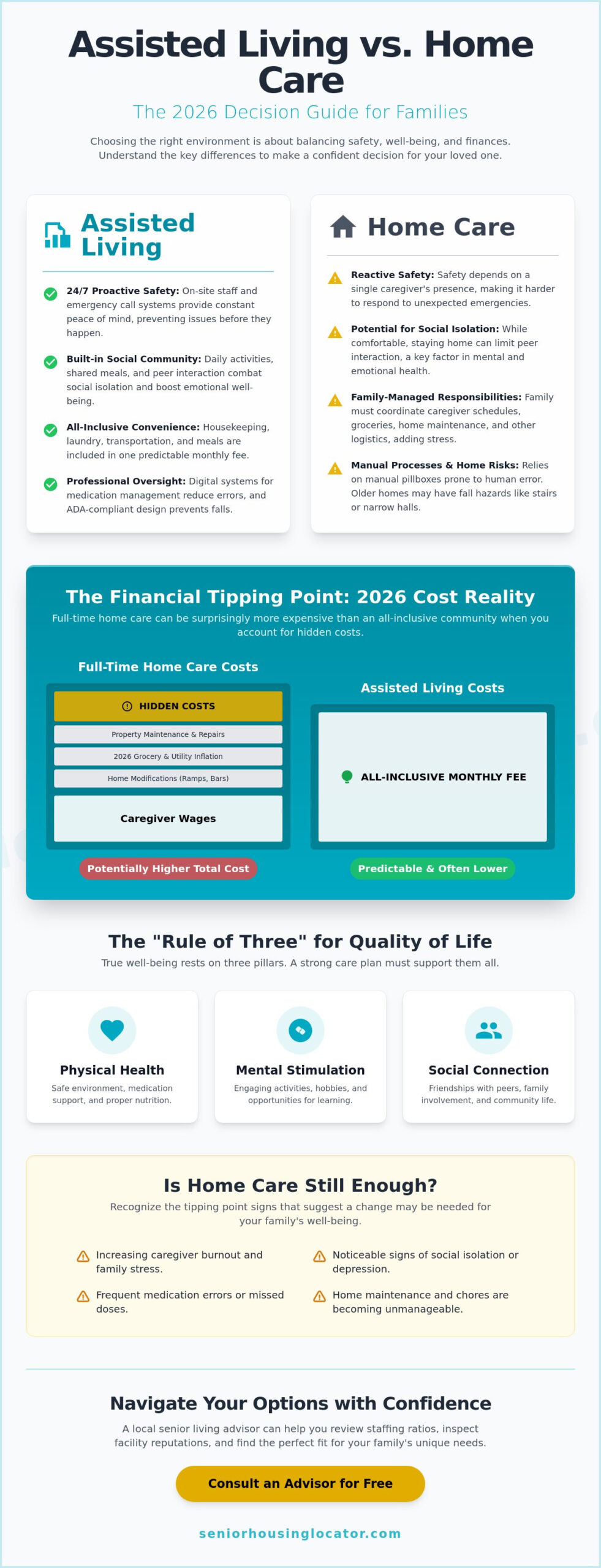
Assisted living provides a structured, supportive environment where everything is handled under one roof. It offers three primary layers of support to ensure a high quality of life. First, it provides 24/7 safety; on-site staff members are available at all times for emergencies or unexpected needs. Second, it features a built-in social infrastructure. Residents have access to daily activities, shared meals, and constant opportunities for friendship. Finally, it offers total convenience. Services like housekeeping, laundry, and transportation are all included in the monthly fee.
The Reality of Home Care
Home care focuses on the comfort of the familiar. It’s often the first choice for seniors who feel a deep emotional tie to their long-time residence. This model provides personalized, one-on-one attention that focuses entirely on your loved one’s specific preferences. It also offers incredible scheduling flexibility. You can hire help for just a few hours a week or arrange for full-time, live-in assistance as needs change. For families looking to see how high-quality, regulated live-in support is delivered, you can visit NeeryVille Care. However, keep in mind that the family usually remains responsible for home maintenance, grocery shopping, and managing the care schedule, which can add to the overall family stress.
If you’re committed to staying at home but want to minimize the burden of property upkeep, you can visit Nu Scape Designs to learn about low-maintenance landscape solutions designed for the Southern California climate.
Comparing Quality of Life: Safety, Socialization, and Care
When families weigh assisted living vs home care, they often focus on the physical space. However, true quality of life is built on a “Rule of Three” that includes physical health, mental stimulation, and social connection. If any one of these pillars is missing, a senior’s overall well-being can decline surprisingly fast. While staying at home feels comfortable, it’s important to ask if that environment still supports all three of these needs in 2026.
Safety in a residential community is proactive rather than reactive. Most modern facilities use sophisticated emergency call systems and have multiple staff members on duty at all times. At home, safety often depends on a single caregiver being in the right room at exactly the right moment. Understanding government-supported Home and Community-Based Services is a helpful way to see what support is available, but many families find that the infrastructure of a community provides a higher level of protection.
Safety and Medical Oversight
Medication management is one of the biggest hurdles for families. Professional facilities use digital tracking systems to ensure every dose is taken correctly and on time. Home care, by contrast, often relies on manual pillboxes that are prone to human error. There’s also the physical environment to consider. Many older Los Angeles homes have narrow hallways and steep steps that are difficult to modify. Purpose-built facilities use ADA-compliant designs that naturally prevent falls. If you aren’t sure which path fits your parent’s health needs, you can consult with a local placement specialist to evaluate their specific situation.
The Impact of Social Engagement
Social isolation is a quiet crisis for seniors living alone. Even with a dedicated home care aide, a senior might go days without a meaningful conversation with a peer. This lack of interaction is a major risk factor for depression. In an assisted living community, socialization is part of the daily rhythm. From fitness classes to art workshops and local outings in the San Fernando Valley, there’s always an opportunity to connect. Even dining becomes a social event. Instead of solitary meals at a kitchen table, residents enjoy nutritious, chef-prepared meals in a lively, communal setting. This constant engagement keeps the mind sharp and the spirit high, which is why choosing the right assisted living facility in Los Angeles often leads to a noticeable improvement in a senior’s happiness and vitality.
The Financial Breakdown: Hidden Costs of Home Care vs. Assisted Living
When families look at assisted living vs home care, they often start with the sticker price. It’s a natural reaction. However, the true cost of aging in place often hides beneath the surface. To get a full picture of your options, you might find the National Institute on Aging’s guide to long-term care helpful for understanding the broad spectrum of services available. In Los Angeles, the median cost for assisted living is approximately $6,281 per month. Contrast this with home care. For just 44 hours of help per week, the average cost in LA is approximately $7,100 per month. If your loved one needs support around the clock, home care costs can quickly double or triple that amount.
Beyond the care itself, staying at home involves expenses that an assisted living community absorbs into its base rate. Homeowners still face property taxes, rising home insurance premiums, and 2026 grocery inflation. These bills don’t stop just because a caregiver is present. For a detailed look at local numbers, see our assisted living costs in Los Angeles guide. You’ll likely find that the all-inclusive nature of a community provides a level of financial efficiency that is hard to replicate at home.
Quantifying Home Care Expenses
Providing 24/7 care at home is an immense financial undertaking. It often exceeds the price of even the most luxury assisted living suites because you’re paying for multiple shifts of staffing. Beyond the hourly rates, you must consider home modifications. Installing ramps, walk-in tubs, or stairlifts can cost thousands of dollars upfront. You also face the logistical burden of caregiver turnover. Each new hire requires background checks and training, which adds both cost and stress to the family’s plate.
Predictability of Assisted Living
Assisted living offers a sense of financial order that many families find deeply comforting. You write one monthly check that covers almost everything. This typically includes three meals a day, all utilities, and property maintenance. Most communities use tiered care levels, which means you only pay for the specific level of support your loved one needs. This predictable model helps you plan for the future without worrying about surprise repair bills, fluctuating utility costs, or the rising price of groceries.
Identifying the Tipping Point: When Home Care is No Longer Enough
Deciding to transition from home care is rarely a single event. It is usually a gradual realization that the current setup is no longer sustainable. While your heart wants to maintain the status quo, your head might be noticing red flags that are impossible to ignore. Identifying the signs a parent needs assisted living early can prevent a family crisis before it happens.
When comparing assisted living vs home care, safety often becomes the deciding factor. Home care works beautifully for companionship or light help. However, it can struggle to manage “sundowning” behaviors or wandering risks associated with memory loss. In these cases, moving to a community isn’t a loss of independence. It’s an upgrade in safety that allows your loved one to move freely within a secure environment without the constant risk of getting lost or hurt.
The Caregiver Health Checklist
Caregiving is a labor of love, but it’s also a physically and emotionally demanding job. If you are the primary support system, you must honestly evaluate your own well-being. Consider these three questions:
- Are you frequently missing work or neglecting your own medical appointments to provide care?
- Is your relationship with your parent becoming defined by chores and medication schedules rather than meaningful connection?
- Do you feel a sense of constant dread or exhaustion when you think about the day ahead?
The tipping point occurs when the complexity of a senior’s medical or safety needs exceeds the family’s physical and emotional capacity to manage them safely at home. If you’re noticing warning signs like missed medications, unexplained falls, or increasing confusion, our detailed guide on signs your parent needs assisted living support can help you identify exactly when it’s time to act.
The Physical Limits of Home Care
There are certain physical challenges that a home environment simply isn’t built to handle. Incontinence management, for example, requires frequent attention and specialized hygiene protocols that are difficult to maintain in a private residence. Mobility issues also present a major hurdle. When a senior can no longer navigate their own home safely, even with modifications, the risk of a life-changing fall increases. Additionally, many family members risk serious back or joint injuries during transfers or lifting. If you find yourself struggling with these physical demands, it may be time to reach out to us for a personalized assessment of your options. Professional communities are designed with the staff and equipment needed to handle these tasks safely for everyone involved.
How a Local Los Angeles Senior Living Advisor Simplifies Your Search
Deciding between assisted living vs home care is a major milestone, but it is only the first step in a much larger journey. Once you have identified the right type of care, the challenge shifts to finding a provider that matches your family’s standards, budget, and location. Families in Woodland Hills and throughout the San Fernando Valley often turn to a free placement service to navigate this complex process. As your trusted local ally, we provide the clarity you need to move forward without the stress of endless, unvetted research.
Why is local knowledge so vital in 2026? It’s about seeing past the glossy brochures and understanding the daily reality of each community. We maintain deep roots in the Los Angeles senior care network, allowing us to track the details that matter most. We know which facilities maintain the best staff-to-resident ratios, which have the most stable leadership teams, and which have recently updated their safety protocols. This inside perspective allows us to reduce your search time from months to just a few days. We match your specific care needs and financial plan immediately, ensuring you only visit the options that are a genuine fit for your loved one.
Expert Referrals for Every Need
Finding the right fit often requires looking at different styles of care that you might not have considered. For example, we help families weigh the benefits of intimate board and care homes in Woodland Hills against the robust social programming of larger assisted living communities. Our role is to advocate for the senior’s social and psychological needs while simplifying the logistics for the family. We handle the heavy lifting of navigating the paperwork and organizing the tour process, allowing you to focus on your relationship with your parent rather than the administrative burden of the transition.
Your Next Steps in the San Fernando Valley
You don’t have to manage this high-stakes decision on your own. The path to peace of mind starts with a simple, supportive conversation. You can schedule a free consultation with a local specialist who understands the unique challenges of the San Fernando Valley care market. To make the most of your time, we recommend preparing for your visits by reviewing our checklist of essential questions to ask an assisted living facility. This preparation ensures you feel empowered and informed during every tour. When you are ready to find a safe, vibrant, and sustainable future for your loved one, we are here to guide you every step of the way. Let us help you find the perfect care solution today.
Taking the Next Step Toward Peace of Mind
Choosing the right path for a parent is one of life’s most significant decisions. You’ve now explored the true financial costs of aging at home and the vital role that social connection plays in a senior’s well-being. By recognizing the signs of caregiver burnout and understanding the safety advantages of a community, you are better prepared to make a confident choice. Deciding between assisted living vs home care doesn’t have to be a source of family stress when you have the right information.
Our team serves as your trusted local ally in the San Fernando Valley. We provide a free personalized placement service rooted in integrity and deep expertise of Woodland Hills facilities. We’ve done the hard work of vetting staffing ratios and safety records so you don’t have to. You deserve to focus on being a daughter or a son again while we handle the logistics of the search.
Start your free senior care search with a local Los Angeles expert today.
You are making a brave and loving choice for your family’s future. With the right support, this transition can lead to a more vibrant and secure life for the person you love most.
Frequently Asked Questions
Is assisted living cheaper than 24/7 home care in Los Angeles?
Yes, assisted living is almost always more affordable than round-the-clock home care. In Los Angeles, full-time home care costs can be double or triple the monthly fee of a residential community. This is because communities share staffing costs among many residents, while 24/7 home care requires paying for individual shifts of labor plus the continued costs of maintaining a private household.
What happens if my loved one’s needs increase while in assisted living?
Most communities use tiered care levels to adjust support as health needs change. If a senior needs more help with mobility or medication management, the facility simply moves them to a higher care tier. This allows residents to age in place comfortably without needing to move to a new building every time their physical or cognitive health changes.
Can home care provide the same level of socialization as a senior community?
It is very difficult for home care to match the social infrastructure of a community. While an aide provides one-on-one companionship, they cannot replicate the peer-to-peer interaction found in communal dining and daily group activities. Isolation remains a high risk for seniors staying at home, even with a part-time caregiver present for several hours a day.
How do I know if my parent is safe staying at home alone?
Look for red flags like frequent falls, unexplained bruising, or missed medication doses. You should also check for signs of confusion or wandering if they have memory issues. When comparing assisted living vs home care, remember that communities offer 24/7 monitoring and emergency call systems that a senior living alone simply doesn’t have available.
Does long-term care insurance cover both assisted living and home care?
Most modern policies cover both options, but you must verify the specific “elimination period” and daily benefit limits of your plan. Some older policies might only cover skilled nursing, so it’s vital to have a specialist review the contract. This ensures you understand exactly how much of the assisted living vs home care cost will be reimbursed by your provider.
What are the main benefits of a board and care home over traditional home care?
A board and care home offers a higher staff-to-resident ratio in a secure, residential setting. Unlike home care, where a senior might be alone when a caregiver isn’t on shift, board and care homes provide 24/7 oversight. They also include all meals, housekeeping, and laundry, which removes the heavy burden of home maintenance from the family.
How long does the placement process typically take in the San Fernando Valley?
The process can take anywhere from a few days to several weeks depending on the urgency of the situation. If you use a local advisor, the search is much faster because they already know which facilities have open beds and match your budget. In crisis situations, we often help families find a safe placement within 48 to 72 hours.
Are there free resources to help me compare senior living options in LA?
Yes, our placement and referral services are completely free for families. We are compensated by the senior communities, which allows us to provide expert guidance, facility tours, and budget analysis at no cost to you. This ensures you have a professional, local ally to help navigate the complex Los Angeles care market with confidence.