
What if the most important detail on a senior living tour isn’t the beautiful courtyard, but how the staff reacts to a resident’s sudden change in health? It’s completely normal to feel a mix of guilt and fear when you start this process. You might worry about your parent being neglected or feel confused by the complex pricing structures found across Los Angeles. Knowing the specific questions to ask assisted living facility directors helps you see past the fancy lobby. It’s the best way to ensure your loved one receives the attention they deserve.
You deserve to walk into every community feeling like a prepared advocate. This article provides a professional-grade checklist designed to reveal the truth about care quality, staff stability, and emergency protocols. We’ll help you understand the 2026 Title 22 updates, which now require annual medical visits and dementia-informed care for all residents showing cognitive changes. You’ll gain a clear framework to compare your options, avoid hidden costs, and find lasting peace of mind.
We’ve organized 25 essential questions into three manageable categories: care standards, financial transparency, and daily lifestyle. This roadmap ensures you have the facts needed to make a confident decision for your family’s future.
Key Takeaways
- Learn why timing your tour during lunch or mid-afternoon activities is the best way to see the true social atmosphere of a community.
- Master the specific questions to ask assisted living facility staff regarding caregiver turnover and overnight emergency protocols.
- Understand the difference between large-scale communities and smaller board-and-care homes to find the environment that fits your parent’s personality.
- Get a clear framework for financial transparency that helps you identify hidden costs and understand how care assessments impact your monthly bill.
- Discover how local placement advisors use expert data to help families in Woodland Hills and Sherman Oaks find safe, high-quality care.
Preparing for Your Assisted Living Tour in Los Angeles
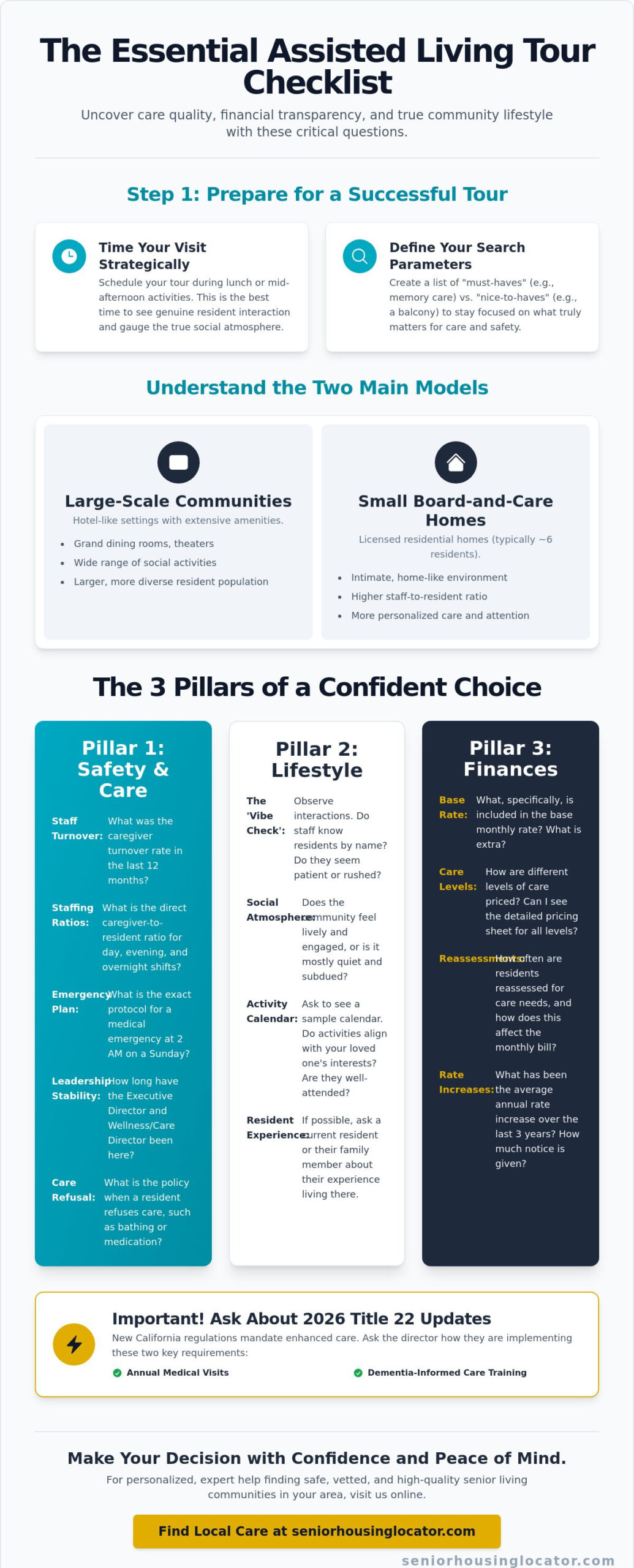
Walking into a senior living community for the first time feels heavy. You’re likely carrying a mix of hope and worry. To get the most out of your visit, timing is everything. Scheduling your tour during lunch or mid-afternoon activity hours allows you to see the community in motion. This is when you can observe how residents interact and whether the atmosphere feels genuinely lively. Before you go, it’s helpful to understand what assisted living is and how different models compare across California.
In the San Fernando Valley, you’ll encounter two main types of care. Large communities often look like luxury hotels with grand dining rooms and movie theaters. In contrast, small board-and-care homes in Woodland Hills are residential houses licensed for six residents. These smaller settings offer more intimacy and a higher staff-to-resident ratio. Bringing a sibling or spouse provides a second set of eyes to catch details you might miss while you’re talking to the director. You can learn more about how to choose assisted living facility options that fit your family’s unique situation.
Creating a list of ‘must-have’ versus ‘nice-to-have’ features keeps your search organized. A ‘must-have’ might be a secure memory care wing or a facility that accepts the Assisted Living Waiver. A ‘nice-to-have’ might be a private balcony or an on-site hair salon. When you separate these, you won’t feel pressured to compromise on the essentials. This preparation makes it easier to remember the specific questions to ask assisted living facility staff once the tour begins.
Defining Your Search Parameters
Start by assessing your parent’s Activities of Daily Living (ADLs). Do they need help with dressing, or is medication management the primary concern? Knowing this helps you narrow down the right care level. Location is also vital in Los Angeles. If you live in Sherman Oaks, choosing a facility in the SFV ensures you can visit frequently without battling hours of traffic. Finally, determine your monthly budget range early. This prevents the sticker shock that often happens when families fall in love with a community they can’t afford.
The ‘Vibe Check’ vs. The Fact-Finding Mission
It’s easy to be impressed by fresh flowers and new carpet, but these don’t provide care. Your real goal is a fact-finding mission. Focus on the staff-resident interactions. Do the caregivers know the residents by name? Do they seem patient or rushed? Prepare a list of three non-negotiable needs, such as a specialized diet or a specific hobby. Having these ready helps you stay focused on your parent’s well-being rather than the decor. You’re looking for a place where they’ll be safe, respected, and truly at home. If you’re still unsure whether the time is right to begin this search, reviewing the signs your parent needs assisted living can help you feel more confident in your decision.
Critical Staffing and Care Questions (The Safety Checklist)
When you visit a community, it’s easy to focus on the floor plan or the landscaping. However, the people working there will determine your parent’s daily happiness and safety. Staff-to-resident ratios are the single most important predictor of care quality. You need to know exactly how many hands are available when your loved one needs help. This is one of the most vital questions to ask assisted living facility managers during your tour.
Start by asking about the staff turnover rate for direct caregivers over the last 12 months. High turnover often leads to inconsistent care and missed details. You should also ask about the specific ratio of caregivers to residents during the night shift. Care needs don’t stop when the sun goes down. Ask how they handle medical emergencies at 2:00 AM on a Sunday. Is there a clear protocol, or do they simply call 911 for every minor issue? Finally, inquire about how staff handles ‘refusal of care.’ If a resident refuses a bath or a meal, the response should be rooted in patience and redirection, not force or neglect.
Evaluating Staff Expertise and Stability
Stability at the top usually means stability on the floor. Ask how long the Executive Director and Wellness Director have been with the community. If the leadership changes every few months, the culture often suffers. While a guide might claim to have low turnover, you can verify this by checking with the local Long-Term Care Ombudsman. For those exploring local care options, having an expert who knows the ‘behind-the-scenes’ reputation of these teams can save you from a difficult mistake. You should also ask about specific training for dementia support. Under 2026 enforcement of Title 22, facilities must apply dementia-informed practices to any resident showing cognitive changes, even without a formal diagnosis.
Medical and Emergency Protocols
California’s updated regulations now require facilities to complete a resident reappraisal at least every 12 months, or whenever a significant change in health occurs. Ask how the facility tracks these changes. You should also ask who is authorized to dispense medications and how they manage complex prescriptions. Is there a doctor or nurse practitioner who makes regular house calls to the building? Understanding the notification policy is equally important. Will you get a call immediately after a fall, or only if there’s a visible injury? A transparent community will have a clear, written policy for family communication that prioritizes your peace of mind and keeps you informed at every step.
Lifestyle and Resident Engagement Questions
Once you’re satisfied with the safety standards, it’s time to look at how your parent will actually spend their days. A beautiful facility can still feel lonely if there isn’t a vibrant social life. You want to ensure the community isn’t just a place to live, but a place to belong. Asking the right questions to ask assisted living facility staff about daily engagement helps you see if the environment matches your parent’s personality.
Start by asking how they integrate a new resident into the social fabric of the community. Is there a welcome committee or a “buddy system” for the first few weeks? You should also inquire about resident feedback. Can residents suggest new activities or outings to the management? A community that listens to its residents is usually one where people feel empowered and happy. It’s also vital to ask what happens if a resident chooses to stay in their room most days. While everyone needs privacy, prolonged isolation can lead to depression. Ask how the staff encourages participation without being pushy or intrusive.
Food is often the highlight of a resident’s day, so don’t settle for surface-level answers about the kitchen. Ask about “anytime dining” options. This flexibility is becoming a standard in 2026, allowing residents to eat when they’re hungry rather than on a strict corporate schedule. This small detail can significantly improve a senior’s sense of independence and dignity.
Social Integration and Mental Health
Activity calendars can be misleading. They often list events that few people attend. Instead, ask: “What was the most popular activity held here last week?” This reveals what the residents actually enjoy. You should also observe the common areas. Are residents interacting with each other, or are they just sitting in front of a TV? If your parent has hearing or vision impairments, ask how the community adapts its programming. True inclusion means every resident can participate regardless of their physical challenges.
Dining and Nutrition Standards
Always ask to see a menu from a week when there wasn’t a tour scheduled. This gives you a more honest look at the daily fare. Inquire about specialized diets, such as low sodium or diabetic-friendly options, and ask how the kitchen ensures these needs are met every single meal. You should also check the guest policy. Being able to share a meal with your parent is a great way to stay connected. Ask if guests are allowed to dine with residents and what the typical cost for a visitor’s meal is. These small logistics make a big difference in how often family members visit and how welcome they feel in the community.
Financial Transparency: Asking the Hard Questions About Costs
Money is often the most stressful part of this journey. You want your parent to have the best care, but you also need to protect your family’s financial future. Most brochures show a beautiful base price, but that number rarely covers the total cost of care. Understanding the full financial picture is one of the most critical questions to ask assisted living facility staff before signing any paperwork. If you feel overwhelmed by the fine print, a senior living advisor Los Angeles can help you decode these complex contracts.
Start by asking exactly what the base rate includes. Does it cover all utilities, laundry, and three meals a day? You should also ask about the historical rate of annual rent increases. In the Los Angeles market, costs are projected to rise by about 3% annually through 2026. Knowing the facility’s past behavior helps you plan for the future. Don’t forget to ask about ‘community fees’ or ‘move-in fees.’ These one-time charges can cost thousands of dollars and are often negotiable if a facility has several vacancies.
Care assessments are another area where costs can surprise you. Under California’s Title 22 regulations, facilities must perform a resident reappraisal at least every 12 months or when a significant health change occurs. Each assessment can move your parent into a higher ‘care level,’ which increases the monthly bill. Ask how often these are done and if you’ll be notified before a price change takes effect. Many families are also surprised to discover that assisted living vs home care costs are closer than they expect, making a community setting a more financially viable option than assumed. If you need help comparing these costs across different communities, our team provides assisted living placement services to find a fit for your budget.
Understanding the Fee Structure
Ask the director to show you an example of a resident’s bill with ‘Level 3’ care. This makes the abstract numbers feel real and reveals how they tally up service points. You should also check if there’s a separate medication management fee. Some facilities bundle this into the care level, while others charge hundreds of dollars extra each month. Finally, ask about the refund policy for the community fee. If your parent needs to move out within the first 30 days because the community isn’t a good fit, you should know if any of that upfront money comes back to you.
Contractual Obligations and Rights
You have protected rights as a consumer in California. Ask how much notice is required before a resident can move out; it’s typically 30 days. It’s also vital to understand the ‘discharge’ policy. Under what specific circumstances can the facility ask a resident to leave? This usually happens if care needs exceed what the facility is licensed to provide. Lastly, ask about the formal grievance process. Knowing there’s a clear way to file a complaint gives you a structured path to resolve issues if they arise later.
Partnering with a Local Advisor to Find the Perfect Fit
Even with a professional checklist in hand, searching for care in the San Fernando Valley can feel like a full-time job. Families in Woodland Hills and Sherman Oaks often turn to local placement specialists to streamline this emotional process. We provide access to “behind-the-scenes” data that isn’t available on public websites or brochures. This includes information on recent management shifts or staffing patterns that could affect your parent’s daily life. Having this insight helps you refine your list of questions to ask assisted living facility directors so you can focus on the most important details.
We understand that your time is valuable. Driving between different communities in Los Angeles traffic can take hours of your day. We create personalized tour plans that group visits together geographically and logically. This ensures you spend your energy evaluating care quality rather than sitting on the 101 freeway. Our goal is to match your parent’s social needs and your family’s budget with complete integrity. You can find more specific local insights in our guide to assisted living placement Woodland Hills.
The Benefit of Local SFV Expertise
We stay deeply rooted in the community to protect your interests. We know which buildings have recently received state citations and which ones have a long history of excellence. Our placement service is free to families because we’re funded by the communities we partner with. We also help you handle the heavy lifting of move-in logistics. We can guide you through the initial paperwork, coordinate with medical providers, and ensure the transition is as smooth as possible.
Taking the Next Step with Confidence
Now that you have a professional-grade checklist, it’s time to put it into action. Review the notes you made regarding the questions to ask assisted living facility staff during your initial tours. If a community stands out as a top choice, schedule a follow-up visit. Try visiting at a different time of day, perhaps on a weekend, to see if the atmosphere remains consistent. When you’re ready to start a customized search in the San Fernando Valley, contact us. We’re here to be your trusted ally and help you find a place where your parent will truly thrive.
Finding the Right Path for Your Family
Finding the right care is a journey that requires both heart and a clear plan. By using this checklist, you’ve moved from a place of uncertainty toward true empowerment. You now know how to look past the lobby decor to evaluate real staff stability and night-shift protocols. You understand how to spot hidden fees before they appear on a monthly bill. Most importantly, you have the right questions to ask assisted living facility directors to ensure your parent’s safety and happiness.
You don’t have to navigate the complex Los Angeles market by yourself. Our team at Senior Housing Locator is here to be your trusted local ally. We provide a free service for families throughout Woodland Hills and the San Fernando Valley, rooted in a commitment to integrity and personalized care. Schedule your free local senior living consultation with an expert today to find the perfect fit. Take a deep breath. You’re doing a great job, and the right community is out there waiting for your loved one.
Frequently Asked Questions
What is the most important question to ask during an assisted living tour?
The most vital question focuses on staff longevity and how the community handles a resident’s sudden change in health. Ask how many of the current caregivers have been with the building for more than two years. Stable staffing often leads to better care and deeper relationships. While there are many questions to ask assisted living facility staff, knowing that the people caring for your parent are happy and experienced provides the most peace of mind.
How do I know if an assisted living facility in California is properly licensed?
Every legitimate community must hold a Residential Care Facility for the Elderly (RCFE) license issued by the California Department of Social Services. You should see this license number prominently displayed in the lobby or near the main entrance. You can also verify the license status and see the facility’s capacity through the Community Care Licensing Division (CCLD) public portal. This ensures the home meets state safety and operational standards.
Can I negotiate the price of an assisted living facility in Los Angeles?
You can often negotiate one-time costs like community fees or move-in incentives, especially if the facility has several vacant apartments. While monthly base rates for care are generally fixed, management may offer a “move-in special” to help fill a room quickly. It’s always helpful to ask if there are any current promotions or if the community fee can be waived or reduced. This can save your family thousands of dollars in upfront costs.
What are the common hidden fees in senior living contracts?
Common hidden fees often include charges for medication management, tray service for meals delivered to the room, and personal laundry. Some communities also charge extra for transportation to medical appointments or for basic supplies like incontinence products. Always ask for a detailed “ancillary fee schedule” before you sign a contract. This document lists every potential add-on cost that isn’t included in the base monthly rent.
What should I look for in the residents’ appearance during a tour?
Observe whether residents are well-groomed, dressed in clean clothes, and appear engaged with their surroundings. Look for small details like clean fingernails, brushed hair, and appropriate footwear. If residents appear disheveled or ignored in common areas, it may indicate that the staff is stretched too thin to provide personalized attention. A happy, well-cared-for resident population is the best indicator of a facility’s true care quality.
How do I find out about a facility’s history of state violations?
You can research a facility’s history of citations and complaints by visiting the California Department of Social Services (DSS) website. Their transparency portal allows you to search for any RCFE by name or zip code to view recent inspection reports. Checking for past citations is one of the essential questions to ask assisted living facility administrators before signing a contract. This step helps you identify any recurring issues with safety or staffing.
What happens if my parent’s care needs exceed what the facility can provide?
The facility will perform a resident reappraisal and may issue a 30-day notice if they can no longer safely meet your parent’s medical needs. This often happens if a resident requires 24-hour skilled nursing care or becomes a danger to themselves or others. In these cases, the facility must work with the family to ensure a safe transition. Understanding the discharge policy early helps you plan for the next level of care if health conditions decline.
Is it better to choose a large community or a small board and care home?
The best choice depends on your parent’s personality and their specific level of care. Large communities offer more social variety, diverse meal choices, and extensive activity calendars. Small board and care homes provide a quiet, residential environment with a much higher staff-to-resident ratio. If your parent thrives in a busy social scene, a larger community is ideal; if they prefer a calm, family-like setting, a board and care home may be a better fit. Before touring any community, it helps to first recognize the physical and cognitive signs a parent needs assisted living so you can communicate their needs clearly to each facility you visit.