
The most beautiful lobby in Los Angeles doesn’t always guarantee the best care for your parent. You might find yourself touring a facility with stunning views, yet still feel a knot of anxiety in your stomach. It’s normal to feel overwhelmed by the fear of making a mistake or the weight of moving a parent out of their long-time home, especially when you are trying to figure out how to choose assisted living facility options that are actually safe. You deserve to feel confident that your choice will lead to a better quality of life and genuine peace of mind for your whole family.
We’re here to act as a helping hand during this high-stress process. This guide provides a clear, empathetic framework to help you manage the 2026 senior living landscape with ease. We’ll break down the latest California transparency laws, compare the costs of different L.A. neighborhoods, and explain the vital differences between intimate board-and-care homes and larger communities. By the end, you’ll have the tools to find a home that matches your loved one’s unique social rhythm and care needs perfectly.
Key Takeaways
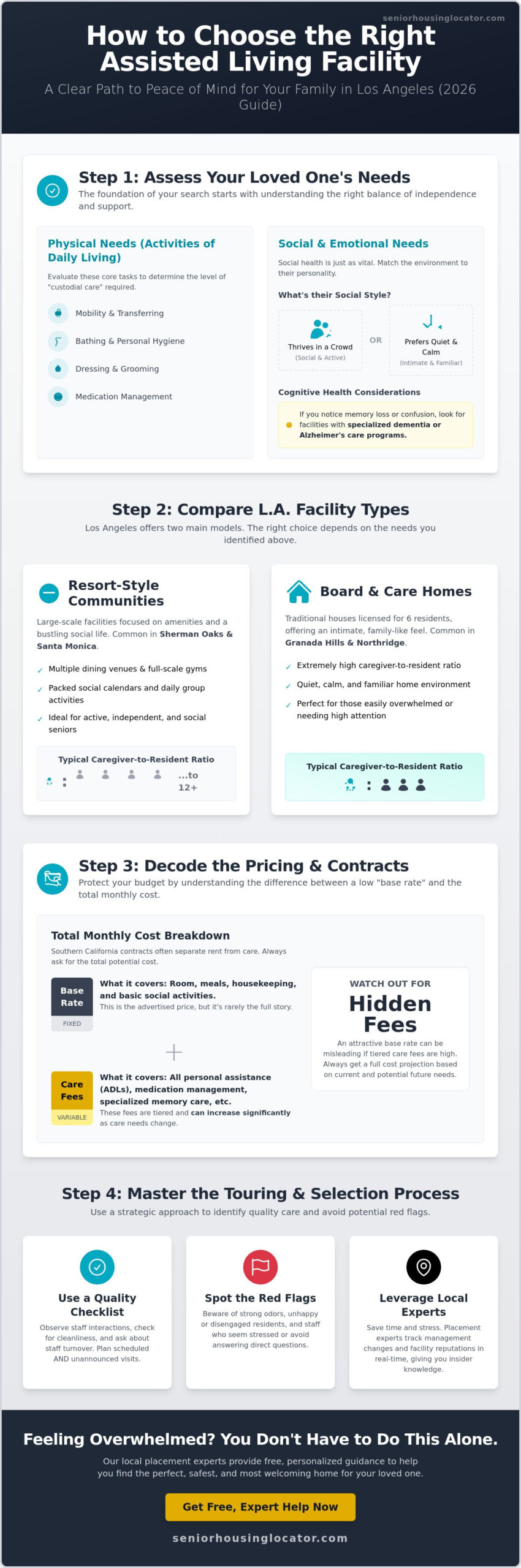
- Define your loved one’s specific needs using the Activities of Daily Living framework to ensure the right balance of independence and support.
- Learn how to choose assisted living facility options in Los Angeles by comparing intimate board-and-care homes with larger, resort-style communities.
- Master the touring process with our checklist for identifying quality care and spotting red flags during unannounced visits.
- Protect your budget by understanding the difference between base rates and tiered care fees common in Southern California contracts.
- Save time and avoid stress by using local placement experts who track management changes and facility reputations in real time.
Assessing Care Needs: The Foundation of Your Search
Finding the right home starts with a simple question: what does your loved one actually need to thrive today? What is Assisted Living? At its heart, it is a residential lifestyle designed to balance independence with tailored support. It isn’t about taking away freedom. Instead, it’s about providing the specific help needed to keep that freedom for as long as possible. Many families struggle with how to choose assisted living facility options because they aren’t sure where the line between “help” and “care” sits.
Professional caregivers use a framework called Activities of Daily Living (ADLs) to measure this. These are the basic tasks we all do to stay healthy and safe. They include moving around safely, bathing, dressing, managing medications, and maintaining proper nutrition. You might notice a “tipping point” when home care feels like a temporary fix rather than a permanent solution. This usually happens when a parent becomes socially isolated or when their safety at home requires constant, exhausting supervision from family members. Before committing to any one path, it’s worth carefully weighing your options by reviewing a detailed comparison of assisted living vs home care to understand which approach truly fits your family’s situation in 2026.
Evaluating Physical and Medical Requirements
Physical needs often fall under “custodial care,” which focuses on daily routines rather than intensive medical treatment. This is different from “skilled nursing,” which involves 24-hour medical supervision by licensed nurses for complex or unstable conditions. When you look at different communities, ask about their ability to handle escalating needs. Can they manage mobility changes or increased medication help? Choosing a community that can scale its support ensures you won’t have to move your loved one again if their health changes.
The Emotional and Social Inventory
Social health is just as vital as physical health. Chronic loneliness can lead to cognitive decline and depression, making social isolation a serious risk for seniors living alone. Think about your parent’s personality. Would they thrive in a large community with a busy social calendar, or would they prefer an intimate board-and-care home with a quiet, family-like atmosphere? If you notice frequent confusion or signs of memory loss, look specifically for specialized dementia or Alzheimer’s programming. These environments provide a higher level of cognitive support and security. Understanding these personality and care nuances is a vital part of how to choose assisted living facility settings that truly feel like home.
Comparing Facility Types in the San Fernando Valley
Los Angeles offers a unique landscape of senior living options. Once you understand your loved one’s needs, the next step is deciding which environment fits their personality best. In areas like Woodland Hills and the wider San Fernando Valley, you’ll generally choose between two distinct models: large, resort-style communities and intimate board-and-care homes. Learning how to choose assisted living facility types depends heavily on whether your parent craves a bustling social life or a quiet, familiar routine.
Each model has its own strengths. A large community might feel like a luxury hotel, while a board-and-care home feels exactly like the house they’ve lived in for decades. Making this distinction early helps narrow your search and reduces the feeling of being overwhelmed by too many choices. If you need help sorting through these local options, you can always reach out for expert placement guidance to find the best fit.
Resort-Style Communities: Amenities and Scale
Large communities are often the first thing people imagine when they think of modern senior living. These facilities, common in Sherman Oaks and Santa Monica, focus on scale and variety. Residents enjoy access to multiple dining venues, full-scale gyms, and packed social calendars. These are ideal for active seniors who want to meet new people and participate in daily group activities. However, the sheer size can be daunting for some. It’s helpful to review expert advice on how to choose a facility to ensure the amenities align with actual daily use rather than just looking impressive on a tour.
Board and Care Homes: Intimacy and High Ratios
In neighborhoods like Granada Hills and Northridge, you’ll find a high concentration of board-and-care homes. These are traditional residential houses licensed for six residents. The primary benefit here is the caregiver-to-resident ratio, which is often as high as 1:3 or 1:2. This level of attention is hard to find in larger settings. These homes are perfect for seniors who are easily overstimulated or those who require more hands-on help with daily tasks. When considering how to choose assisted living facility settings for someone with advanced care needs, the quiet, predictable, and supervised nature of a 6-bed home often provides a much-needed sense of security and calm.
The Touring Process: Identifying Quality and Red Flags
Walking through the front door of a facility for the first time is often a polished experience. The lobby is clean, the music is soft, and the marketing director is ready with a smile. However, learning how to choose assisted living facility locations that truly provide high-quality care requires looking past the initial presentation. You’re looking for the heart of the home, not just the decor. It’s about the daily reality for the people who live there.
One of the most effective strategies is the unannounced follow-up visit. After your scheduled tour, return on a different day or at a different time, such as a weekend or during an evening meal. This allows you to see the community in its natural state. Pay close attention to how staff members speak to residents. Do they use their names? Is there eye contact? A caring environment is built on these small, respectful interactions rather than just a list of services. If the staff seems rushed or ignores residents’ requests, it may indicate a deeper issue with the facility’s culture. To make the most of every tour, prepare in advance with our 25 essential questions to ask an assisted living facility so you know exactly what to look for beyond the surface.
Don’t forget to check the details that aren’t in the brochure. Look at the baseboards in the hallways, check the lighting in the corners, and be mindful of any lingering odors. In California, every assisted living community is technically a Residential Care Facility for the Elderly (RCFE). You should always ask to see their current license and check for any recent state citations. As of July 1, 2026, California law requires facilities to provide written disclosures before you sign a contract. These documents must show their annual rate increase history for the past three years and their staff-to-resident ratios. Checking these facts is a critical step in how to choose assisted living facility options that offer long-term stability.
The “Vibe Check”: Social Engagement
Are residents actually enjoying themselves, or are they just sitting in front of a television? Meaningful engagement involves activities that challenge the mind or spark social connection. This is far more valuable than passive entertainment. Watch a meal service to see if the atmosphere feels lively and if the food looks appetizing. Much like how visitors discover Laurel Haven Estate for its scenic dining and welcoming vibe, a top-tier assisted living community should offer a mealtime experience that residents genuinely look forward to. If the dining room is silent or residents seem ignored, it might be a sign of a disconnected culture.
Staffing and Tenure: The Heart of Care
Consistent care depends on the people providing it. Ask the Executive Director or Wellness Coordinator about staff turnover. If most caregivers have been there for several years, it usually points to a healthy work environment where staff feel valued. A “burnout” culture is often visible in rushed movements or short tempers. A “caring” culture is evident when staff members seem genuinely happy to be there, providing the stability your loved one needs.
Understanding Pricing and Contracts in Southern California
Talking about money is often the hardest part of this journey. You want the best care for your parent, but you also need a plan that is sustainable for the long term. In Los Angeles, most communities use a two part pricing model. There is a base rate and then there are care tiers. Understanding this structure is a critical part of how to choose assisted living facility options that fit your family’s budget without unexpected surprises.
The base rate typically covers the essentials of daily life. This includes the apartment or room, three daily meals, utilities, and basic housekeeping. On top of this base, facilities add care tiers. These are extra fees based on the specific amount of hands on help a resident needs with tasks like bathing, dressing, or medication. Most facilities also require a one time community fee. This fee often equals one or two months of rent and covers the administrative costs of the move in process. It’s also vital to check the discharge and notice policies. Most California contracts require a 30 day written notice before moving out, which is a standard safety and financial protection for both parties.
Transparency is getting better for families. A new California law taking effect July 1, 2026, requires facilities to provide written disclosures of all fees and their rate increase history for the past three years before you sign anything. This helps you plan for the future with real data. If you are struggling to compare different quotes, you can request a personalized cost comparison to see which local options offer the best value for your specific needs.
Hidden Costs and Tiered Care
Many facilities use a “points system” to determine care tiers. A resident might “cost” more points as they need more help, which leads to monthly price increases. It’s common for rent to increase annually; a 3% yearly increase is a standard projection to keep in mind. Always ask if specialized diets, laundry, or pharmacy delivery services are included or if they come with an extra charge. The recent increase in the California minimum wage to $16.90 on January 1, 2026, has also influenced staffing costs, so it’s wise to ask how the facility manages its labor budget.
Financial Resources and Planning
While private funds are the primary way families pay for care in Los Angeles, other resources can help. Veterans and their surviving spouses may qualify for the VA Aid and Attendance benefit, which can provide up to $2,431 per month as of 2026. Long term care insurance is another common tool, though you should verify the “elimination period” before benefits kick in. For those with limited assets, the Medi-Cal Assisted Living Waiver (ALW) is an option, though it often has a waitlist. Knowing how to choose assisted living facility providers that accept the ALW is essential if you are relying on state assistance, as reimbursement rates were updated on January 1, 2026, to reflect new care tiers. Families who are still weighing their options may also find it helpful to read a thorough breakdown of assisted living vs home care costs and benefits before making a final financial commitment.
Streamlining the Search with a Local Placement Expert
Finding the right care is a heavy lift. It often feels like a full-time job on top of your own career and family life. When you’re trying to figure out how to choose assisted living facility options in a city as large as Los Angeles, the sheer volume of choices can lead to decision fatigue. A local placement expert acts as your personal guide, taking the burden of research off your shoulders and providing a clear path forward.
These experts offer an “Insider Advantage” that a basic internet search simply can’t provide. They know which communities in Woodland Hills or Encino have recently changed management or which ones are currently undergoing staff transitions. This local knowledge ensures you aren’t just looking at a pretty building, but a facility with a stable, high-quality care team. Just as professional firms like the Shepherd HomeOwners’ Association maintain excellence in residential communities, a well-managed senior living facility relies on consistent oversight to thrive. They understand the nuances of the local market, from the specific reputations of board and care homes to the activity levels of large resort-style campuses.
Many families worry about the cost of professional advice. However, these placement services are typically free for families. The experts are compensated by the communities through a referral model once a successful placement is made. This allows you to receive expert guidance, local data, and emotional support without adding to the financial stress of senior living. It is a service designed to prioritize your peace of mind and your loved one’s well-being above all else.
Personalized Matching vs. Internet Search
Star ratings on the internet only tell a tiny part of the story. A local advisor looks for the right cultural fit. They understand the “social rhythm” of a community and how it matches your parent’s personality. If family members disagree on the best path forward, an advisor acts as a calm, objective buffer. They provide a curated list of vetted, high-quality options, so you only spend time touring the best candidates. This efficiency saves you weeks of unnecessary stress and helps avoid the mistake of choosing a facility based on a marketing pitch alone.
Your Next Steps to Peace of Mind
Don’t wait for a medical crisis to start your search. Beginning early gives you the luxury of time and choice. It’s the best way to ensure your loved one feels included in the decision and transitions smoothly into their new home. You can contact our local experts for a free care assessment today to start this journey with confidence. Learning how to choose assisted living facility care doesn’t have to be a lonely process when you have a trusted ally by your side.
Taking the Next Step with Confidence
Finding the perfect home involves more than just a tour. It requires a deep understanding of care tiers and the honesty found during unannounced visits. You now have a clear framework for how to choose assisted living facility options that align with your parent’s unique personality and health needs. By focusing on transparency and social engagement, you can turn a high-stress decision into a manageable, step-by-step process.
Our local experts in Woodland Hills and the San Fernando Valley have already done the hard work of vetting local communities. We provide 100% independent and objective referrals to ensure your loved one finds the right fit. This is a free service for families with no hidden fees, designed to act as a helping hand when you need it most. Start your free personalized senior housing search today.
You have the knowledge and the tools to make a great choice. Your loved one’s comfort and your own peace of mind are well within reach.
Frequently Asked Questions
What is the difference between assisted living and a nursing home?
Assisted living provides help with daily tasks like dressing and meals in a social, residential setting. Nursing homes offer 24/7 clinical medical care for people with complex or unstable health conditions. If your loved one is mostly mobile but needs a helping hand, assisted living is usually the right fit. Nursing homes are for those who require constant supervision from licensed medical professionals.
How much does assisted living cost in Los Angeles in 2026?
Monthly costs in Los Angeles for 2026 generally average between $6,281 and $7,965. Prices change based on the neighborhood. San Fernando Valley communities typically range from $6,500 to $9,500, while West LA can reach over $12,000. Understanding these regional price gaps is a major part of how to choose assisted living facility locations that fit your family’s financial plan.
Is assisted living tax deductible in California?
The care portion of your monthly bill may be tax deductible if a doctor certifies that the resident is chronically ill. This typically means they need help with at least two Activities of Daily Living. While we can’t provide financial advice, many families find that a significant part of the cost qualifies as a medical expense. You’ll want to speak with a tax expert about California’s specific deductions.
Can I move my parent to assisted living against their will?
You can only move a parent against their will if they lack the mental capacity to make safe decisions and you have legal authority. This usually requires a Power of Attorney or a court ordered conservatorship. It’s a difficult situation that requires a gentle, empathetic approach. We often suggest involving a neutral third party, like a local placement expert, to help facilitate these tough family conversations.
What should I look for in a memory care facility specifically?
Look for high staffing ratios and specific dementia training for every employee. A good facility will have secured perimeters and wayfinding cues to help residents navigate safely without feeling trapped. Observe the residents during your visit. They should be engaged in sensory activities or social interaction rather than sitting alone. Effective memory care prioritizes dignity and safety through a predictable, calming daily routine.
How do I know if a facility in the San Fernando Valley is licensed?
You can check the license of any San Fernando Valley home through the California Department of Social Services. Every facility must hold a valid Residential Care Facility for the Elderly (RCFE) license. This public record shows you any past citations or safety violations. Verifying this data is a non negotiable step when you are learning how to choose assisted living facility options for a loved one.
Do assisted living facilities in LA accept Medicare?
Medicare does not cover the cost of assisted living room, board, or daily care. It is designed for short term medical needs and hospital stays rather than long term residential support. Most families pay for these services using private savings, the sale of a home, or Veterans benefits. If your loved one has a medical need, Medicare may still pay for their specific doctor visits or physical therapy.
What is a “Board and Care” home and is it better than a large facility?
A Board and Care is a licensed residential home that usually houses six residents. It offers a more intimate, family style environment compared to a large, resort style community. These homes are often better for seniors who need high levels of supervision or those who find large buildings confusing. They provide a quiet routine and a very high caregiver to resident ratio for personalized attention.