What if the most expensive community in Northridge or Sherman Oaks isn’t actually the one that provides the best long term value for your family? When you start looking into memory care costs San Fernando Valley families often feel overwhelmed by the lack of clear answers. It’s completely normal to feel a bit of sticker shock or to worry about how long your savings will last as care needs increase. You want your loved one to be safe, happy, and well cared for without the constant fear of financial uncertainty.
We’re here to help you make sense of the 2026 pricing landscape with clarity and compassion. This guide provides a straightforward look at how different facility models impact your monthly bill. You’ll learn about the new California transparency laws that protect your budget, the specific differences between assisted living surcharges and all inclusive rates, and the latest updates on financial assistance programs like the Medi-Cal Assisted Living Waiver. We’ve organized everything you need to know to choose a care option that is both high quality and financially sustainable.
Key Takeaways
- Learn how to distinguish between base rent and care points to budget accurately for your loved one’s unique needs.
- Compare the “boutique” feel of residential board and care homes with the amenities of larger memory care communities.
- Explore financial resources like long-term care insurance and state waivers to help manage memory care costs San Fernando Valley families face in 2026.
- Use new California transparency requirements to uncover hidden fees and understand rate histories before you sign.
- Find out how a local placement expert can guide you toward pre-vetted communities that fit your family’s budget and care goals.
Understanding Memory Care Pricing in the San Fernando Valley
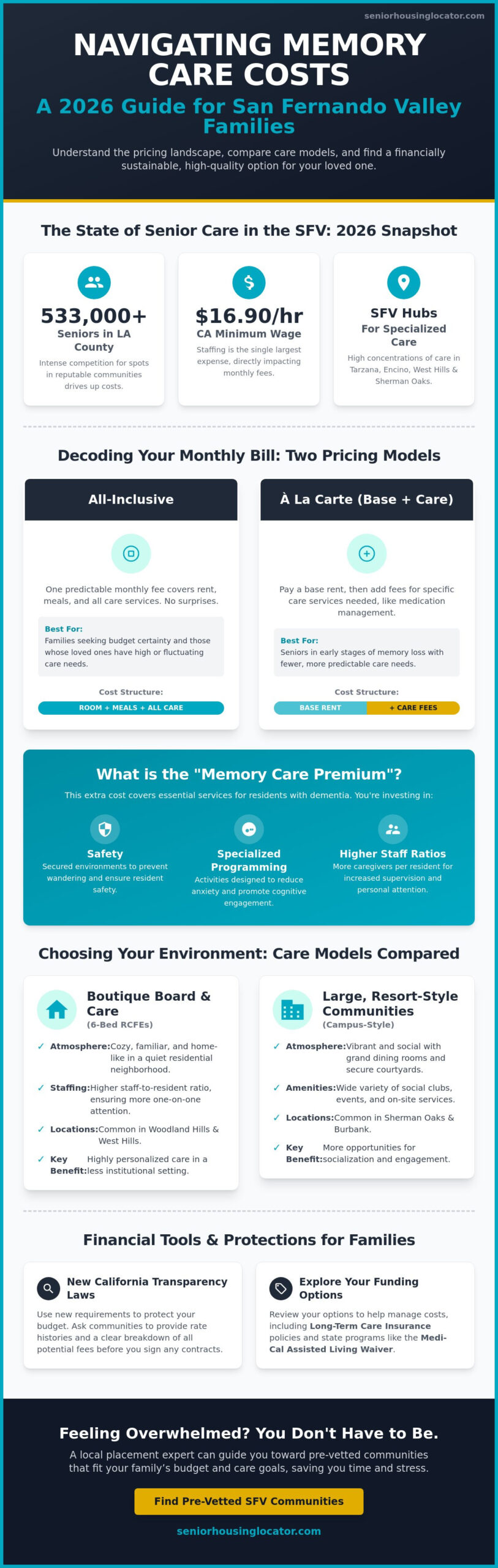
Memory care is more than just a place to live. In California, it is officially considered a specialized tier of Assisted Living designed specifically for those with Alzheimer’s or dementia. When you look at memory care costs San Fernando Valley providers often charge more than the national average. This is largely because our local demand is incredibly high and the cost of doing business in Los Angeles is significant. Neighborhoods like Tarzana and Encino have become hubs for these services, offering a high concentration of specialized care that caters to the Valley’s growing senior population.
Facilities usually use one of two pricing structures. Some offer all inclusive rates that cover rent, meals, and all care tasks in one monthly bill. Others use an a la carte model where you pay a base rent and then add service fees for specific needs like medication management or dressing assistance. Understanding which model a community uses is the first step in avoiding unexpected financial surprises. Pricing also shifts depending on where you look. For instance, communities in West Hills might offer more residential board and care options, while Burbank often features larger, resort style campuses. Each has a different price tag based on the local real estate and the level of luxury provided.
The 2026 State of Senior Care in the Valley
Staffing is the heart of quality care, but it’s also the biggest expense for facilities. As of January 1, 2026, California’s minimum wage increased to $16.90 per hour. This change, along with stricter staffing ratios, means facility overhead is higher than ever. With over 533,000 seniors living in Los Angeles County, the competition for a spot in a reputable community is intense. Local expertise is vital here. Zoning and licensing rules can vary between a community in West Hills and one in Burbank. This local nuance often dictates the price point and the type of care available.
Memory Care vs. Standard Assisted Living Costs
You might notice a “Memory Care Premium” when comparing quotes. This extra cost covers secured environments, specialized staff training, and higher caregiver to resident ratios. It isn’t just a locked wing; it’s a dedicated service designed to reduce anxiety and promote engagement. If you’re curious about the specific clinical differences, our Memory Care vs. Assisted Living guide explains what your loved one actually receives for that higher price. When calculating memory care costs San Fernando Valley families should remember they’re paying for three things: safety, specialized programming, and peace of mind.
Comparing Care Models: Board and Care vs. Large Communities
Choosing the right environment is just as important as the price tag. In the San Fernando Valley, you’ll generally choose between two distinct formats. These are smaller residential board and care homes or larger, campus-style communities. Each option impacts memory care costs San Fernando Valley families must plan for in different ways. Both models provide high-quality care, but they offer very different daily experiences for your loved one.
In neighborhoods like Woodland Hills and West Hills, you’ll find a high concentration of “boutique” board and care homes. These are traditional houses in quiet suburbs that have been converted into licensed care facilities. They offer a cozy, familiar atmosphere that can be very grounding for someone with dementia. On the other hand, areas like Sherman Oaks and Burbank are known for larger, resort-style communities. These facilities offer grand dining rooms, secure outdoor courtyards, and a wide variety of social clubs.
Deciding between these options often comes down to a trade-off between socialization and staffing. Large communities provide a vibrant social life, which can be wonderful for seniors in the early stages of memory loss. Smaller homes usually offer a much higher staff-to-resident ratio. This means your loved one gets more one-on-one attention throughout the day. If you aren’t sure which environment suits your family best, you can explore our local referral services to see which models are currently available near you.
Boutique Board and Care Homes (6-Bed RCFEs)
A Residential Care Facility for the Elderly (RCFE) is often a six-bed home nestled in a local neighborhood. These homes are popular because they feel less like an institution and more like a family. Many of these SFV homes use “all-in” pricing. This means your monthly statement is predictable because it covers room, board, and all care needs in one flat fee. While you won’t find a swimming pool or a cinema room here, the intimate setting often leads to deeper bonds between caregivers and residents. It’s a simpler, more direct way to manage your budget.
Large-Scale Memory Care Communities
Large communities typically use a tiered system to determine fees. You might start at Level 1 for basic supervision and move to Level 4 as more physical assistance is required. This model allows you to pay only for the care currently needed. These facilities invest heavily in “lifestyle” amenities. You’ll find secure wandering paths, specialized dining programs, and sensory rooms designed to reduce agitation. To see how these options compare, check out our list of the Top Memory Care Communities in San Fernando Valley for specific local examples of these tiered models.
Hidden Factors That Influence Your Monthly Statement
Understanding your monthly statement requires looking past the single sticker price. Most communities in our area split the bill into two main parts: the “Base Rent” and the “Care Level.” Base rent covers the physical room, basic utilities, and three meals a day. This portion is strictly about real estate. Because property values vary across the Valley, the base rent in a West Valley neighborhood like Woodland Hills or Sherman Oaks may be significantly higher than a similar room in North Hills or Sylmar. It’s helpful to think of the base rent as the “apartment” cost and the care level as the “service” cost.
The care portion is where the bill becomes personalized. This fee is based entirely on your loved one’s “acuity,” which is a professional way of describing how much hands-on help they require. When researching memory care costs San Fernando Valley providers offer, remember that you are paying for a specific number of care hours. This is why two residents in the same building can have wildly different monthly bills. One might be in the early stages of dementia and only need reminders; another might need two caregivers for every daily task. Knowing this split helps you see exactly where your money is going each month.
The “Point System” and Care Tiers
Most large facilities use a point system to determine your care tier. During the initial move-in process, a nurse will perform an assessment to see how many points your loved one needs. Activities of Daily Living (ADLs) like bathing, dressing, and eating are the primary drivers of your monthly care fee. If your loved one is still fairly independent, they might start at Level 1. As their needs grow, they move up the tiers. We always recommend requesting a re-assessment every six months. If a resident’s health stabilizes or they become more cooperative with care, you might be able to lower your tier and save money.
Common Add-On Expenses in SFV Facilities
Beyond the base rent and care tiers, several smaller fees can add up quickly. It’s best to ask about these upfront so they don’t surprise you on your first invoice. These are the most common “hidden” costs in our local market:
- Medication Management: Most facilities charge a monthly fee to store, track, and administer medications. This often includes a surcharge for using the facility’s preferred pharmacy delivery service.
- Incontinence Supplies: Some homes include these in a flat fee, while others charge for every pull-up and wipe used. You can often save money by purchasing these in bulk yourself and having them delivered.
- Community Fees: Almost every Southern California facility requires a one-time “move-in” or “community” fee. This covers the administrative cost of the nurse assessment and preparing the room for your arrival.
Planning for these extras ensures your budget remains sustainable for the long term. It moves you from a place of uncertainty to a place of control, allowing you to focus on your loved one’s well-being rather than the fine print.
Funding and Financial Resources for Valley Families
Finding the funds for specialized care is often the most stressful part of this journey. It’s a common misconception that Medicare pays for residential dementia care. In reality, Medicare only covers clinical medical expenses like doctor visits, hospital stays, or short-term rehab. It does not pay for the room, board, or 24/7 supervision your loved one needs. If your family has a Long-Term Care Insurance (LTCI) policy, now is the time to review it. These policies are designed specifically to help manage memory care costs San Fernando Valley families encounter, though you’ll need to verify the daily benefit amount and the elimination period before care begins.
In a high-value real estate market like Los Angeles, many families also look toward home equity. A reverse mortgage or a bridge loan can provide the liquidity needed to cover monthly fees without forcing an immediate sale of the family home. This can be a helpful strategy while you wait for other benefits to kick in or while you prepare a property for the market.
VA Aid and Attendance Benefits
For veterans and their surviving spouses, the VA Aid and Attendance benefit is a crucial resource. This is a monthly stipend added to a standard VA pension for those who require help with daily activities. To be eligible, the veteran must have served at least 90 days of active duty, with at least one day during a period of war. It’s an excellent way to bridge the gap between standard assisted living and the higher cost of memory care. We recommend connecting with a local Veteran Service Officer (VSO) in the Valley, such as those at the Sepulveda VA Ambulatory Care Center, to help with the application process. It can take several months to approve, so starting early is vital.
California-Specific Programs and Tax Deductions
California offers specific programs that can ease the burden, though they often require careful planning. The Medi-Cal Assisted Living Waiver (ALW) is available in Los Angeles County and can help pay for care in certain licensed facilities. However, you should be aware of the 2026 requirements and limitations:
- Income and Asset Limits: As of April 2026, a single applicant’s income limit is $1,836 per month, and the asset limit is $130,000.
- Waitlist Realities: There is currently a statewide waitlist of over 18,000 individuals for the ALW program, so it is rarely an immediate solution.
- Tax Deductions: Many families don’t realize that memory care can often be classified as a deductible medical expense. This includes both the care portion and sometimes even the room and board.
- Caregiver Credits: California has expanded tax credits for working family members to help offset out-of-pocket caregiving expenses.
For a broader look at how these programs fit into the local landscape, you can view our Assisted Living Costs in Los Angeles guide. If you feel overwhelmed by these financial options, you can speak with a local placement expert who can help you identify communities that accept the specific funding sources you have available.
Finding the Right Fit with Senior Housing Locator
Searching for memory care is often a full-time job that you didn’t ask for. It involves making dozens of phone calls, scheduling tours, and trying to decode complex contracts while managing the emotional weight of a loved one’s diagnosis. Senior Housing Locator steps in to carry that burden. Our placement service is entirely free for families, which means you get professional guidance without adding another expense to your budget. We’ve spent years building a pre-vetted network of board and care homes and large communities to ensure every recommendation meets our high standards for safety and comfort.
Our deep roots in the San Fernando Valley give us a unique advantage. We know about “quiet” openings and unadvertised pricing specials in neighborhoods like Woodland Hills, Northridge, and Sherman Oaks. These local insights can significantly impact the memory care costs San Fernando Valley families end up paying. By knowing which communities are currently offering move-in incentives or have unique vacancies, we can help you find a sustainable care option that doesn’t compromise on quality. We’ve already done the hard work of auditing these facilities, so you can skip the guesswork.
We also know that timing is everything. Decisions made during a medical crisis are often the most stressful and expensive. We encourage you to explore your options early so you can make a choice from a place of calm rather than urgency. If you’re still deciding if it’s the right moment for this transition, our guide on When to Move a Parent to Memory Care offers a gentle, compassionate perspective on the process.
Our Personalized Approach to Your Budget
We don’t believe in one-size-fits-all lists. Instead, we match your loved one’s specific care requirements to your unique financial plan. Our process is designed to be a “helping hand” that simplifies your journey. We handle the logistics of touring and the nuances of the negotiation process to ensure you find the best possible value. Our commitment is rooted in integrity. You’ll never experience high-pressure sales tactics here; our only goal is to find a placement where your loved one will truly thrive and feel at home.
Start Your Search in the San Fernando Valley Today
You don’t have to navigate these complex waters alone. We invite you to a free consultation with a local advisor who understands the San Fernando Valley market inside and out. We have spent years vetting facilities in Northridge, Sherman Oaks, and beyond so you can feel confident in your choice. Think of us as your knowledgeable guide and trusted local ally. We’ve already done the research and the reviews, allowing you to focus on what matters most: your family’s peace of mind and your loved one’s well-being.
Secure a Sustainable Care Plan for Your Family
Planning for your loved one’s future doesn’t have to be a source of constant worry. You now have the tools to distinguish between base rent and care tiers, and you know how to look for hidden fees before signing a contract. By understanding the local landscape and the financial resources available, you can make a choice that balances high-quality support with long term financial stability. Navigating memory care costs San Fernando Valley families face is much easier when you have a local expert by your side to help you sort through the details.
Our 5-star rated senior living advisors have deep knowledge of over 200 facilities throughout the Valley. We provide a completely free placement service to help you find the perfect match for your budget and care needs. You don’t have to do this alone. Get a Free, Personalized Memory Care Cost Analysis for Your Loved One and take the first step toward peace of mind. We are here to support you every step of the way, ensuring your family feels cared for and confident in the journey ahead.
Common Questions About Memory Care Budgeting
How much does memory care cost per month in the San Fernando Valley?
Monthly rates vary significantly based on the neighborhood and the specific level of care your loved one requires. Generally, prices in the Valley reflect the high demand for specialized dementia services in Los Angeles County. Factors such as whether you choose a private or shared room and the facility’s location in areas like Encino or Northridge will influence the final bill. It is best to look at these costs as a combination of rent and a personalized care service fee.
Does health insurance cover any of the costs of memory care in California?
Standard health insurance and HMO plans generally do not cover the residential “room and board” portion of memory care. These plans are designed to pay for clinical medical expenses like hospital stays, doctor visits, and medications. If you have a long term care insurance policy, that is usually the primary insurance resource for covering daily care costs. We recommend reviewing your specific policy to understand its daily benefit limits and any waiting periods before coverage starts.
Is memory care more expensive than a nursing home in Los Angeles?
Nursing homes are typically more expensive because they provide 24/7 clinical medical care and skilled nursing services. Memory care is often a more affordable middle ground for seniors who are medically stable but require a secure environment and specialized dementia support. While both options offer high levels of supervision, nursing homes focus on medical recovery and complex health needs, while memory care centers on cognitive engagement and safety in a residential setting.
What is the difference between a community fee and a security deposit?
A community fee is a one-time, non-refundable administrative charge that covers the cost of pre-move-in assessments and preparing the room. In contrast, a security deposit is a refundable sum meant to cover potential property damage during the stay. Most memory care facilities in Southern California prefer the community fee model. It’s helpful to ask for a clear breakdown of these upfront costs so you can factor them into your initial move-in budget.
Can I use the VA Aid and Attendance benefit for board and care homes in the Valley?
Yes, you can apply this benefit toward the cost of any licensed residential care facility, including smaller board and care homes. The VA Aid and Attendance stipend is specifically intended to help veterans and their spouses pay for assistance with daily living tasks. This includes the personalized care provided in the many boutique six-bed homes found throughout the San Fernando Valley. It is a vital resource that helps bridge the gap for many local families.
What happens if my loved one runs out of money while in a memory care facility?
You should ask every facility about their “spend-down” policy and if they participate in the Medi-Cal Assisted Living Waiver program before you sign a contract. Some communities may allow a resident to stay if they transition to a different funding source, while others might require a move to a more affordable setting. Having a clear plan for financial transitions ensures your loved one’s care remains consistent and stable even if your budget changes over time.
Are there any low-income memory care options in the San Fernando Valley?
Managing memory care costs San Fernando Valley families face often requires looking into state-funded programs like the Assisted Living Waiver. While these options have long waitlists, they are the primary way to access care on a limited budget. Additionally, smaller board and care homes in less expensive neighborhoods often provide a more budget-friendly alternative to large luxury campuses. Exploring these residential homes can reveal high-quality care at a more accessible monthly price point.
How often do memory care facilities in the Valley increase their rates?
Most facilities increase their rates annually to account for rising labor costs and inflation. Starting in July 2026, California law requires facilities to provide a written disclosure of their rate increase history for the past three years before you sign a contract. This transparency allows you to see how often and by how much a community typically raises its prices. It’s an essential tool for helping you choose a community that remains affordable for years to come.