
Last Tuesday, you found your father standing in the kitchen with the burner on, unsure of what he was trying to cook. You remember the promise you made to keep him at home forever, but the constant worry and sleepless nights are starting to take their toll. It’s a heartbreaking realization when the home that once felt safest now feels like a place of potential danger. You aren’t alone in feeling this way; many families in Los Angeles struggle with the difficult question of when to move parent to memory care.
We understand the guilt, the exhaustion, and the fear of making the wrong choice for someone you love. This guide is here to offer a steady hand and clear answers during this stressful time. You’ll learn how to recognize critical safety signs, understand how 2026 California regulations protect your loved one’s dignity, and follow a simple roadmap to find a community that offers the security your parent deserves. By the end of this article, you’ll have the tools to move forward with confidence, clarity, and peace of mind.
Key Takeaways
- Spot the critical safety thresholds, such as wandering or disorientation, that indicate home is no longer the safest environment for your loved one.
- Recognize exactly when to move parent to memory care by identifying six specific physical and behavioral signs of advanced cognitive decline.
- Compare specialized care models, including larger communities and local board and care homes, to determine which setting fits your parent’s unique needs.
- Use our step-by-step transition roadmap to conduct professional assessments and tour local facilities in the San Fernando Valley with confidence.
- Learn how local expertise helps you filter through hundreds of Los Angeles senior living options to find a community that feels like home.
Recognizing the Threshold: Why Timing Matters for Memory Care
Memory care is a specialized type of residential support tailored for individuals living with Alzheimer’s, dementia, or other cognitive challenges. It focuses on creating a secure environment where residents can thrive through structured routines and expert engagement. Deciding when to move parent to memory care is rarely a single moment of clarity. Instead, it’s usually a series of small realizations that the current living situation is no longer safe or sustainable.
Waiting for a crisis is a common mistake that many families make. If a parent suffers a severe fall or wanders away from home, the decision is often forced by emergency circumstances. Sudden moves are incredibly stressful and disorienting for someone with cognitive decline. By identifying needs early, you ensure the transition happens with dignity rather than in an emergency room. Proactive planning allows your parent to settle in while they can still participate in the process.
Many Southern California families belong to what experts call the “Sandwich Generation.” You might find yourself squeezed between the needs of your growing children and the increasing demands of an aging parent. Dementia caregiving often leads to physical exhaustion and emotional depletion for the primary caregiver. Recognizing this burden isn’t a sign of weakness. It’s a legitimate reason to seek professional help to ensure everyone in the family stays healthy and safe.
Memory Care vs. Standard Assisted Living
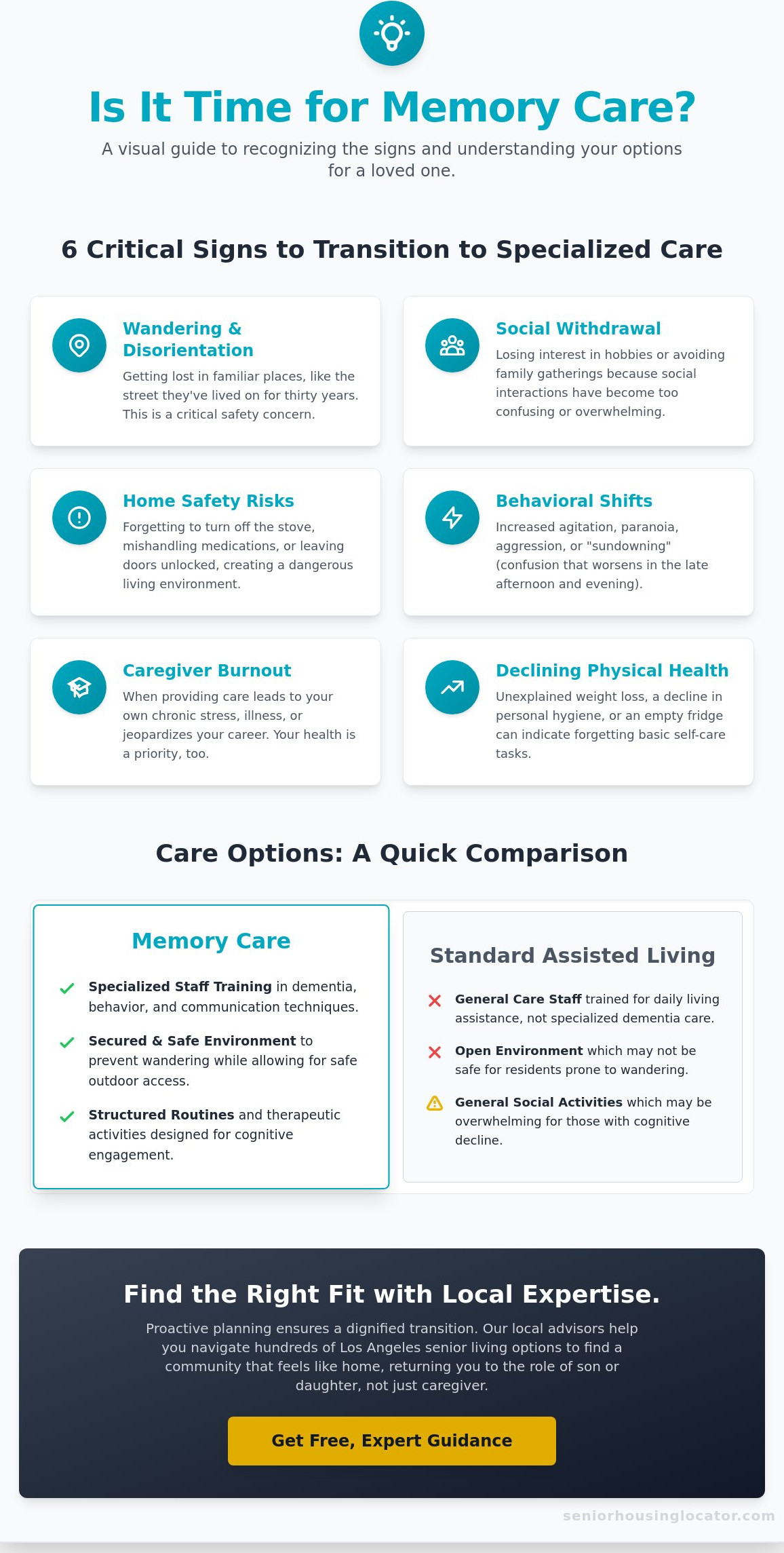
The primary difference between these two care levels lies in staff expertise and environmental safety. Staff in memory care receive specific training in behavioral management, communication techniques, and sensory engagement. The physical environment is also unique. Most communities feature a “secured perimeter” to prevent wandering while still allowing for safe outdoor access. For a detailed breakdown of these differences, you can view our memory care vs assisted living 2026 comparison guide.
The Emotional Weight of the Decision
It’s common to feel deep guilt over a promise to keep a parent at home. However, that promise was likely made when their medical and safety needs were manageable. As dementia progresses, “home” might no longer be the best place for them to receive the stimulation they need. Try to shift your perspective. You aren’t moving them out of their life; you are moving them toward a higher quality of care. When you consider when to move parent to memory care, remember that the goal is to return to being a daughter or son again, rather than a full-time medical manager.
6 Critical Signs It’s Time to Transition to Specialized Care
Identifying the exact moment to transition a loved one can feel like trying to hit a moving target. You might wonder if a bad day is just a temporary setback or a sign of something more permanent. Understanding when to move parent to memory care requires looking past occasional forgetfulness and focusing on patterns of safety and well-being. If you notice these six indicators, it may be time to consider professional support.
- Wandering and Disorientation: This is often the most frightening sign. It isn’t just about getting lost in a new city; it’s about your parent losing their way on the street where they’ve lived for thirty years.
- Declining Physical Health: Keep an eye out for unexplained weight loss or a sudden decline in hygiene. If the fridge is empty or clothes aren’t being washed, they may be forgetting how to perform these basic tasks.
- Behavioral Shifts: Many families notice increased aggression, paranoia, or “sundowning,” where confusion and agitation peak as the sun goes down.
- Home Safety Risks: Hazards like leaving the stove on, forgetting to lock the front door, or mishandling life-saving medications create a dangerous environment.
- Caregiver Burnout: Your health matters too. If providing care is causing you chronic stress, illness, or threatening your career, the current situation is no longer sustainable.
- Social Withdrawal: If a parent stops attending family gatherings or loses interest in hobbies, it often signals that they find social interaction too confusing to manage.
If these signs feel familiar, reaching out for a professional memory care placement assessment can help you determine the safest path forward for your family.
The “Activities of Daily Living” (ADLs) Test
Healthcare professionals use six basic “Activities of Daily Living” to measure independence: eating, bathing, dressing, toileting, transferring (moving from a bed to a chair), and continence. If your parent needs help with three or more of these, home care often becomes insufficient. You should also watch “Instrumental ADLs,” which include managing finances, grocery shopping, and using a phone. When these complex tasks fall by the wayside, it’s a clear signal that cognitive decline is progressing. The Alzheimer’s Association notes that residential care becomes a vital option when these daily needs exceed what a family can provide at home.
Social Isolation and Cognitive Decline
Sitting in front of a television for hours might seem peaceful, but it can actually accelerate the progression of dementia. Without active engagement, the brain loses the stimulation it needs to maintain function. Specialized memory care communities provide structured social programs designed to meet residents where they are. Starting in 2026, California D-SNP plans even require dyadic care plans that integrate the caregiver’s needs into the process, acknowledging that social health is a family affair. Choosing a setting with specialized cognitive stimulation ensures your parent isn’t just “safe,” but truly engaged with the world around them.
Evaluating Care Options in Los Angeles: Memory Care vs. Alternatives
Families in Los Angeles have access to a wide variety of care settings, but this abundance can sometimes lead to “decision paralysis.” Choosing between a large, resort-style community and a small, residential home depends entirely on your parent’s personality and the stage of their diagnosis. Understanding when to move parent to memory care is the first step; the second step is matching their specific needs to the right environment in the San Fernando Valley.
Large memory care communities often offer extensive amenities, such as secure walking paths, specialized dining programs, and structured daily social events. These are excellent for seniors who were very social throughout their lives and enjoy being around many peers. However, for those who become easily overstimulated by noise or large groups, these environments can sometimes feel overwhelming. In these cases, board and care homes Woodland Hills offer a much smaller, quieter scale. These are typical residential houses converted into care facilities, usually limited to just six residents. This 6-bed ratio ensures your parent receives highly personalized attention in a setting that feels like a real home.
While many families start with senior home care, it can become difficult to manage as dementia progresses. In-home care provides one-on-one attention, but it may lack the specialized security features and consistent peer interaction found in a residential community. Additionally, the cost of 24/7 in-home care in Los Angeles often exceeds the monthly rate of a dedicated memory care facility. Analyzing the cost-benefit of each option requires looking at both the financial impact and the quality of life for your parent.
The Board and Care Advantage in Southern California
A smaller, residential setting can significantly reduce anxiety for dementia patients who struggle with the “institutional” feel of larger facilities. Local Los Angeles board and care homes often boast higher staff-to-resident ratios, sometimes as close as 1:3. This allows caregivers to learn your parent’s specific quirks, such as how they like their coffee or what music calms them down. The homelike atmosphere eases the transition from a long-term family residence, making the change feel less like a “move” and more like a relocation to a supportive neighbor’s house.
When Skilled Nursing is Necessary
It’s vital to differentiate between cognitive needs and complex medical needs. Memory care focuses on safety and engagement for those with dementia. However, if your parent requires advanced medical intervention, such as wound care, feeding tubes, or constant monitoring of a terminal illness, a skilled nursing facility may be necessary. Memory care is often a better social fit than a clinical nursing home, but safety must always come first. If you’re unsure which level is appropriate, a professional care assessment can help determine if 24/7 medical supervision is required.
How to Plan a Smooth Transition to a Memory Care Community
Once you decide when to move parent to memory care, the focus shifts to logistics. A successful move isn’t just about picking a building; it’s about managing a major life change with grace. Start by conducting a professional care assessment. Under the 2026 updates to California Title 22 regulations, facilities must now conduct resident reappraisals at least every 12 months, or whenever a significant change in condition occurs. Getting an accurate baseline of your parent’s physical and cognitive status ensures you choose a community capable of meeting their specific needs from day one.
Next, you should tour local facilities in Woodland Hills, Encino, or Sherman Oaks. Visit at different times of the day, such as during a meal or an afternoon activity. This allows you to see the community in various states of energy. When you select a place, help your parent downsize with dignity. Focus on creating a “memory nook” in their new room by bringing a favorite armchair, family photos, or a familiar bedspread. These small touches provide a sense of continuity that reduces “transfer trauma” during those first few nights.
The actual move day requires a thoughtful strategy. Many families find success with a “therapeutic fib” or a simple distraction to ease the anxiety of leaving home. Once they’ve arrived, allow for an adjustment period of 30 to 60 days. It takes time for the brain to rewire itself to a new routine and for the staff to learn your parent’s unique personality. If you feel overwhelmed by these steps, you can get expert help with memory care placement to streamline the entire process.
What to Look for During Your Tour
Pay close attention to the physical layout and the atmosphere. Look for “circular hallways” that allow residents to wander safely without hitting frustrating dead ends. Observe the staff carefully. Are they actively engaging with residents, or are they simply monitoring them from a distance? Finally, trust your senses. A quality facility should feel like a clean, well-cared-for home rather than a clinical hospital. The smell and the lighting play a huge role in how comfortable your parent will feel.
Communicating the Move to Your Parent
Talking about the move is often the hardest part. The “Doctor’s Orders” approach is frequently effective because it shifts the perceived “blame” from the family to a medical professional. Keep your explanations simple. Focus on the positive aspects, like the “new club” atmosphere or the resort-style dining. If family tensions are high, involving a senior living advisor Los Angeles can help mediate conflicts. An objective third party often provides the calm perspective needed to keep the conversation productive and focused on your parent’s safety.
Finding the Right Fit in the San Fernando Valley with Local Expertise
Navigating the senior living market in Greater Los Angeles is a massive undertaking. There are over 533,000 residents aged 65 and older in Los Angeles County, and the number of care options has grown to match that demand. Knowing when to move parent to memory care is only half the battle; the other half is finding a place that actually feels right. National referral sites often rely on broad databases that miss the nuances of local San Fernando Valley board and care homes. They might not know if a facility in Northridge recently changed management or if an Encino community has an exceptionally warm activities director.
Local experts who specialize in assisted living placement Woodland Hills can help you filter these choices by budget, care level, and personality. We know the “unspoken” reputation of facilities in the area because we visit them regularly. We understand that a community’s atmosphere is just as important as its clinical rating. This local insight allows us to find “hidden gem” facilities that don’t always appear on major national portals, ensuring your parent receives the best possible match. For families who want a deeper look at the local landscape, our guide to memory care placement San Fernando Valley walks through how to identify a truly safe and licensed environment that fits your family’s unique needs.
Local Neighborhood Expertise: From Burbank to Santa Monica
Location is a primary factor in maintaining family connections. We help you match a facility to your daily commute, whether you live in Burbank or work in Santa Monica. Easier visiting schedules lead to better outcomes for residents and less stress for you. We also understand the local price variations across the valley. A memory care community in Encino may have a different cost structure than one in Northridge. By knowing these local market trends, we help you find a high-quality setting that respects your family’s financial boundaries. To compare vetted options side by side, our guide to the top memory care communities San Fernando Valley has to offer provides 2026 local rankings that account for neighborhood differences, updated state regulations, and real family feedback.
How Senior Housing Locator Simplifies the Search
We’ve designed a simple, three-step referral process to remove the burden from your shoulders. First, we conduct a deep-dive consultation to understand your parent’s medical needs and social preferences. Second, we provide a curated list of vetted options that meet those specific criteria. Finally, we help you coordinate tours and ask the right questions. Our service is 100% free for families. We’re here to act as your trusted local ally, ensuring you never feel alone in this journey. If you’re ready to explore your options, schedule a local consultation with us today to review your parent’s specific needs and find the perfect community.
Taking Your Next Steps Toward Peace of Mind
Deciding when to move parent to memory care is one of the most selfless acts of love you can perform. By focusing on the critical safety signs and understanding the unique benefits of local San Fernando Valley board and care homes, you’re prioritizing your parent’s quality of life. You’ve learned how to spot the threshold of need and how to plan a transition that honors their dignity. Now, you can move forward with the clarity that you’re doing what’s best for their long-term health.
You don’t have to navigate the hundreds of Los Angeles facilities alone. Our team provides a free, personalized service for LA families, offering expert knowledge of local board and care homes and larger communities. We pride ourselves on compassionate, integrity-driven placement that puts your family’s needs first. We’ve done the hard work of vetting local options so you can focus on being a supportive daughter or son again.
Better days are ahead for both you and your loved one. With the right support, this new chapter can be one of security, engagement, and renewed connection.
Frequently Asked Questions
What is the difference between dementia care and memory care?
Dementia care is the specialized support and medical attention provided to those with memory loss, while memory care is the actual residential setting designed to deliver that support. You can receive dementia care in various environments, including through senior home care. However, memory care communities provide a secured, 24/7 environment specifically built to prevent wandering and provide structured cognitive engagement.
Can I move my parent to memory care if they refuse to go?
Yes, you can move a parent who refuses to go if you have the legal authority through a Power of Attorney or if a medical professional determines it’s a safety necessity. Many families find success by shifting the focus away from “moving” and toward the social benefits of the new community. Using a “therapeutic fib” or focusing on the “resort” aspects can often help lower their resistance and anxiety.
How much does memory care cost in Los Angeles for 2026?
Memory care costs in Los Angeles depend heavily on the specific neighborhood and the level of personalized care your parent needs. Rates in the San Fernando Valley often differ from those in coastal areas like Santa Monica. When planning your budget, it’s important to account for annual rate increases, which typically range between 3% and 8% across California facilities.
Does Medicare pay for memory care facilities in California?
Medicare generally does not cover the long-term room and board costs associated with memory care facilities in California. It’s primarily designed to cover medical expenses, such as doctor visits, medications, and short-term rehabilitation. Families usually rely on private funds, long-term care insurance, or specific Medi-Cal programs to cover the monthly residential fees of a memory care community.
What happens if my parent outlives their money in memory care?
If a parent runs out of funds, they may need to transition to a facility that accepts Medi-Cal. For 2026, the asset limit for an individual to qualify for Medi-Cal’s nursing home coverage is $130,000. It’s vital to discuss “spend-down” options with a facility early on to see if they offer a path to stay in the community once private funds are exhausted.
Is a board and care home better than a large memory care community?
The best choice depends on your parent’s personality and the specific stage of their cognitive decline. Board and care homes offer an intimate, 6-bed ratio that’s often less overwhelming for those with high anxiety. Larger communities provide more extensive social calendars and amenities. Deciding when to move parent to memory care involves matching these settings to your parent’s unique social needs.
How do I know if the facility is safe and well-staffed?
You can verify safety by checking the facility’s compliance with California Title 22 regulations and asking to see their recent staffing logs. As of 2026, RCFEs are required to document an annual medical visit for every resident. This mandate ensures that the staff and medical professionals are consistently monitoring your parent’s health and adjusting their care plan as their needs change.
What should I pack for my parent when they move to memory care?
Focus on packing items that provide comfort and trigger positive memories, such as family photo albums, a favorite quilt, or a familiar lamp. You don’t need to bring a full house of furniture; in fact, too much clutter can be a fall hazard. Creating a “memory nook” with a few cherished pieces helps ease the transition and makes the new space feel like home immediately.