
What if the most loving choice you can make isn’t about finding more help, but about finding a different kind of security? You’ve likely spent your evenings worrying about a stove left on, a door left unlocked, or the heavy toll of caregiver burnout. It’s a high-stress journey, and it’s completely normal to feel overwhelmed by the complex options in California’s senior living landscape.
Deciding between memory care vs assisted living is often a transition from needing physical support to requiring cognitive protection. We understand that you want more than just a facility; you want peace of mind and a sense of order for your loved one. This 2026 guide will give you the clarity you need to make a confident, compassionate decision without the guesswork.
We’ll walk you through the essential differences in care levels, explain how new California RCFE regulations impact your search, and help you determine which setting offers the best environment for your family to thrive again.
Key Takeaways
- Discover the core differences between a social model focused on daily physical help and a medical model designed for cognitive security.
- See how secure floor plans and specialized staff training provide a safety net that standard senior living environments cannot match.
- Learn to recognize the critical signs, such as wandering or caregiver burnout, that signal a need for specialized memory support.
- Explore local housing alternatives in the San Fernando Valley, from large communities to intimate residential board and care homes.
- Understand how a local advisor helps you make the memory care vs assisted living decision with firsthand knowledge of communities in Woodland Hills and Northridge.
Understanding the Basics: What is Memory Care vs. Assisted Living?
Choosing the right path for a family member is a deeply personal task. It often starts with a simple question: How much help does my loved one actually need? When we compare memory care vs assisted living, we are looking at two distinct philosophies of care. Both options aim to improve quality of life, but they do so by addressing very different challenges. Understanding these nuances helps you move from a place of uncertainty to a place of confidence.
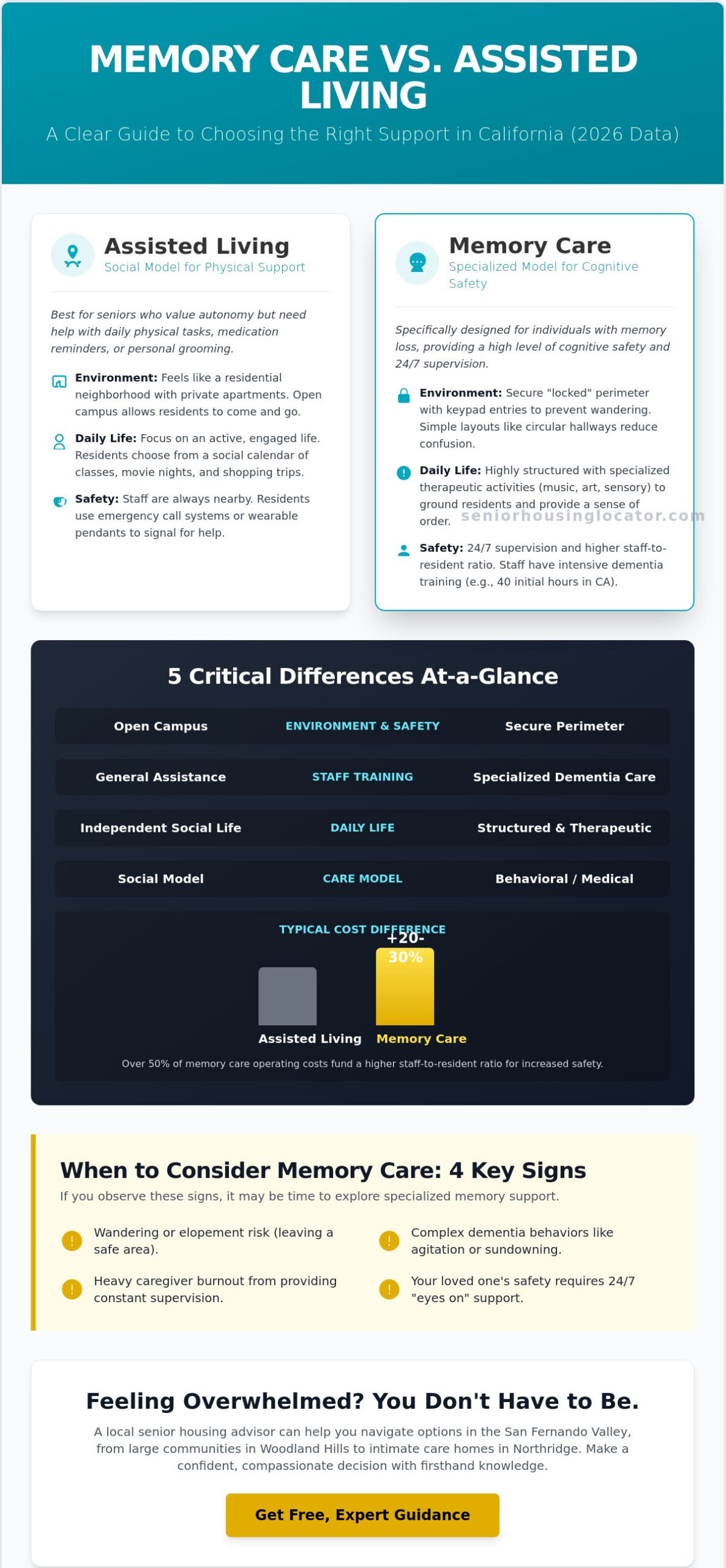
Assisted living serves as a bridge for seniors who value their autonomy but struggle with certain physical tasks. It’s a social model where the focus remains on living an active, engaged life. Conversely, memory care is a specialized behavioral model. It’s specifically designed to provide a high level of cognitive safety for those with memory loss. While the settings look different, they both aim to remove the stress of home maintenance and isolation.
While their goals differ, these two care levels share several core services that form the foundation of senior support. Residents in both types of communities enjoy:
- Nutritious Meals: Chef-prepared dining that meets specific dietary needs.
- Housekeeping: Regular linen changes and laundry services to keep life simple.
- Daily Assistance: Help with “Activities of Daily Living,” such as dressing, bathing, and mobility support.
The primary difference is the balance between independence and security. Assisted living maximizes a resident’s freedom, allowing them to come and go as they please. Memory care provides a protective environment that manages the unique risks of dementia, ensuring that safety is never compromised for the sake of convenience.
What to Expect in Assisted Living
In an assisted living community, your loved one typically lives in a private or semi-private apartment that feels like a real home. The atmosphere is vibrant and residential, designed to feel like a neighborhood. Residents can join group exercise classes, attend movie nights, or go on scheduled shopping trips. Staff members are always nearby to help with medication reminders or personal grooming, but they step back to let the resident lead their own day. It’s the ideal choice for someone who needs a helping hand with the physical side of aging but still wants to make their own choices and maintain a busy social calendar.
What to Expect in Memory Care
Memory care is different because it offers 24/7 supervision in a secure setting. This is vital for residents who might experience elopement, which is a clinical term for wandering away from safety. The physical layout is often simpler, using circular hallways to prevent confusion and dead ends. Staff members undergo intensive training to manage complex dementia behaviors like agitation or sundowning. In California, this includes an initial 40 hours of training, with 12 hours dedicated specifically to dementia care. Daily life is highly structured, featuring specialized activities like music, art, or sensory therapy. These programs help ground residents in the present moment and provide a much-needed sense of order in their daily lives.
5 Critical Differences: Safety, Training, and Daily Life
While both environments provide a sense of community, the operational reality of memory care vs assisted living varies significantly. If you’re currently evaluating what to look for in assisted living, you’ll notice a focus on hospitality and social freedom. In contrast, memory care is built around the specific needs of those with cognitive decline. These differences ensure that every resident receives the right level of “eyes on” support for their specific situation.
Staffing is the primary reason for the cost premium in memory care. According to industry data from 2026, memory care typically costs 20% to 30% more than assisted living. This isn’t just for the room; it’s because more than 50% of operating costs in high-quality memory care go directly toward maintaining a higher staff-to-resident ratio. This ensures that help is always seconds away, providing the security that families need for their peace of mind.
Safety Features and Environment
The physical environment is the most visible difference. Assisted living communities often feature open campuses with multiple exits and beautiful outdoor spaces. Residents use emergency call systems or wearable pendants to signal for help. Memory care units use a “secure” or locked perimeter with keypad entries and obscured exits. This design isn’t about restriction. It’s about prevention. Circular floor plans allow residents to walk freely without hitting frustrating dead ends. This specific layout, combined with soft lighting, helps reduce the agitation often associated with “sundowning” in the late afternoon.
Specialized Staff Training
In California, staff training is rigorous. Employees at facilities with dementia residents must complete 40 hours of initial training, including 12 hours focused specifically on dementia care. Beyond the basics, memory care teams use specialized techniques like validation therapy. This approach meets the resident in their current reality rather than correcting them, which lowers stress levels. If you aren’t sure which level of support matches your parent’s current needs, speaking with a placement specialist can help clarify the best path forward.
Daily life also follows a different rhythm. Assisted living residents enjoy a flexible schedule with various social outings and community events. Memory care relies on a highly structured routine. Predictability is a form of medicine for memory loss. By keeping meal times, activities, and rest periods consistent, communities help residents feel safe and grounded. This structure moves the resident from a state of confusion toward a state of calm order.
When is it Time? Signs Your Loved One Needs Memory Care
Recognizing the right time for a move is often the hardest part of the caregiving journey. It’s common to feel a mix of guilt and uncertainty as you watch a parent struggle. You might wonder if you are overreacting or if things are “bad enough” to justify a change. When evaluating memory care vs assisted living, the deciding factor is often the presence of functional impairment rather than just physical frailty. We are here to help you spot these signs before a crisis occurs.
A single instance of a loved one leaving the house and losing their way is a life-threatening emergency. This “wandering risk” is one of the most urgent signals that a standard environment is no longer safe. Beyond physical safety, your own well being matters too. Caregiver burnout isn’t a sign of weakness. It’s a signal that the level of care required has exceeded what one person can safely provide at home. You might also notice sudden aggression, unfounded paranoia, or a deep social withdrawal that wasn’t there before. These behavioral changes are difficult to manage without professional training. If you are wrestling with the difficult question of when to move a parent to memory care, understanding these warning signs is the first step toward making a confident, compassionate decision.
Nutritional decline is another quiet red flag. It’s common to find expired food in the fridge or realize a parent is simply forgetting how to use the microwave. Choosing a specialized community isn’t about giving up. It’s an act of love that prioritizes their safety and restores your role as a family member rather than just a 24-hour monitor. It allows you to focus on quality time while experts handle the complex daily needs.
The Safety Checklist for Families
If you’re unsure, ask yourself these three questions. First, are they leaving the stove on or forgetting to lock doors at night? Second, have there been recent falls or unexplained bruises that they can’t account for? Third, are they getting lost in familiar places around Woodland Hills? If you answer “yes” to any of these, it’s time to explore a more secure setting. These small lapses can quickly lead to major accidents in an unsecured home.
Assessing Cognitive Needs
It’s important to distinguish between normal age-related forgetfulness and functional impairment. Forgetting where the keys are is one thing; forgetting what the keys are used for is another. The point of transition occurs when a loved one’s need for a secure, supervised environment outweighs their need for simple physical assistance. When you have the “I don’t want to go” conversation, lead with empathy. Focus on the benefits of the new community, like new friends and better meals, rather than the things they are “losing.” This approach keeps the focus on their comfort and dignity.
Navigating Senior Living Options in the San Fernando Valley
Finding the right home for a loved one in the San Fernando Valley requires a local perspective. Our corner of Los Angeles offers a unique variety of choices that go beyond the massive complexes you might see from the 101 freeway. When families weigh the choice of memory care vs assisted living in neighborhoods like Encino or Sherman Oaks, they often discover a specific local alternative: the Board and Care home. These residential settings provide a different atmosphere than the larger, resort-style communities found in the more developed parts of the Valley.
Families in Sherman Oaks often prefer large facilities because of the robust social calendars and extensive amenities. However, if your loved one feels overwhelmed by crowds or loud dining rooms, a smaller residential home might be the better fit. Making this choice is about balancing social needs with personal comfort. For those specifically looking at the western end of the Valley, our Assisted Living Placement in Woodland Hills guide provides a deeper look at the options available in that specific community.
Board and Care vs. Assisted Living
The San Fernando Valley is famous for its 6-bed residential care model. These are traditional houses in quiet neighborhoods like Northridge or Granada Hills that have been converted to care for seniors. Because the staff-to-resident ratio is often one caregiver for every three residents, the level of attention is incredibly high. While they lack the movie theaters of big facilities, they offer a “memory care-lite” environment. The smaller footprint is naturally easier to navigate, which can significantly reduce the anxiety and confusion often felt by those with early-stage dementia.
Local Los Angeles Considerations
Proximity to medical care is a top priority for most families. Choosing a home near West Hills Hospital or Northridge Hospital ensures that help is close during an emergency. Beyond medical needs, you must consider the “Valley traffic” factor. A facility might look close on a map, but if it takes an hour to reach from your home in Burbank, regular visits will become a burden. We always recommend touring communities during the times you actually plan to visit. This gives you a realistic view of the commute and the daily atmosphere your loved one will experience.
If you feel overwhelmed by the hundreds of licensed homes in our area, you don’t have to search alone. You can request a personalized local consultation to narrow down the best options for your family’s specific needs and neighborhood preferences.
Finding the Right Fit with a Local Senior Housing Advisor
The journey to find the right care setting is often filled with long nights and heavy hearts. By now, you understand the core differences in memory care vs assisted living, but the sheer number of options in Los Angeles can still feel like a maze. You aren’t just looking for a room; you’re looking for a community where your loved one will be safe, respected, and truly seen. This is where a neighborly hand makes all the difference in moving from confusion to a clear resolution.
Many families start their search by calling national 1-800 numbers, only to find themselves speaking with someone in a distant state who has never stepped foot inside a San Fernando Valley building. We take a different approach. A local ally offers “boots on the ground” knowledge of the communities in Woodland Hills and Burbank. We know which homes have stable leadership, which ones have the most engaging activities, and which ones truly excel at the specialized behavioral support required for memory loss.
Why Use a Local Placement Specialist?
A local specialist does more than just provide a list of addresses. We stay updated on the most recent state inspections and the quiet reputations that only locals know. When you tour a facility, it’s easy to be impressed by a beautiful lobby or a modern dining room. We help you look past the decor to ask the tough questions about staffing ratios, caregiver longevity, and resident satisfaction. Partnering with a Senior Living Advisor Los Angeles ensures that you have an expert advocate who knows the local landscape inside and out.
Taking the Next Step with Confidence
At Senior Housing Locator, we believe that families should never have to pay for the guidance they need during a crisis. Our placement service is provided at no cost to you, allowing you to focus your resources on your loved one’s care. We handle the heavy lifting by pre-screening options, scheduling your tours, and guiding you through the final paperwork. Our process is designed to be simple and methodical:
- Listen: We learn about your loved one’s unique needs, personality, and budget.
- Match: We identify a curated selection of homes that meet those specific criteria.
- Support: We walk beside you through every tour and transition until your loved one is settled.
The emotional relief of having an expert handle these logistics is immense. It allows you to stop being a stressed researcher and start being a supportive daughter, son, or spouse again. You’ve done the hard work of recognizing that help is needed. Now, let a trusted local ally help you find the best place for the next chapter of your family’s story. You don’t have to do this alone.
Take the Next Step for Your Family’s Peace of Mind
Choosing the right care environment is a powerful act of love. It marks the transition from daily worry to a future of professional support and cognitive security. By exploring the differences in memory care vs assisted living, you’ve gained the clarity needed to prioritize your loved one’s safety. You now understand which signs indicate a need for specialized care and how local options can meet those needs.
Finding the right community doesn’t have to be an overwhelming task. At Senior Housing Locator, we provide a free placement service for families. Our local experts have physically toured facilities across the San Fernando Valley to provide compassionate, integrity-driven guidance. We’ve done the research so you can focus on being a family again.
Contact our local Woodland Hills advisors for a free consultation today. You’ve carried this burden long enough; let a trusted local ally help you find the way home.
Frequently Asked Questions
Does Medicare pay for assisted living or memory care in California?
Medicare doesn’t pay for the room and board costs of assisted living or memory care. It’s designed to cover clinical medical expenses, hospital stays, and short-term rehabilitation. In California, families typically use private funds or Medi-Cal to cover residential costs. The individual asset limit for Medi-Cal coverage in 2026 is $130,000. Some residents may access the Assisted Living Waiver, but these spots are limited and depend on the specific facility’s participation.
How much more expensive is memory care than assisted living in Los Angeles?
Memory care is usually 20% to 30% more expensive than standard assisted living in Los Angeles. This premium covers higher staffing ratios and specialized dementia training for the team. High-quality communities spend over 50% of their operating budget directly on staffing. Costs in the San Fernando Valley reflect local labor and real estate rates, making professional guidance helpful for families planning their long-term budgets.
Can a person with dementia live in an assisted living facility?
Yes, someone with dementia can live in assisted living during the early stages of the disease. New 2026 California regulations require dementia care standards to be implemented facility-wide, providing a baseline of support for everyone. A move to a secured unit is necessary when the resident begins to wander or needs 24/7 supervision. The decision depends on whether they need physical assistance or cognitive security.
What is the difference between memory care and a nursing home?
Memory care is a residential model for cognitive safety, while a nursing home provides 24/7 clinical medical care. Nursing homes are for those with complex health needs or those recovering from surgery. Memory care focuses on social engagement and managing dementia behaviors in a home-like setting. It’s a choice between medical stability and specialized behavioral support.
Is memory care always in a locked unit?
Memory care units are secured to prevent wandering, but they shouldn’t feel like a locked ward. Designers use keypad entries and circular hallways to allow for safe, continuous movement. This specific layout prevents the frustration of dead ends. It provides a secure perimeter while encouraging residents to explore their environment with dignity and independence.
How do I know if my parent needs a Board and Care home instead?
A Board and Care home is ideal if your parent prefers a quiet, residential neighborhood. These are 6-bed houses in areas like Northridge or Encino. They offer a high staff-to-resident ratio, often one caregiver for every three seniors. It’s a great “memory care-lite” option for those who find large, resort-style buildings overwhelming.
What happens if my parent outlives their funds in assisted living?
Facility policies vary when a resident runs out of private funds. Some communities accept Medi-Cal or have spend-down programs, while others are strictly private pay. You might need to move to a more affordable Board and Care home or a facility with different licensing. Always ask about financial transitions and “aging in place” policies before signing a residency agreement.
Can I move my parent from assisted living to memory care in the same building?
Many Los Angeles communities offer multiple levels of care on the same campus. This makes the move from memory care vs assisted living much smoother for the resident. They stay in a familiar building with known staff while gaining the security they need. It reduces transfer trauma and keeps your loved one in a comfortable, stable environment during a difficult transition.