
Last Tuesday, Sarah spent four hours managing three different caregiver schedules while worrying if her father was eating enough at his home in the San Fernando Valley. You’ve likely felt that same exhaustion, wondering if you’re doing the right thing by keeping a parent at home or if a move would be better. It’s a heavy burden, especially when you’re trying to balance the high costs of Southern California care with the deep desire to honor their wishes. Choosing between in-home care vs assisted living isn’t just about a change of address; it’s about finding where your loved one will truly thrive.
We understand the guilt and anxiety that come with these big life transitions. This guide will give you the clarity you need to make a confident decision for 2026. We’ll help you understand the real “tipping point” where one option becomes more practical than the other, both financially and for your parent’s safety. You’ll gain a clear roadmap for evaluating care levels, new California transparency laws, and social benefits in Los Angeles. Our goal is to ensure you can move forward with total peace of mind and a plan that works for your whole family.
Key Takeaways
- Understand the core differences between in-home care vs assisted living and how to identify the “tipping point” where costs and safety needs shift.
- Discover why the hidden risks of staying home, such as social isolation or fall hazards, often outweigh the comfort of a familiar environment.
- Learn how to compare the variable hourly rates of home care against the predictable, all-inclusive monthly models of communities in the San Fernando Valley.
- Identify five critical warning signs, including poor nutrition and medication errors, that suggest your loved one may need a higher level of residential support.
- Simplify your search with a free placement service that uses local expertise in Woodland Hills and Encino to find the perfect match for your family.
In-Home Care vs. Assisted Living: Senior Care Options
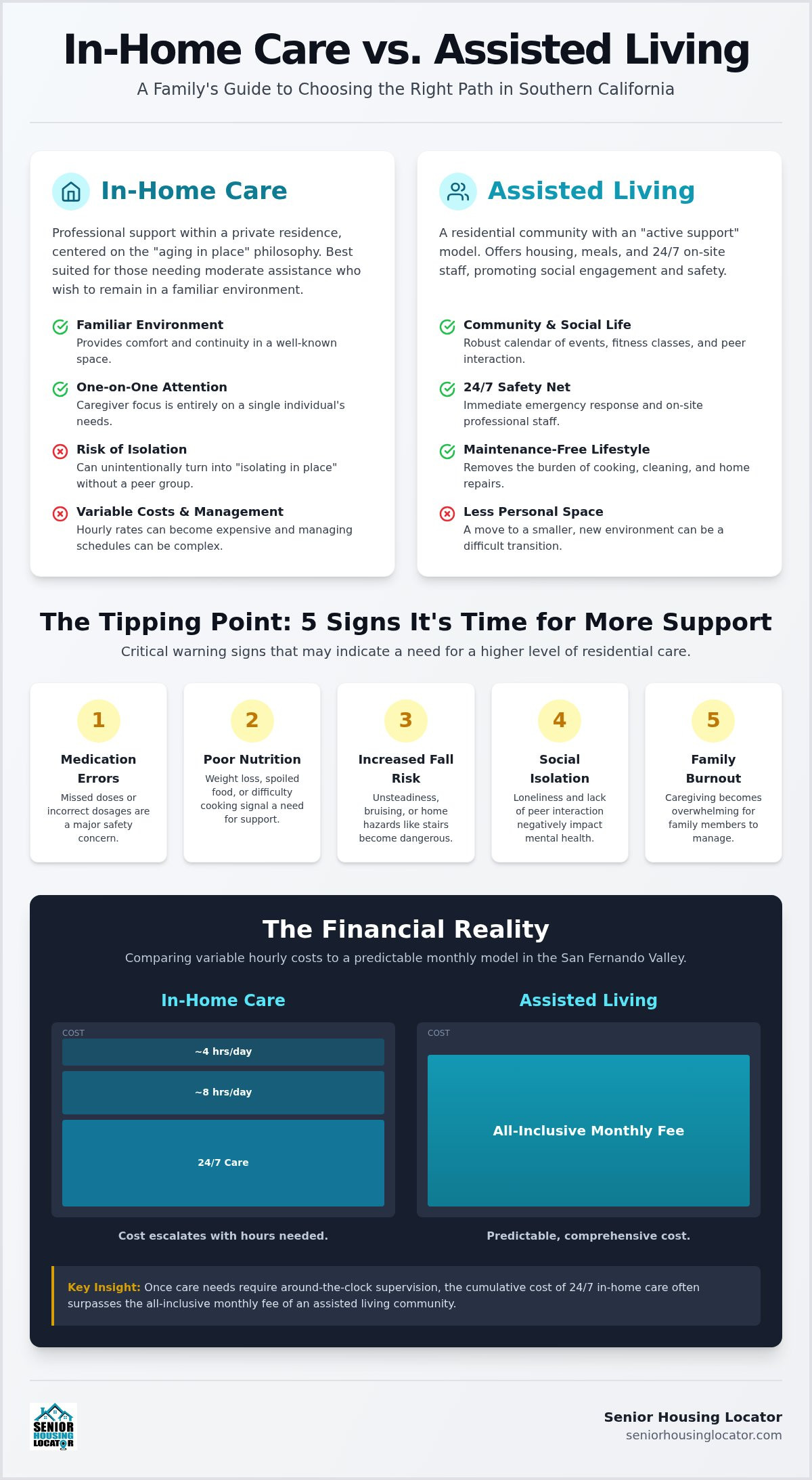
Choosing between in-home care vs assisted living starts with a clear understanding of how each service functions day-to-day. In-home care is professional support provided directly within your parent’s private residence. It is designed to help with daily tasks while allowing them to stay in their own space. Assisted living is a residential community that offers housing, shared meals, and 24/7 care from on-site staff.
Both options share a common goal: improving your loved one’s quality of life. However, they use very different operational models to get there. To help you evaluate which path is best, we recommend using our Rule of Three framework:
- Care Needs: How much physical assistance does your parent require with bathing, dressing, or medication management?
- Social Needs: Does your loved one have enough daily interaction to prevent loneliness and depression?
- Budgetary Needs: Which model provides the most sustainable value for your family’s long-term finances?
The ‘Aging in Place’ Philosophy
Many families in Los Angeles prioritize “aging in place” because of the deep emotional value attached to a family home. Staying in a familiar environment can provide a sense of security and continuity that is hard to replicate. However, this model has its limits. If medical or safety needs increase suddenly, home care schedules can become difficult to manage. We often see situations where “aging in place” unintentionally turns into “isolating in place.” When a senior’s mobility declines, the four walls of their home can start to feel like a barrier to the outside world, especially in a spread-out city like ours.
The Residential Community Model
Assisted living is built on a model of “active support.” It is not a clinical hospital setting; it is a social environment where help is always available but does not define the day. For families dealing with cognitive decline, a specialized memory care placement in San Fernando Valley offers a secure, engaging atmosphere that a private home often cannot match. These residential settings provide an immediate emergency response system. If a fall occurs at 2:00 AM, there is a trained professional just seconds away. This level of oversight provides a safety net that is often missing when a senior is alone between caregiver shifts.
Key Differences: Comparing Lifestyle, Safety, and Socialization
When you compare in-home care vs assisted living, the most immediate shift isn’t just the level of care; it’s the daily lifestyle. A senior living at home often follows a quiet, repetitive routine that can feel stagnant. They might spend long hours alone between caregiver visits or wait for a family member to help with basic needs. In contrast, a vibrant community offers a structured day filled with choice and movement. Assisted living removes the heavy physical and mental burden of home maintenance, grocery shopping, and meal preparation. Instead of managing a household, seniors can spend their energy on hobbies and connections that bring them joy.
Social Isolation vs. Community Engagement
Loneliness is a silent health crisis for seniors in a sprawling city like Los Angeles. It’s easy to become housebound when traffic and distance make visiting friends a major chore. While a home caregiver provides vital one-on-one companionship, they can’t provide a true peer social circle. Most local assisted living communities offer a robust calendar of events, including:
- Daily fitness classes and walking clubs tailored to different mobility levels.
- Creative workshops, book clubs, and garden groups.
- Scheduled outings to local Los Angeles landmarks and cultural events.
Regular peer interaction is a powerful tool for preventing cognitive decline and boosting emotional health. If you feel overwhelmed by the variety of choices, our team can help you find a community that matches your loved one’s specific personality and social preferences.
Safety and Medical Supervision
Safety is the primary reason most families begin this journey. Staying home involves “hidden” risks that are often overlooked until an accident happens. These include fall hazards like steep stairs, poor lighting, or high-sided bathtubs. There’s also the constant worry of medication errors when a senior is managing several different prescriptions alone. Assisted living provides 24/7 staff availability, which effectively closes the dangerous gaps found in shift-based home care. For those managing complex conditions like Parkinson’s or early-stage Alzheimer’s, this constant oversight provides vital protection. Acuity matching ensures your loved one receives the exact level of medical and personal support their specific condition requires to remain safe and stable.
The Financial Reality: Cost Comparison in Los Angeles and the San Fernando Valley
Understanding the financial landscape of senior care in Southern California is often the most stressful part of the decision process. In Los Angeles, you’re essentially choosing between two different financial models. In-home care operates on an hourly basis, where you pay only for the time a caregiver is physically present. Assisted living uses a monthly, all-inclusive model that covers housing, food, and support. Because of the high cost of labor and real estate in the San Fernando Valley, the gap between these two options can close much faster than families expect.
Most experts point to a “tipping point” when comparing in-home care vs assisted living. In 2026, if your loved one requires more than 20 to 30 hours of professional assistance per week, the monthly cost of a private caregiver often starts to exceed the cost of a residential community. For families in areas like Woodland Hills or Sherman Oaks, board and care homes often provide a middle-ground pricing option. These are smaller, residential homes that offer a more intimate setting and can be more budget-friendly than larger, luxury assisted living facilities.
Calculating the True Cost of In-Home Care
When you look at the price of home care, it’s easy to focus only on the caregiver’s hourly wage. However, the true cost includes much more. You must factor in agency fees, the rising cost of groceries, and ongoing home maintenance or modifications. There’s also a hidden financial risk in “caregiver burnout.” When family members step in to fill the gaps between professional shifts, it often leads to missed work or health issues for the adult children. For a deeper look at these variables, you can review our guide on Assisted Living Costs in Los Angeles.
What’s Included in Assisted Living Fees?
Assisted living fees are designed to simplify your life by bundling almost all living expenses into one monthly payment. This typically covers your rent, all utilities, three daily meals, and weekly housekeeping. Most communities also include basic care services and a full calendar of social events. It’s important to ask about “Level of Care” (LOC) add-ons, which are additional charges based on how much physical help a resident needs. When you evaluate the return on investment, consider the value of having professional 24/7 supervision and a built-in social network. These benefits often provide a level of safety and engagement that is difficult to recreate at home without spending significantly more.
Decision Framework: 5 Signs It’s Time to Consider Residential Placement
Deciding when to transition from home care to a community setting is rarely a single, sudden event. Usually, it’s a series of small “yellow flags” that eventually signal a need for more support. When you’re evaluating in-home care vs assisted living, it helps to look at the situation objectively. Are you seeing frequent falls or “near misses” that indicate the home is no longer safe? Is there unintentional weight loss or poor nutrition because cooking has become too difficult? Perhaps you’ve noticed social withdrawal or signs of depression in your loved one. These are clear indicators that the current environment may be working against their well-being.
You should also consider the health of the primary family caregiver. When a daughter or son reaches a state of total exhaustion, their own health begins to decline, creating a second crisis for the family. Finally, wandering or increased confusion related to cognitive decline requires a level of oversight that part-time home care simply cannot provide. If you’re seeing these signs, it’s time to explore a more structured environment where safety and socialization are built into the daily routine.
Assessing Your Loved One’s ADLs
Activities of Daily Living, or ADLs, are the basic tasks required for independent living. These include bathing, dressing, and “transferring,” which is the ability to move from a bed to a chair safely. When a senior requires more than 4-6 hours of daily assistance with these tasks, the logistics of home care often become overwhelming. A senior living advisor in Los Angeles can perform a professional needs assessment to help you determine if your parent’s needs have outpaced their current care plan.
The Safety Audit of the Home
A thorough safety audit often reveals why a private residence is no longer the best fit. Steep stairs, narrow doorways that won’t accommodate a walker, and slippery bathroom floors are major hazards for seniors. While home modifications are possible, the high cost of renovation in Southern California often makes moving to a purpose-built facility a more logical choice. For families who want a safer environment without the “big facility” feel, board and care homes in Woodland Hills provide a wonderful middle ground with high-acuity support in a traditional house setting.
If you’re feeling stuck or unsure of the next step, our team is here to help you navigate these choices with clarity and confidence. Reach out to Senior Housing Locator today to start your personalized search for a safer, more social future.
How Senior Housing Locator Simplifies Your Search in Los Angeles
Deciding between in-home care vs assisted living is a major milestone for any family. While the information we’ve covered helps you understand the “why” and “when,” the “how” can still feel overwhelming. You shouldn’t have to spend your weekends calling dozens of facilities or navigating confusing websites alone. Senior Housing Locator was built to take that weight off your shoulders by providing expert guidance at no cost to your family.
We operate on a “Free to Families” model. Our fees are covered by the communities, which allows us to focus entirely on your loved one’s well-being. We prioritize integrity over commissions, ensuring our recommendations are based on three key factors: medical needs, social preferences, and your specific budget. By offloading the research to a local expert who has personally vetted these homes, you can focus on being a supportive family member rather than a stressed-out researcher.
Your Trusted Local Ally in the San Fernando Valley
National call centers often rely on outdated spreadsheets and generic data. We believe “boots on the ground” knowledge is the only way to ensure a senior’s safety and happiness. Our team lives and works right here in the community, maintaining deep roots in Woodland Hills, Encino, and Sherman Oaks. We have spent years building personal relationships with local facility administrators across the wider San Fernando Valley. This local insight allows us to provide tailored options for assisted living placement in Woodland Hills that match your parent’s unique personality. We know which homes have the best staffing ratios, which ones offer the most engaging activities, and which ones have recently updated their facilities.
Starting Your Stress-Free Transition
Your journey with us begins with a simple, supportive conversation. During your free initial consultation, we listen to your worries and document your parent’s specific care requirements. We don’t just send you a list of addresses; we walk beside you through the entire process. This includes:
- Curating a shortlist of homes that meet your exact “Rule of Three” criteria.
- Scheduling and accompanying you on tours of the top communities.
- Asking the tough questions about care protocols, staffing turnover, and hidden fees.
We are there to act as your advocate, ensuring you have all the facts before signing any contract. Your family’s peace of mind is our primary mission. Whether you are in the early stages of comparing in-home care vs assisted living or you need to make a move immediately, we are here to provide the calm, expert guidance you deserve.
Your Next Step Toward Peace of Mind
Choosing between in-home care vs assisted living is a deeply personal decision that impacts your entire family’s well-being. We’ve explored how to spot the signs that it’s time for a change and how to evaluate the true costs in the Los Angeles market. Whether you’re looking for a small board and care home in Encino or a vibrant community in Woodland Hills, the right fit is out there. Our team of local specialists has personally vetted these communities to ensure they meet the highest standards of care. We provide a free placement and referral service for all LA families to take the research burden off your plate.
You’ve already done the heavy lifting by starting this research. Now, let’s work together to find a safe, social, and supportive environment where your loved one can truly thrive. You aren’t alone in this journey, and we’re ready to help you find clarity and confidence in every step of the transition.
Frequently Asked Questions
Which is cheaper: in-home care or assisted living in Los Angeles?
In-home care is usually the more affordable option if your loved one only needs a few hours of help each day for basic tasks. However, assisted living becomes the more cost-effective choice once they require more than 20 to 30 hours of weekly support. In Los Angeles, the cost of round-the-clock home care can quickly double the monthly rate of a residential community.
Is in-home care safer than assisted living for someone with dementia?
Assisted living, specifically memory care, is often safer because the environment is purpose-built to prevent wandering and common household accidents. While a private home is familiar, it often contains hazards like steep stairs and unsecured kitchens. Professional communities provide 24/7 oversight, ensuring there are no dangerous gaps in supervision during the night when confusion often increases.
Can I use Medicare to pay for in-home care or assisted living in California?
Medicare does not pay for long-term “custodial care,” which includes most in-home help or assisted living fees. It is strictly designed to cover short-term medical needs, such as physical therapy or nursing care after a hospital stay. Most families in California use private funds, long-term care insurance, or the Assisted Living Waiver program to cover these costs.
What happens if my parent’s care needs increase after they move to assisted living?
Most communities use a tiered system called “Levels of Care” to adjust support as your parent’s needs change. If they eventually require more help with bathing, dressing, or medication management, the facility updates their care plan and adjusts the monthly fee. This allows your loved one to stay in their new home without the stress of moving to a different facility.
How do I know if a board and care home is better than a large assisted living facility?
A board and care home is usually a better fit for seniors who prefer a quiet, intimate setting and need more hands-on attention. These are traditional houses in neighborhoods like Woodland Hills that typically care for six residents. Large facilities are better for seniors who are still very social and want access to fitness centers, movie theaters, and large group outings.
Is there a fee to work with a senior placement specialist at Senior Housing Locator?
There is never a fee for families to use our placement and referral services. Our costs are covered by the residential communities, which allows us to provide you with expert guidance at no charge. This model ensures you have a professional advocate to help you compare in-home care vs assisted living without adding any financial burden to your search.
How quickly can you help me find a care placement in an emergency situation?
We can often help you identify and move into a safe community within 24 to 48 hours. If you are facing a sudden hospital discharge or a primary caregiver crisis, we know exactly which local facilities have immediate availability. We handle the frantic research and phone calls so you can focus on being there for your family.
Do you provide referrals for in-home care agencies as well as residential facilities?
Yes, we provide referrals for both professional home care agencies and residential communities across the San Fernando Valley. Our primary goal is to help you find the right level of support, whether that happens in a private residence or a specialized community. We only refer to providers that have been vetted for quality, safety, and reliability.