
You’ve likely spent weeks rehearsing the words in your head, only to stay silent when the moment finally arrives. It’s hard to watch the people who raised you struggle with daily tasks, yet the fear of their rejection or the weight of your own guilt often keeps the conversation at bay. Learning how to talk to parents about assisted living isn’t about taking away their independence. Instead, it’s about finding a supportive path that restores their quality of life. You want them to be safe, healthy, and happy, but you also want to remain their child rather than their exhausted caregiver.
We understand that this is one of the most emotional journeys a family can take. This guide provides a clear, compassionate roadmap to help you handle these delicate discussions while preserving your parent’s dignity. You’ll learn how to prepare for the talk, how to explain the different care levels available in California, and how to reach a peaceful decision together. We are here to help you move from a state of uncertainty toward a solution that brings safety for them, improved wellness for the family, and much-needed peace of mind for you.
Key Takeaways
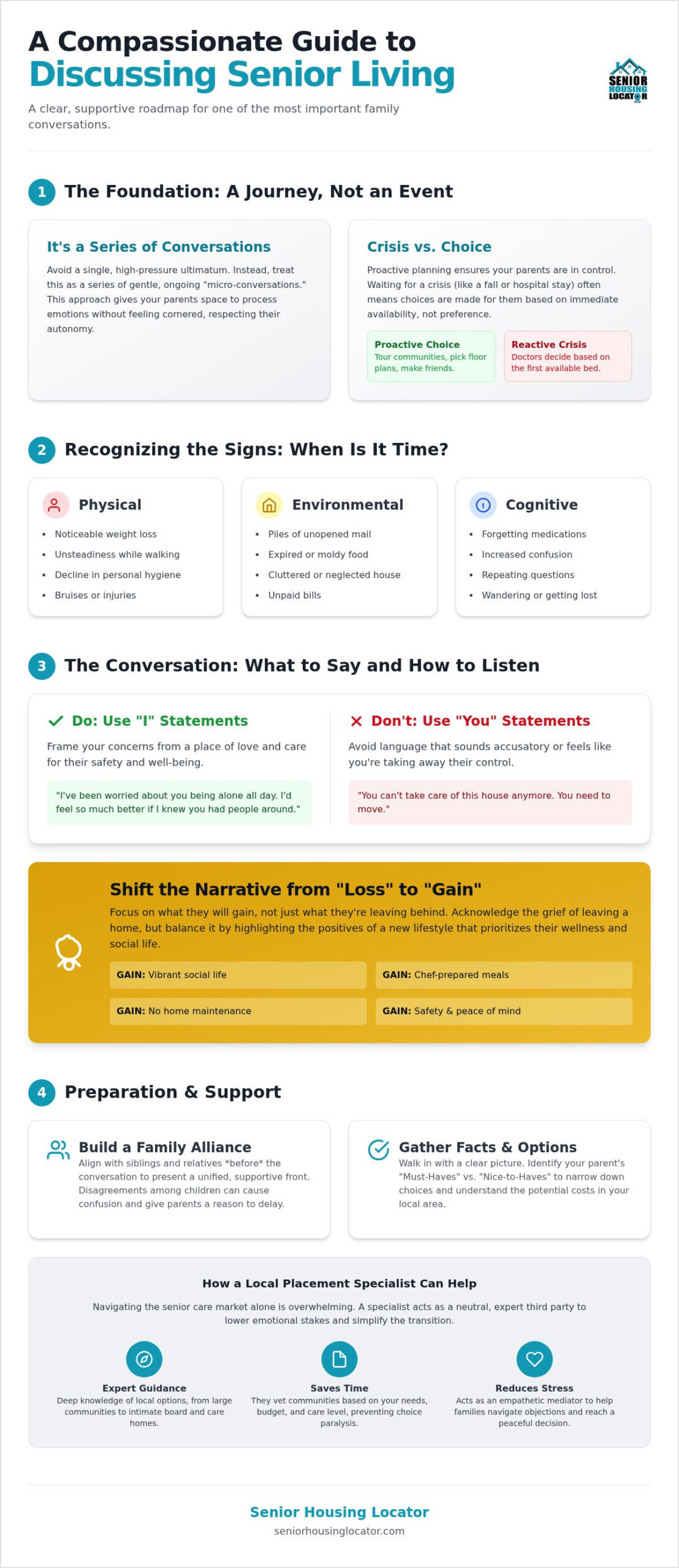
- Shift your mindset by viewing this as a series of gentle, ongoing conversations rather than a stressful, one-time ultimatum.
- Master how to talk to parents about assisted living by using “I” statements that focus on your love and concern for their safety.
- Ensure family harmony by aligning with siblings and relatives before starting the discussion to present a unified, supportive front.
- Navigate common objections with empathy by redefining what being “ready” for care looks like and focusing on the social benefits of community living.
- Learn how a local placement specialist acts as a neutral third party to lower the emotional stakes and simplify the transition.
The Foundation: Why the Senior Living Talk is a Journey, Not an Event
The “Assisted Living Talk” is often feared because we imagine it as a heavy, one-time confrontation. In reality, when you are figuring out how to talk to parents about assisted living, remember that the most successful families treat this as a collaborative series of micro-conversations. It’s a journey, not an event. When you approach the topic slowly, you give your parents space to process their emotions without feeling backed into a corner. Most resistance comes from a deep-seated fear of losing autonomy. To many seniors, their home represents their history and their identity. Moving feels like a surrender, but starting the dialogue early shifts the power back into their hands.
Understanding What is Assisted Living? helps frame the move as a proactive choice. We often see families wait until a crisis occurs, such as a fall or a sudden illness. This “Crisis vs. Choice” framework is vital. If you decide now, your parents can tour communities, pick their favorite floor plan, and make friends on their own terms. If you wait for an emergency hospital discharge, the choices are often made by doctors or social workers based on whatever bed is available that day. Proactive planning actually extends independence through restorative care. By removing the physical burdens of home maintenance and yard work, your parents can focus their energy on wellness and social connection.
Recognizing the Signs: When is it Time?
It can be difficult to know when the occasional slip-up becomes a pattern that requires more support. Look for these specific red flags in their daily life:
- Physical red flags: Noticeable weight loss, unsteadiness while walking, or a decline in personal hygiene.
- Environmental red flags: Piles of unopened mail, expired or moldy food in the kitchen, or a house that feels unusually cluttered or neglected.
- Cognitive red flags: Forgetting to take life-saving medications or showing increased confusion about dates and times. If these signs are accompanied by wandering or safety concerns, you might need to explore memory care placement San Fernando Valley for specialized support.
Shifting the Narrative from “Loss” to “Gain”
The secret to learning how to talk to parents about assisted living is changing what you highlight. Instead of focusing on what they are leaving behind, talk about what they will gain. This includes a vibrant social life, chef-prepared meals, and chauffeured transportation that removes the stress of driving in traffic. It’s okay to acknowledge the grief of leaving a long-term home; that feeling is real and valid. However, you can balance that grief by validating their future safety and comfort.
Assisted living is a lifestyle choice that prioritizes personal wellness over the burden of daily chores.
Preparation: Gathering Facts and Building Your Support Team
Success begins long before the first conversation. When you’re learning how to talk to parents about assisted living, the preparation phase is where you build your confidence. You need to walk into the room with more than just feelings; you need a clear picture of the options and the budget. Start by identifying “Must-Haves” versus “Nice-to-Haves.” Does Mom need a pet-friendly room? Is a private patio essential? Does the location need to be near a specific neighborhood in the San Fernando Valley? Narrowing these down early prevents “choice paralysis” later on.
The Local Advantage: Knowing Los Angeles Options
Los Angeles has a complex senior care market that national referral sites often fail to capture. While large, resort-style communities are popular, many families find that board and care homes in Woodland Hills offer a more intimate, personalized setting. These residential homes usually house six residents or fewer, providing a higher staff-to-resident ratio. It’s also critical to understand that assisted living costs in Los Angeles vary wildly by neighborhood. A facility in Encino may have a different price structure than one in Burbank. For a broader view of your choices, the National Institute on Aging provides official information on long-term care to help you compare different levels of support.
Building Your Family Alliance
Sibling conflict is one of the biggest hurdles in this process. Before talking to your parents, you must get on the same page. If a sibling who lives out of state disagrees with the move, it can create a rift that stalls progress. Try assigning roles to keep everyone involved. One sibling can be the “researcher,” another the “financial lead,” and another the “emotional support.” This team approach ensures no one person carries the entire burden. If you’re feeling stuck during this research phase, reaching out to a local expert at Senior Housing Locator can provide the clarity you need to move forward together.
Finally, organize a “Care Folder.” This should include medical records, a list of current medications, and a summary of financial assets. Having this documentation ready allows you to speak from a place of authority and calm. It shows your parents that you aren’t just reacting to a problem, but rather planning for their future with care and precision.
The Conversation Strategy: What to Say and How to Listen
Executing the plan requires a gentle touch and a lot of patience. When you are ready for how to talk to parents about assisted living, timing is everything. Choose a quiet, familiar environment where they feel safe, such as their own living room. Avoid busy holidays or stressful family gatherings. Pick a time of day when they are most alert and energized. Many seniors experience “sundowning” or late-day fatigue, so mornings are often the most productive time for a calm discussion.
Your choice of words can either open a door or build a wall. Use “I” statements to share your feelings rather than making accusations. Instead of saying, “You can’t take care of this house anymore,” try, “I am worried about your safety on these stairs.” This reduces defensiveness and keeps the focus on your love for them. Ask open-ended questions like, “What is the hardest part of your day right now?” or “How do you feel about the upkeep of the yard?” These questions allow them to identify their own challenges.
Listen more than you speak. Practice active listening by repeating back what they share. If Mom says she misses her friends, respond with, “So you’re feeling a bit lonely since the neighbors moved?” This ensures they feel heard and respected. Always end with a low-pressure next step. Suggest looking at just one local community together without any commitment to move. This keeps the momentum going without making them feel rushed into a life-changing decision.
Conversational Scripts for Common Scenarios
Having a few opening lines ready can lower your anxiety. If safety is the main concern, try the Safety First approach: “Dad, that fall last week really shook me. I want us to look at options where help is just a button press away so I don’t have to worry when I’m at work.” If they are isolated, use the Social Isolation approach: “Mom, I notice you haven’t been out much lately. I found a place nearby with a great garden club that I think you’d love.” For those who are still healthy, the Future Planning approach works best: “We don’t need to move today, but I’d feel better if we did some research now so we have a plan in place just in case.” Knowing how to talk to parents about assisted living using these scripts makes the topic feel like a shared project rather than an ultimatum.
Body Language and Tone
Non-verbal cues are just as important as your words. Maintain eye level by sitting down next to them rather than standing over them, which can feel intimidating. Keep your voice calm and neighborly. It’s easy to accidentally slip into a “parenting the parent” tone, but this usually triggers resistance. Treat them like the capable adults they are. Finally, recognize when to pause the conversation. If emotions run too high or they become visibly upset, it’s okay to say, “Let’s take a break and talk more about this tomorrow.”
Overcoming Resistance: Navigating Objections with Empathy
Resistance is a natural part of this transition. When you are figuring out how to talk to parents about assisted living, it helps to view their pushback as a defense mechanism against fear. Most seniors aren’t rejecting help; they are protecting their sense of self. One of the most common hurdles is the “I’m not ready yet” objection. You can address this by gently defining what “ready” actually looks like. Waiting until a major health crisis occurs often limits their choices. Moving while they are still relatively healthy allows them to enjoy the amenities, build new friendships, and truly settle into their new home on their own terms.
Many parents also worry about being “around old people” or losing their freedom. You can reframe this by focusing on the active lifestyle modern communities offer. Remind them that they aren’t moving to a clinical facility, but rather a vibrant social hub that handles the chores they’ve grown to dislike. Assisted living actually provides more freedom because it removes the burdens of cooking, cleaning, and home maintenance. When someone else handles the transportation and the yard work, your parents have more time to spend on the hobbies they love.
The concern over cost is also significant. Families often feel overwhelmed by monthly fees, but it’s helpful to compare those numbers to the hidden costs of staying at home. Property taxes, homeowners insurance, expensive home repairs, and grocery delivery services add up quickly. When you look at the total picture, the consolidated cost of a senior living community often provides better value and more comprehensive support than aging in place with fragmented services.
The “What If” Strategy
Sometimes, hypothetical scenarios can help your parents visualize a safer reality without feeling attacked. Use gentle questions to guide their thinking:
- “What if you had another fall and I wasn’t there to answer the phone right away?”
- “What if we could find a beautiful place in Sherman Oaks that allows your dog to live with you?”
- “What if you didn’t have to worry about who is going to fix the roof or mow the lawn this summer?”
When Resistance Becomes Unsafe
There are times when a parent’s cognitive decline or dementia makes a rational conversation impossible. If safety is at immediate risk, you may need to involve their primary care physician. Often, a doctor “prescribing” a move for health reasons carries more weight and less emotional baggage than a suggestion from a child. If you find yourself in a deadlock, it’s a good idea to senior living advisor in Los Angeles. A local expert acts as a neutral mediator, offering professional guidance that can lower the emotional temperature of the room. If the stress of this decision is becoming too much to handle alone, you can speak with a compassionate senior living expert to find a clear path forward.
Taking the Next Step: How a Local Placement Specialist Simplifies the Transition
Once you’ve mastered the basics of how to talk to parents about assisted living, the next challenge is the sheer volume of choices. Los Angeles is home to hundreds of senior living options, from massive luxury communities to quiet residential homes. A local placement specialist serves as your guide through this maze. Unlike national call centers that often operate from distant states, a local expert has physically visited the facilities in your neighborhood. They know which communities in the San Fernando Valley are truly thriving and which ones might be going through a management change.
One of the greatest advantages of working with an advisor is the “Neutral Third Party” effect. As we discussed earlier, the child-parent dynamic can be charged with emotion. Sometimes, a parent who is resistant to your suggestions will be much more open to hearing the same facts from a knowledgeable professional. This removes the emotional baggage from the process of learning how to talk to parents about assisted living and allows the focus to remain on their well-being. Senior Housing Locator simplifies the search by narrowing down the vast list of LA options to the top three that match your parent’s medical needs, social preferences, and budget.
When you go on tours, look beyond the fancy lobby. Watch how the staff interacts with residents. Is there a genuine sense of community? Ask the questions that families often forget, such as the specific staff-to-resident ratio during night shifts or how the community handles a change in care levels. A local expert can help you prepare a checklist for these tours to ensure no detail is overlooked.
The Benefits of a Free Placement Service
It’s helpful to know that this personalized support comes at no cost to you. The service is paid for by the senior living communities, which means you get expert advice without any financial burden. We vet every facility for safety, cleanliness, and social atmosphere. This allows you to skip the high-pressure sales pitches and get straight to the facts about each community’s reputation. We do the legwork so you can focus on supporting your parents through the emotional side of the move.
Starting the Search in Woodland Hills and Beyond
The discovery process begins with a simple, free consultation. During your first call with an advisor, you can expect a guided conversation about your parent’s current health, their favorite activities, and your preferred location. Whether you are looking specifically in Woodland Hills or exploring the wider Los Angeles area, we provide the local insights you won’t find in a brochure.
Ready to start the journey? Contact a Senior Living Advisor today.
Finding Peace of Mind for Your Family
You now have the practical tools to turn a potentially stressful transition into a collaborative and respectful plan. Remember that mastering how to talk to parents about assisted living is a gradual process that requires patience, deep empathy, and clear communication. By focusing on their safety and overall quality of life rather than a loss of independence, you help your parents feel empowered and respected. This journey is about preserving your relationship while ensuring they have the support they need to thrive in a new environment.
You don’t have to carry the weight of this decision alone. Our team at Senior Housing Locator offers a completely free service for Los Angeles families. We provide expert knowledge of facilities in Woodland Hills and the San Fernando Valley, combined with compassionate, integrity-driven guidance. We do the hard work of vetting options so you can focus on being a supportive child rather than an exhausted researcher. You can Get Free, Personalized Help from a Local Senior Living Expert today to start this next chapter with confidence. Better days are ahead for both you and your parents.
Frequently Asked Questions
How do I start the conversation about assisted living without offending my parents?
You can start the conversation by asking about their daily experiences rather than making a suggestion right away. Focus on their feelings by asking open-ended questions like “How are you feeling about managing the house?” This approach helps you learn how to talk to parents about assisted living without making them feel like they are losing control over their own lives.
What do I do if my elderly parent refuses to move to assisted living?
Listen to their concerns first and validate their feelings of fear or loss. If the situation isn’t an immediate emergency, give them time to process the idea while you continue to share your worries about their safety. Sometimes involving a neutral third party can help break the deadlock when a parent is particularly resistant to change.
Is there a “right age” to move into a senior living community in Los Angeles?
There is no specific age because the decision depends entirely on health, safety, and social needs. In Los Angeles, many seniors move in their late 70s or early 80s, but others choose to move earlier to enjoy the social amenities while they are still active. The best time to move is before a health crisis makes the decision for you.
How can I help my parent overcome the guilt of leaving their family home?
Acknowledge that grieving the home is a normal and necessary part of the process. You can help by focusing on the memories you’ve shared there rather than the physical structure itself. Remind them that those memories travel with them. Their new space will be a safe place for the family to gather without the constant stress of home repairs.
What are the main differences between assisted living and a board and care home?
Assisted living communities are typically larger, resort-style facilities with many social activities, while board and care homes are residential houses for about six residents. Board and care homes often provide a higher staff-to-resident ratio and a quieter, more intimate environment. The right choice depends on whether your parent prefers a vibrant, busy social scene or a calm, home-like setting.
How much does it cost to use a senior placement agency like Senior Housing Locator?
Our senior placement service is completely free for families. We are paid by the communities we partner with, so you can receive expert guidance and personalized recommendations without any financial burden. This allows you to focus on your parent’s care instead of worrying about extra fees. We are here to help you understand how to talk to parents about assisted living while finding the best local options.
Can a doctor help convince my parent that assisted living is necessary?
Yes, a primary care physician can be a powerful ally in this discussion. Seniors often view a doctor’s recommendation as a medical necessity rather than a personal opinion. A “prescription” for a safer living environment can help your parent accept that a move is the best choice for their health. This takes the pressure off the child and places it on a medical professional.
How long does the transition to assisted living typically take?
The timeline varies, but most families spend between one and three months researching, touring, and making a final decision. In urgent cases, such as a hospital discharge, a placement can happen within a few days. Starting the process early ensures you have the time to find the perfect fit and allows for a much smoother emotional transition for everyone involved.