You might think a massive, state-of-the-art facility is the safest place for a parent with memory loss, but for many families, the opposite is actually true. It’s completely normal to feel overwhelmed while searching for board and care for dementia los angeles. You’re likely worried about your loved one wandering off, suffering a fall, or simply getting lost in the shuffle of a large corporate building. With over 190,300 seniors currently living with Alzheimer’s in Los Angeles County, the pressure to find the right fit can feel heavy.
We understand that you want your parent to feel seen, safe, and supported. This guide will show you why small-scale residential homes often provide superior safety and the personalized attention your family deserves. We’ll explore how these intimate settings offer higher staff-to-resident ratios, explain the latest 2026 California RCFE licensing updates, and provide the expert guidance you need to sort through the 2,000 plus homes in the local area. You don’t have to make this transition alone; we’re here to help you find a place that feels like home.
Key Takeaways
- Learn why board and care for dementia los angeles is often a safer choice than large facilities by reducing overstimulation and noise.
- Understand the RCFE licensing requirements and how to verify that a home has the proper “Dementia Waiver” to provide legal memory care.
- Discover the benefits of consistent caregiving where the same small team supports your parent every day to build trust and familiarity.
- Compare the all-inclusive monthly costs of residential care against the rising expenses of 24/7 in-home support in the San Fernando Valley.
- Gain access to a free, personalized matching process that helps you narrow down over 2,000 local options to find the right home for your family.
What is a Board and Care Home for Dementia?
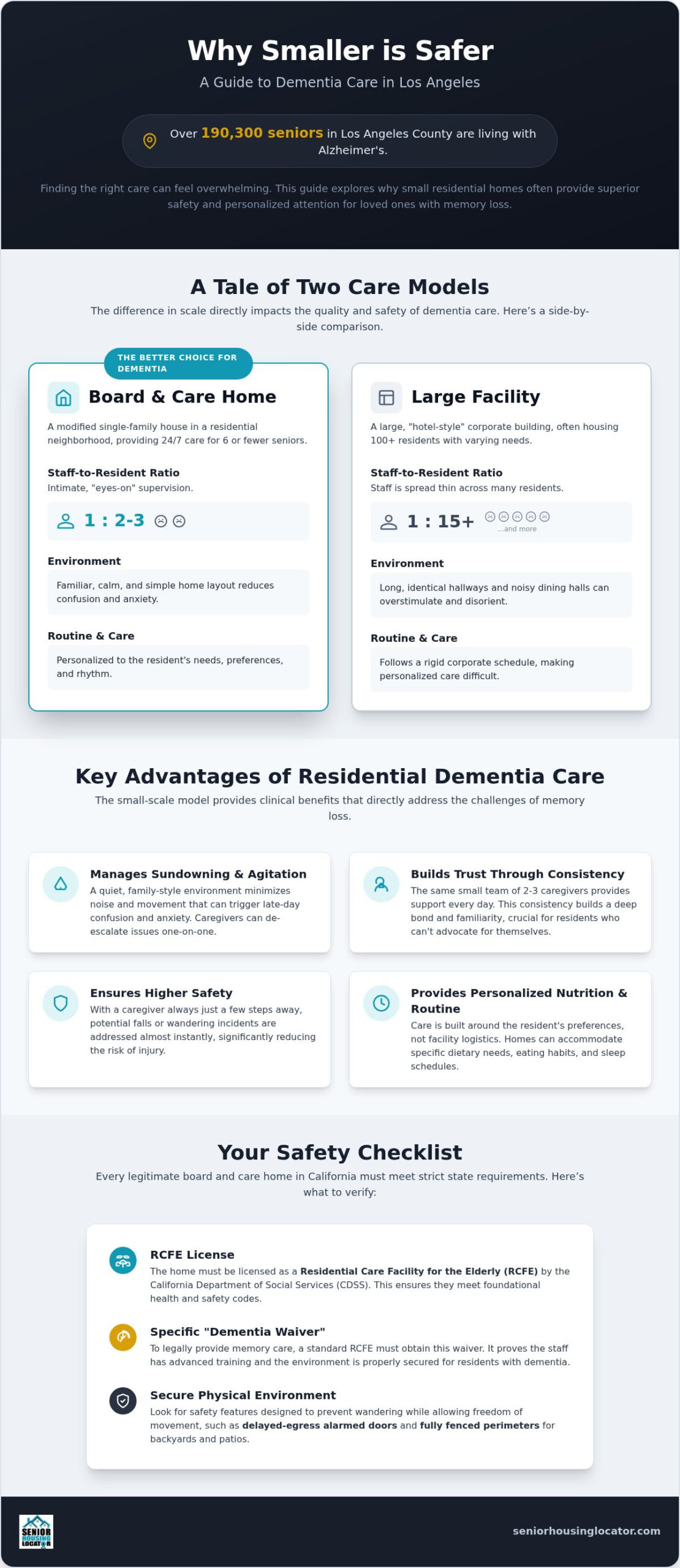
Many families in Los Angeles feel a sense of relief when they realize they don’t have to move their parent into a clinical, hospital-like facility. A board and care home is a traditional single-family house located in a regular residential neighborhood. It looks just like the other homes on the block in areas like Woodland Hills, Encino, or Santa Monica. Inside, these houses are modified to provide professional 24-hour support for six or fewer seniors. This small scale is exactly what makes board and care for dementia los angeles such a reassuring option for families who worry about their loved one being “just a number” in a massive building.
The RCFE Licensing Standard in California
Every board and care home must be licensed as a Residential Care Facility for the Elderly (RCFE). The California Department of Social Services monitors these homes through regular inspections to ensure they meet strict health and safety codes. While a standard RCFE provides basic help with daily living, a home specialized for memory care must go a step further. These homes obtain a specific “dementia waiver.” This waiver proves the staff has received extra training and the physical environment is secure. You’ll typically find safety features like delayed-egress alarmed doors and fully fenced perimeters to prevent wandering while still allowing residents to enjoy a backyard or patio safely.
Board and Care vs. Assisted Living: The Scale Difference
The biggest difference between these homes and large assisted living facilities is the level of “eyes-on” supervision. In a 100-resident “hotel-style” community, a single caregiver might be responsible for 15 different people at once. In a board and care setting, the ratio is often one caregiver for every two or three residents. This intimate oversight is vital for seniors with dementia who can no longer advocate for themselves or remember to press a call button. It’s the difference between a staff member checking in every few hours and a caregiver who is always just a few steps away in the next room. This model provides three major benefits:
- Reduced Confusion: A simple floor plan prevents the anxiety of getting lost in long hallways.
- High Safety: Falls or wandering are caught almost instantly because the staff is always present.
- Personalized Rhythm: Meals and activities are tailored to what the resident likes, not a corporate schedule.
Choosing a home with only five other neighbors creates a calm, predictable environment. It’s a setting that feels familiar and safe, helping to lower the stress that often triggers difficult dementia symptoms.
Why Residential Care is Often Better for Dementia
Living in a standard house isn’t just a comfort; it’s a clinical advantage for those with memory loss. When choosing board and care for dementia los angeles, you’re selecting an environment that mirrors the home your parent spent their life in. This familiarity helps ground them. Large facilities often have long, identical hallways and echoey dining halls that can trigger “spatial disorientation” or a sense of being lost. In a residential home, the layout is simple. The bathroom is just a few steps from the bedroom, and the living room is where everyone gathers. This smaller footprint means caregivers are always within earshot, significantly reducing the risk of falls.
Managing Sundowning and Agitation
Sundowning refers to the state of increased confusion, anxiety, and agitation that many dementia patients experience in the late afternoon and evening. In a large building with 50 or more residents, the noise and movement during shift changes can be terrifying for someone with memory loss. Residential homes offer a much calmer alternative. Instead of a loud cafeteria, residents sit at a family-style dining table. This quiet atmosphere helps keep stress levels low. When a resident does become agitated, the 1:3 staff ratio means a caregiver can step in immediately to de-escalate the situation through one-on-one engagement and reassurance.
Personalized Nutrition and Routine
Routine is the bedrock of effective memory care. In a small home, the schedule is built around the resident, not the facility’s logistics. If your parent prefers to sleep in or eats better with “finger foods” while walking, a board and care home can accommodate those specific needs. This level of Evaluating Board and Care for Dementia involves looking at how well a home handles Activities of Daily Living (ADLs). Whether it’s specialized bathing techniques or gentle reminders, the same 2-3 caregivers provide this support every day. This consistency builds a deep bond of trust that is nearly impossible to replicate in larger settings.
Finding a home that matches your parent’s specific personality and care level takes time. If you’re feeling overwhelmed by the choices, you can view our vetted local home referrals to see which residences in your neighborhood provide this high level of specialized support. We focus on three core goals: ensuring safety, maintaining dignity, and providing a true sense of belonging.
Evaluating Board and Care for Dementia in Los Angeles
With more than 2,000 residential care homes scattered across the city, finding the right board and care for dementia los angeles can feel like looking for a needle in a haystack. While the physical house matters, the quality of life for your parent depends on the specific “culture” of the home. You aren’t just looking for a clean room; you’re looking for a team that understands the nuances of memory loss. As you explore different types of long-term care, you’ll find that the best homes prioritize engagement over simple “supervision.”
The first thing to verify is the presence of a Dementia Waiver. Every RCFE is licensed, but only those with this specific waiver are legally permitted by the state of California to care for residents with a dementia diagnosis. Once you’ve confirmed the paperwork, pay close attention to the caregivers. Are they actively engaged with the residents, or is the television acting as the primary source of stimulation? In a high-quality home, you’ll see caregivers chatting with residents, assisting with small tasks, or leading simple activities that maintain cognitive function.
You’ll also need to decide between a private or shared room. While a private room offers more dignity and space for personal belongings, some residents with dementia actually do better in a shared room. Having a roommate can reduce the fear of being alone and provide a sense of security during the night. Finally, trust your senses. The “smell test” is a classic for a reason. A home should smell like a home, perhaps with the scent of a meal cooking or fresh laundry, rather than being masked by heavy bleach or clinical odors.
The San Fernando Valley and Woodland Hills Landscape
The geography of Los Angeles plays a significant role in your search. There is a high concentration of exceptional residential homes in the San Fernando Valley, particularly in neighborhoods like Woodland Hills, Sherman Oaks, and Encino. These areas often offer slightly more spacious properties with secured backyard gardens, which is a major plus for residents who enjoy being outdoors. If you’re looking for neighborhood-specific details, our Board and Care Homes in Woodland Hills: A Complete Guide provides a deeper look at the options in that specific area. Generally, homes in more affluent zip codes or coastal areas like Santa Monica will come with a higher monthly price point due to local real estate costs.
Questions to Ask During Your Tour
Don’t be afraid to ask direct questions to the house manager. Their transparency is a good indicator of how they handle challenges. Consider adding these to your checklist:
- How does the staff specifically handle exit-seeking or wandering behaviors?
- What is your policy for “aging in place” as the dementia progresses into later stages?
- Can we see your most recent state inspection reports, specifically the LIC 809 or LIC 256 forms?
- What is the typical tenure of your caregivers?
A home that is proud of its care will have no problem sharing its inspection history and discussing its specific strategies for managing difficult behaviors. Your goal is to find a partner in care, not just a place for your parent to stay.
Costs of Memory Care Board and Care in LA (2026)
Understanding the financial side of memory care is often the most stressful part of the journey for families. When you look at board and care for dementia los angeles, the pricing structure is typically more straightforward than what you’ll find in large corporate facilities. Most residential homes use an “all-inclusive” model. This means your monthly payment covers the three core pillars of support: your loved one’s room, three daily meals plus snacks, and 24-hour personal care. You won’t have to worry about separate bills for utilities, laundry, or basic housekeeping.
One of the biggest financial surprises for families is how residential care compares to 24/7 in-home support. In Los Angeles, hiring around-the-clock caregivers at home can quickly become the most expensive option because you are paying for 168 hours of labor every week. In a board and care setting, those labor costs are shared among six residents. This allows for a high level of supervision at a more manageable monthly rate. While most homes are private pay, many families use Long-Term Care Insurance to help cover the costs, provided the policy was active before the dementia diagnosis.
It’s also helpful to understand how “Level of Care” charges work. As dementia progresses, a resident may require more hands-on help with daily tasks. Homes typically assess care needs in three areas:
- Physical Assistance: Help with bathing, dressing, and mobility.
- Behavioral Support: Extra time spent managing agitation or exit-seeking.
- Incontinence Care: Frequent checks and assistance with personal hygiene.
These care tiers ensure the home can maintain the proper staffing levels as your parent’s needs change over time.
Why Private Rooms Cost More
The choice between a private or shared room is the biggest factor in your monthly budget. Private rooms offer a quiet sanctuary for residents who value their personal space and want to surround themselves with familiar furniture. However, these rooms are in high demand and come at a premium. You can view SFV Board and Care with Private Rooms to see how these layouts typically look. In many older Los Angeles homes that have been retrofitted for care, private bathrooms are rare; residents usually share a large, ADA-compliant bathroom with one or two other housemates.
Hidden Savings vs. Large Facilities
Families often find “hidden savings” in the board and care model because they avoid the nickel-and-diming common in big facilities. You generally won’t see “community fees” that can cost thousands of dollars upfront, nor will you see separate monthly charges for medication management or escorting a resident to the dining room. This predictability makes it much easier to plan for the long term. For a deeper dive into how these rates compare across the city, see our Assisted Living Costs in Los Angeles. If you need help finding a home that fits your specific budget, contact us for a free list of vetted referrals tailored to your financial needs.
Finding the Right Home with Senior Housing Locator
Searching for the right board and care for dementia los angeles shouldn’t feel like a second full-time job. With over 2,000 options in the area, it’s easy to feel paralyzed by the sheer volume of choices. At Senior Housing Locator, we act as your trusted local ally to streamline this entire journey. We don’t just hand you a generic list of addresses. Instead, we use our deep roots in the community to match your parent with a home that fits their specific personality, medical needs, and your family’s budget.
You might wonder how we can offer such a comprehensive service at no cost to you. Our model is simple: our fees are paid by the care providers once a successful placement is made. This allows us to offer our expertise to families for $0. Our priority is integrity. We only recommend homes that meet our strict internal standards for safety and dementia-aware care. If we wouldn’t place our own family member there, we won’t suggest it for yours. We focus on removing the burden of the search so you can focus on being a daughter or a son again.
Our Step-by-Step Placement Process
We’ve designed a methodical three-step approach to move you from uncertainty toward a clear resolution. First, we start with an initial consultation to understand your loved one’s history and current stage of dementia. Second, we provide curated tours. We don’t just send you an email; we schedule the appointments and can even accompany you to the homes to help you ask the right questions. Finally, we offer transition support. We help you navigate the complex paperwork and provide the emotional guidance needed for a smooth move-in day.
Why a Local Advisor Beats a National Hotline
National referral sites often rely on outdated databases and call centers located thousands of miles away. They may recommend a board and care for dementia los angeles without ever having stepped foot inside the front door. We live and work here. We’ve personally toured the homes in Woodland Hills, Encino, and Santa Monica. We understand the local nuances that a computer algorithm misses, such as which homes are closest to the best local hospitals or how LA traffic might affect your ability to visit on a weekday afternoon. You deserve a guide who knows the neighborhood as well as you do. Schedule a free consultation with a Senior Living Advisor in Los Angeles today.
Take the Next Step Toward Quality Care
Choosing the right environment for a parent with memory loss is a significant decision, but it doesn’t have to be a lonely one. You now understand how the small scale of residential care reduces overstimulation, provides consistent caregiving, and offers a more predictable all-inclusive cost model. These intimate settings prioritize your loved one’s safety and dignity in a way that large, impersonal facilities often cannot match. By focusing on a home-like atmosphere, you’re helping your parent maintain a sense of calm and belonging.
Finding the ideal board and care for dementia los angeles requires local expertise to navigate the thousands of available options. We’re here to do the heavy lifting for you. Our service is completely free for families, and we provide personalized tours of vetted homes throughout the San Fernando Valley, Woodland Hills, and the greater LA area. You can Find the Perfect Board and Care Home for Your Loved One; Free Expert Help by reaching out to our team today. We’ll help you find a place where your parent is truly known and supported, giving you the peace of mind you deserve.
Frequently Asked Questions
Is a board and care home the same as a nursing home?
No, they are quite different settings. Nursing homes focus on complex medical needs and often look like hospitals with clinical hallways. Board and care homes are private houses that provide help with daily tasks like bathing, dressing, and meals. While they don’t have on-site nurses, they offer a warm, family-style environment that is often more comfortable for those with memory loss.
How do board and care homes prevent dementia residents from wandering?
These homes use a combination of physical security and close supervision. You’ll find delayed-egress doors that sound an alarm if opened and fully fenced backyards. Because the staff is always just a few steps away, they can redirect a resident before they ever reach an exit. This constant oversight is a key safety feature of residential care.
Are there board and care homes in Los Angeles that specialize in Alzheimer’s?
Yes, many local residences are specifically designed for memory support. These homes obtain a “Dementia Waiver” from the state of California. This waiver ensures the staff has received specialized training to manage symptoms like agitation or confusion. Choosing a specialized board and care for dementia los angeles means your parent is in a setting built for their specific needs.
Can my parent stay in a board and care home until the end of life?
Most residents can stay through the end of life if the home has a hospice waiver. The home partners with a visiting hospice agency to provide medical comfort care. This allows your parent to remain in a familiar environment surrounded by the caregivers they already trust. It prevents the trauma of a late-stage move to a nursing facility.
How much does board and care for dementia cost in Los Angeles in 2026?
Costs in Los Angeles depend on the specific neighborhood and the amount of hands-on care required. Generally, these homes are more budget-friendly than hiring 24/7 caregivers at home. They also avoid the extra “add-on” fees for things like medication management that are common in large facilities. We can help you find a home that fits your family’s financial plan.
What is the staff-to-resident ratio in a typical LA board and care?
You can expect a ratio of one caregiver for every three residents. In a typical house with six seniors, there are usually two caregivers on duty during the day. This is much better than large assisted living buildings where one person might look after fifteen residents. It ensures your parent gets the quick attention they need for safety and comfort.
Do board and care homes provide medical care or doctors on-site?
Board and care homes are non-medical, so they don’t have doctors on staff. However, they coordinate with visiting nurses, physical therapists, and mobile doctors who come directly to the house. This allows your parent to receive care in their own room. The staff also helps manage prescriptions and handles the logistics of all necessary health appointments.
How do I know if a board and care home is licensed for memory care?
You should always ask to see the home’s RCFE license issued by the California Department of Social Services. Check specifically for a “Dementia Waiver” on the paperwork. This waiver is the legal proof that they are qualified to provide board and care for dementia los angeles. You can also look up their inspection history online to see their most recent safety reports.