
What if covering quality senior care didn’t require draining your family’s life savings? Figuring out how to pay for assisted living in California can quickly feel overwhelming, especially when you are trying to balance personal comfort with long-term financial security. If you feel anxious about whether a parent will outlive their nest egg, or confused about why Medicare won’t foot the bill for residential room and board, you aren’t alone. Most families begin this process feeling unprepared for complicated state applications and lengthy agency waitlists.
The good news is that you don’t have to carry this heavy burden by yourself. In this 2026 guide, you will discover proven public and private funding strategies to cover care without exhausting your family’s hard-earned savings. We’ll show you how to layer state support, veterans benefits, and personal assets efficiently, giving you a clear roadmap to secure compassionate placement within a realistic household budget.
Key Takeaways
- Learn how to pay for assisted living in California by understanding how state licensing defines care services and why Medicare excludes daily room and board.
- Discover how California’s Assisted Living Waiver helps qualified seniors offset care expenses while managing waitlists and eligibility guidelines.
- Uncover how wartime veterans and surviving spouses can access monthly supplemental funding through underutilized VA Aid and Attendance pensions.
- Explore smart asset strategies, including boutique board and care homes and short-term bridge options that help protect family savings.
- Create a sustainable care budget with local placement guidance to anticipate tiered fee increases before signing any residency agreement.
Understanding How Assisted Living Is Funded in California
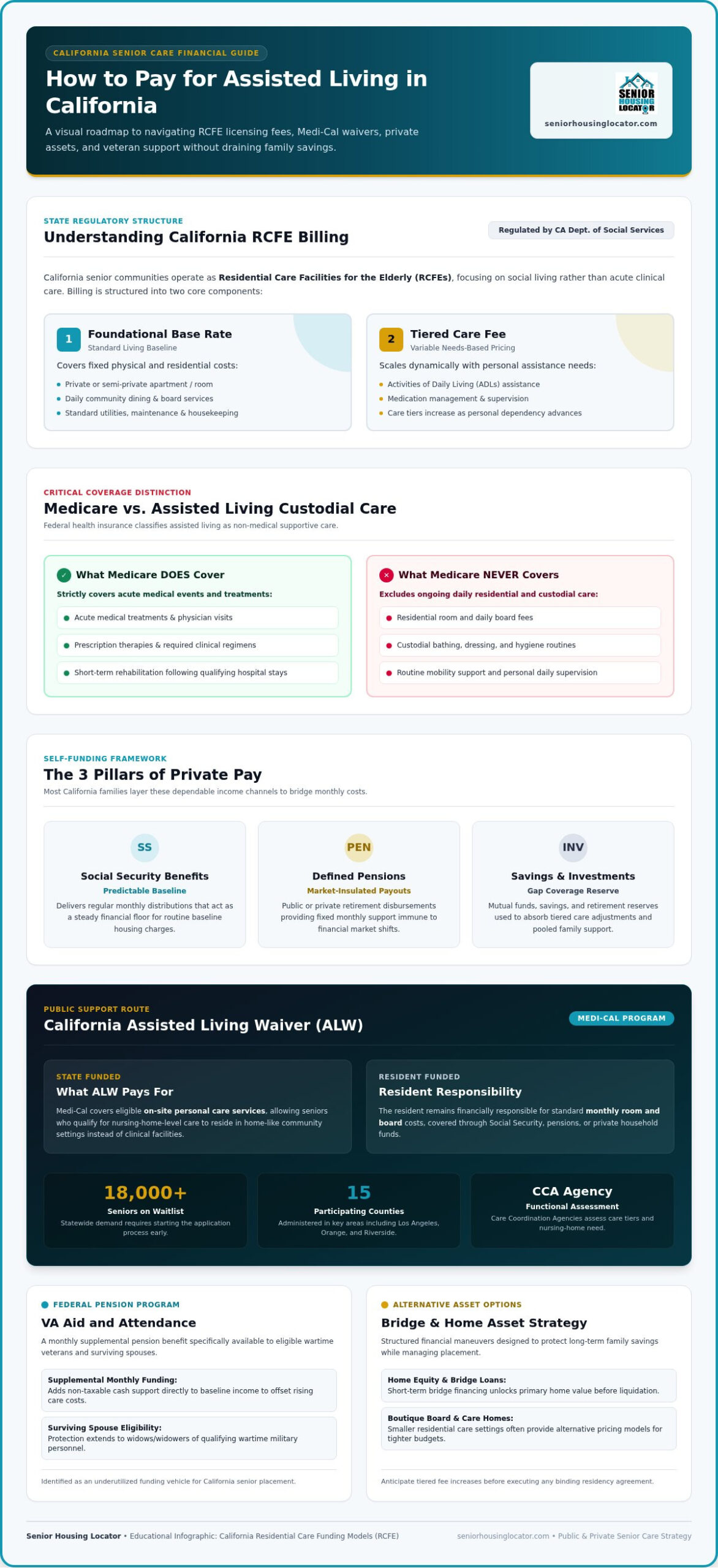
California regulates senior communities under the Department of Social Services as Residential Care Facilities for the Elderly (RCFEs). Understanding these regulatory structures is essential when learning how to pay for assisted living in California. Unlike acute clinical settings, an RCFE typically charges through a two-part fee model: a foundational rate covering room and board, paired with a tiered care fee tied directly to personal daily needs. Because these facilities emphasize social models of housing rather than intensive medical care, funding responsibilities fall primarily on families rather than federal health insurance.
Most families begin by relying on private-pay resources, but lasting financial security rarely depends on a single account. A sustainable long-term approach layers personal retirement assets, family support, and specialized public programs into a balanced, manageable structure.
The Critical Difference Between Medicare and Long-Term Care
Traditional Medicare does not pay for residential room, board, or ongoing custodial care in assisted living communities. Instead, Medicare strictly covers acute medical treatments, doctor visits, prescription therapies, and short-term rehabilitation following a qualifying hospital stay.
Custodial assistance involves non-medical support with activities of daily living, such as bathing, dressing, medication management, and mobility. While assisted living teams provide compassionate, round-the-clock help with these routine personal tasks, federal insurance programs classify this as supportive care rather than medical treatment. Dispel the common assumption that Medicare covers monthly residency, so your family can plan realistically without unexpected financial surprises.
Private Pay Basics: Personal Savings, Pensions, and Social Security
For most households, private assets form the cornerstone of senior care funding. Families generally assemble a dependable foundation using three primary income channels:
- Social Security benefits: Monthly distributions provide a steady, predictable baseline for routine housing costs.
- Defined pensions: Public or private retirement payouts offer dependable monthly supplements that do not fluctuate with market changes.
- Personal savings and investments: Dedicated savings accounts, mutual funds, or individual retirement reserves help bridge any monthly gaps.
Family members often choose to contribute together, pooling monthly resources or sharing ancillary fees to protect an aging parent’s core nest egg. Before deciding on a location, reviewing an assisted living costs in Los Angeles guide helps you evaluate neighborhood fee models, clarify care levels, and build an accurate monthly budget.
Navigating California Public Assistance: Medi-Cal and the Assisted Living Waiver
Public programs offer vital relief for seniors who need daily custodial help but lack the personal wealth to fund decades of private care. While traditional Medicaid strictly funds skilled nursing environments, California operates specialized community programs that help seniors age comfortably in home-like residential settings. Understanding these state resources is a powerful step in determining how to pay for assisted living in California.
The state delivers this bridge through Medi-Cal, California’s Medicaid program. Rather than forcing seniors into clinical nursing facilities, Medi-Cal seeks to support dignified independent living whenever possible. Connecting with a local advisor at Senior Housing Locator can help your family identify licensed communities that accept public program participants throughout Greater Los Angeles.
How the California Assisted Living Waiver (ALW) Operates
The Assisted Living Waiver (ALW) pays for on-site personal care services while the resident remains responsible for room and board. Administered across 15 participating counties, including Los Angeles, Orange, and Riverside, the ALW assesses an applicant’s clinical needs to determine appropriate care tiers.
Registered Care Coordination Agencies conduct functional assessments to verify that an individual qualifies for nursing-home-level care. Demand runs exceptionally high. With over 18,000 seniors on the statewide waitlist, early planning is essential to secure placement.
Recent Medi-Cal Eligibility Changes and CalAIM Community Supports
Qualifying for Medi-Cal long-term care services has evolved considerably. While strict financial tests once forced individuals to exhaust almost all life savings, California expanded asset thresholds up to $130,000 for individuals and $195,000 for married couples. These generous asset rules make it far easier to preserve family resources while applying for state support.
Income guidelines still apply, and individuals with monthly revenue above state thresholds often participate through a share-of-cost arrangement. Beyond the ALW, the state’s CalAIM initiative introduces flexible Community Supports designed to smooth residential transitions:
- Housing transition navigation: Case managers assist seniors in locating, applying for, and securing supportive community housing.
- Housing tenancy services: Ongoing behavioral and practical coaching helps residents maintain stability in community settings.
- Personal care coordination: Direct integration between medical providers and residential staff prevents unnecessary emergency room visits.
Knowing how to pay for assisted living in California means pairing these state supports with realistic timelines, giving your family confidence while moving through application approvals.
Unlocking Veterans Benefits and Long-Term Care Insurance
Exploring dedicated earned benefits can dramatically alter your care budget. Two of the most effective non-Medicaid funding streams available to California households are Department of Veterans Affairs (VA) pensions and private long-term care insurance. When families look into how to pay for assisted living in California, these instruments often supply the exact bridge needed to choose a preferred residential community over a more restrictive setting.
While public programs like California’s Assisted Living Waiver (ALW) focus on state health coverage, VA benefits and insurance policies deliver direct payments that can go straight toward monthly room, board, and tiered personal assistance.
Qualifying for the VA Aid and Attendance Benefit
The VA Aid and Attendance benefit provides a tax-free monthly pension enhancement to eligible wartime veterans and surviving spouses. To qualify, an applicant must meet three specific requirements:
- Service records: At least 90 days of active military duty, including at least one full day during a federally recognized wartime period.
- Clinical need: Written medical evidence that the applicant requires daily personal help with tasks like dressing, bathing, or medication coordination.
- Financial thresholds: Net worth and annual household income must fall beneath established VA limits after deducting recurring medical care expenses.
Locate the veteran’s military discharge papers (Form DD-214) early. Processing times through regional VA offices frequently take several months, meaning families often cover short-term initial fees out of pocket before retroactively awarded funds arrive.
Activating Long-Term Care Insurance Policies Effectively
Holding a private long-term care insurance policy simplifies residential planning, but activation requires careful coordination. Most policies feature an elimination period of 30 to 90 days. During this window, you must self-fund daily care before insurance reimbursements begin.
Review the policy language to verify that licensed California Residential Care Facilities for the Elderly qualify for coverage under your specific terms. Request an official benefit determination letter from your carrier before moving in. This step confirms the daily maximum payout and avoids unexpected billing surprises.
IRS Medical Deductions for Assisted Living Expenses
Tax relief represents another practical way to reduce out-of-pocket costs when solving how to pay for assisted living in California. Under federal tax law, the medical and custodial care portion of assisted living fees may be deductible as qualified medical expenses.
To support this deduction, secure a written plan of care from a licensed healthcare practitioner confirming that the senior requires daily personal assistance or ongoing supervision. Because deduction thresholds vary by individual household income, consult an elder law attorney or certified tax specialist to confirm your family’s exact eligibility.
Strategic Asset Options: Home Equity, Bridge Loans, and Board and Care
Real estate often represents the largest portion of a family’s overall net worth. When exploring how to pay for assisted living in California, unlocking the equity tied up in a parent’s home can transform long-term care from a looming worry into an easily managed transition. Beyond standard property transactions, smaller community models and specialized bridge tools can stretch available dollars significantly further.
Families also look into life insurance policy conversions or life settlements to generate immediate liquidity. If an aging parent holds an active life insurance policy they no longer need, selling or converting it into an irrevocable long-term care benefit account can fund care right away without surrender penalties.
Utilizing Home Equity and Short-Term Senior Bridge Loans
Managing real estate assets requires evaluating timing, family goals, and ongoing maintenance responsibilities. When families decide to leverage residential equity, they usually consider three primary paths:
- Outright property sale: Selling the family home liquidates substantial capital into a protected investment reserve dedicated strictly to ongoing senior care.
- Rental income generation: Leasing the home provides consistent monthly cash flow to offset assisted living fees while keeping the property within the family estate.
- Senior bridge loans: These short-term, interest-only lines of credit cover immediate community entrance fees and monthly dues while the home is prepped, staged, and sold.
Reverse mortgages require careful caution. Under standard loan agreements, the entire loan balance becomes due once the homeowner moves out of the primary residence for 12 consecutive months. If your loved one relocates permanently to a care community, relying on a reverse mortgage can trigger an unexpected forced sale.
Considering Residential Board and Care Homes to Maximize Budgets
Many families assume assisted living only exists in massive, multi-story hospitality complexes. In reality, residential care homes, often called board and care homes, provide the exact same state licensing standards in intimate, single-family neighborhood properties.
These smaller settings typically house around six residents. With fewer residents sharing dedicated staff, board and care environments often feature higher caregiver-to-resident ratios. Because their operating overhead is lower than expansive luxury communities, they frequently offer more inclusive, predictable monthly pricing with fewer tiered surcharges. Explore our guide to board and care homes in Woodland Hills for localized comparisons across the West Valley.
Finding the right balance between personal assets and supportive living requires an experienced hand. To evaluate boutique residential homes tailored to your personal resources, contact Senior Housing Locator for free placement guidance today.
Creating a Sustainable Long-Term Payment Plan with Local Guidance
Planning for care is not simply about covering the first month’s invoice. A truly sustainable strategy anticipates how physical and cognitive needs evolve over time. When figuring out how to pay for assisted living in California, mapping out a multi-year horizon helps prevent the heartbreak of having to relocate a parent due to unexpected price increases down the road.
Partnering with a seasoned local placement advisor removes the guesswork. Before you start touring communities independently, scheduling an assisted living placement in Woodland Hills consultation gives your family a realistic financial roadmap tailored to your neighborhood and budget.
Accounting for Future Care Tier Increases and Community Fees
California residency agreements rarely charge a flat rate forever. Most communities use tiered care structures that adjust as a senior requires additional daily help. To keep your financial plan secure, scrutinize these contract elements before signing:
- Point-based care tiers: Facilities periodically assess activities like transfer assistance, incontinence management, and memory support, assigning points that increase the monthly care invoice.
- One-time community fees: Most licensed facilities charge an upfront move-in fee that covers administrative intake and apartment refurbishment.
- Annual cost-of-living adjustments: Contracts typically outline annual base-rate percentage increases to keep up with regional operational costs.
Accounting for these progressive adjustments early ensures your family reserves remain resilient as care needs naturally change over time.
Partnering with a Local Placement Advisor at No Cost
You don’t have to tackle community research, contract terms, and fee evaluations alone. Senior Housing Locator provides comprehensive placement and referral guidance that is completely free to families, with services funded entirely by licensed care communities.
Working alongside an experienced senior living advisor in Los Angeles ensures you tour only those communities that match your parent’s care profile and household budget. From boutique board and care homes in Sherman Oaks and Encino to full-scale assisted living residences in Burbank and Pasadena, we pre-screen options to ensure high standards of care and transparent fee structures.
Discovering how to pay for assisted living in California is much simpler when you have a dedicated local guide by your side. Contact Senior Housing Locator today for compassionate, no-cost senior placement guidance and find the right home with complete confidence.
Secure the Right Care for Your Loved One Today
Understanding how to pay for assisted living in California doesn’t have to be an exhausting, solitary process. By pairing personal retirement streams with underutilized resources like VA Aid and Attendance or Medi-Cal waiver programs, sustainable senior care is well within reach. Considering smaller residential board and care homes also unlocks attentive, high-touch support while protecting your family’s hard-earned savings over the long haul.
You don’t have to navigate these complex decisions by yourself. Senior Housing Locator provides a 100% free personalized placement service for families across Los Angeles and the San Fernando Valley, funded entirely by licensed care communities. Our team brings deep neighborhood expertise spanning Woodland Hills, Sherman Oaks, Encino, Burbank, and Pasadena, matching your loved one with thoroughly vetted communities suited to their care needs, social preferences, and household budget.
Take a deep breath and let an empathetic guide simplify each step. Connect with a compassionate local advisor at Senior Housing Locator today to discover the right community with complete peace of mind.
Frequently Asked Questions
Does Medicare pay for assisted living in California?
Medicare does not pay for assisted living room, board, or ongoing custodial care in California. The federal program strictly limits coverage to acute medical interventions, prescription therapies, and short-term rehabilitative care following a qualified hospital stay. Daily personal support, such as bathing, dressing, and dining assistance, remains an out-of-pocket or waiver-funded responsibility. Understanding this distinction is vital when researching how to pay for assisted living in California.
How does the California Assisted Living Waiver (ALW) work?
The California Assisted Living Waiver covers certified daily care and personal support services, while the resident pays for room and board. Eligible seniors must qualify for full Medi-Cal and demonstrate a clinical need for nursing-home-level care. Because participation is limited to select counties like Los Angeles and Riverside, and waitlists are substantial, working with local care coordinators early is the best way to secure an eligible residential setting.
Can I qualify for Medi-Cal to help pay for assisted living if I own a home?
Yes, owning a primary residence generally does not disqualify you from Medi-Cal assistance in California. Under current state eligibility rules, your primary home is considered an exempt asset as long as you or your spouse intend to return or meet specific community-spouse protections. However, estate recovery guidelines and monthly income rules still apply, so speaking with an elder law specialist is recommended before submitting state benefit applications.
How much monthly income can a veteran receive through VA Aid and Attendance?
Eligible wartime veterans and their surviving spouses can receive substantial monthly, tax-free pension enhancements through the VA Aid and Attendance program. For 2026, qualifying single veterans can access up to $2,424 per month, married veterans up to $2,874, and surviving spouses up to $1,558. These direct payments can be applied straight toward daily room, board, and care in licensed residential communities across Greater Los Angeles.
Are assisted living costs tax deductible in California?
Yes, portions of your assisted living fees may qualify as tax-deductible medical expenses on federal and California tax returns. The custodial and clinical care portion of your monthly invoice is generally deductible if a licensed physician certifies that the senior requires daily assistance or constant supervision. Retain detailed care assessments and consult a certified tax professional to calculate your exact deduction under current IRS and state tax thresholds.
What happens if a senior runs out of money while living in assisted living?
If personal reserves run out, families usually explore transitioning to a community that participates in the Assisted Living Waiver, downsizing to a shared room, or moving to a residential board and care home. Some facilities allow residents to convert to state support programs if waiver beds are available. Planning ahead with a placement advisor ensures families build a realistic spending timeline that protects against unexpected mid-residency moves.
Why are placement referral services like Senior Housing Locator completely free for families?
Senior Housing Locator is 100% free for families because licensed residential care communities fund the service directly through standard referral agreements. When helping families evaluate how to pay for assisted living in California, our team provides unbiased guidance, deep neighborhood insight across Woodland Hills and Los Angeles, and personalized community tours without ever charging you a single dime or adding hidden fees to your contract.