
What if the hardest part of supporting an aging parent isn’t managing their physical needs, but resolving the friction it creates between the people who love them most? When adult siblings step into caregiving roles, old family dynamics resurface fast. Handling family disagreements about senior care can quickly leave everyone feeling unheard, defensive, and emotionally drained.
It’s completely normal to feel overwhelmed when your family can’t find common ground. You might be carrying the daily caregiving weight while an out-of-town sibling insists everything is fine, or perhaps you’re clashing over whether a parent needs assisted living or specialized memory care. When fear and guilt take over, productive conversations easily break down into painful arguments.
The good news is that senior care conflicts usually resolve when families replace personal assumptions with objective assessments. In this guide, you’ll learn practical strategies to align on living options, organize productive family meetings, and lean on neutral guidance to make sound decisions without tearing your family apart.
Key Takeaways
- Understand the emotional roots behind sibling conflict, including anticipatory grief, old family roles, and the fear of letting a parent down.
- Discover a step-by-step framework for running calm, organized family meetings that prioritize your parent’s safety over heated personal arguments.
- Learn how to master handling family disagreements about senior care by evaluating daily living needs with objective checklists rather than personal assumptions.
- Uncover practical strategies to navigate sensitive financial conversations transparently while exploring suitable living options together.
- See how partnering with a neutral senior living placement specialist can break deadlocks and bring lasting clarity to your entire family.
Why Family Disagreements Over Senior Care Occur
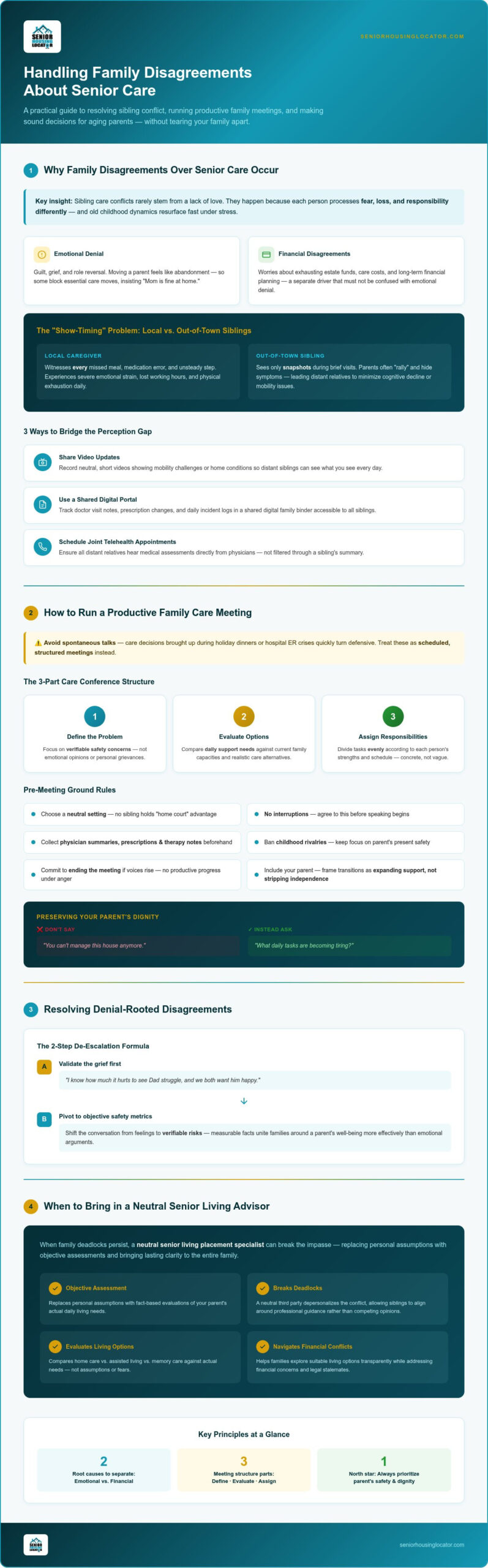
Caring for aging parents exposes deep emotional vulnerabilities. Long-standing childhood dynamics, unresolved rivalries, and old habits quickly resurface during stressful transitions. Successfully handling family disagreements about senior care requires understanding that these clashes rarely stem from a lack of love. Instead, they happen because each sibling processes fear, loss, and responsibility differently.
To resolve these disputes, families must clearly distinguish emotional denial from financial disagreements. A sibling fighting a transition might genuinely fear watching a parent decline, while another worries about exhausting estate funds. Without separating these two drivers, conversations spiral into personal attacks rather than productive solutions.
The Burden of the Primary Caregiver vs. Out-of-Town Siblings
A major divide often opens between the local caregiver and siblings living far away. According to documented research on family caregivers, those providing daily hands-on support experience severe emotional strain, lost working hours, and physical exhaustion. They witness every missed meal, medication error, and unsteady step.
In contrast, out-of-town siblings see snapshots during brief visits. A parent often rallies for a two-day holiday trip, hiding symptoms effectively. This phenomenon, known as “show-timing,” leads distant relatives to minimize cognitive decline or mobility issues. To bridge this gap:
- Share video updates: Record neutral, short videos showing mobility challenges or home conditions.
- Use a shared portal: Track doctor visit notes, prescription changes, and daily incident logs in a digital family binder.
- Schedule joint telehealth appointments: Ensure distant relatives hear medical assessments directly from physicians.
Denial, Guilt, and Role Reversal Traps
Taking over decisions for a parent feels unnatural. Adult children often wrestle with profound guilt, feeling that moving mom or dad into assisted living or memory care equals abandonment. This emotional denial causes some relatives to block essential care moves, insisting that “Mom is fine at home.”
When handling family disagreements about senior care rooted in denial, fighting emotion with frustration never works. Validate your sibling’s grief by saying, “I know how much it hurts to see Dad struggle, and we both want him happy.” Then, pivot immediately back to objective safety metrics. By shifting the conversation from feelings to verifiable risks, families can unite around their parent’s immediate well-being.
How to Run a Productive Family Care Meeting
Care decisions rarely go well when brought up during holiday dinners or in the middle of a hospital emergency room crisis. Spontaneous talks quickly turn defensive. When handling family disagreements about senior care, treating these conversations as scheduled, structured meetings creates the psychological safety everyone needs to think clearly.
A productive care conference relies on a simple three-part structure:
- Define the central problem: Focus on verifiable safety concerns rather than emotional opinions.
- Evaluate realistic options: Compare daily support needs against current family capacities.
- Assign concrete responsibilities: Divide tasks evenly according to each person’s strengths and schedule.
Setting Ground Rules and Pre-Meeting Preparation
Preparation sets the tone. Choose a neutral setting, such as a private conference room or a scheduled video call, so no single sibling holds “home court” advantage. Before gathering, collect written physician summaries, updated prescription lists, and recent therapy notes. Reviewing established family meeting guidelines helps keep discussions centered on objective facts rather than long-standing family friction.
Agree on strict ground rules before speaking. Forbid interruptions, ban the dredging up of past childhood rivalries, and commit to ending the meeting if voices rise. Keeping the spotlight on safety prevents old patterns from derailing the present conversation.
Involving Your Aging Parent in the Discussion
Preserving your parent’s dignity is essential. Assess their cognitive capabilities honestly to decide whether full, partial, or staged participation makes sense. If early dementia causes agitation during complex logistics talks, include them during the opening phase to share preferences, then finalize specific details among siblings later.
Always frame transitions around expanding support rather than stripping independence away. Ask questions like, “What daily tasks are becoming tiring?” instead of declaring, “You can’t manage this house anymore.” When parents feel consulted as partners in their own care plan, resistance drops dramatically.
Conclude every meeting by summarizing clear action items, designated owners, and a firm date for a follow-up check-in. If your family hits an impasse over which care setting fits best, consulting Senior Housing Locator can provide unbiased insight that eases tension and unifies everyone around a practical plan.
Resolving Core Disagreements: Home Care vs. Senior Living Communities
One of the sharpest battles among adult children centers on location. One sibling often insists on keeping a parent at home at all costs, while another recognizes that round-the-clock needs have surpassed what family members can safely provide. Handling family disagreements about senior care in this scenario requires moving past subjective hopes and looking directly at daily realities.
While staying at home sounds ideal, managing constant companion schedules, home upkeep, and emergency safety often proves overwhelming. For families seeking an intimate, residential setting rather than a large campus, exploring board and care homes Woodland Hills offers a balanced middle ground with personalized daily attention in a quiet, home-style neighborhood.
Assessing True Care Needs Beyond Wishful Thinking
Wishful thinking easily clouds judgment. An objective way to dissolve sibling debates is to score daily living capabilities using standardized Activities of Daily Living (ADLs) and Instrumental Activities of Daily Living (IADLs). Track tangible markers across several weeks:
- Physical mobility: Are there unexplained bruises, near-falls, or struggles getting out of bed?
- Medication management: Are daily pill organizers missed, doubled up, or forgotten entirely?
- Cognitive safety: Does your parent leave stove burners on, misplace essentials, or show signs of disorientation?
When cognitive decline advances to exit-seeking, wandering, or intense sundowning, home settings become precarious. In these situations, specialized memory care placement San Fernando Valley provides secure perimeters, sensory-soothing layouts, and dementia-trained teams that in-home setups simply cannot replicate.
Overcoming the Myth That Senior Living Means Abandonment
Guilt frequently fuels opposition. Sibling resistance often melts away once families realize that residential communities do not mean giving up on a parent. Instead, they solve the quiet epidemic of senior loneliness, providing structured social activities, chef-prepared meals, and wellness programming that revive a parent’s quality of life.
Selecting dedicated assisted living placement Woodland Hills removes the exhausting burden of daily caregiving tasks like bathing, laundry, and meal prep. Handling family disagreements about senior care becomes significantly easier when adult children realize professional care frees them to step out of the exhausted caregiver role and return to simply being loving sons and daughters.
Navigating Financial Conflicts and Legal Stalemates
Money represents one of the most volatile triggers during long-term care planning. When adult children face the reality of funding care, unspoken expectations about estate preservation often collide with immediate safety needs. Handling family disagreements about senior care requires a clear shift in mindset: a parent’s savings belong to them, and those assets exist first and foremost to fund their comfort, health, and dignity.
Tension drops when everyone operates with real local numbers instead of vague estimates. Reviewing comprehensive pricing breakdowns like assisted living costs Los Angeles grounds sibling debates in factual monthly ranges. This helps families create practical spending plans without relying on guesswork.
Establishing Financial Transparency Across the Family
Secrecy fuels suspicion. If one child manages parental accounts while others remain in the dark, resentment builds quickly. To clear the air, compile a transparent financial overview and share it with every sibling:
- Liquid assets: Checking balances, savings, and retirement accounts.
- Fixed monthly income: Social Security payments, pensions, and annuities.
- Insurance and benefits: Active long-term care policies or VA Aid and Attendance eligibility.
Laying these numbers on the table allows the entire family to assess realistic long-term affordability together. It eliminates quiet fears that one sibling is overspending or improperly guarding personal inheritances at the expense of parental care.
Clarifying Legal Roles: Power of Attorney vs. Equal Voice
Designated legal authority often sparks family friction. A durable Power of Attorney (POA) grants one individual legal authority to make binding decisions. It does not, however, mean other siblings should feel shut out of the process. Healthy collaboration means the POA invites family discussion while remaining clear on their legal fiduciary duty to act strictly in the parent’s best interest.
When communication breaks down completely, costly court battles or conservatorships should remain absolute last resorts. Bringing in an objective third party can de-escalate volatile sibling debates before legal stalemates cause harm. If your family is divided over budgets and living choices, connect with a local senior placement specialist to gain neutral guidance, compare vetted options, and resolve deadlocks with confidence.
How a Neutral Senior Living Advisor Eliminates Family Deadlocks
When discussions stall between stubborn viewpoints, introducing an objective third party fundamentally changes the room. A local placement advisor carries no emotional baggage, harbors no childhood rivalries, and holds no personal stake in estate distributions. Handling family disagreements about senior care becomes far simpler when families lean on a professional who can assess physical and cognitive realities without bias.
Advisors help adult children see choices clearly across the entire care spectrum. Whether a parent thrives in active, maintenance-free settings like independent living communities Woodland Hills or requires around-the-clock support, an experienced guide matches specific needs to the right setting. Best of all, placement services are 100% free for families, which immediately removes financial worry from getting expert assistance.
The Power of an Unbiased Third-Party Perspective
Siblings often debate care levels because each person visualizes something different. Touring communities alongside a knowledgeable guide quickly dispels false impressions. When hesitant relatives walk through vibrant dining rooms, see secure outdoor courtyards, and speak directly with care staff, hypothetical fears turn into reassuring facts.
Partnering with a trusted senior living advisor Los Angeles transforms subjective sibling arguments into fact-based evaluations. An advisor acts as a compassionate facilitator by:
- Conducting holistic assessments: Evaluating physical capabilities, social preferences, and memory concerns impartially.
- Curating verified options: Filtering through hundreds of licensed facilities to present only top-tier, appropriate choices.
- Organizing guided tours: Asking tough questions regarding staffing ratios, care plans, and licensing compliance on your family’s behalf.
Moving Forward Together with Confidence and Peace of Mind
The ultimate goal is never about winning an argument against a brother or sister. The true goal is providing your aging parent with a safe, dignifying environment where they can genuinely flourish. By handing the heavy research over to an organized professional, your family avoids decision fatigue and unnecessary blame.
Take the next step collaboratively. Schedule visits to two or three pre-screened communities together. As everyone witnesses the warm environments and professional support available, defensive walls fall away. Handling family disagreements about senior care ultimately paves the way toward family harmony, leaving everyone confident that their parent is safe, respected, and thoroughly cherished.
Bringing Peace and Confidence to Your Family’s Care Journey
Successfully handling family disagreements about senior care comes down to replacing emotional friction with objective clarity. When you ground decisions in verifiable daily needs, lead structured family conversations, and practice open financial transparency, defensive walls crumble. You protect your parent’s safety while preserving precious family relationships.
You don’t have to walk this sensitive road alone. Connect with a compassionate Senior Living Advisor for free family care guidance. Our local specialists support families throughout Woodland Hills, Sherman Oaks, and the greater Los Angeles area. We offer a 100% free, personalized referral service, delivering unbiased community recommendations tailored to your parent’s physical, emotional, and social needs.
With a trusted ally by your side, your family can move past exhaustion and find shared confidence, knowing mom or dad is surrounded by dignity, comfort, and exceptional care.
Frequently Asked Questions
What should we do if one sibling refuses to accept that our parent needs assisted living?
Involve a neutral third party, such as a primary physician, social worker, or care manager, to conduct a formal functional evaluation. Siblings often push back out of guilt or fear when the message comes from a brother or sister. When a clinical professional presents documented risks regarding safety, medication management, and daily living hurdles, it removes personal blame. Handling family disagreements about senior care becomes much easier when the conversation centers on objective medical recommendations.
How can we hold a family meeting about elder care if siblings live in different cities?
Schedule a dedicated video conference using platforms like Zoom or Google Meet, treating it as an organized care conference rather than a casual catch-up. Distribute an agenda alongside relevant medical records and community research at least two days in advance. Appoint one sibling to take neutral notes and record agreed next steps. Consistent virtual meetings ensure distant family members stay engaged and informed without feeling excluded from vital decisions.
Who makes final senior care decisions if siblings cannot agree and there is no Power of Attorney?
If your parent is cognitively competent, the final decision legally rests entirely with them. If they lack mental capacity and haven’t designated a durable Power of Attorney, no individual adult child holds automatic legal authority. In persistent deadlocks, families must seek legal guardianship or conservatorship through local probate courts. Because court proceedings are costly, emotionally grueling, and public, finding consensus through structured mediation or advisory support is always the preferred path.
How do we handle disagreements between adult children and our parent who refuses outside help?
Avoid issuing ultimatums that trigger defensive resistance. Instead, focus discussions on their comfort and dignity. Ask what daily household tasks drain their energy and suggest small trial periods, such as a temporary respite stay or scheduled companion support. When parents realize that accepting help protects their freedom rather than taking it away, they become far more receptive. A calm, staged approach helps bridge the gap between sibling concerns and parental wishes.
Can a professional senior living advisor help resolve our family disputes about care?
Yes. An advisor provides an unbiased perspective that defuses tension. In communities across Los Angeles, including Woodland Hills and Burbank, Senior Housing Locator offers free placement guidance to help families compare licensed assisted living, memory care, and residential board and care homes. By focusing on your parent’s unique care needs and budget, an advisor removes subjective guesswork, making handling family disagreements about senior care a collaborative, stress-free process for everyone involved.
What happens when siblings disagree over how to spend our parents savings on care facilities?
Sibling financial disputes usually stem from differing beliefs about inheritance preservation versus care quality. Remember that your parent’s assets belong to them and must prioritize their health and dignity. Create complete transparency by sharing account summaries, pension details, and insurance benefits with all siblings. Establishing a clear, realistic monthly budget based on vetted local care options prevents suspicions and aligns the family on what is genuinely affordable.
Is professional mediation necessary when family care discussions break down completely?
Professional elder mediation becomes essential when communication stalls and unresolved conflict puts your parent’s safety at risk. Certified elder mediators specialize in facilitating tough conversations about living arrangements, finances, and caregiving responsibilities without taking sides. Unlike an adversarial court battle, mediation keeps decision-making power inside the family. It helps adult children resolve long-standing disputes, reach practical compromises, and rebuild the mutual trust needed to care for aging parents effectively.