Is the biggest senior living community always the best choice for your parent? In Los Angeles, the most expensive option doesn’t always equal the highest level of personal attention. You’re likely feeling overwhelmed by the maze of California’s RCFE licensing and the high costs across the San Fernando Valley. It’s perfectly normal to worry about whether a smaller board and care home or a larger assisted living facility will keep your loved one safe and socially engaged. You want them to feel at home, not just like another name on a roster.
This guide will clear up the confusion between an assisted living vs board and care home. You’ll discover how to choose based on your family’s unique needs and your parent’s daily routine. We’ll break down the specific staff-to-resident ratios you can expect in Woodland Hills, compare the lifestyle differences, and provide a simple decision-making framework. By the end, you’ll have the local knowledge needed to move forward with confidence and peace of mind. We’ve vetted these options nearby so you don’t have to do it alone.
Key Takeaways
- Identify the core differences between large-scale resort communities and intimate, six-resident residential houses in Los Angeles neighborhoods.
- Compare staff-to-resident ratios to see why an assisted living vs board and care home offers different levels of hands-on physical support.
- Determine if your parent’s personality fits better with high-energy social outings or a calm, familiar household setting.
- Learn how to navigate Los Angeles pricing models to find a predictable budget that won’t surprise you with hidden care fees.
- Gain a clear decision-making framework to evaluate your loved one’s mobility and safety needs before you start touring facilities.
Defining the Options: What is Assisted Living vs. a Board and Care Home?
Choosing between an assisted living vs board and care home in Los Angeles often starts with a single question: how much space does your parent need? While they look very different from the outside, both options share the same core mission. They provide non-medical care, daily supervision, and help with personal tasks. They are designed to keep seniors safe while removing the burdens of home maintenance and cooking.
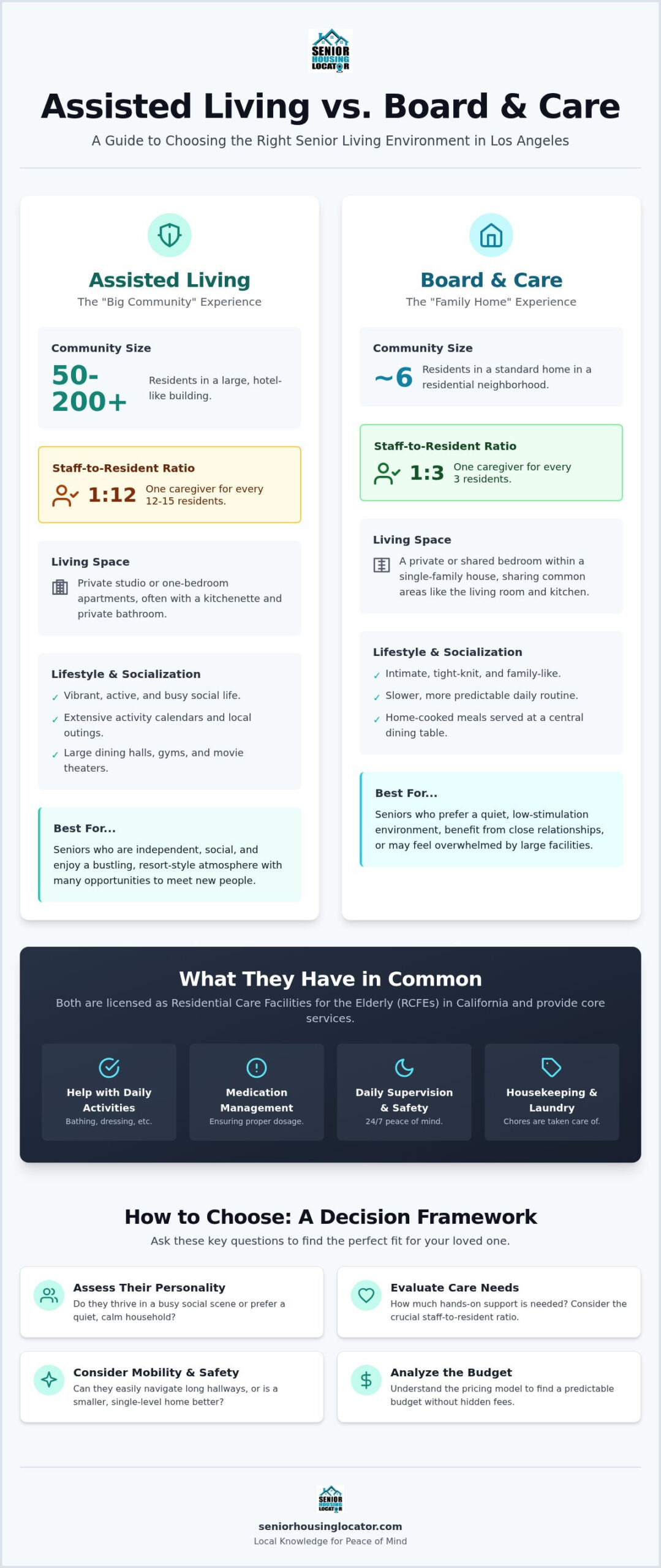
In California, both of these options fall under the same legal category. They are officially known as Residential Care Facilities for the Elderly (RCFEs). The California Department of Social Services licenses and inspects both types to ensure they meet strict safety standards. Whether the building houses 200 people or just six, they are required to help your loved one with Activities of Daily Living (ADLs). This typically includes:
- Assistance with bathing and dressing
- Management of daily medications
- Housekeeping and laundry services
The real difference between an assisted living vs board and care home comes down to the environment, the scale of the community, and the pace of daily life. Understanding these physical differences helps you visualize where your parent will feel most comfortable.
The “Big Community” Experience: Assisted Living
Assisted living facilities are designed for seniors who value their independence but want to ditch the chores. These communities usually house between 50 and 200 residents. Think of it like living in a high-end hotel or a luxury apartment complex. Residents typically have their own private studio or one-bedroom apartment. These units often include kitchenettes and private bathrooms, allowing for a sense of autonomy.
The focus here is on a vibrant, active social life. These communities offer three major benefits for social seniors: extensive common areas like gyms or movie theaters, busy activity calendars with local outings, and large dining halls where residents can meet new friends. It is a great fit for someone who wants to stay busy and enjoys being part of a large crowd.
The “Family Home” Experience: Board and Care
A board and care home offers a much more intimate setting. These are standard single-family houses located in quiet residential neighborhoods like Woodland Hills, Northridge, or other parts of the San Fernando Valley. Most of these homes are licensed for exactly six residents. This small scale creates a tight-knit, family-like atmosphere that is easy to navigate.
Instead of a private apartment, your loved one will have a private or shared bedroom within the house. Life here is slower and more predictable. Meals are usually home-cooked in the house kitchen and served at a central dining table. It’s a comforting, low-stimulation choice for those who might feel overwhelmed by a large building or long hallways.
Key Differences in Care Ratios and Staffing
When comparing an assisted living vs board and care home, the most vital number to look at is the staffing ratio. This metric determines how quickly someone will answer a call for help. In the Los Angeles area, these ratios vary wildly even though both types of homes share the same RCFE license. Understanding these numbers helps you decide which setting can actually provide the level of safety your parent requires.
In a board and care home, the staffing is incredibly intimate. You will typically find a ratio of one caregiver to every three residents. This usually means two dedicated staff members are present during the day to care for a house of six people. Because the environment is so small, staff turnover is often much lower than in larger corporations. Caregivers and residents get to know each other’s favorite foods, sleeping habits, and morning routines. It feels less like a facility and more like a household.
Large assisted living communities operate differently due to their massive scale. Ratios here often range from one caregiver to every 12 or 15 residents during the day. While these facilities use high-tech call buttons and professional management systems, the staff must balance the needs of many more people across long hallways. At night, board and care homes usually have one “awake” staff member or an on-call caregiver living on-site. Assisted living facilities often have a larger night crew, but they are spread across several floors.
Choosing the right fit is a big decision, but talking to a local guide who has toured these homes can make the process much lighter.
Why Ratios Matter for High-Needs Seniors
Staffing ratios aren’t just numbers on a page; they impact the daily health of your loved one. Higher ratios in board and care settings often lead to faster response times for bathroom assistance, which is a key factor in preventing falls. Better monitoring also means caregivers can notice small changes in appetite or mood immediately. This personalized attention ensures seniors stay hydrated and well-nourished throughout the day.
The Role of the Nursing Staff
Assisted living facilities typically have a nurse on-site or on-call 24/7 to handle minor medical issues and coordinate care. If you are looking for a community with specific medical oversight, exploring assisted living placement Woodland Hills can help you find facilities with robust nursing teams. In contrast, board and care homes utilize visiting nurses or home health agencies for clinical needs. The house staff handles the daily care, while outside professionals come in for specialized medical treatments.
Lifestyle and Socialization: Which Environment Fits Their Personality?
Beyond the physical care, you must consider how your parent will spend their afternoons. The social atmosphere is one of the biggest differences when comparing an assisted living vs board and care home. Some seniors thrive in a bustling environment with constant activity, while others find large crowds exhausting or confusing. Matching the environment to your loved one’s personality is key to their long-term happiness.
Assisted living is often the best choice for the “extrovert” senior. These communities function like a small town, offering resident-run clubs, group exercise classes, and off-site outings to local Los Angeles attractions. Your parent will have dozens of peers to meet in the dining room and multiple lounges to visit. If they enjoy being “out and about” and making new friends, the high-energy lifestyle of a large facility can be very life-giving.
A board and care home offers a much more intimate, “introvert-friendly” experience. Because there are only a handful of residents, the social interaction is informal and low-pressure. Instead of a structured ballroom dance class, socialization might look like a chat at the kitchen table or watching a favorite show together in the living room. It’s a quiet, low-stimulation environment that feels like a traditional family home.
The logistics of daily life also differ between these two models. Assisted living facilities usually provide scheduled shuttles for doctor appointments or shopping trips. In a board and care setting, transportation is typically coordinated by the family or through private car services. Activity programming in large facilities is highly structured with a printed monthly calendar; in a board and care home, activities are often tailored on the fly to the specific interests of the six people living there.
Socialization as Medicine
Isolation is a major health risk for seniors living alone. Daily group interactions help combat depression and keep the mind sharp. Assisted living communities excel here by providing “restaurant-style” meals with varied menus and rotating dining partners. We define social engagement as a key factor in slowing cognitive decline. Having a reason to get dressed and leave the room every morning can significantly improve a senior’s outlook on life.
When Low-Stimulation is Better
For some seniors, too much activity is actually a negative. Those with advanced dementia or sensory processing issues can become overwhelmed by the noise and size of a 200-resident building. The “familiarity” factor of a standard residential layout helps reduce anxiety for those with memory loss. If your loved one is prone to wandering or gets easily confused by long hallways, you might want to explore memory care placement San Fernando Valley options that offer a smaller, more secure footprint.
Cost Comparison: Assisted Living vs. Board and Care in Los Angeles
The financial side of senior living in Southern California can feel like a heavy burden to carry alone. When you compare an assisted living vs board and care home, you’ll quickly see that the pricing structures are rarely identical. In the San Fernando Valley market for 2026, families should expect to pay between $5,000 and $9,000 per month. These rates vary based on the neighborhood, the room size, and the specific level of care your loved one requires. Understanding where your money goes helps you plan for the long term without fear of running out of resources.
Understanding the Assisted Living “Level of Care” System
Many large assisted living communities use a complex point-based system to determine their final price. You start with a base rent that covers the apartment, meals, and basic utilities. However, as your parent needs more help with bathing, grooming, or walking to the dining hall, the facility adds “levels of care” fees. It’s common for a base rate of $5,000 to grow into $7,500 or more once these daily tasks are factored in. This “price creep” can be a major source of stress for families on a fixed budget. For a deeper look at these variables, see our full assisted living costs Los Angeles guide.
Board and Care Pricing Structure
If you prefer a more predictable bill, a board and care home might be the right path. These homes typically use an all-inclusive model where one flat monthly rate covers rent, food, and most personal care. You will still see price differences between a private bedroom and a shared one, but the monthly total stays much more consistent. This transparency makes it easier to manage a parent’s savings over several years. You can find more details in our board and care homes Woodland Hills resource. Comparing an assisted living vs board and care home often reveals that the latter is more budget-friendly for seniors who need significant physical help.
Beyond the monthly rent, keep an eye out for common hidden fees that can surprise you. Most facilities charge a one-time community fee or move-in fee. You might also see extra monthly surcharges for medication management, incontinence supplies, or specialized tray service for meals in the room. If you are feeling overwhelmed by these numbers, contact us for a free local referral to find a home that fits your specific budget.
How to Choose: A Decision Framework for Families
Making the final choice between an assisted living vs board and care home is a deeply personal process. It requires looking beyond the lobby decor and focusing on how your parent actually lives their day. To find the right fit, you need a framework that balances their current physical health with their social personality. It’s about finding a place where they don’t just exist, but truly feel at home.
Start by assessing physical mobility and daily stamina. Can your loved one walk the length of a football field several times a day to get to the dining hall or mailbox? If not, the vast hallways of a large assisted living facility might become a barrier to their independence. Conversely, if they are a flight risk or easily overwhelmed by noise, the secure and enclosed environment of a board and care home provides a much-needed sense of safety and calm.
Next, consider their social battery. Do they want a busy calendar filled with art classes, bridge clubs, and new faces? Or do they prefer the comfort of a favorite recliner in a quiet living room with the same few familiar people? We recommend that families tour at least three of each type in the San Fernando Valley. This allows you to develop a baseline for comparison and a “gut feeling” for what feels like a community versus what feels like a business.
The “Touring Checklist” for Los Angeles Families
When you walk through the door of a potential home, pay attention to the small details. Notice the smell and the general cleanliness, but focus even more on the “vibe” of the current residents. Are they engaged and smiling, or do they seem ignored? Watch how the staff interacts with the seniors. Is the tone respectful and warm, or does it feel rushed and clinical? Before you sign any contracts, ask the manager to see the latest state inspection reports to ensure the home meets California’s licensing standards.
Why a Senior Living Advisor Makes the Difference
You don’t have to navigate these difficult choices on your own. A local advisor provides access to “off-market” board and care homes in Los Angeles that don’t advertise on big national websites. We offer neutral advocacy during your search. We don’t work for the buildings; we work for you and your family. Our goal is to help you find a setting that fits your budget and your parent’s care needs perfectly. Schedule a free consultation with a Los Angeles Senior Living Advisor to start your search with a trusted local ally.
Finding Peace of Mind for Your Family
Deciding between an assisted living vs board and care home is about more than just a floor plan. It’s about matching your parent’s daily needs with the right level of attention and social connection. You now understand that while large facilities offer vibrant activity calendars, smaller residential homes provide the intimate care ratios that many high-needs seniors require. You also know how to navigate the Los Angeles pricing models to avoid hidden surprises.
You don’t have to carry this stress alone. As local experts serving Woodland Hills and the San Fernando Valley since 2026, we are here to guide you with integrity. We’ve personally toured these facilities to ensure they meet the highest standards for your loved one’s well-being. Let us help you find the perfect care home—at no cost to your family. We offer a free personalized placement and referral service to make this transition as smooth as possible. You are doing a great job for your parent, and the right solution is within reach.
Frequently Asked Questions
Is a board and care home the same as a nursing home?
No, these are different levels of care. A board and care home provides help with daily tasks like bathing and meals in a residential house. A nursing home is a medical facility for those who need 24/7 clinical supervision or complex wound care. While board and care homes offer a high level of physical assistance, they don’t provide the intensive medical treatments found in a skilled nursing facility.
Which is cheaper: assisted living or a board and care home in Los Angeles?
Board and care homes are often more cost-effective for seniors who need significant hands-on help. In the Los Angeles market, assisted living facilities often start with a lower base rent but add expensive care levels for every task. When comparing an assisted living vs board and care home, the all-inclusive pricing of a residential house usually results in a more predictable monthly bill for families managing a fixed budget.
Can my parent stay in a board and care home until the end of life?
Yes, many homes are able to provide care through the end of life by obtaining a hospice waiver. This allows outside hospice agencies to come into the home and provide specialized comfort care. This means your parent can stay in a familiar environment surrounded by caregivers they know. It’s best to ask each home about their specific hospice policies and experience before you decide to move in.
What happens if my parent’s care needs increase in assisted living?
If your parent needs more help, the facility will usually increase their monthly fee after a new care assessment. This happens if they need more assistance with walking, grooming, or medication. If their needs become too high for a large building, the staff might suggest moving to a specialized memory care wing or a more intimate board and care home where the staff-to-resident ratio is much higher.
Are board and care homes in California licensed and inspected?
Yes, every board and care home in California must be licensed by the Department of Social Services. They are regulated as Residential Care Facilities for the Elderly (RCFEs), just like large assisted living communities. The state conducts regular inspections to check for safety, cleanliness, and proper staffing. You can always ask to see the most recent inspection report when you tour a potential home in your neighborhood.
Is memory care available in both assisted living and board and care homes?
Yes, both settings can provide specialized memory care for residents with Alzheimer’s or dementia. Large assisted living facilities usually have a dedicated wing with secured doors and specific programming. Many board and care homes are also specifically licensed to care for memory loss. The smaller, residential environment of a board and care home is often very calming for seniors who get easily confused by large crowds or long hallways.
How do I find the best board and care homes in the San Fernando Valley?
The most efficient way to find high-quality options is to work with a local referral service that knows the area. We personally tour homes throughout Woodland Hills and the San Fernando Valley to ensure they meet our standards for safety and kindness. We can provide you with a tailored list of vetted homes that fit your parent’s personality and budget. This approach saves you time and helps you avoid poor-quality facilities.