
Imagine sitting at your kitchen table in the San Fernando Valley, surrounded by brochures and feeling a deep sense of guilt about moving your parent out of their lifelong home. You want them to be safe, but the difference between a nursing home and assisted living woodland hills often feels like a confusing maze of jargon and hidden costs. It’s a heavy burden to carry alone, especially when you worry about whether a facility truly lives up to its marketing or if the care standards are high enough for your family.
We believe that finding the right care shouldn’t feel like a second job or a source of constant stress. This 2026 guide is designed to clear the fog and help you find the perfect care setting with total confidence. We will walk you through a curated list of top-tier facilities, explain the new California transparency laws that protect your rights, and provide a clear path toward a peaceful transition for your loved one. By looking at local regulations and medical needs together, we can ensure your family feels supported every step of the way.
Key Takeaways
- Understand how assisted living serves as a vital bridge between independent living and skilled nursing, focusing on daily support and social engagement.
- Compare the resort-style amenities of large communities against the intimate, high-ratio staffing of local residential board and care homes.
- Learn to evaluate the true quality of assisted living woodland hills by identifying staff longevity and using sensory cues during unexpected facility tours.
- Demystify the local pricing landscape by breaking down the two-part model of base rent and tiered care levels to avoid hidden financial surprises.
- Discover how a local placement specialist provides a free service to families, acting as a buffer against sales pressure while finding the perfect medical and social match.
What is Assisted Living in Woodland Hills? Defining Your Options
Choosing a senior living community is a significant step, and understanding the options is the best way to find peace of mind. Many families feel overwhelmed because they assume every facility is a clinical nursing home. In reality, assisted living woodland hills offers a vibrant middle ground. It’s a supportive bridge for seniors who don’t need 24/7 medical supervision but do require a little extra help with daily tasks. To understand the broader definition, you can look at What is Assisted Living on a national level, but local care in the San Fernando Valley often adds a resort-style touch.
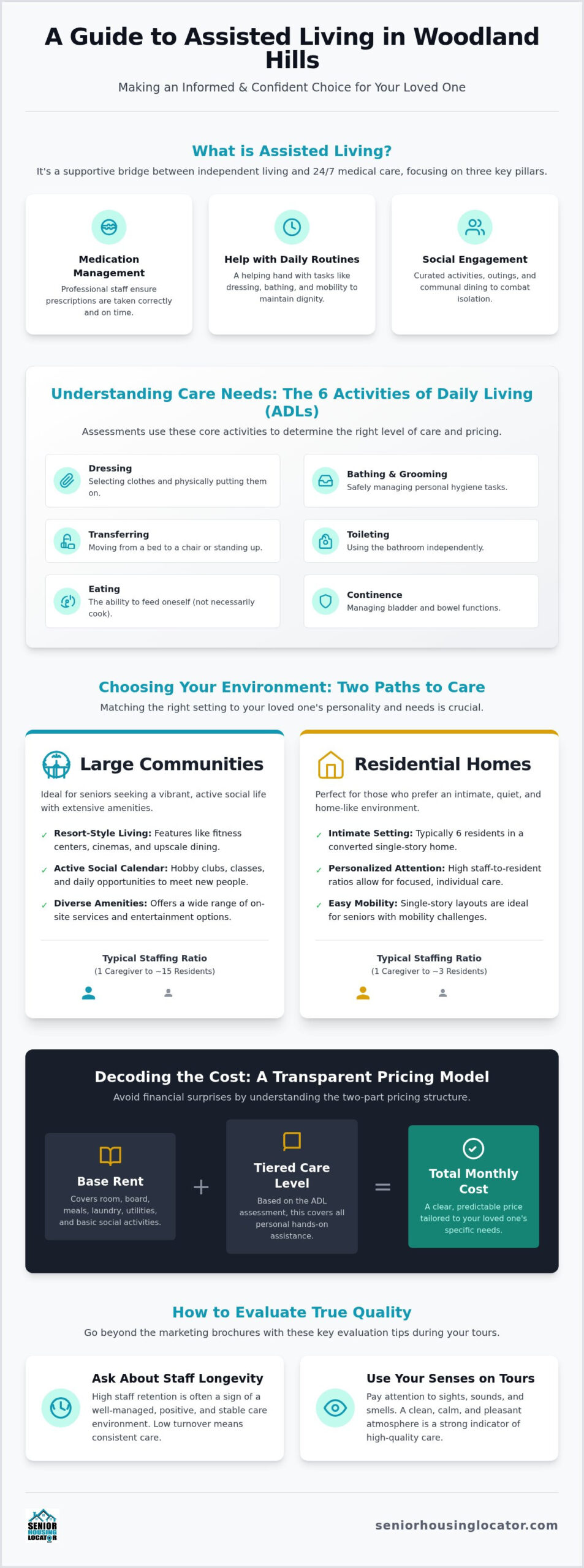
Most communities focus on three main pillars: medication management, help with daily routines, and social engagement. Residents enjoy their own private spaces while having professional staff nearby to help with things like keeping track of prescriptions or getting ready for the day. Living here also means being close to the beauty of the Santa Monica Mountains and the convenience of local shopping at Westfield Topanga. By focusing on a “helping hand” approach, these communities prioritize dignity and independence.
Activities of Daily Living (ADLs) Explained
Assessments are vital because they help ensure your loved one gets exactly the right amount of care without paying for services they don’t use. Most providers look at six specific Activities of Daily Living (ADLs) to determine care levels and pricing:
- Bathing and grooming: Managing personal hygiene tasks safely.
- Dressing: Selecting clothes and physically putting them on.
- Eating: The ability to feed oneself, though not necessarily cook.
- Transferring: Moving from a bed to a chair or standing up.
- Toileting: Using the bathroom independently.
- Continence: Managing bladder and bowel functions.
A professional assessment is the first step in your search. It isn’t just a formality; it’s a tool for clarity. This step prevents the stress of unexpected care costs later on and helps you compare different assisted living woodland hills options on an even playing field.
The Woodland Hills Senior Living Landscape
The San Fernando Valley offers a diverse range of settings. The Warner Center area has seen a boom in luxury, resort-style communities that feel more like a vacation spot than a care facility. These often feature upscale dining, fitness centers, and cinema rooms. For many families, being near medical hubs like Kaiser Permanente Woodland Hills provides an extra layer of security for chronic health needs.
The neighborhood “feel” is just as important as the facility itself. You might prefer the quiet, tree-lined residential streets near Mulholland or the energy of a more urban center. Whether your loved one enjoys a peaceful afternoon on a patio or a busy social calendar, the local landscape has a setting that fits their personality and your family’s logistical needs.
Large Communities vs. Residential Board and Care Homes
When you begin your search for assisted living woodland hills, you’ll quickly notice two distinct styles of care. One path leads to expansive, resort-style campuses. The other leads to quiet residential streets where traditional houses have been transformed into small, intimate care settings. While both types of facilities must adhere to California’s official regulations, the daily rhythm of life in each is very different. Understanding these differences helps you match the environment to your loved one’s personality.
Large communities often feel like a cruise ship on land. They offer grand dining rooms, cinema rooms, and multiple floors accessed by elevators. Residential board and care homes, however, are typically single-story ranch houses with a much smaller physical footprint. This matters for seniors who struggle with mobility. A walk to the dining room in a large facility might be a long journey, while in a board and care home, it’s just a few steps. Staffing ratios also vary. In a large facility, one caregiver might look after 15 residents. In a residential home, that ratio often drops to one caregiver for every three residents.
When a Large Community is the Right Choice
These settings are ideal for seniors who want a vibrant, active social life. If your loved one enjoys fitness classes, hobby clubs, and meeting new people every day, a large community provides that energy. These campuses often house specialized memory care wings too. This setup allows for a seamless transition if care needs increase later. When touring, pay attention to the social dynamics. Do you see residents laughing together in the common areas? A high-energy “vibe” usually indicates a well-run social program.
The Benefits of Woodland Hills Board and Care Homes
These residential settings are the San Fernando Valley’s hidden gems. They provide a quiet, family-style environment that feels like a real home rather than a business. For seniors who require a high level of physical assistance, these homes are often more cost-effective because the care is built into the intimate setting. You won’t find long hallways or crowded elevators here. Instead, you’ll find a familiar kitchen table and a small group of consistent caregivers. For a deeper look at these options, see our guide on Board and Care Homes in Woodland Hills.
If you aren’t sure which environment suits your parent’s temperament, we can help you view vetted local options that match their specific medical and social needs.
Evaluating Quality: How to Tour Facilities in the San Fernando Valley
Walking through the front door of a potential community is often an emotional experience. It’s easy to get distracted by beautiful lobbies or gourmet menus, but the real quality of assisted living woodland hills lies in the details you can’t see on a website. Use your senses. A “smell test” is a simple but effective tool; a facility should smell clean and fresh without being masked by heavy floral scents. Look for resident engagement. Are people active in common areas, or are they sitting alone? Evaluating care facilities properly means looking for signs of a warm, lived-in home rather than a cold institution.
Every facility in the San Fernando Valley must follow California’s Title 22 regulations. These rules cover everything from food safety to staffing requirements. Before your tour, look up the facility’s recent inspection reports through the Department of Social Services (DSS) website. These documents reveal the history of the building, including any past citations and how quickly the management resolved them. A transparent facility will be happy to discuss their record with you during your visit.
Staffing and Care Culture
The people who provide the care are the heartbeat of the community. Ask about staff longevity and caregiver training programs. High turnover can lead to inconsistent care, while long-term staff often treat residents like family. Watch how the team interacts with seniors. Are they making eye contact and using residents’ names, or do they seem rushed and distracted? The Executive Director plays a huge role here too. A director who is visible and knows the residents by name usually fosters a more respectful and compassionate culture.
Safety and Environment Standards
Safety should be your top priority when visiting any care setting. Look for emergency pull cords in bathrooms and wearable call buttons that residents can use at any time. Check the floors for trip hazards and ensure that hallways are well-lit and equipped with sturdy handrails. Cleanliness matters, but look beyond the surface. Is the furniture in good repair? Are the outdoor spaces secure and accessible? Acuity-based staffing is a critical safety metric where the number of staff on duty changes based on the actual physical and medical needs of the residents.
Calculating the Real Cost of Care in Woodland Hills
Understanding the financial side of assisted living woodland hills is often the most stressful part of the journey. Most families expect a single flat rate, but the reality is usually a two-part pricing model. First, you pay a base rent for the apartment itself. Second, you pay for a “care level” based on the ADLs we discussed earlier. This ensures you only pay for the specific help your loved one needs. You should also prepare for a one-time community fee, which typically covers the administrative costs of the move-in process and initial health assessments.
Location within the San Fernando Valley also plays a role in your monthly budget. While Woodland Hills is a premier destination with an average monthly cost of $5,901 as of late 2026, costs can vary. You might find that Northridge offers slightly more modest rates, while Sherman Oaks often mirrors the higher-end pricing found in the Warner Center area. If your loved one requires specialized memory care, expect the monthly budget to increase significantly. This is due to the higher staffing ratios and specialized safety measures required for dementia support.
Financial Assistance and Planning
Many families use Long-Term Care Insurance (LTCI) to help manage these expenses. In California, it’s important to verify that the facility is a licensed Residential Care Facility for the Elderly (RCFE) to ensure your policy pays out. Veterans and their surviving spouses may also qualify for the “Aid and Attendance” benefit. This is a monthly pension that can provide thousands of dollars in additional tax-free income to help cover care costs. For a deeper dive into these numbers, see our Assisted Living Costs in Los Angeles.
Avoiding Hidden Costs
Always ask about annual rent increases. Most facilities raise rates by a small percentage each year to keep up with rising labor costs and inflation. You should also look closely at “add-on” services. Some communities charge extra for medication management, laundry, or incontinence care. As of July 1, 2026, California law requires facilities to provide clear, written disclosures about pricing and staffing ratios before you sign a contract. Use this transparency to your advantage. Don’t be afraid to negotiate move-in incentives, especially in a competitive market. If you’re feeling overwhelmed by the math, we can help you compare local pricing to find a home that fits your budget.
How a Local Placement Specialist Simplifies Your Search
Searching for assisted living woodland hills can feel like a full-time job at a time when your family is already under immense pressure. Families often spend hours researching online, making dozens of cold calls, and touring facilities that don’t actually fit their needs. A local placement specialist acts as a “Compassionate Facilitator” to lift this heavy burden. We serve as your personal buffer against high-pressure sales tactics and marketing jargon. By using a deeply vetted database of San Fernando Valley facilities, we narrow your search to a curated list of homes that truly match your requirements.
This expert guidance is entirely free for families. We are compensated by the senior living providers, which allows us to focus all our energy on your peace of mind and your loved one’s comfort. We handle the logistical heavy lifting, from the initial care assessment to move-in day advocacy. You don’t have to worry about whether a home meets high care standards; we’ve already checked their records for you. It’s about having a knowledgeable friend in your corner during a high-stakes transition. We provide the calm and order you need when the process feels chaotic.
The Value of Local Expertise
A glossy brochure only tells a small part of the story. Real expertise comes from knowing the “insider reputation” of a community, such as how often the staff changes or how the management handles difficult situations. We maintain close, professional relationships with local discharge planners at West Hills Hospital to ensure smooth transitions for seniors leaving medical care. Working with a Senior Living Advisor Los Angeles gives you access to years of local knowledge that a national website simply can’t provide. We know which homes have recently updated their facilities and which ones have the most consistent, long-term care teams.
Personalized Matching Criteria
Our team doesn’t just look at medical charts or budget sheets. We match seniors based on their social interests, unique personalities, and lifestyle preferences. Does your parent love gardening, or would they prefer a quiet library? We take these details into account to find a community where they will truly thrive. If a crisis occurs at home and you need an urgent placement, we move quickly to find a safe, supportive environment. Our ultimate goal is to facilitate a “one-time move” to the perfect home where your loved one can age in place with dignity and comfort.
Finding Peace of Mind in Your Senior Living Search
Choosing the right care setting is a journey that starts with clarity. You now have the tools to distinguish between large resort-style campuses and the intimate atmosphere of a board and care home. By focusing on sensory cues during your tours and understanding the two-part pricing model, you’re already ahead of the curve. These steps ensure that your decision is based on facts and feelings rather than just marketing brochures.
Finding the ideal assisted living woodland hills doesn’t have to be overwhelming. We’re here to act as your trusted local ally, using our vetted network of Woodland Hills communities to find the right fit. Our personalized assessments look at both social interests and medical needs to ensure your loved one thrives. Families across the San Fernando Valley trust us to simplify this transition and provide an extra layer of protection during the search.
Let our local Woodland Hills experts help you find the perfect care—at no cost to your family.
You’re making a brave and loving choice for your parent. With the right guidance, your family can move forward with confidence and a shared sense of relief.
Frequently Asked Questions
How much does assisted living in Woodland Hills typically cost per month?
In late 2026, the average monthly cost for assisted living in the Woodland Hills area is approximately $5,901. This rate typically covers your base rent, three daily meals, and basic utilities. You should also plan for additional care tier costs based on your loved one’s specific medical needs. Some luxury communities in the Warner Center area may have higher starting points than smaller residential homes.
Is there a difference between a board and care home and assisted living?
Yes, the primary difference lies in the size and setting of the facility. Assisted living typically refers to larger communities with 50 to 100 residents and a resort-style atmosphere. Board and care homes are intimate, residential houses that usually serve only six residents. While both provide help with daily tasks, board and care homes often offer a higher caregiver-to-resident ratio in a quiet, family-style environment.
Does Medicare pay for assisted living facilities in California?
Medicare typically doesn’t pay for long-term custodial care in assisted living woodland hills. It’s designed to cover medical expenses, hospital stays, and short-term rehabilitation in a skilled nursing facility. Most families use private funds, long-term care insurance, or Veterans benefits like the Aid and Attendance pension to cover the monthly costs of a residential care setting. We can help you explore these financial options during our search.
What is the best way to start looking for senior housing in the San Fernando Valley?
The best starting point is a professional assessment of your loved one’s medical needs, social preferences, and budget. Instead of calling dozens of facilities yourself, you can work with a local placement specialist who knows the San Fernando Valley landscape. We help you skip the high-pressure sales calls by providing a curated list of vetted homes that match your specific criteria. This approach saves you time and reduces the stress of the search.
Can my parent stay in assisted living if their care needs increase significantly?
Most residents can stay in their community as their needs change through tiered care levels. Many Woodland Hills facilities offer a continuum of care model, allowing transitions from assisted living to specialized memory care if dementia progresses. However, if a resident requires 24/7 intensive medical supervision or complex nursing care, a transition to a skilled nursing facility might eventually become necessary. We help you evaluate which communities offer the best aging-in-place options.
How do I know if a Woodland Hills facility is properly licensed?
Every legitimate facility in California must hold a Residential Care Facility for the Elderly (RCFE) license issued by the Department of Social Services. You can verify a facility’s status and view their recent inspection history on the state’s Community Care Licensing Division website. We also verify the current licensing and safety records of every home in our vetted network. This ensures your loved one is moving into a facility that meets all state safety standards.
What happens if my loved one has dementia or Alzheimer’s?
When a resident has dementia, we look for specialized memory care. These settings provide secure environments, higher staffing ratios, and activities tailored to cognitive support. Many larger assisted living woodland hills communities have dedicated memory care wings. Alternatively, some residential board and care homes specialize in dementia care; they offer a quiet, familiar setting that reduces confusion and anxiety for seniors with memory loss.
Why is your senior placement service free for families?
Our placement service is free to families because our costs are covered by the senior living providers in our network. They pay us a referral commission once a successful placement is made. This allows us to provide you with expert local guidance, personalized facility tours, and move-in advocacy without any out-of-pocket expense. Our priority is simply to help you find the safest, most supportive home possible while acting as your advocate throughout the entire process.