
What if the most stressful part of aging wasn’t a health diagnosis, but the fear of sleeping in a different building than the person you’ve loved for fifty years? For many, exploring senior living for couples feels overwhelming because you worry that different health needs will mean living separate lives. You’ve spent decades building a home together, and the thought of being apart is heartbreaking. It’s completely natural to feel anxious about pricing or the weight of becoming a full-time caregiver for your spouse. You deserve a solution that honors your marriage while providing the professional support you both need to thrive.
The good news is that dual-occupancy options in 2026 are more flexible and accessible than ever before. This guide will show you exactly how couples can age together in one unit, even when one person requires more medical attention than the other. We’ll break down the “second person fee” structure, explain how to navigate split-care needs, and provide a clear path to finding a community that feels like home. You’ll learn how to protect your partnership and ensure that both your social and medical needs are met without compromise.
Key Takeaways
- Understand how modern communities prioritize keeping you together, ensuring that health changes don’t have to mean living apart.
- Discover how to select the best senior living for couples by determining which spouse’s health needs should serve as the “anchor” for your care level.
- Learn practical strategies for “split-care” situations where one partner needs specialized support, like memory care, while the other remains independent.
- Demystify the “second person fee” and learn why sharing a larger suite is often more manageable than paying for two separate units.
- Gain a step-by-step approach to evaluating local Los Angeles communities to find the specific floor plans and layouts that fit your unique lifestyle.
Understanding Senior Living Options for Couples in 2026
Senior living for couples is about more than just sharing a room; it’s about choosing a community designed specifically for dual occupancy. In 2026, we see a major shift toward “aging in place.” Modern communities now focus on keeping partners together even as health needs change. This approach offers significant benefits. Research often shows that couples who stay together experience less loneliness, better emotional stability, and improved physical health outcomes. Staying together reduces the trauma of relocation and keeps your most important support system right by your side.
Many Continuing Care Retirement Communities (CCRCs) are leading this trend. They allow you to move into a community while you’re both independent, with the peace of mind that care is available right there if you need it later. Instead of moving to a separate wing, many newer buildings are licensed to bring care services directly to your shared apartment. This keeps your daily life consistent and your marriage at the center of your care plan. It removes the stress of wondering “what if” because the solution is already built into your home.
Independent Living for Active Couples
This option is perfect for couples who are ready to trade home maintenance for a more vibrant social life. You can say goodbye to mowing the lawn, fixing leaky faucets, and managing a large house. Instead, you’ll focus on shared meals, fitness classes, and community outings. Transitioning from a long-time family home into a luxury senior apartment can feel like a fresh start. It’s a chance to simplify your life while staying connected to your partner in a resort-style environment. You get the freedom of a private home with the perks of a community.
Assisted Living for Couples
When one or both of you need help with daily tasks like dressing or medication management, assisted living provides a supportive safety net. The goal is to keep your unit feeling like a home rather than a clinic. In 2026, the best communities offer floor plans with separate living and sleeping areas. This is vital for privacy and comfort. It allows the more independent spouse to have their own space to read or relax while the other receives care. Choosing the right senior living for couples means finding a layout that respects both your shared life and your individual needs.
Comparing Care Levels: From Independent Living to Assisted Living for Couples
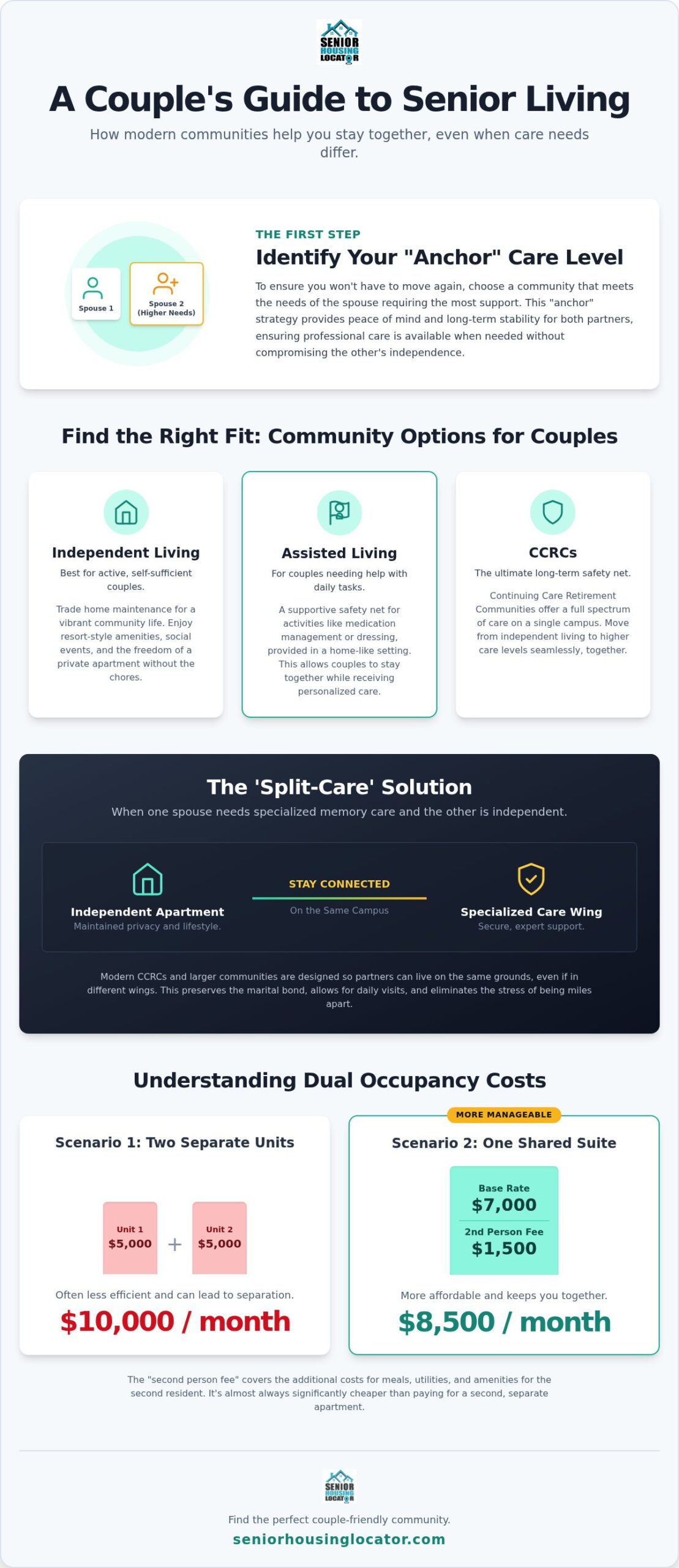
Finding the right senior living for couples starts with identifying your “anchor” care level. This is the specific amount of support required by the spouse with the most immediate health concerns. While one partner might only need a social community, the other may require help with a variety of services like medication management or mobility assistance. By choosing a community based on the higher level of care, you ensure that both of you are protected and won’t have to move again if needs increase. It’s also vital to look at the social needs of the healthier spouse. They shouldn’t feel like they’re living in a hospital; they need access to fitness centers, hobbies, and peer groups to maintain their own well-being.
The CCRC Advantage for Couples
For many families in Los Angeles, Continuing Care Retirement Communities (CCRCs) offer the ultimate safety net. These communities often provide a “Type A” contract, which essentially guarantees care for life on a single campus. In a CCRC, you pay an entry fee and a monthly fee, but your costs stay relatively stable even if one of you moves from independent living to a higher care level. It’s a secure way to manage your future without the fear of being separated by a sudden health crisis. This model provides long-term stability for couples with different health trajectories, ensuring you always have a place together.
Assisted Living vs. Board and Care for Couples
Larger assisted living communities provide a resort-style experience with movie theaters, multiple dining rooms, and daily events. They’re great for couples who love to stay busy and meet new people. On the other hand, board and care homes in neighborhoods like Woodland Hills and Sherman Oaks offer a quiet, intimate atmosphere. These are residential homes that typically house six to ten residents, providing a high staff-to-resident ratio.
Choosing between these two depends on what makes you feel most at home. Board and care homes often foster better intimacy because the environment is smaller and more personalized. However, a larger facility might offer the social variety that a more active spouse craves. If you’re feeling stuck between these choices, consulting a local senior living advisor can help you compare specific senior living for couples in your preferred neighborhood for free. Both options allow you to stay together, but the “feel” of your daily life will be very different.
Navigating the ‘Split-Care’ Challenge: When Spouses Have Different Health Needs
What happens when one partner faces cognitive decline while the other remains physically active? This is the heart of the ‘split-care’ challenge. Many families worry that a memory care diagnosis means living in different zip codes. In 2026, the best senior living for couples options solve this by offering tiered care within a single campus. You can live in the same building, share your morning coffee, and participate in community events, even if you sleep in different wings tailored to your specific medical needs. Using respite care during this transition can also provide a helpful trial run to see how both partners adjust to the new environment without the pressure of a permanent move.
Managing the emotional toll on the independent spouse is just as important as the medical care for the other. It’s common to feel guilty about “handing over” care duties. However, staying in the same building allows you to remain the primary emotional support without the physical exhaustion of being a 24/7 nurse. This proximity ensures that your daily connection remains unbroken while professional staff handle the complex safety requirements that come with advanced health needs.
Living Together in Memory Care
It’s a common question: can a healthy spouse move into a locked memory care unit with their partner? While California regulations generally allow this if the facility agrees, it’s a decision that requires careful thought. Living in a secured area can feel isolating for an independent person who still wants to drive, shop, or visit friends easily. Safety for the independent spouse is also a factor, as memory care environments are specifically designed for those with cognitive impairment. A more balanced alternative is for the independent spouse to live in the assisted living wing while the other resides in memory care. This setup ensures safety for one and freedom for the other, all while keeping you just a short hallway apart.
The Burden-Shift: From Caregiver to Spouse
The most profound benefit of this transition is the emotional relief it brings to the healthier partner. When you’re no longer responsible for managing medications or monitoring safety around the clock, you can finally return to your true role. Professional care restores the husband-and-wife dynamic by removing the heavy lifting of daily medical tasks. This shift allows you to focus on companionship rather than logistics. Most communities also offer dedicated support groups for well spouses, providing a space to share experiences with others who truly understand the unique path you’re walking.
Evaluating Costs and Logistics for Dual-Occupancy Senior Housing
One of the biggest hurdles for families is understanding how the bill changes when two people move in together. Many assume that the cost will simply double, but that isn’t how senior living for couples typically works. Most communities use a “base plus fee” model. You pay for the apartment itself, and then you pay a second person fee to cover the additional resident’s daily needs. This approach is almost always more affordable than maintaining two separate units or staying in a large family home with rising property taxes and maintenance costs. However, you must also account for tiered care pricing. While you share a roof, your medical care is priced individually based on your specific health needs.
The Second Person Fee Explained
The second person fee is a standard industry practice that covers the variable costs of having an extra resident in the room. This includes three meals a day, all utilities, weekly housekeeping, and access to the community’s social calendar. It’s a fraction of the cost of a second apartment because you’re already paying for the real estate. In the Los Angeles market, this fee is a predictable monthly addition that simplifies your budgeting. If one spouse eventually passes away or needs to move to a higher level of care like a skilled nursing wing, this fee is usually removed from the monthly statement. This flexibility provides a financial safety net during difficult life transitions.
Financial Planning for the Move
Many couples in neighborhoods like Woodland Hills or Encino fund their move by tapping into their home equity. Selling a long-time family home can provide a significant nest egg that covers entrance fees and monthly costs for years. You should also review your long-term care insurance policies together. Some policies allow couples to “pool” their benefits, or they may offer a discount for spouses living in the same community. It’s also worth discussing the tax implications with a professional. In many cases, a portion of the fees for assisted living can be considered a deductible medical expense, which can lower your overall financial burden.
Understanding the nuances of local pricing is key to making a confident decision. For a more detailed breakdown of what to expect in our area, you can explore this guide to assisted living costs in Los Angeles. Every community has a slightly different way of bundling their services, so it helps to have a clear comparison. If you’re feeling overwhelmed by the math, you can talk to a local advisor for free to get a personalized cost comparison for the best senior living for couples in your preferred neighborhood.
Finding the Perfect Couple-Friendly Community in Los Angeles and Woodland Hills
Searching for senior living for couples in the Los Angeles area requires a focused approach. While there are 127 assisted living communities in the city, not all of them offer the layouts or care models that support a shared life. You need to start by assessing the total care needs of both individuals. This involves looking at current medical requirements, potential future needs, and the social activities that keep both of you engaged. Once you have a clear picture, you can tour communities with an eye for dual-occupancy amenities like larger suites and flexible dining programs. Utilizing a free placement service is a smart way to filter for local availability, ensuring you only visit buildings that can actually accommodate two people comfortably.
Local expertise is vital because every neighborhood has its own character and pricing structure. An advisor who knows the San Fernando Valley can point you toward communities in Woodland Hills that offer more space, or find hidden gems in Sherman Oaks that specialize in “aging in place” for partners. This targeted search saves you from the frustration of visiting facilities that only offer small studio units. By focusing on your specific social and medical needs, you can find a community that feels like a natural extension of your current life.
The Role of a Senior Living Advisor in Los Angeles
A local expert does more than just provide a list of addresses. They understand the nuances of the market and can quickly identify facilities in Burbank or Pasadena that cater specifically to couples. They know which buildings have the best two-bedroom floor plans and which ones offer the most flexible care transitions. Instead of spending hours on the phone, you can see how a senior living advisor in Los Angeles simplifies the search by matching you with communities that fit your budget and lifestyle. This service is free for families, removing one more burden from your decision-making process.
Questions to Ask During Your Tour
When you’re on a tour, it’s important to look beyond the lobby decor. Ask the staff about shared dining options for couples who might be in different care levels. You should also clarify the specific policy for “aging in place” together. Can you stay in the same room if one person’s health needs increase significantly? Finally, ask if you can bring your own furniture. Bringing your favorite sofa or dining table can help make the new space feel like your long-time family home. These answers will help you decide if a community truly supports the goal of staying together while getting the care you need.
Taking the Next Step Together
You’ve spent a lifetime building a partnership, and moving to a senior community shouldn’t mean leaving that bond behind. Modern senior living for couples ensures that your marriage remains the priority, whether you need independent living or specialized memory care. By understanding the “second person fee” and leveraging local Los Angeles expertise, you can find a shared home that balances medical safety with the intimacy you’ve always cherished. You deserve a transition that feels like a fresh start rather than a difficult compromise.
Our team provides a free placement service for Los Angeles families, specializing in San Fernando Valley senior care. We offer integrity-driven, personalized referrals to help you find the specific floor plans and care models that fit your unique situation. Let our local experts find the perfect couple-friendly community for you—free of charge.
You don’t have to navigate these complex decisions alone. We’re here to act as your trusted local ally, ensuring you and your spouse can continue your journey together with peace of mind and total comfort.
Frequently Asked Questions
Can couples live together in assisted living if only one needs help?
Yes, couples can absolutely live together in assisted living even if their care needs differ. Most communities in Los Angeles and Woodland Hills are designed to support one spouse who requires help with daily tasks while the other remains independent. The spouse needing assistance receives professional care within the shared apartment. This allows you to stay together in a home-like environment while ensuring everyone’s medical and social needs are met.
How much more does it cost for a second person in senior living?
Instead of doubling the monthly rent, most facilities charge a second person fee for an additional resident. This fee covers daily meals, utilities, housekeeping, and access to all community amenities. It is a predictable way to manage your budget without the expense of two separate units. In the 2026 market, this structure remains the most affordable way for partners to access professional support while sharing a single apartment.
What happens if my spouse needs memory care and I do not?
Many communities in the San Fernando Valley offer split-care arrangements to keep you close. You might live in an assisted living unit while your spouse receives specialized support in the memory care wing of the same building. This setup ensures your spouse is safe and professionally cared for while you maintain your independence. You can still spend your days together in shared common areas or during scheduled visits without the stress of caregiving.
Are there two-bedroom senior living apartments in Los Angeles?
Yes, many communities in Santa Monica, Burbank, and Northridge feature two-bedroom apartments. These larger floor plans are ideal for senior living for couples who need extra room for hobbies, a home office, or overnight guests. Having separate bedrooms can also be helpful if one spouse has different sleep schedules or medical equipment. We can help you identify which local buildings offer these specific layouts to fit your lifestyle.
Can we bring our pet to a couple-friendly senior living community?
Most modern senior living communities are pet-friendly and welcome your furry family members. They understand that pets provide vital emotional support and companionship as you age. Many facilities in Pasadena and Sherman Oaks even include pet-focused amenities like walking paths or grooming stations. Always check the specific pet policy regarding size or breed before moving in to ensure your pet is a perfect fit for the community.
Is independent living for couples cheaper than staying at home?
For many homeowners in Granada Hills or Encino, independent living is a cost-effective alternative to homeownership. When you add up property taxes, home repairs, landscaping, and food costs, a single monthly fee often proves more manageable. It also removes the hidden costs of future home modifications. You get a predictable budget that includes your housing, dining, and social life all in one simplified monthly statement.
What if my spouse passes away while we are in senior living?
If your spouse passes away, you can usually remain in your shared apartment. The facility will typically remove the second person fee from your monthly bill, reflecting the change in occupancy. Staying in a familiar environment allows you to lean on the support of the community staff and friends you have already made. It provides a sense of continuity and comfort during a difficult emotional transition without the need for another move.
How do we find senior living for couples in the San Fernando Valley?
Finding the right senior living for couples in the San Fernando Valley is easier when you use a local expert. At Senior Housing Locator, we provide a free referral service that filters for communities in Woodland Hills and surrounding areas that meet your specific care and social needs. We know which buildings have the best layouts for couples and can help you compare options based on your budget and preferred location.