
What if the most expensive facility in town actually offers less personal attention than a standard neighborhood home? When you start looking at senior living, it’s easy to feel overwhelmed by the choices and the fear of making a wrong turn. You’re likely weighing a board and care home vs assisted living, wondering which environment will truly help your parent thrive. It’s completely natural to feel a sense of guilt, confusion, or fear, especially when you’re trying to decode licensing terms or the new 2026 dementia care standards.
We understand that you want more than just a room; you want peace of mind. With California’s 2026 reinstatement of the Medi-Cal asset test and stricter resident reappraisal rules, the senior care environment is shifting. This guide helps you manage these updates while comparing the intimate feel of a residential home against the amenities of a larger community. You’ll gain a clear framework to justify the cost differences and find the right social fit. We’ll break down the care levels, environments, and local options so you can make a choice that feels right for your family.
Key Takeaways
- Learn the difference between a 100-resident community and a small, 6-resident residential home to see which environment fits your loved one’s personality.
- Compare a board and care home vs assisted living based on specific daily care needs, social activity levels, and the overall “vibe” of the facility.
- Understand the pricing models, including the difference between “all-inclusive” flat rates and “base rate plus care” tiered pricing common in larger facilities.
- Use our decision framework to weigh high socialization against personalized oversight, ensuring your loved one doesn’t get “lost in the crowd.”
- Discover how a local placement specialist can filter your search by budget and location to find “hidden gem” facilities in Woodland Hills or Los Angeles.
Understanding the Basics: What is a Board and Care Home vs. Assisted Living?
Choosing the right environment for a parent is a deeply personal task. It’s helpful to realize that in California, both options are regulated as Residential Care Facilities for the Elderly (RCFE). While the state views them similarly from a licensing perspective, your loved one’s daily life will look very different depending on which path you choose. The core difference between a board and care home vs assisted living lies in the scale of the environment and the variety of social programming available. One offers an intimate, household feel, while the other provides a bustling, community-centered lifestyle.
The Residential Care Home (Board and Care) Model
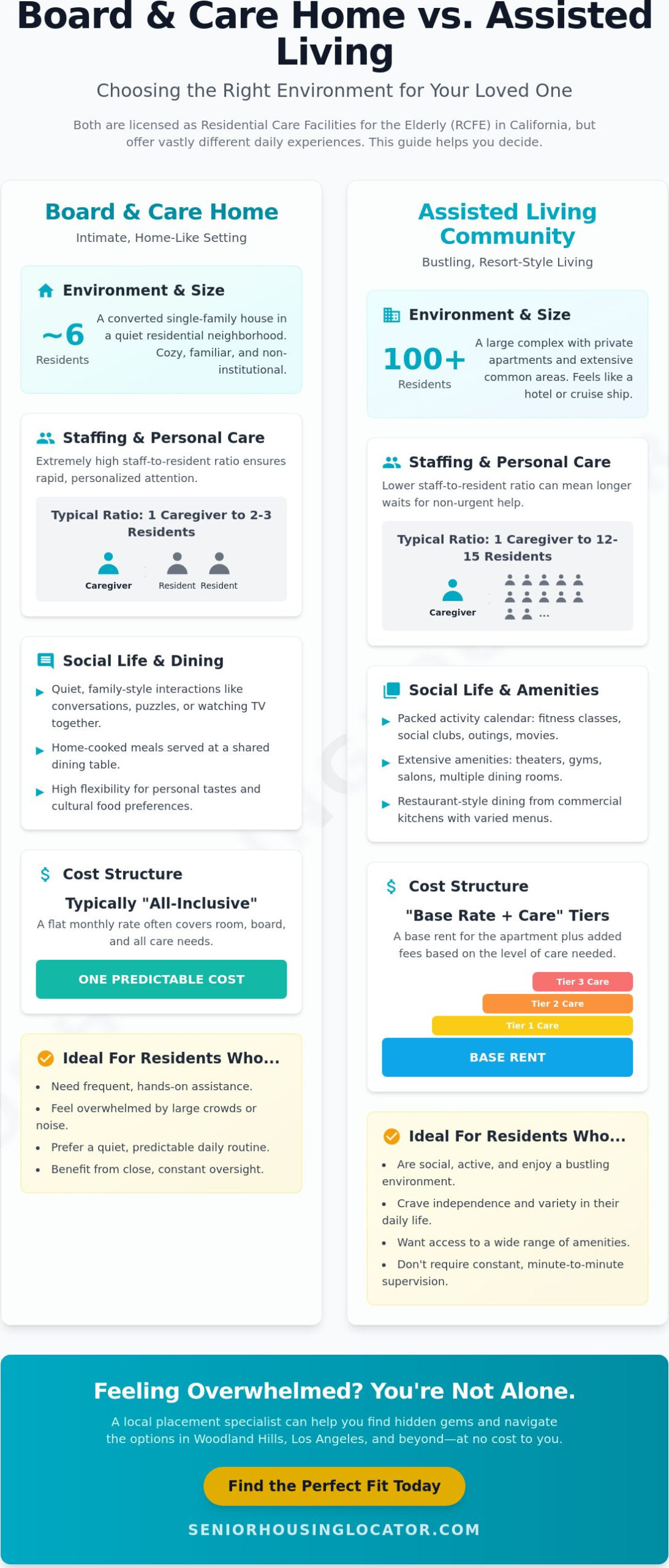
These facilities are typically converted single-family houses nestled in quiet, residential neighborhoods like Woodland Hills or Encino. They look just like any other home on the block. Inside, they usually house six residents, creating a cozy and familiar atmosphere that doesn’t feel like a facility. Meals are served family-style around a shared dining table, and living rooms are communal spaces for watching television or chatting. One of the biggest draws is the high staff-to-resident ratio, which often sits at 1:2 or 1:3. This means caregivers are always nearby. It’s an ideal setting for those who might feel overwhelmed by large crowds or who need more frequent, hands-on attention throughout the day. Families researching board and care homes San Fernando Valley often find that these intimate residential settings provide far more personalized attention than larger luxury communities.
The Assisted Living Community Model
For seniors who enjoy a bustling social life, Assisted living communities offer a hotel-style or resort-style experience. These are larger complexes where residents live in private apartments, allowing them to keep their independence while having help nearby. The amenities are extensive. You’ll often find on-site theaters, fitness centers, and multiple dining rooms. Life here is structured around a calendar full of social clubs, fitness classes, and scheduled outings. It’s an environment designed for those who want a wide range of activities and the chance to meet many new neighbors. The scale is much larger, often housing 100 or more residents, which provides a sense of energy and constant motion.
Deciding between a board and care home vs assisted living means matching your loved one’s personality to the setting. Does your parent prefer the quiet comfort of a familiar living room or the energy of a community lobby? Both provide essential support for daily tasks, but the “vibe” of each will dictate how comfortable they feel. Smaller homes offer simplicity and close oversight. Larger communities offer variety and independence. Understanding these basic structures is the first step toward finding a place where your family member can truly feel at home.
Comparing Care Levels, Amenities, and Daily Life
What does a typical Tuesday afternoon look like for your parent? In a large assisted living community, it might involve a bridge club meeting, a fitness class, or a movie in an on-site theater. In a board and care home, it might be a quiet conversation on the back patio or help with a favorite puzzle in the living room. Both settings are technically a Residential Care Facility for the Elderly (RCFE), but the social pulse is night and day. While assisted living offers the energy of a crowd, board and care provides the comfort of a small family circle.
When comparing a board and care home vs assisted living, many families assume a larger building equals better medical care. This is a common misconception. Both environments provide help with Activities of Daily Living (ADLs) like bathing, dressing, and medication management. The difference is often found in the kitchen. Assisted living typically uses commercial kitchens with restaurant-style menus and multiple choices. Board and care homes offer home-cooked meals prepared in a standard kitchen, often allowing for more personal input on what’s for dinner. If your loved one is a picky eater or has specific cultural preferences, the smaller setting can be much more accommodating.
Staffing Ratios: The Hidden Differentiator
Staffing ratios are the single most important factor in how quickly help arrives. In a large community, a single caregiver might be responsible for 12 to 15 residents. This can lead to longer wait times when a call button is pressed. In a residential board and care home, the ratio is frequently 1:3 or 1:2. This level of oversight means caregivers notice small changes in a resident’s health or mood almost immediately. You also get incredible consistency. Your parent will see the same three or four faces every day, rather than a rotating staff of dozens. This familiarity is vital for managing specialized needs like catheters or diabetes, where knowing a person’s “normal” is key to safety.
Social and Emotional Wellness
The right choice often depends on whether your loved one is an introvert or an extrovert. Assisted living is like a cruise ship. It’s perfect for the senior who wants a busy schedule and a wide social circle. However, for a senior who is more reserved, the “living room” vibe of a board and care home is often less intimidating. It prevents the social isolation that can happen when someone feels lost in a large crowd. If you are exploring options in the San Fernando Valley, our board and care homes Woodland Hills guide provides a closer look at these intimate local settings. If you’re still unsure which environment fits best, speaking with a local advisor can help clarify your priorities and simplify the search.
The Financial Landscape: Costs in Woodland Hills and Greater Los Angeles
Financial clarity is the foundation of a confident choice for your family. While the California Department of Aging provides a broad overview of care types, understanding the local board and care home vs assisted living cost structure is essential for families in the San Fernando Valley. In neighborhoods like Woodland Hills and Encino, the way you pay for care depends heavily on the scale of the facility you choose. It’s not just about the monthly rent; it’s about how care services are bundled into that total.
Assisted Living Pricing Structures
Large communities often use a “base rate plus care” model that functions much like a menu. You pay a monthly fee for the apartment itself, which varies based on whether you choose a studio or a one-bedroom unit. On top of that, the facility adds a care tier based on the resident’s specific needs. These tiers, usually labeled Level 1 through Level 4, cover assistance with tasks like grooming or mobility. Because these facilities maintain high overhead for amenities like theaters and fitness centers, they also typically charge a one-time “community fee” before move-in. For a deeper look at these expenses, our assisted living costs Los Angeles guide breaks down the 2026 pricing landscape in detail.
Board and Care Pricing Models
Residential homes usually take a simpler, more transparent approach to billing. Most board and care homes offer an all-inclusive flat rate. This single monthly bill covers room, board, and all care services, which makes budgeting much easier for families who want to avoid the surprise of “add-on” fees for things like medication management or incontinence supplies. The main price driver in this setting is the choice of room. Finding a board and care home with private rooms Los Angeles often comes at a higher price point, while shared rooms offer a more cost-effective path without sacrificing the high level of personal oversight.
In Woodland Hills and surrounding areas, local supply and demand also play a role in what you’ll pay. Larger assisted living communities might have more immediate openings for certain floor plans, while the most popular six-bed residential homes often have waitlists. This availability can sometimes influence a facility’s willingness to negotiate on move-in fees or secondary costs. By understanding these board and care home vs assisted living dynamics, you can look past the initial price tag and focus on the long-term value for your loved one’s specific needs.
Decision Framework: Which Senior Living Option Fits Your Family?
Making the final call between a board and care home vs assisted living often comes down to your loved one’s social energy and physical needs. It’s about finding where they will feel seen, safe, and supported. When you weigh these options, the choice often hinges on three main factors: social habits, physical safety, and the level of daily oversight required. While one senior might thrive in a bustling community with a full calendar, another might find that same environment overwhelming and lonely.
A common concern for families is whether a parent is “too active” for a residential board and care home. This is a frequent misconception. If your loved one enjoys gardening in a backyard, reading in a quiet sunroom, or having a consistent routine, the peaceful nature of a residential home can be a perfect fit. Conversely, the biggest risk in a large assisted living facility is the potential for a senior to “get lost” in the crowd. Without a high level of social initiative, some residents may stay in their apartments and become isolated despite being surrounded by people.
Safety is another vital consideration. In a medical emergency, both types of facilities follow strict protocols. In a large community, staff are trained to respond to call buttons and notify emergency services. In a board and care home, the smaller footprint means a caregiver is usually just a few steps away at all times. This can lead to faster recognition of subtle health changes, such as a brewing infection or a slight change in mobility. If you need help matching these factors to a specific community, you can start your personalized search with a local expert today.
When Assisted Living is the Best Choice
This model is usually the right fit if your loved one is social, mobile, and eager for variety. It’s ideal for seniors who want to maintain a sense of independence in an apartment-style layout but no longer want to deal with home maintenance or cooking. Assisted living is a great “age in place” option for those in the early stages of care needs who still want access to on-site theaters, fitness classes, and multiple dining venues. It provides a vibrant, resort-style lifestyle that keeps active seniors engaged with their peers.
When a Board and Care Home is the Best Choice
A residential home is often the safer and more comfortable choice for seniors with advanced dementia or significant physical care needs. These settings are perfect for those who are easily overwhelmed by large crowds, loud hallways, or frequent changes in routine. Families often prefer this model because it offers a single point of contact. You’ll likely speak with the same one or two caregivers every time you call for an update. This intimacy ensures that the people looking after your parent truly know their personality, their favorite foods, and their unique care requirements. Our comprehensive guide to board and care homes in the San Fernando Valley can help you understand current costs and what to look for when touring these intimate residential settings.
How a Local Placement Specialist Simplifies Your Search
Searching for the right senior care environment often feels like a full-time job. You’re likely balancing your own career and family responsibilities while trying to make a life-altering decision for a parent. It’s easy to feel stuck between the options of a board and care home vs assisted living, especially when every website claims to be the best. This is where a senior living advisor Los Angeles becomes an invaluable partner. We act as a “Compassionate Facilitator,” doing the heavy lifting of research so you can focus on being a supportive son or daughter.
Our role is to filter the noise. We listen to your specific needs regarding budget, preferred location, and the level of care required. Whether you’re comparing facilities in Woodland Hills or looking toward Pasadena, we identify the “hidden gems” that fit your criteria. We’ve walked the hallways, interviewed the staff, and checked the latest state records for you. Perhaps most importantly, this is a free service to families. We are compensated by the communities, which means there is no financial barrier to receiving expert, local guidance during this high-stakes process.
The Value of Local SFV Expertise
Quality control in senior living isn’t just about the architecture of a building; it’s about the people inside. In the San Fernando Valley, we maintain direct relationships with administrators in Woodland Hills and Encino. We know which homes have stable staffing and which ones have recently changed management. This insight is critical when families face “urgent” placements due to a sudden hospital discharge. When time is short, you don’t have the luxury of touring twenty different homes. Our local knowledge of San Fernando Valley facilities ensures a ‘right-fit’ placement the first time. We help you navigate the paperwork and the logistics, ensuring the transition is as smooth as possible for your loved one.
Your Next Steps Toward Peace of Mind
The best time to start your search is before a medical crisis forces your hand. By scheduling a consultation early, you can explore board and care home vs assisted living options at a steady, reassuring pace. Our referral process is entirely no-obligation. We provide the information and the tours, but the final choice always remains with your family. We’re here to lower the emotional stakes and provide a clear, logical path forward. You don’t have to do this alone. Contact Senior Housing Locator today for your free personalized care plan.
Finding the Best Path Forward for Your Family
Choosing between a board and care home vs assisted living isn’t just about finding a room; it’s about finding a community where your loved one feels safe and recognized. You now have the tools to match their social personality to the right environment, whether they crave the energy of a large campus or the quiet comfort of a neighborhood house. You also understand how to look past the initial price tag to find a pricing model that fits your family’s long-term budget. Every senior deserves a setting that honors their independence while providing the exact level of support they need.
We are here to help you navigate the 2026 landscape with confidence. Our team offers expert local knowledge of the San Fernando Valley and Los Angeles to identify the best options for your specific situation. We provide personalized placement tailored to your budget and care needs, and our service is 100% free for seniors and their families. Let our local experts find the perfect senior living match for your family—Free of Charge. You’ve done the hard work of researching, and now you can take the next step toward a brighter future for your loved one.
Frequently Asked Questions
Is a board and care home cheaper than assisted living in Los Angeles?
A board and care home is generally more cost-effective because it operates with lower overhead and typically uses an all-inclusive pricing model. Large assisted living communities often have higher base rents and add extra charges for each level of care provided. While luxury residential homes exist, the flat-rate nature of most board and care settings helps families avoid the unexpected fees that can occur in larger facilities.
What is the primary difference between an RCFE and a board and care home?
There is no legal difference between the two because “Board and Care” is simply a common name for a Residential Care Facility for the Elderly (RCFE). In California, the Department of Social Services licenses both small residential homes and large assisted living communities under this same RCFE category. They both must follow the same Title 22 regulations regarding safety, staffing, and care standards.
Do board and care homes in Woodland Hills offer private rooms?
Yes, many board and care homes in Woodland Hills provide private rooms for residents who prefer their own space. While shared rooms are a popular way to reduce monthly costs, private options allow for more personal furniture and a quieter environment. Availability for private rooms can be limited in the San Fernando Valley, so it is helpful to check current vacancies with a local advisor.
Can my parent move from assisted living to board and care if their needs increase?
Yes, many seniors transition from assisted living to a board and care home when they require more frequent physical assistance or closer supervision. As care needs grow, the high staff-to-resident ratio in a smaller home often provides a safer environment than a large community. This move can offer more personalized attention and a slower, less overwhelming daily pace for the resident.
How many residents typically live in a board and care home?
Most residential board and care homes in California are licensed for exactly six residents. This small number allows the facility to maintain a household atmosphere while ensuring caregivers stay in close proximity to everyone at all times. Some larger residential homes may house up to ten or twelve people, but the six-bed model remains the standard for neighborhood-based care.
Are medical services like physical therapy available in these settings?
Medical services like physical therapy are typically provided by outside home health agencies rather than the facility staff itself. While caregivers in a board and care home vs assisted living setting help with daily living tasks, licensed therapists come in to provide specialized medical care. The facility staff coordinates with these providers to ensure your loved one receives their treatments in the comfort of their own room.
What happens if my loved one has dementia; which option is better?
The best option for dementia care depends on how easily your loved one becomes overwhelmed by noise and large groups. Smaller board and care homes are often excellent for those who wander or experience high levels of confusion because the environment is easy to navigate and very quiet. Larger assisted living communities offer specialized memory care wings with more robust social programming, which can benefit seniors who are still very physically active.
How do I know if a facility is properly licensed by the state of California?
You can verify a facility’s license by searching the California Department of Social Services Community Care Licensing Division website. Every licensed RCFE is required to post its license number publicly and keep a copy of its most recent state inspection report on-site for families to review. Checking these public records allows you to see any past citations and ensure the home meets current 2026 safety standards.