What if the most attentive care for your parent isn’t found in a sprawling, luxury high-rise, but in a quiet residential house right in your neighborhood? Many families assume that bigger means better, yet the reality of large facilities often involves long hallways and caregivers who are spread too thin. You want to know your loved one is safe, supervised, and truly known by the people looking after them. It’s completely natural to feel anxious about them getting lost in the crowd or confused by the complex terminology used in California’s senior living industry.
Finding the right board and care homes los angeles offers a solution that prioritizes intimacy and safety. This guide will show you how these small-scale settings provide an impressive 1:3 caregiver-to-resident ratio, ensuring your parent receives the dedicated attention they deserve. We’ll simplify the licensing process, explain the latest 2026 transparency laws, and provide a clear path to finding a vetted home in the San Fernando Valley or West LA. By the end, you’ll have the clarity and confidence needed to make a choice that brings your family lasting peace of mind.
Key Takeaways
- Understand how licensed RCFEs provide a familiar house environment for seniors who prefer a smaller, more intimate group setting.
- Learn why the 1:3 caregiver-to-resident ratio in board and care homes los angeles ensures your loved one isn’t lost in the crowd.
- Compare the physical and social differences between quiet residential homes and large, multi-story assisted living communities.
- Identify the specific red flags to look for in state licensing reports before you sign an admission agreement.
- Discover how working with a local placement expert can save you hours of stress and lead you directly to vetted, high-quality homes.
What Exactly is a Board and Care Home in Los Angeles?
If you’ve spent any time driving through residential neighborhoods in the San Fernando Valley or West LA, you’ve likely passed several board and care homes los angeles without even realizing it. These homes are standard houses in quiet communities that have been thoughtfully converted to provide senior care. Unlike large, multi-story facilities that can feel like hotels or hospitals, these residences maintain the look and feel of a family home. From the outside, you’ll see a front porch, a manicured lawn, and a backyard; inside, you’ll find a small group of seniors living together with 24/7 non-medical supervision.
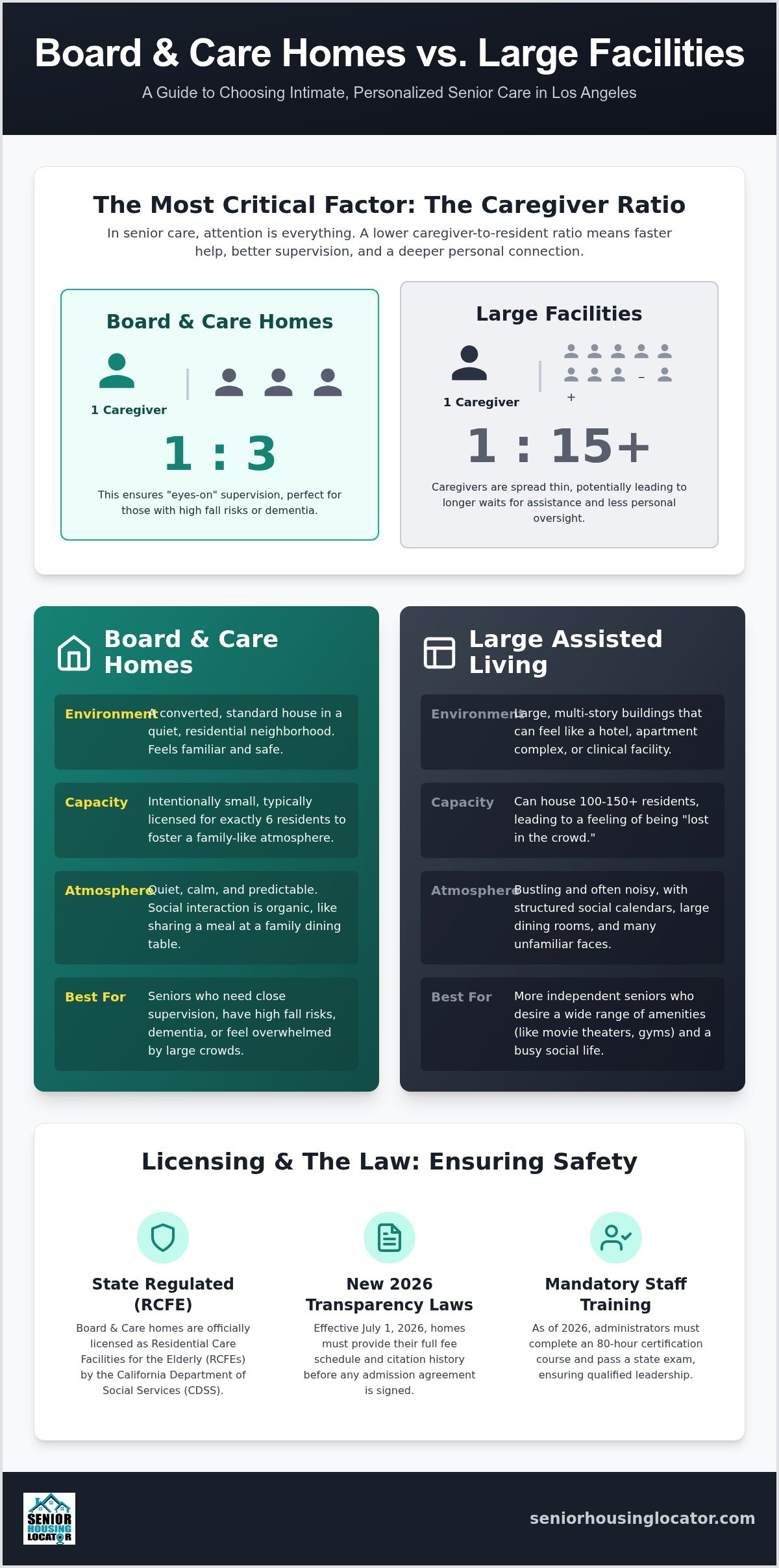
In California, these small-scale settings are officially classified as Residential Care Facilities for the Elderly (RCFEs). Most of these homes in Los Angeles are designed for exactly six residents. This 6-bed structure is intentional. It allows for a level of intimacy that’s impossible to achieve in a community housing 150 people. It’s a setting where the staff knows exactly how a resident likes their coffee and can spot a slight change in their mood or mobility immediately.
The RCFE Designation and California Licensing
While they look like private homes, every licensed board and care is strictly regulated by the California Department of Social Services (CDSS). To operate, these homes must pass a rigorous fire clearance and meet specific safety standards. Staff members aren’t just neighbors helping out; they must undergo background checks and specific training. In fact, as of 2026, California law requires administrators to complete an 80-hour certification course and pass a state exam. Regular state inspections ensure that the home stays clean, the food is nutritious, and the care remains consistent. Under the new transparency laws effective July 1, 2026, these homes must also provide you with their full fee schedule and citation history before you sign any paperwork.
Who is the Ideal Candidate for a Board and Care Home?
Choosing a board and care is often the best move for seniors who need more “eyes on” supervision. If your parent has a high fall risk or struggles with wandering due to dementia, the small footprint of a house is much safer than a large facility with long, confusing hallways. It’s a predictable environment where the bathroom is just a few steps away and the dining table is always in the same spot. These homes are perfect for seniors who feel overwhelmed by loud, bustling social calendars and prefer the quiet companionship of a few familiar faces. It’s about trading the “crowd” for a community that feels like home.
Why Families Choose Residential Care Over Large Facilities
When you start your search, it’s easy to be impressed by the grand lobbies and movie theaters of large senior living communities. However, many families find that their loved ones thrive much better in the intimate setting of board and care homes los angeles. This “intimacy advantage” isn’t just about the size of the building; it’s about the quality of the emotional connection. In a smaller group, residents aren’t just room numbers. They’re friends and neighbors who share a dining table every night, which significantly reduces the feelings of isolation that can occur in massive facilities.
Staffing is the heart of the matter. In a typical large facility, a single caregiver might be responsible for 15 residents during a busy shift. That’s a lot of ground to cover. In a residential board and care, that ratio often drops to 1:3. This ensures your parent doesn’t have to wait twenty minutes for help getting to the restroom or getting dressed in the morning. Because the same small team works in the home every day, they become experts on your loved one’s specific needs, preferences, and personality. If you’re feeling overwhelmed by the thousands of options in LA, you can reach out to a local advisor to help you narrow down the best fit.
Personalized Care and High Staff Ratios
The high caregiver-to-resident ratio allows for a truly “eyes-on” approach that’s vital for seniors with high-acuity needs. Caregivers in 6-bed homes notice small changes in health much faster than staff in a 100-unit building. They’ll spot a slight cough, a decrease in appetite, or a change in walking speed immediately. This level of supervision provides a safety net for seniors who struggle with everyday tasks. It’s a supportive environment where help with dressing, bathing, and mobility is always just a few steps away.
The Comfort of a Familiar, Homelike Environment
There are deep psychological benefits to living in a “real” house rather than a hotel-style facility. The lack of “facility noise” is one of the biggest advantages. You won’t hear the constant hum of heavy service carts or the startling chime of overhead intercoms, both of which can trigger anxiety in seniors with cognitive issues. Instead, the home is filled with familiar sounds and smells, like home-cooked meals tailored to specific dietary or cultural preferences. This predictability creates a sense of peace, order, and dignity that helps seniors feel truly at home.
Board and Care vs. Assisted Living: A Side-by-Side Comparison
Choosing between a large community and a smaller residence is often the biggest hurdle families face. While both options provide essential support, the daily experience in each is vastly different. Large assisted living facilities usually feel like bustling hotels, complete with grand lobbies, fitness centers, and scheduled outings. In contrast, board and care homes los angeles focus on quiet companionship. Instead of a crowded dining hall, your parent shares a kitchen table with five other people. It’s a much softer transition for a senior who is leaving a family home they’ve lived in for decades.
The physical layout also plays a major role in safety and comfort. Large facilities often require residents to navigate elevators and long, carpeted hallways just to get to breakfast. For a senior with limited energy or mobility issues, this can be exhausting. Residential care homes are almost always single-story houses. There are no elevators to wait for and the distance from the bedroom to the living room is only a few steps. This layout reduces the “travel time” within the home, making it much easier for residents to stay active and engaged.
Choosing Based on Social and Physical Needs
Deciding which environment is right depends on your loved one’s personality and physical health. It’s helpful to consider these three factors:
- Social Engagement: Active seniors who want clubs, gyms, and movie theaters usually prefer the “campus” feel of assisted living.
- Cognitive Health: Seniors with advanced dementia often thrive better in the simplicity of a board and care where there’s less noise and fewer strangers.
- Mobility Aids: Residential homes are often more manageable for those using walkers or wheelchairs because the floor plan is compact and predictable.
Cost Predictability in Los Angeles Homes
Budgeting for senior care in Southern California is often stressful because of complex fee structures. Most large facilities use a tiered pricing model. They charge a base rent and then add extra costs for every shower, medication reminder, or escort to the dining room. This can make your monthly bill unpredictable. Most board and care homes los angeles offer a flat monthly rate that includes care, meals, and laundry. This “all-in” approach provides families with financial peace of mind. For a more detailed breakdown of what to expect, you can read our guide on Assisted Living Costs in Los Angeles to compare your options effectively.
How to Evaluate a Board and Care Home in Los Angeles
Visiting board and care homes los angeles for the first time can feel overwhelming. You aren’t just looking at the furniture; you’re trying to see the heart of the home. To make an informed choice, start by checking the state licensing report for any recent citations. Under the transparency laws effective July 1, 2026, these facilities must provide you with their staffing levels by shift and their state violation records before you sign an admission agreement. This data gives you a clear, honest look at the home’s track record.
Next, try to visit during mealtime. This is the best way to observe how caregivers interact with residents. Are they rushing the process, or are they sitting down to chat? You should also ask about staff longevity. High turnover is a red flag. Caregivers who have been with a home for years provide the stability and deep knowledge your parent needs. If you’re looking in the San Fernando Valley, verify if they have private room options, as these are in high demand and can fill up quickly. Finally, trust your gut feeling. If a home feels warm, clean, and smells like fresh cooking, it’s a strong sign of a healthy environment.
Vetting the Staff and Ownership
In a small 6-bed home, the owner or administrator sets the entire tone for care. Meeting them is crucial to understanding the home’s philosophy. Ask about nighttime staffing specifically. Does the home have “awake” staff who stay up all night, or “sleep-over” staff who are on-call? For residents with dementia, specialized memory care training is essential to ensure the team can handle changing behaviors with patience and skill. If you need help narrowing down your options, our team can provide a shortlist of vetted homes that meet these high standards.
Neighborhood Nuances: Woodland Hills to Santa Monica
The location of board and care homes los angeles often dictates the style and layout of the house. You’ll find a high concentration of quality residential homes in Woodland Hills and Sherman Oaks. These areas are known for larger, ranch-style houses that offer plenty of space for residents using walkers or wheelchairs. You can find more local specifics in our guide to Board and Care Homes in Woodland Hills.
If you’re looking in West LA, Santa Monica, or Pasadena, the homes might have different architectural styles, such as historic bungalows or two-story builds with ramps. While these coastal and historic areas are convenient, the San Fernando Valley often offers a wider selection of modern, single-story layouts. These are generally easier for seniors with mobility challenges to navigate safely. Understanding these local differences helps you target the neighborhoods that best fit your parent’s physical needs.
Simplifying Your Search with a Senior Living Advisor
Trying to find the right board and care homes los angeles on your own can quickly feel like a second full-time job. With thousands of licensed residences scattered across the city, the sheer volume of choices is overwhelming. You might spend hours on the phone only to find that a home has no availability or doesn’t meet your parent’s specific medical needs. It’s a high-stakes decision made during an already emotional time. You don’t have to carry that burden alone.
A local advisor provides the “inside scoop” on board and care homes los angeles that you won’t find on a website or a state database. While AI tools can match data points, they can’t step into a home to see if the caregivers are smiling or if the kitchen smells like a fresh meal. We visit these homes regularly. We know which ones are currently thriving and which ones have had recent management changes. This local expertise ensures you aren’t just finding a bed; you’re finding a community where your loved one will be truly seen and supported.
Having an advocate by your side during tours and contract negotiations changes the entire experience. We help you ask the hard questions about nighttime staffing and fee structures that you might overlook in the moment. Perhaps most importantly, this placement service is provided at no cost to your family. We’re here to simplify the process, remove the guesswork, and act as your “Trusted Local Ally” from the first call to the day of move-in.
The Personalized Placement Process
Our work begins with a thorough assessment of your loved one’s medical, social, and budget needs. We don’t just send you a long list of every home in the zip code. Instead, we curate a shortlist of 3-4 homes that actually fit your specific criteria. This focused approach saves you time and prevents “decision fatigue.” In times of family crisis, we act as a “Compassionate Facilitator,” handling the logistical details so you can focus on being a supportive son or daughter.
Taking the Next Step with Senior Housing Locator
If you’re ready to move from uncertainty to a clear plan, we encourage you to reach out for a no-obligation consultation. Our team provides deep coverage across the San Fernando Valley and the Greater Los Angeles area. We’ve already done the hard work of vetting these homes so you don’t have to. You can learn more about how we work by visiting our page on Senior Living Advisor Los Angeles. Let’s find the perfect match together and bring your family the peace of mind you deserve.
Finding Peace of Mind for Your Loved One
Deciding on the next step for a parent is a journey that requires both heart and hard data. You now understand that the high caregiver ratios and predictable flat-rate pricing of residential homes offer a level of security that large facilities often can’t match. Choosing from the many board and care homes los angeles can be the start of a safer, more connected chapter for your parent. By focusing on vetted RCFEs and checking state licensing reports, you’re already ahead of the curve.
You don’t have to navigate this complex market alone. With over 10 years of local experience, our team has already done the hard work of vetting a network of high-quality homes in the San Fernando Valley and beyond. Let our expert advisors find the perfect Los Angeles board and care home for your family; at no cost to you. We provide a personalized, full-service approach to ensure you find a home that fits your budget and care needs perfectly. You’ve got this, and we’re here to help every step of the way.
Frequently Asked Questions
How much do board and care homes cost in Los Angeles?
Monthly rates for board and care homes los angeles are determined by the specific neighborhood and the level of care required. Generally, a shared room is the most affordable option, while private rooms in high-demand areas like Woodland Hills command a higher rate. These fees typically cover all utilities, meals, and 24-hour supervision. Because most homes use a flat-rate model, you can avoid the unpredictable “add-on” fees often found in larger assisted living communities.
Is a board and care home the same as a nursing home?
No, these are different levels of care. Board and care homes provide non-medical assistance with daily activities like bathing and dressing in a residential house. Nursing homes, or skilled nursing facilities, offer 24/7 medical care by licensed nurses for residents with complex health needs. If your parent needs help with mobility but doesn’t require daily medical procedures, a residential home in Northridge or Granada Hills is often a more comfortable, homelike alternative.
Do board and care homes offer private rooms?
Yes, most residential homes in Los Angeles offer both private and shared room options. Private rooms are highly sought after in areas like Woodland Hills because they provide more dignity and personal space. While a private room comes at a higher monthly rate, it allows seniors to bring their own furniture and maintain a sense of independence. We can help you identify which homes currently have private vacancies in your preferred neighborhood.
Can a board and care home provide memory care for dementia?
Many board and care homes are specifically licensed to provide memory care for seniors with Alzheimer’s or other forms of dementia. These homes must meet California’s 2025 dementia care standards, which include mandatory staff training and secure perimeters to prevent wandering. The small, 6-bed environment is often ideal for dementia patients because the low noise levels and consistent routines reduce confusion and anxiety compared to larger, busier communities.
How do I know if a Los Angeles board and care home is licensed?
Every legitimate home must be licensed as a Residential Care Facility for the Elderly (RCFE) by the California Department of Social Services. You can verify a license by checking the state’s facility search database or asking the administrator for their license number. Under the 2026 transparency laws, homes must also disclose their citation history and staffing levels. We only work with a vetted network of licensed homes across the San Fernando Valley.
What is the caregiver-to-resident ratio in a typical board and care?
The standard ratio in board and care homes los angeles is usually 1:3 during daytime hours. This means one caregiver is responsible for only three residents, allowing for immediate attention and personalized support. In contrast, large assisted living facilities often have ratios of 1:15 or higher. This high-ratio care is a primary reason families in Burbank and Santa Monica choose residential settings for loved ones who need frequent supervision.
Are meals and laundry included in the monthly cost?
Yes, nearly all board and care homes include three home-cooked meals, snacks, and full laundry services in their flat monthly rate. Caregivers often tailor menus to meet specific dietary needs or cultural preferences, which is much easier to do in a small kitchen than in a large industrial one. This all-inclusive model simplifies budgeting for families, as you won’t see extra charges for basic housekeeping or linen changes.
How do I find a board and care home near me in the San Fernando Valley?
The most efficient way to find a quality home is to partner with a local placement advisor who knows the specific nuances of neighborhoods like Woodland Hills or Northridge. We maintain an updated list of vetted homes and can match your parent’s medical needs and budget to the right environment. Instead of calling hundreds of houses, you can receive a curated shortlist of 3-4 homes that are currently thriving and have available rooms.