
Imagine you just received a call from the hospital discharge planner. Your loved one is stable, but they now require 24/7 medical supervision that you simply can’t provide at home. In a massive city with approximately 360 options, finding the right skilled nursing facilities los angeles can feel like a mountain you aren’t prepared to climb. It’s a high-stakes decision made during an already emotional time, and it’s natural to feel anxious about safety, cleanliness, and the quality of daily life.
We understand that you’re looking for more than just a medical bed; you’re looking for a place where your family member will be treated with dignity and expert care. This guide is designed to lower those emotional stakes by giving you a clear, step-by-step roadmap to identify and secure the best possible placement in 2026. You’ll discover how to decode complex California staffing regulations and navigate the transition from hospital to facility with ease.
We will preview the latest Medicare payment updates, explain how to use local expertise to filter through hundreds of LA options quickly, and provide the checklists you need to evaluate any facility firsthand. By the end of this article, you’ll have the tools to move from a state of uncertainty to a position of confident, informed control.
Key Takeaways
- Understand the vital differences between 24/7 medical supervision and standard assisted living to ensure your loved one receives the correct level of clinical care.
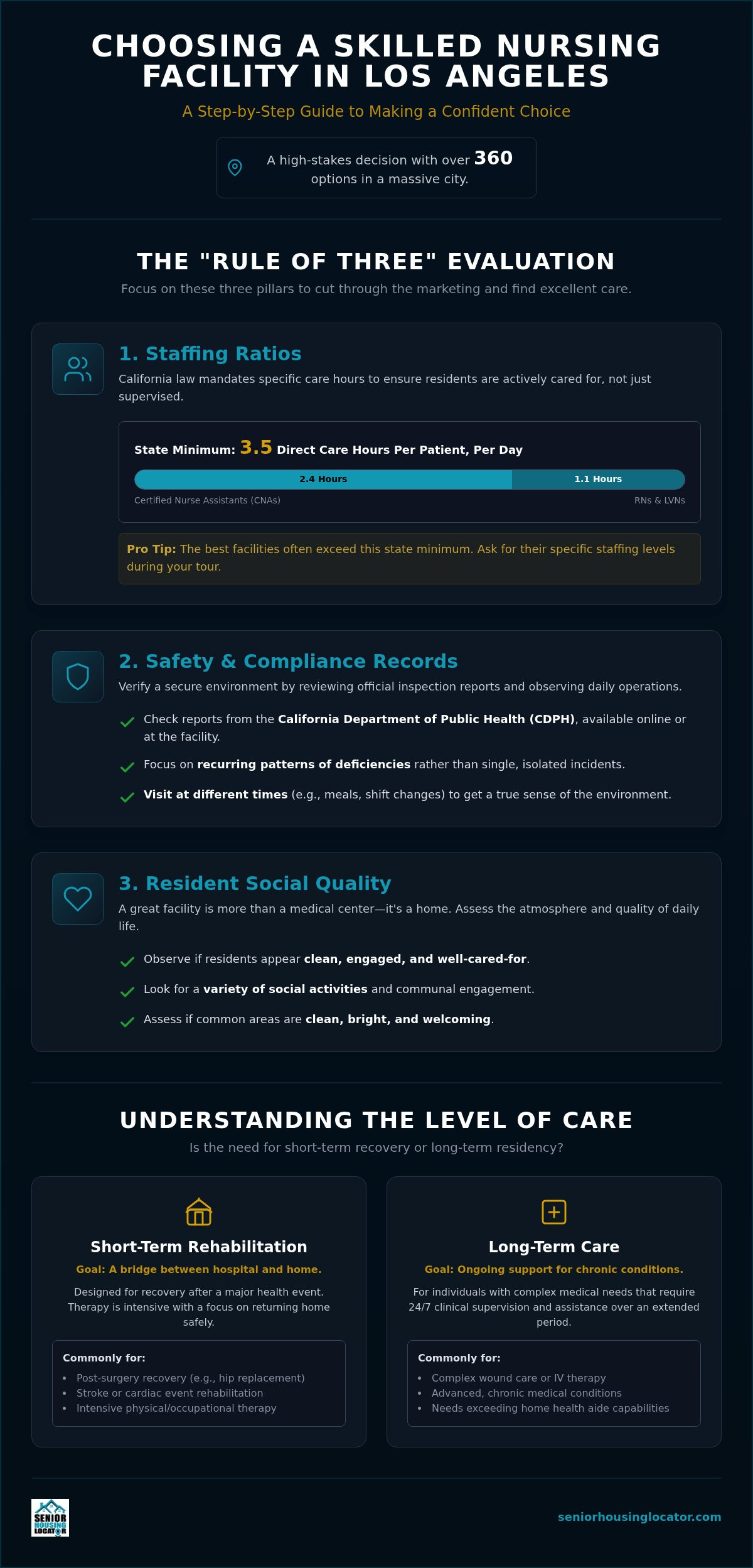
- Use our simple “Rule of Three” to evaluate skilled nursing facilities los angeles by focusing on staffing ratios, safety records, and resident social quality.
- Learn why short-term rehabilitation goals differ from long-term residency and how to plan for a smooth transition back home.
- Discover why geographic proximity in neighborhoods like the San Fernando Valley is a top priority for both patient recovery and family well-being.
- Find out how a local senior living advisor handles the stressful “hard work” of checking facility availability and insurance fit at no cost to your family.
What is a Skilled Nursing Facility (SNF) in Los Angeles?
Deciding to move a family member into professional care is one of the most difficult choices you’ll ever make. You likely have many questions about what these environments actually offer. To start, What is a Skilled Nursing Facility (SNF) is officially defined as a licensed healthcare residence that provides 24/7 medical supervision. While assisted living communities offer a wonderful social environment for seniors who need help with dressing or meals, skilled nursing facilities los angeles are clinical in nature. They are designed for individuals who require the constant presence of licensed nurses and specialized medical equipment.
In California, these facilities operate under strict Title 22 regulations and are overseen by the Department of Public Health. This means they must meet high standards for safety and medical care. It’s a level of support that goes far beyond what a traditional home care setup can provide. It offers you peace of mind that a medical professional is always just a few steps away, ready to respond to any change in your loved one’s condition.
The Core Services Provided in LA Nursing Homes
Every facility in Los Angeles is required to provide a specific level of attention. For example, California law in 2026 requires these centers to provide at least 3.5 direct care service hours per patient every day. Out of those hours, at least 2.4 must be provided by certified nurse assistants. This ensures your loved one isn’t just supervised, but actively cared for. Core services include:
- Around the clock nursing supervision and complex medication management.
- On-site rehabilitation including physical, occupational, and speech therapy.
- Dedicated assistance with high-acuity needs like feeding tubes or respiratory care.
These services are delivered by a team of Registered Nurses (RNs) and Licensed Vocational Nurses (LVNs) who work together to manage clinical stability. The goal is to provide a safe, clean environment where medical needs are the priority.
When is Skilled Nursing the Right Choice?
How do you know if this is the correct path? Usually, the need for skilled nursing facilities los angeles becomes clear after a major health event. If your loved one is being discharged from a hospital after a stroke, a cardiac event, or a major surgery like a hip replacement, they often need a bridge between the hospital and home. This is known as short-term rehab. In other cases, long-term care is necessary for chronic conditions that require:
- Complex wound care that needs sterile dressing changes.
- Intravenous (IV) therapy or frequent injections.
- Advanced medical monitoring that exceeds what a family caregiver or a home health aide can safely manage.
If the medical needs have become the primary focus of daily life, a skilled setting is likely the safest and most supportive option for your family. It’s about finding a place where they can heal or live comfortably with the right professional support.
Evaluating Quality: What to Look for in LA Facilities
Choosing from the hundreds of skilled nursing facilities los angeles can feel like an impossible task. How do you tell the difference between a facility that looks good and one that provides excellent care? We suggest using the “Rule of Three”: Staffing, Safety, and Social Quality. Staffing tells you if they have enough hands. Safety tells you if the environment is secure. Social Quality tells you if your loved one will actually be happy there. By focusing on these three pillars, you can cut through the marketing and see the true heart of a facility.
When Navigating the Los Angeles SNF Landscape, you should always start with the hard data. The California Department of Public Health (CDPH) conducts regular, unannounced inspections. You can find these reports online or posted within the facility itself. Look for recurring patterns of “deficiencies” rather than a single isolated incident. In high-traffic LA centers, pay close attention to staffing levels. While the state requires 3.5 direct care hours per patient, the best facilities often exceed this to ensure no one is left waiting for help. It’s helpful to visit at different times of the day, such as during a meal or a shift change, to see how the team handles pressure.
The Importance of Specialized Staffing
The quality of care starts at the top. Every reputable facility has a Medical Director and a Director of Nursing (DON) who set the clinical tone. When you visit, ask about staff longevity. Do the nurses and aides stay for years, or is there a revolving door of temporary help? Consistency is key to recovery. If your loved one needs specific help, like regaining mobility after a stroke, ensure the facility has dedicated physical and occupational therapists on-site daily rather than just a few times a week. Specialized therapists are the backbone of a successful recovery plan.
Touring Checklist for Los Angeles Families
Walking through the doors tells you a lot. Look past the fresh flowers in the lobby. The real story is told in the hallways and resident rooms. Use this checklist to evaluate what you see during your visit:
- Cleanliness and Odor: Does the facility smell fresh? Lingering unpleasant odors are often a sign of inadequate staffing or poor maintenance.
- Resident Engagement: Are seniors participating in activities, or are they sitting alone in their rooms? Look for smiles and genuine conversation between staff and residents.
- Safety Features: Check for sturdy grab bars in bathrooms, easy-to-reach emergency call buttons, and secure exits for residents with cognitive needs.
A local senior care advisor can help you filter these options based on real-time quality data and availability. Finding the right home is about more than just a 5-star rating; it’s about finding the place where your family feels most at peace. Trust your instincts when you observe how staff members interact with residents. A warm smile and a patient tone often matter as much as the medical equipment on hand.
Short-Term Rehab vs. Long-Term Care in Southern California
Most skilled nursing facilities los angeles serve two very different populations. One group is there for a short stay to recover after a medical event, while the other group requires permanent, around the clock medical supervision. Recognizing which type of care your loved one needs will help you set the right expectations for their recovery and daily life. It’s also vital for understanding how insurance, like Medicare, might cover the stay.
The transition between these two types of care often happens within the same building. A senior might enter a facility for rehabilitation after a fall, but during their stay, the medical team may determine that returning home isn’t safe. In these moments, the facility becomes a permanent residence. Having this conversation early with the facility’s social worker can help your family prepare for the emotional and logistical shift from a temporary “bridge” to a long-term home.
Short-Term Rehabilitation Goals
Short-term rehab is all about intensive therapy and functional independence. The goal is simple: get the patient strong enough to return to their previous living situation. This is a common path for seniors recovering from hip replacements, pneumonia, or cardiac events. In 2026, research shows that approximately 88% of nursing home residents are actually discharged within three months, proving that most stays are focused on recovery rather than permanent residency.
The process usually begins in the hospital. A discharge planner will work with you to find a facility that has an open bed and the specific equipment needed for your loved one’s recovery. Because these stays are often covered by Medicare for a limited time, the pace of therapy is typically brisk and goal-oriented.
Long-Term Residential Skilled Nursing
When a senior has chronic or progressive medical needs that exceed what can be managed at home, long-term care is the right choice. Here, the focus shifts from intensive therapy to quality of life, comfort, and social engagement. Facilities prioritize creating a sense of community through structured social programs and amenities designed for permanent residents. It’s about ensuring they feel at home while receiving the professional medical support they require.
If you discover that your loved one’s needs are more social than medical, you might want to explore other options. Comparing the assisted living costs Los Angeles families typically encounter can help you decide if a different level of care is more appropriate. Long-term skilled nursing is specifically for those who need a high level of clinical intervention that assisted living simply cannot provide. Choosing the right environment ensures your loved one is neither overwhelmed by too much medicalization nor underserved by too little care.
Navigating the Los Angeles SNF Landscape: Neighborhoods and Logistics
Los Angeles is a vast patchwork of neighborhoods, each with its own unique character and logistical challenges. When you’re searching for skilled nursing facilities los angeles, geography should be one of your first considerations. While medical ratings are vital, the physical location of a facility can significantly impact your loved one’s recovery. Proximity to family isn’t just a matter of convenience; it’s a clinical advantage. Regular visits from familiar faces reduce resident isolation, improve mood, and allow you to stay actively involved in the care planning process.
The reality of Southern California traffic means that a facility ten miles away can often feel like it’s in another state. If you live in Woodland Hills, a center in Santa Monica might be world-class, but the two-hour round trip will eventually limit how often you can visit. We often recommend focusing your search on specific clusters like the San Fernando Valley, where neighborhoods such as Sherman Oaks and Burbank offer a high concentration of reputable options. By staying local, you ensure that “stopping by” remains a sustainable part of your daily routine.
Understanding Availability in High-Demand Areas
Finding an open bed in high-demand areas like Pasadena or West LA can be challenging. In the first quarter of 2026, senior housing occupancy rates reached 89.5%, creating a tighter market for families in a crisis. While a hospital discharge planner will provide a list of options, you always have the final choice in placement. If your preferred facility in Santa Monica has a waitlist, it’s wise to have a backup list in nearby areas like Encino. Having a “Rule of Three” for your geographic search allows you to act quickly when a bed becomes available without compromising on quality.
Financial Considerations for LA Families
Understanding how to pay for care is the next logical step. Most families start with Medicare, which typically covers short-term rehabilitation under the “100-day rule” if certain clinical requirements are met. For 2026, CMS finalized a 3.2% update to payment rates, reflecting the rising costs of professional care. If your loved one requires long-term residency, you may need to look into Medi-Cal. As of 2026, the asset limit for an individual to qualify for long-term care assistance is $130,000, while a couple can have up to $195,000 in countable assets.
If you’re still weighing whether your loved one needs this level of medical supervision, you can compare options with our guide on Assisted Living vs. Nursing Home: Understanding the Costs. Making sense of these numbers while managing a health crisis is overwhelming. If you need help filtering through hundreds of LA options quickly, contact a local senior living advisor today to find a facility that fits your budget and your neighborhood.
How a Senior Living Advisor Simplifies Your Search
Searching for skilled nursing facilities los angeles while managing a family crisis is an immense burden. You’re likely balancing hospital meetings, work obligations, and the emotional weight of seeing a loved one in a vulnerable state. This is exactly where Senior Housing Locator steps in. We act as your “Trusted Local Ally,” providing a helping hand to ensure you don’t have to navigate this complex system alone. Our goal is to lower the emotional stakes of this process by offering a clear, organized path toward a safe and clean environment for your family member.
Because we offer a free referral service for families, you gain access to professional expertise without any added financial stress. We believe that every family deserves high-quality guidance, regardless of their budget. We do the “hard work” of checking real-time availability, verifying insurance compatibility, and filtering through hundreds of options to find the few that truly meet your specific needs. Instead of making dozens of cold calls to facilities, you receive a curated list of placements that match your loved one’s medical acuity and your family’s geographic preferences.
Why Local Expertise Matters in Los Angeles
Los Angeles is a unique market where a facility’s online rating doesn’t always tell the whole story. We spend our time on the ground in neighborhoods like Woodland Hills, Sherman Oaks, and the wider San Fernando Valley. This allows us to know the “real” reputation of local centers beyond what you see on a government website. We understand which facilities have stable leadership and which ones have recently improved their staffing ratios. This insider knowledge is vital for Senior Living Advisor Los Angeles: Navigating Care Options with confidence.
Getting Started with Your Free Placement Support
We’ve designed our process to be as simple and stress-free as possible. It follows a logical, three-step progression that moves you from uncertainty to a final decision. First, we start with a personalized consultation to understand your medical needs and budget. Second, we filter the skilled nursing facilities los angeles landscape to find the best matches. Finally, we help you coordinate tours so you can see the care in action. We don’t just give you a list; we advocate for your loved one throughout the entire transition from the hospital to their new room.
You don’t have to make these high-stakes decisions in a vacuum. Let us handle the logistics so you can focus on being present for your family. If you’re ready to find the right care with less stress, schedule your free consultation with a Los Angeles expert today and let us help you find the peace of mind you deserve.
Taking the Next Step Toward Quality Care
Finding the right medical support for a loved one is a journey that requires both clinical knowledge and local insight. You now have the tools to distinguish between short-term rehabilitation and long-term residential care. By applying the “Rule of Three” to evaluate staffing, safety, and social quality, you can move past the marketing and find a facility that truly prioritizes well-being. Whether you are looking in Woodland Hills or across the San Fernando Valley, staying geographically close is one of the best ways to support a successful recovery.
Selecting from the many skilled nursing facilities los angeles offers doesn’t have to be a burden you carry alone. Our team provides deep expertise in the Greater LA area and offers personalized care matching. We do the hard work of checking availability and insurance fit so you can focus on your loved one. Let our Los Angeles experts find the right care for your family, for free. This is a 100% free service for families designed to bring you order and calm. You’ve done the research; now let us help you take the final step toward a safe, supportive home.
Frequently Asked Questions
What is the average cost of skilled nursing in Los Angeles for 2026?
Costs for skilled nursing in the Los Angeles area reflect the high level of 24/7 medical supervision and professional therapy provided. While rates vary significantly between neighborhoods like Santa Monica and the San Fernando Valley, families should plan for costs that account for the 3.2% update to federal payment rates finalized for 2026. A local advisor can help you compare specific options in areas like Woodland Hills to find a facility that fits your family’s budget.
Does Medicare pay for skilled nursing facilities in California?
Medicare typically covers short-term stays in a skilled nursing facility if the patient has a qualifying three-day hospital stay. This coverage is generally limited to 100 days per benefit period and focuses on rehabilitation services like physical or speech therapy. For 2026, federal updates have adjusted how these services are reimbursed. After this period, many California families transition to private pay or qualify for Medi-Cal to cover the costs of long-term residency.
How is a skilled nursing facility different from assisted living?
The main difference lies in the level of clinical care. Skilled nursing facilities are medical environments that provide 24/7 supervision by licensed nurses for high-acuity patients. Assisted living is a social model designed for seniors who need help with daily tasks like bathing or dressing but don’t require constant medical monitoring. If your loved one needs complex wound care or IV therapy, a skilled nursing setting is the safest and most appropriate choice for their health.
Can I choose which skilled nursing facility my parent goes to after the hospital?
You have the legal right to choose which skilled nursing facilities los angeles your parent enters after hospital discharge. While hospital planners provide a list of centers with available beds, you aren’t required to pick the first one mentioned. It’s helpful to have a backup list of preferred locations in neighborhoods like Encino or Northridge. This ensures you find a clean, high-quality environment that is also convenient for family members to visit during the recovery process.
What are the top-rated skilled nursing facilities in the San Fernando Valley?
To identify the best skilled nursing facilities los angeles in the San Fernando Valley, you should use Medicare’s Care Compare tool to review health inspection results and staffing levels. Look for facilities in Woodland Hills, Sherman Oaks, and Granada Hills that maintain high direct care hours per patient. Local advisors often have real-time knowledge of which centers currently have the most stable staff and the best reputations for specialized rehabilitation, helping you skip the guesswork.
How do I check a nursing home’s inspection record in Los Angeles?
You can access public inspection records through the California Department of Public Health (CDPH) website or the federal Care Compare tool. These reports detail any deficiencies found during unannounced visits and explain how the facility addressed those issues. When reviewing records for LA facilities, look for consistent patterns in safety and cleanliness rather than a single isolated incident. A transparent facility will often have these reports available for you to review during an in-person tour.
What should I bring for a short-term rehab stay in LA?
For a successful short-term stay, you should pack items that promote comfort and safety. We recommend bringing:
- Five to seven days of loose, comfortable clothing and sturdy, non-slip shoes for therapy.
- Personal toiletries and familiar items like a favorite blanket or framed family photos.
- A list of current medications and essential personal aids like glasses, hearing aids, or dentures.
Keeping the environment familiar helps reduce stress during the intensive rehabilitation process.
How long can a senior stay in a skilled nursing facility?
The length of stay depends on whether the senior is there for rehabilitation or long-term care. Short-term rehab stays are usually brief, with most patients being discharged within three months after reaching their recovery goals. For seniors with permanent medical needs, a skilled nursing facility can become a long-term residence. The clinical team will perform regular assessments to ensure the level of care still matches the resident’s health requirements as their needs change over time.