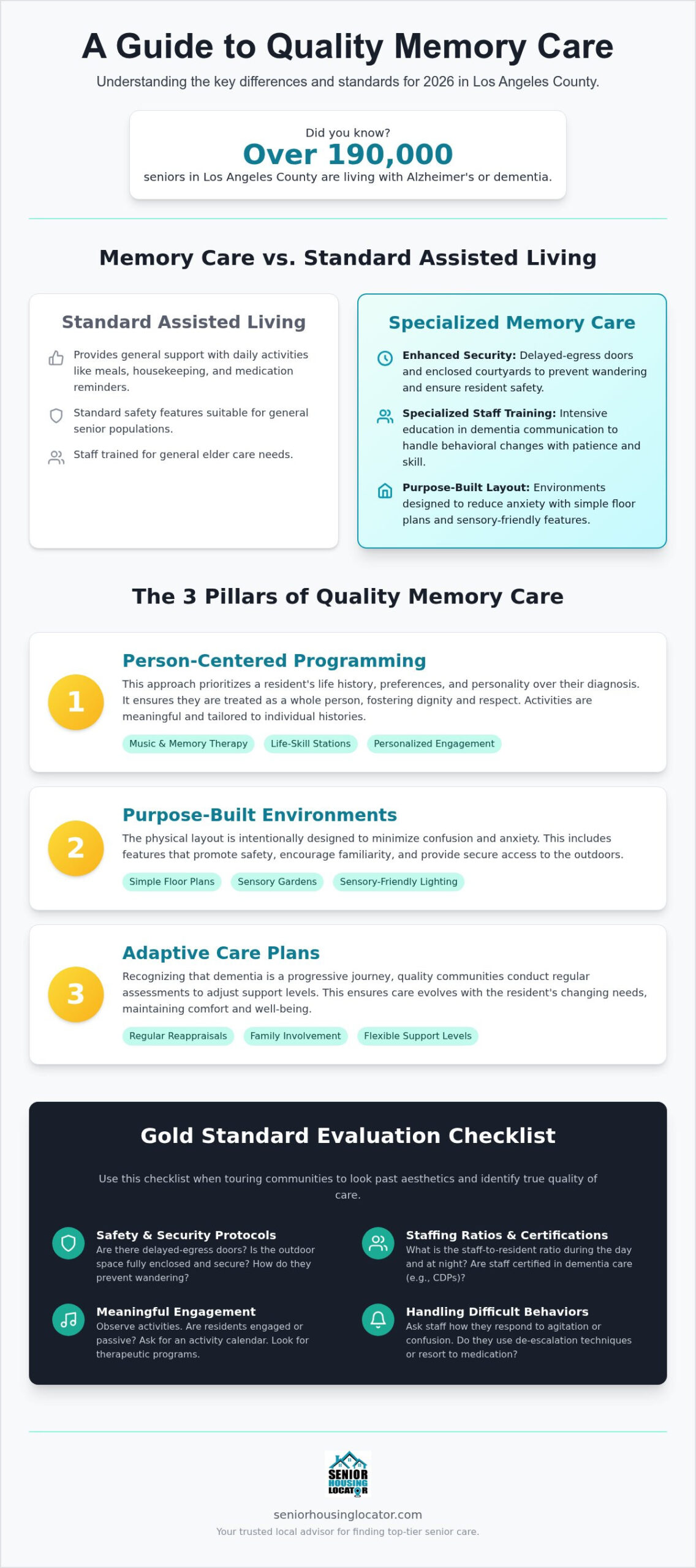
Did you know that over 190,000 seniors in Los Angeles County are currently living with Alzheimer’s or dementia? This means thousands of local families are in the same position as you, searching for answers and finding quality memory care that feels like a true home rather than a clinical facility. It is completely normal to feel emotionally exhausted by the search, especially when you are worried about safety protocols or the fear of neglect. You want your loved one to be secure, but you also want them to be treated with the dignity they deserve.
We’ve created this guide to replace that heavy burden with a clear, manageable path forward. You’ll learn exactly how to identify high-quality care, understand the new 2026 California transparency laws that protect your family, and use a straightforward checklist to evaluate any community you visit. We will walk through the latest dementia care standards and show you how to streamline your search without the typical stress. By the end of this guide, you will have the tools to secure a safe, supportive environment that gives your family the peace of mind you’ve been looking for.
Key Takeaways
- Learn how to distinguish between standard assisted living and specialized memory care to ensure your loved one receives the right level of cognitive support.
- Discover the three essential pillars for finding quality memory care, including person-centered programming and purpose-built environments.
- Identify the specific staffing ratios and professional certifications that serve as the gold standard for safety and expert care in 2026.
- Understand how the local Los Angeles landscape affects your options and how to navigate the search from Woodland Hills to Pasadena.
- Find out how a free local placement service can remove the emotional burden of the search while providing expert, community-based knowledge.
Why Finding Quality Memory Care is a Unique Challenge in 2026
Memory care is more than just a secure wing in a senior living community. It is a specialized, person-centered approach to supporting individuals living with Alzheimer’s, dementia, or other forms of cognitive impairment. In 2026, the task of finding quality memory care in Los Angeles has become more complex as the number of residents needing these services continues to rise. Families often begin this search while they are in the middle of a crisis, which makes it harder to evaluate the subtle differences between a facility that simply provides safety and one that truly honors a resident’s dignity.
The emotional weight of this transition cannot be overstated. A deeper understanding dementia caregiving shows that the constant vigilance required at home often leads to severe caregiver burnout. This exhaustion can cloud your judgment, making every brochure and tour look the same. Adopting a “Quality First” mindset means looking past the granite countertops and focusing on how the staff interacts with residents who are having a difficult day. It’s about moving away from the idea of “warehousing” and toward a model of active, meaningful engagement that respects the individual’s history and personality.
Memory Care vs. Assisted Living: The Key Differences
Many families assume that standard assisted living is enough, but memory care offers three critical layers of support that standard facilities don’t. First, it includes enhanced security features, such as delayed-egress doors and enclosed courtyards, specifically designed to prevent elopement and wandering. Second, the staff undergoes intensive training in dementia-specific communication to handle behavioral changes with patience and skill. Finally, the physical layout is structured to reduce anxiety; these environments use simple floor plans and sensory-friendly lighting to minimize the confusion often associated with “sundowning” symptoms.
When is it Time to Start the Search?
Identifying the right time to move is one of the hardest decisions a family will face. Usually, the “tipping point” arrives when safety at home is compromised or when the primary caregiver’s own health begins to decline. It is vital to start planning before a fall or a medical emergency forces your hand. If you are currently debating when to move parent to memory care, remember that early placement often leads to better outcomes. A structured environment provides social connections and cognitive exercises that are difficult to replicate in a home setting, helping your loved one stay engaged and secure for a longer period.
Defining the Gold Standard: The 3 Pillars of Quality Memory Care
When you are finding quality memory care, it helps to look past the surface level aesthetics and focus on the core philosophy of the community. A high-standard facility built for 2026 relies on three foundational pillars: person-centered programming, a purpose-built environment, and adaptive care plans. Person-centered care is a philosophy that prioritizes the resident’s life history and preferences. This approach ensures that your loved one is seen as a whole person with a rich past, rather than just a patient with a medical diagnosis.
Adaptive care plans are equally vital because dementia is a progressive journey. A facility that offers a “one size fits all” approach will eventually fail to meet your loved one’s changing needs. Quality communities conduct regular reappraisals to adjust support levels, ensuring the resident remains comfortable as the disease evolves. When choosing a long-term care facility, ask how often these plans are updated and how the family is involved in those decisions.
The Role of Therapeutic Activities
Engagement should be meaningful and rooted in the resident’s former life. Music and memory therapy programs are excellent indicators of quality; they use familiar songs to spark joy and cognitive connection. You should also look for sensory gardens that provide safe, secure outdoor access. Many top-tier Los Angeles communities now feature life-skill stations, such as a mock office desk or a gardening bench. These areas encourage familiar daily rhythms, which helps reduce the anxiety often associated with memory loss.
Environmental Design for Dementia
The physical layout of a building can either cause frustration or provide a sense of calm. Look for circular hallways that allow residents to walk freely without hitting a “dead-end,” which is a common trigger for agitation. Visual cues, such as color-coded doors or memory boxes outside each room, help residents navigate their surroundings independently. It is also helpful to check if the community uses zoning to separate high-acuity and low-acuity residents. This ensures that those in the early stages of dementia aren’t overwhelmed by those requiring more intensive support. If you find these technical details confusing, speaking with a local senior care expert can help you identify which Los Angeles facilities actually put these design principles into practice.
Evaluating Specialized Staffing and Safety Protocols
When you are finding quality memory care, the most important factor isn’t the building or the amenities. It’s the people. The staff members are the ones who will navigate your loved one’s difficult afternoons and celebrate their small victories. In 2026, California law has made it easier for families to see behind the curtain. Since July 1, 2026, facilities must provide written disclosures regarding their staffing ratios and historical regulatory citations before you sign a contract. This transparency is a gift to families, allowing you to make a decision based on hard data rather than just a marketing brochure.
High-quality communities often go beyond state minimums by employing staff with specific certifications, such as the Certified Dementia Practitioner (CDP) designation. This shows a commitment to advanced education in dementia-specific communication and behavioral management. When you tour a facility, watch how the caregivers handle “sundowning” or moments of confusion. A skilled team stays calm, uses gentle redirection, and never rushes a resident. They understand that a behavioral change is often an attempt to communicate an unmet need, like hunger or discomfort.
Staff Training and Longevity
Consistency is key for someone living with memory loss. High turnover rates can be incredibly disruptive to a resident’s sense of security. Ask the administrator about their average staff tenure and how they support their team to prevent burnout. In California, direct-care staff must have at least 6 hours of dementia-specific initial training and 8 hours of annual continuing education. However, the best communities provide much more. Look for three signs of a healthy staff culture: eye contact between caregivers and residents, a relaxed pace in the hallways, and staff members who know the personal stories of the people they serve.
Safety and Medical Oversight
Safety protocols should be robust but discreet to maintain a home-like feel. Many Los Angeles communities now use sophisticated wandering prevention technology, like RoamAlert systems, which notify staff if a resident nears an exit without being intrusive. Medication management is another vital area to evaluate. Ask who is responsible for clinical oversight and how they handle emergency response times. A quality facility has a clear, written protocol for medical crises and maintains open, proactive communication with families. They don’t wait for you to call with questions; they reach out to you with regular updates on your loved one’s well-being and any changes in their care plan.
Navigating the Search in the San Fernando Valley and Los Angeles
Finding quality memory care in a city as large as Los Angeles requires more than just a quick online search. From the quiet suburbs of Woodland Hills to the historic streets of Pasadena, every neighborhood offers a different feel and price point. It’s vital to understand how location directly impacts assisted living costs in Los Angeles. While coastal communities often carry a premium, the San Fernando Valley (SFV) provides a wide range of options that balance professional care with a neighborly atmosphere.
If a large community feels overwhelming, consider “Board and Care” homes as a smaller, intimate alternative. These are traditional houses in residential neighborhoods that have been licensed as Residential Care Facilities for the Elderly (RCFEs). They typically serve six residents or fewer, which allows for a very high level of personal attention and a staff-to-resident ratio that is often as low as one to three. This setting is often perfect for seniors who find large, busy buildings confusing or anxiety-inducing, as it preserves the familiar feeling of a family home.
A Local Touring Checklist
When you visit a potential home, look for the “Secret Sauce” that brochures don’t mention. Use your senses to evaluate the environment. You can learn a lot about the culture of a facility by focusing on these three areas:
- Smell and cleanliness: Check beyond the front lobby; look into the back hallways, laundry areas, and resident bathrooms to ensure the high standards are consistent throughout the building.
- Resident engagement: Are people well-groomed and actively participating in an activity? Look for residents who are smiling or interacting with staff rather than sitting alone in common areas.
- The Vibe Test: Trust your intuition. Does the facility feel like a warm, supportive home or a cold, clinical hospital?
Regional Considerations in Los Angeles
Traffic is a major factor when choosing a location in LA. You want to be close enough to visit frequently without facing a stressful commute. Proximity to specialized medical centers in the SFV is also a significant benefit for families. Areas like Woodland Hills and Sherman Oaks are high-demand neighborhoods because they offer easy access to healthcare, shopping, and local amenities. Choosing a home near these hubs can make the logistical side of caregiving much easier to manage, allowing you to focus on spending quality time with your loved one.
Searching for the right fit on your own can be an emotional and exhausting process. Our team acts as a trusted local ally to help you narrow down the best options in your area. Since our placement service is free for families, you can get expert guidance without any added financial burden.
How a Local Advisor Streamlines Your Search for Top-Tier Care
Searching for the right facility in a city as sprawling as Los Angeles is often a full-time job that families have to manage during an already emotional time. This is where a local advisor becomes an essential partner. Our “Free Placement” model is designed to remove the financial and logistical hurdles of finding quality memory care. Because our services are paid for by the senior living communities, families receive professional guidance, personal advocacy, and local expertise at no cost to them. This allows you to focus entirely on your loved one’s well-being rather than worrying about additional fees or navigating the complex senior care market alone.
One of the biggest benefits of working with a local ally is having a buffer against the high-pressure sales tactics common in the industry. When you search for care on your own, your contact information is often shared with dozens of facilities, leading to a flood of aggressive sales calls. We act as your primary point of contact, filtering out the noise and only presenting options that truly meet your specific criteria. We believe in transitioning with integrity, which means we prioritize your family’s peace of mind and the resident’s dignity over simply filling a bed.
The Senior Housing Locator Process
Our method is highly structured to move you from a state of uncertainty toward a clear, confident resolution. We begin with a deep assessment of your loved one’s care needs, lifestyle preferences, and monthly budget. From there, we curate a shortlist of vetted memory care placement San Fernando Valley options that we know personally. We don’t just look at a database; we visit these homes, check their regulatory history, and understand their unique “vibe.” Finally, we guide you through the touring process and help you evaluate the subtle details that make a facility a true home.
Why a “Trusted Local Ally” Matters
Generic national referral sites often lack the “boots on the ground” knowledge required to find the best care in Los Angeles. They might suggest a facility based on a zip code without knowing about recent staff changes or local traffic patterns that could make visiting a nightmare. A local advisor understands the nuances of different neighborhoods and provides access to “hidden gem” board and care homes that don’t have large marketing budgets. These smaller settings often provide the highest level of personalized attention but are nearly impossible to find through a standard internet search. Contact us today for a personalized senior living advisor in Los Angeles to start your search with a knowledgeable guide by your side.
Securing Your Loved One’s Future with Confidence
Finding quality memory care doesn’t have to be a journey you take alone. By focusing on the three pillars of person-centered programming, purpose-built environments, and adaptive care, you’ve already taken the first step toward ensuring your loved one’s safety and dignity. Remember that the best care settings prioritize a resident’s life history and provide a sense of home rather than a clinical atmosphere. Whether you are exploring large communities or looking for an intimate board and care home in the San Fernando Valley, local knowledge is your most valuable asset.
Our team at Senior Housing Locator is here to act as your trusted local ally. We offer deep expertise in the Los Angeles area and an integrity-first approach to every senior care transition. Because our placement service is free for families, you can access personalized guidance without any added stress on your budget. We’ve done the hard work of vetting facilities so you can focus on being a supportive family member again.
Find the perfect memory care community for your loved one with our free expert guidance.
You now have the tools and the checklist to make an informed choice. Take a deep breath; a brighter, more secure chapter for your family is within reach.
Frequently Asked Questions
What is the average cost of memory care in Los Angeles in 2026?
Monthly facility costs in Los Angeles vary significantly based on the neighborhood and the resident’s specific care needs. You will find that rates in coastal areas or the Westside are generally higher than those in the San Fernando Valley. Since July 2026, new California laws require facilities to provide clear written disclosures on all pricing and staff ratios. This transparency helps families compare total costs and understand historical rate increases before making any final decisions.
How is memory care different from a standard nursing home?
Memory care is designed specifically for cognitive impairment and is usually provided within a Residential Care Facility for the Elderly. Standard nursing homes, or skilled nursing facilities, focus on residents who need 24/7 clinical medical care or complex wound management. While memory care provides a secure, social environment with specialized activities and dementia-trained staff, a nursing home is a more clinical setting. Both play vital roles depending on your loved one’s specific medical requirements.
Can I use long-term care insurance to pay for memory care in California?
Yes, most long-term care insurance policies in California cover memory care services. These policies typically pay for care in licensed Residential Care Facilities for the Elderly. It is important to review your specific policy to understand the elimination period and the daily benefit amount. We can help you navigate these details during the search process. Many families find that these benefits significantly help cover the monthly costs of high-quality local communities in the San Fernando Valley.
What are the red flags to watch for during a memory care facility tour?
Watch for strong odors or a lack of cleanliness beyond the front lobby. Observe the staff; if they seem rushed or don’t interact warmly with residents, it’s a major red flag. Another warning sign is seeing residents left alone in common areas for long periods without engagement. When finding quality memory care, you should also ask about recent staff turnover rates. A high turnover often indicates an unstable environment for your loved one’s daily routine.
Is a small board and care home better than a large memory care community?
The choice depends on your loved one’s personality and social needs. A small board and care home in areas like Northridge or Encino offers a quiet, family-like setting with very high staff-to-resident ratios. This is often better for those who feel overwhelmed by large crowds. Conversely, a large community might offer more diverse social clubs and specialized amenities. We help you evaluate both options to see which environment feels most like home for your family.
How do I talk to my parent about moving to a memory care facility?
Start the conversation early and focus on “we” rather than “you.” Frame the move as a way to ensure their safety and provide them with more social opportunities. It’s helpful to talk about the professional support they will receive rather than focusing on their memory loss. Be patient and listen to their fears without dismissing them. We can offer guidance on how to approach this sensitive topic with dignity and love for your parent’s well-being.
What security features are standard in quality memory care?
Quality facilities use several layers of security to prevent wandering, also known as elopement. Standard features include delayed-egress doors that sound an alarm if opened and secure, enclosed outdoor courtyards for safe exercise. Many modern communities in Los Angeles also use sophisticated wandering prevention technology like RoamAlert. This allows residents to move freely within safe zones while alerting staff if they approach an exit, ensuring they remain secure without feeling trapped or overly restricted.
Why is a local placement service better than a national one?
A local placement service like Senior Housing Locator offers “boots on the ground” expertise that national sites simply can’t match. We personally visit homes in Woodland Hills, Burbank, and Pasadena to check staff interactions and cleanliness. National call centers often rely on outdated databases and have never set foot in the facilities they recommend. We understand local traffic patterns and the current reputation of each community, ensuring your family finds a trusted environment without any added expense.