What if the “base rate” you’re quoted for a senior living community is only half the story? It’s a common fear for families in the San Fernando Valley, where navigating woodland hills assisted living costs can feel like deciphering a complex puzzle. You aren’t alone if you feel overwhelmed by the difference between room rent, care levels, and medication management fees. We understand that this isn’t just about a budget. It’s about ensuring your loved one has a stable, comfortable home while protecting your family’s peace of mind and long-term savings.
This guide is here to replace that uncertainty with a clear, manageable plan. We promise to help you uncover the true cost of care in 2026, including how new California transparency laws finally put the power back in your hands. We will walk through the price differences between intimate board and care homes versus larger communities, explain how to spot hidden add-ons before you sign, and share expert strategies for funding the move. By the end, you’ll have the local knowledge, the confidence, and the tools to make a decision that feels right for your family’s future.
Key Takeaways
- Understand how 2026 pricing in the San Fernando Valley compares to broader Los Angeles averages to help you build a realistic budget.
- Compare the financial and lifestyle differences between intimate residential board and care homes and larger, resort-style communities.
- Learn to look beyond the “base rate” on brochures to calculate how care levels and point systems affect woodland hills assisted living costs.
- Explore effective ways to fund a move, including how to leverage the VA Aid and Attendance benefit for eligible veterans and spouses.
- Discover how working with a local placement advisor can help you identify high-value communities that aren’t always easy to find on your own.
What is the Average Cost of Assisted Living in Woodland Hills, CA?
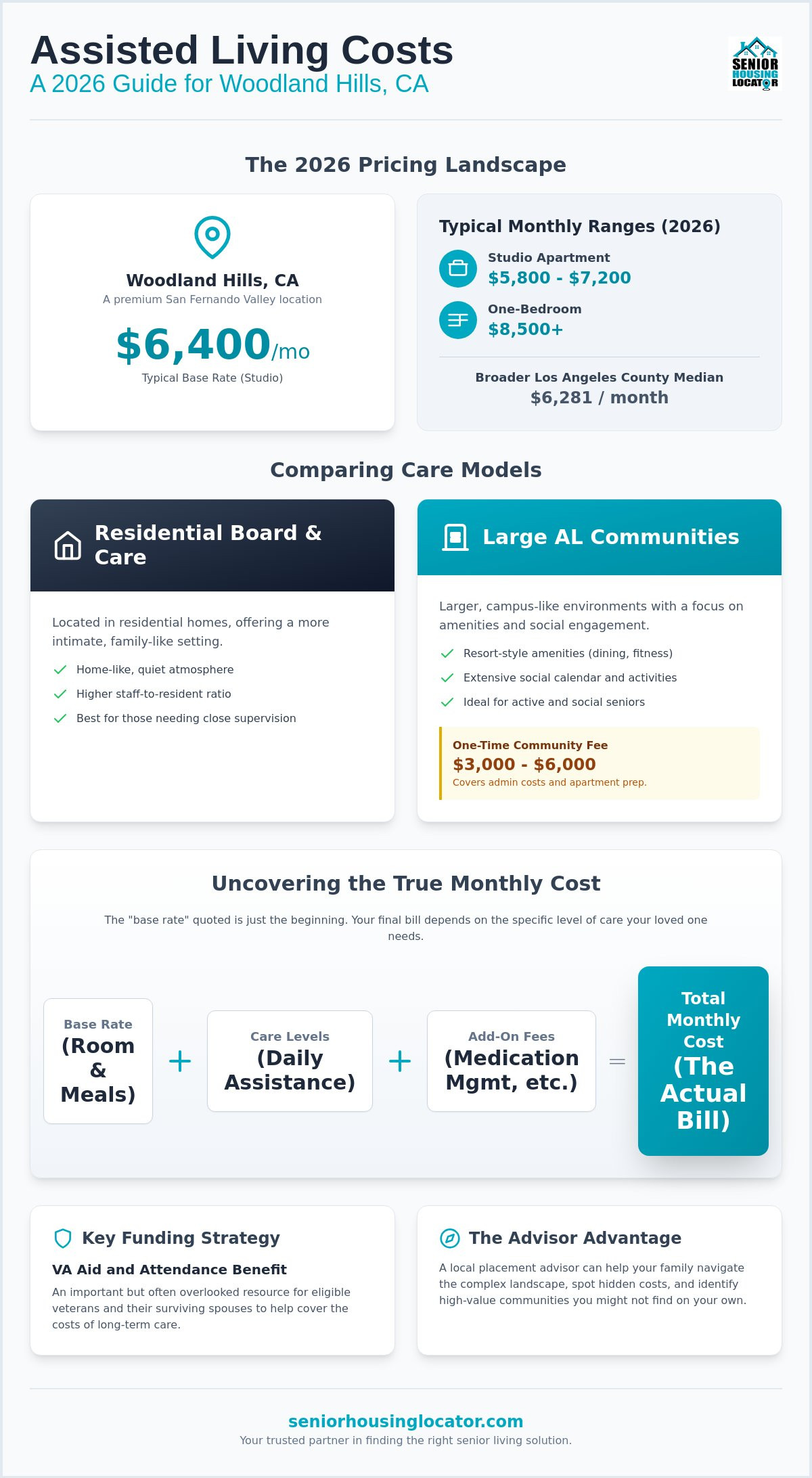
Woodland Hills serves as a premier destination for senior care in the San Fernando Valley. It’s known for its unique blend of suburban comfort and urban convenience, which attracts families from across Southern California. This local reputation means that woodland hills assisted living costs often sit at the higher end of the spectrum for Los Angeles County. While the county median for 2026 is projected at $6,281 per month, families looking in the 91364 or 91367 zip codes should expect local averages to reflect the premium nature of the area.
Comparing these numbers to neighboring communities reveals a clear hierarchy for woodland hills assisted living costs. You’ll often find that rates in Woodland Hills are higher than those in Tarzana or Winnetka, though they remain slightly more affordable than the luxury options in Calabasas. It’s a middle ground that offers high-end amenities without the “celebrity” price tag of the furthest west valley. However, an “average” can be a tricky number. It usually only covers the room and basic meals, which is why your final monthly statement depends heavily on the specific level of support your loved one needs.
Understanding the basics of Assisted living is the first step in planning. These costs are designed to cover housing, utilities, maintenance, and a baseline of personal care. In Woodland Hills, the competitive market means facilities are constantly updating their services to stand out, which can influence the price you see on a brochure versus what you actually pay each month.
The 2026 Pricing Landscape in the San Fernando Valley
The financial side of senior living has shifted recently due to new California staffing regulations and general inflation. For 2026, a studio apartment in a Woodland Hills community typically ranges from $5,800 to $7,200, while one-bedroom units can reach $8,500 or more. These prices reflect the increased operational costs facilities face to maintain high-quality care teams and modern facilities. The typical “Base Rate” for a standard assisted living studio in Woodland Hills for 2026 is approximately $6,400 per month before care levels are added.
Why Woodland Hills Costs Vary by Neighborhood
Location within the city plays a major role in what you’ll pay. Communities near the Warner Center often feature newer, resort-style builds with high-rise views and urban proximity, which commands a higher price. Conversely, residential options South of the Boulevard might offer a more traditional, quiet atmosphere but can still be pricey due to the high real estate values in those hills. For a broader look at how these local rates fit into the regional picture, you can explore Assisted Living Costs in Los Angeles: Your Complete 2026 Pricing Guide. Luxury amenities like gourmet dining, cinema rooms, and daily chauffeured transportation will always push the monthly bottom line toward the higher end of the scale.
Comparing Care Models: Residential Board and Care vs. Assisted Living Communities
Families in Woodland Hills often feel torn between two very different paths when choosing senior care. In zip codes like 91364 and 91367, you’ll find both large, sprawling senior living campuses and small, residential board and care homes. Each model handles woodland hills assisted living costs differently, and the right choice depends on your loved one’s personality and daily needs. The California Department of Aging notes that both types fall under the same licensing, yet their daily operations and price structures are distinct.
Large Assisted Living Communities: The All-Inclusive Feel
Most large facilities in Woodland Hills charge a one-time community fee that typically ranges from $3,000 to $6,000. This fee covers the administrative costs of the move-in process and apartment preparation. Once you’re settled, your monthly bill covers a social lifestyle that feels like a high-end hotel. You’re paying for restaurant-style dining, fitness centers, and scheduled transportation to the Promenade or local medical offices. If your loved one is active and social, this model offers great value for the lifestyle it provides. For more details on these specific facilities, see our Assisted Living Placement in Woodland Hills: Your 2026 Local Guide.
Residential Board and Care: A More Intimate Cost Structure
If you’re looking for a quieter setting, a board and care home might be the answer. These are traditional houses in neighborhoods like Walnut Acres that have been converted to care for usually six residents. Because these homes have lower overhead, they often provide more transparent, flat-rate pricing. You won’t see the same “resort” amenities, but you’ll get a much higher staff-to-resident ratio, often one caregiver for every two or three seniors. This is often the most cost-effective way to manage woodland hills assisted living costs when a senior needs 24/7 supervision. You can learn more in our guide on Board and Care Homes in Woodland Hills.
Which one offers better value? It often comes down to care intensity. In a large community, as care needs increase, the “add-on” fees for things like incontinence care or mobility assistance can skyrocket. In a board and care home, that high level of care is often built into the base price or added at a much lower rate. If your loved one needs significant help with daily tasks, the residential model usually provides more specialized attention for every dollar spent. If you aren’t sure which path fits your budget, talking to a local advisor can help clarify your options and find the best fit for your family.
Understanding the “Hidden” Costs: Care Levels and Add-on Fees
When you look at a brochure for a senior living community in the Valley, the price you see is often just the beginning. This “Base Rate” typically covers the apartment, basic utilities, and three meals a day. However, it rarely includes the personal support that makes the move necessary in the first place. Understanding woodland hills assisted living costs requires a closer look at how facilities calculate care levels. Most communities use a point system or a tiered structure, ranging from Level 1 for minimal help to Level 5 for high-acuity care. These tiers ensure you only pay for what you use, but they can also lead to surprises if you aren’t prepared for how they scale.
Common add-on fees can include medication management, incontinence care, and escorts to meals or activities. These services are essential for safety, yet they can add anywhere from $500 to over $2,500 to your monthly bill. Resources from the California Department of Social Services help families verify that a facility is licensed to provide these specific levels of care. New California laws taking effect in July 2026 now require facilities to provide a three-year history of their annual rate increases before you sign a contract. This transparency helps you plan for the long term and avoids the anxiety of unexpected price hikes later on.
How Care Levels Are Assessed
Before your loved one moves in, a nurse or care coordinator will perform a thorough pre-move-in assessment. They evaluate Activities of Daily Living (ADLs) such as bathing, dressing, and mobility. Simply put, the more hands-on help a resident requires with their ADLs, the higher the monthly care tier will be. Memory care costs significantly more than standard assisted living, often adding an extra $1,200 to $2,500 per month. This premium covers the specialized staffing, secure environments, and tailored programming required for residents with cognitive needs.
One-Time Fees to Budget For
Beyond the monthly rent, you should budget for several one-time expenses that appear at the start of the journey. Community fees, often called move-in fees, usually equal one month’s rent and cover the cost of refurbishing the apartment and administrative setup. Some families find they can negotiate these fees, especially if a community has several vacancies. You should also account for assessment fees, pharmacy setup costs, and the physical costs of moving furniture within the Woodland Hills area. Planning for these upfront costs ensures your transition is as smooth and stress-free as possible.
How to Pay for Assisted Living in Woodland Hills
Financing woodland hills assisted living costs doesn’t have to come solely from your monthly pension or personal savings. While many families start the process feeling anxious about outliving their resources, several financial tools can help bridge the gap. Most seniors in our community use a combination of private funds, insurance benefits, and specialized veterans’ programs to create a sustainable plan. Understanding how these pieces fit together allows you to focus on finding the right care rather than just worrying about the bill.
There are three common ways families manage these expenses:
- Private Pay: Using income from Social Security, pensions, and the sale of investments.
- Insurance: Leveraging long-term care policies that were established years in advance.
- Government Benefits: Accessing specific programs like the VA Aid and Attendance for those who served.
VA Benefits and Long-Term Care Insurance
For veterans and their surviving spouses in the San Fernando Valley, the VA Aid and Attendance benefit is a vital resource. As of 2026, this benefit can provide over $2,400 per month to eligible individuals to help offset the cost of care. To qualify, a veteran must meet specific active-duty service requirements and demonstrate a medical need for assistance with daily tasks. We recommend coordinating with local VA representatives in the Los Angeles area early, as the application process can take several months. A common pitfall is failing to document the “medical necessity” clearly, which can lead to delays or denials in reimbursement.
Long-term care insurance (LTCI) is another powerful tool. To “trigger” these benefits, a senior typically needs assistance with at least two Activities of Daily Living (ADLs), such as bathing or dressing. It’s essential to review your specific policy to check for “elimination periods,” which are waiting periods before the insurance company starts paying. Some families use life insurance conversions or bridge loans to cover these initial weeks while waiting for LTCI or VA payments to begin.
Tapping Into Real Estate Equity
Woodland Hills is a high-value real estate market, and for many, the family home is their largest asset. Selling a home South of the Boulevard or in the Walnut Acres area can often fund a decade or more of high-quality assisted living. If a quick move is necessary, some families opt for a “rent-back” agreement, allowing the senior to stay in the home for a short period after the sale. Others use a bridge loan to pay for move-in fees while the house is still on the market. A senior living advisor in Los Angeles can help coordinate these moving parts by connecting you with trusted real estate specialists who understand the unique needs of seniors. If you’re feeling overwhelmed by these financial choices, contact a local placement expert today to help you build a clear, manageable budget for your move.
Navigating Woodland Hills Senior Living with a Professional Advisor
Choosing a senior living home is one of the most significant decisions your family will ever make. Trying to compare woodland hills assisted living costs on your own can quickly become an overwhelming chore. Many families spend weeks calling facilities, only to find that the “starting at” prices on brochures don’t match the actual care their loved one requires. This DIY approach often leads to overpaying because it’s difficult to know which fees are standard and which can be adjusted. A local placement specialist acts as your neighborly advocate, cutting through the marketing noise to find a home that fits your budget, your location, and your care needs.
We specialize in identifying “value” communities across the San Fernando Valley that don’t spend heavily on advertising. These are often the hidden gems of the industry, such as boutique residential homes that offer incredible care without the corporate price tag. Because we visit these locations frequently, we understand their staffing patterns, their daily atmosphere, and their long-term reputation. Having an organized expert on your side during the contract phase provides a layer of protection. We help you ask the right questions, compare the fine print, and ensure there are no surprises on that first monthly invoice.
The Value of Local Expertise
In Woodland Hills, a facility’s reputation is just as vital as the monthly rate. A lower price point isn’t a bargain if the care doesn’t meet your expectations, and a luxury price doesn’t always ensure a perfect fit. We focus on three main pillars when helping you choose: the quality of the care team, the social environment, and the long-term financial stability of the community. We match your specific budget to the best available options in zip codes like 91364 and 91367. Our placement services are provided at no cost to your family because we are compensated through a referral-based model by the senior living communities.
Your Next Steps in Woodland Hills
When you begin scheduling tours, we suggest bringing a specific list of questions regarding the pricing sheet. Ask about the frequency of rate increases, the cost of moving between care levels, and the specifics of the move-in fee. It’s always better to start this journey before a sudden change in health requires a “crisis move.” Taking the time to explore your options now gives you the gift of choice and ensures your loved one feels settled and safe. For a deeper look at your local options, Contact Senior Housing Locator for a personalized cost analysis to start your journey with a trusted ally by your side.
Taking the Next Step Toward Peace of Mind
Planning for senior living is a journey that requires both heart and strategy. By now, you understand how care levels, neighborhood location, and community models interact to determine your monthly bill. You also know that 2026 transparency laws and creative funding options, like VA benefits or real estate equity, provide a path forward even when the numbers seem daunting. The most important thing is to remember that you don’t have to make these complex decisions alone.
Our team of local San Fernando Valley experts is ready to help you simplify woodland hills assisted living costs. We use an integrity-first referral approach to match your loved one with the right home, and because we use a referral-based model, our service is completely free for families. We’re here to do the heavy lifting, from comparing pricing sheets to identifying hidden value in communities that don’t advertise. Let us help you turn this overwhelming process into a clear, manageable plan.
Get a Free Personalized Cost Comparison for Woodland Hills Care
You’ve already taken a huge step by educating yourself on the local landscape. With the right information and a bit of local support, you can find a community that offers both the care your loved one deserves and the financial security your family needs.
Frequently Asked Questions
Is assisted living in Woodland Hills more expensive than in the rest of Los Angeles?
Woodland Hills is considered a premium market within the San Fernando Valley. While Los Angeles County has a broad range of prices, woodland hills assisted living costs often reflect higher local real estate values and luxury amenities. You’ll generally find that rates here are higher than in the North Valley; however, they often remain more accessible than the luxury options in nearby Calabasas.
Does Medicare or Medi-Cal pay for assisted living in Woodland Hills?
Medicare does not pay for long-term assisted living care. It is designed to cover short-term stays in skilled nursing facilities for rehabilitation purposes only. Medi-Cal offers an Assisted Living Waiver (ALW) that can help with costs, but these spots are very limited in Woodland Hills and often have long waitlists. Most families in this area rely on private funds, long-term care insurance, or VA benefits.
What is the difference between a community fee and a security deposit?
A community fee is a one-time, non-refundable charge used for administrative setup and apartment preparation. In contrast, a security deposit is a refundable amount held to cover potential damages to the unit. Most large Woodland Hills communities prefer the community fee model; meanwhile, smaller board and care homes may still use traditional security deposits.
How much extra does memory care cost in the San Fernando Valley?
Memory care requires a significant monthly premium over standard assisted living rates. This additional cost covers the 24-hour supervision, secure environment, and specialized cognitive programming provided by trained staff. Families should plan for this premium to reflect the much higher staffing ratios required to ensure the safety and engagement of residents with dementia or Alzheimer’s.
Can I negotiate the monthly rate at a Woodland Hills assisted living facility?
You can often negotiate certain aspects of the initial costs, particularly the one-time community fee. While monthly base rates are typically more fixed, facilities with higher vacancy rates may offer move-in specials or temporary rent credits. Working with a local advisor can help you identify which communities are currently more flexible with their woodland hills assisted living costs.
What happens if my loved one runs out of money while in assisted living?
If a resident runs out of funds, the facility may issue a discharge notice unless they are a participant in the Medi-Cal waiver program. Some communities have a “spend-down” policy where they allow a resident to stay if they have been a private-pay resident for a specific number of years. It’s vital to discuss these scenarios with the community director before you sign any long-term contract.
Are there low-income senior housing options in Woodland Hills?
Woodland Hills has very few dedicated low-income senior housing options that include assisted living services. Most affordable senior apartments in the area are independent living only and do not provide personal care. Families looking for subsidized care often need to explore other parts of the San Fernando Valley or apply for the state’s Assisted Living Waiver program years in advance.
How often do Woodland Hills facilities increase their rates?
Most facilities increase their monthly rates once per year to account for rising labor costs and inflation. Starting July 1, 2026, a new California law requires all assisted living facilities to provide a written three-year history of their annual rate increases to prospective residents. This transparency helps you predict future costs and ensures you aren’t surprised by a price hike shortly after moving in.