
It is 2:00 AM, and you are wide awake again, listening for the sound of a footstep or a door latching, wondering if your loved one is wandering safely. You want them to have the best support possible, but the fear of moving them into a cold, clinical facility that feels like a hospital keeps you up at night. It’s completely normal to feel overwhelmed by the complex senior living options for dementia, especially when you’re trying to decode California-specific terms like “Board and Care” while managing your own exhaustion.
We believe that finding the right care shouldn’t feel like a high-pressure sales pitch or a confusing maze. This guide is designed to give you back your peace of mind by simplifying the transition process from start to finish. You’ll learn how to distinguish between different levels of support, from in-home care to specialized memory care communities right here in Los Angeles. We will explore how to find a safe, home-like environment, identify which care stage matches your loved one’s needs, and access expert local guidance to make this journey manageable for your whole family.
Key Takeaways
- Learn how to distinguish between the primary senior living options for dementia, including the key differences between specialized memory care and residential board and care homes.
- Understand the practical trade-offs between managing in-home support and the structured safety provided by professional residential communities.
- Discover how to identify your loved one’s specific “care triggers” to match them with the most appropriate level of support for their current stage of dementia.
- Gain clarity on Los Angeles-specific terms like RCFEs to find a safe, home-like environment that avoids a clinical, hospital-like feel.
- Learn how working with a trusted local advisor can help you find high-quality care without the stress of high-pressure sales tactics.
Defining Senior Living Options for Dementia in 2026
How do you know if a community is truly equipped to handle the nuances of memory loss? It is a question many families ask when they first begin exploring senior living options for dementia. In 2026, the care landscape is more specialized than ever. It has moved away from a “one-size-fits-all” model toward highly tailored environments that prioritize both safety and dignity. These options generally include in-home support for the early stages, assisted living for moderate needs, and dedicated memory care for those requiring a higher level of security.
The primary goal of these specialized settings is to manage “exit-seeking” behavior. This is the technical term for wandering, which remains one of the biggest safety concerns for families. By providing a structured daily routine, these communities help seniors feel grounded and less confused. This sense of order is often what makes specialized care significantly safer than general senior housing, where the environment may be too open or the staff may lack specific training in memory support.
What Makes Dementia Care Different?
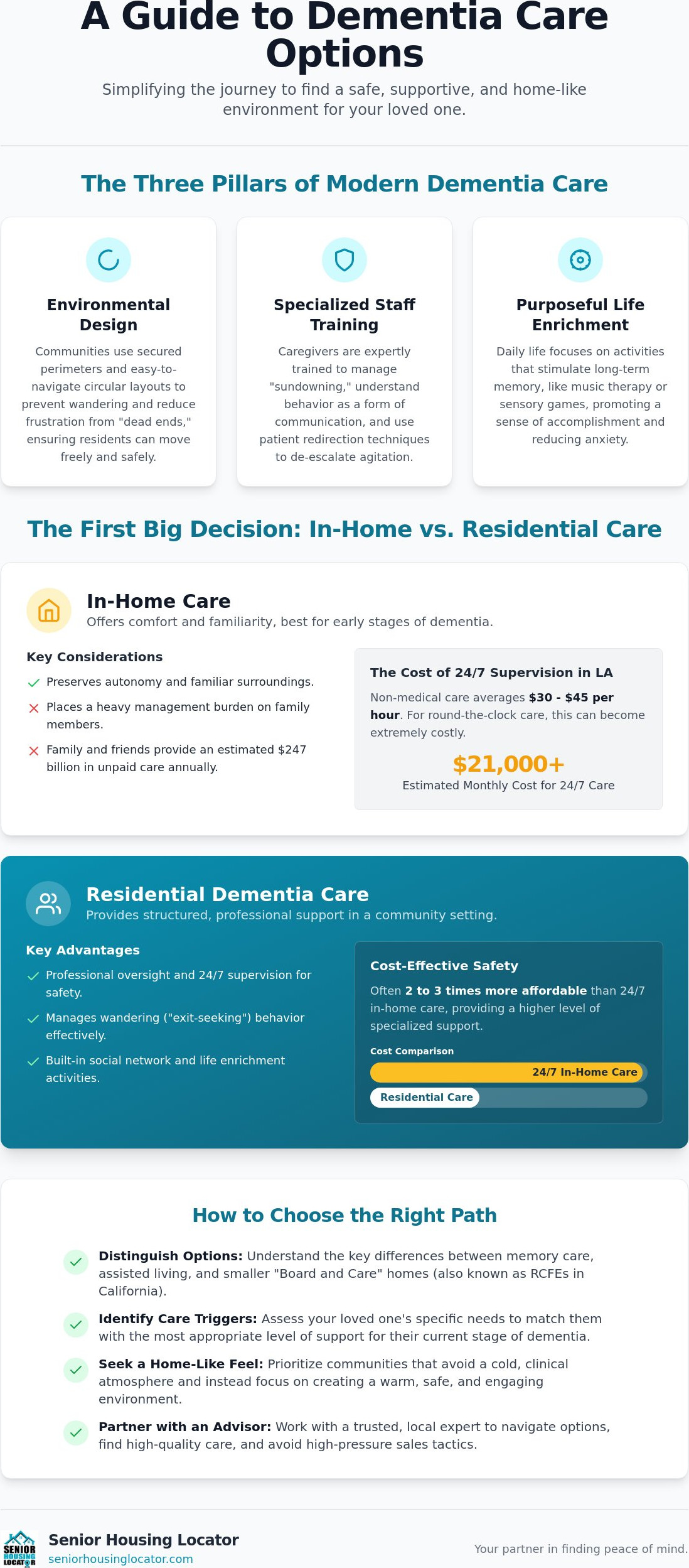
True dementia care is built on three core foundations: thoughtful design, expert training, and purposeful activity. These elements work together to create a “helping hand” atmosphere rather than a clinical one.
- Environmental design: These communities use secured perimeters and easy-to-navigate layouts. You will often see circular pathways that allow residents to walk freely without hitting a “dead end,” which can often cause frustration or anxiety.
- Staff training: Caregivers receive specialized training to manage “sundowning” and evening agitation. They understand that behavior is a form of communication and know how to use redirection with patience.
- Life enrichment: Daily life focuses on activities that stimulate long-term memory. This might include music therapy, tactile gardening, or sensory games designed to reduce anxiety and promote a sense of accomplishment.
The Role of Cognitive Support in Senior Living
Modern senior living options for dementia have shifted from simple custodial care to engagement-based care. This means the staff doesn’t just watch over your loved one; they actively step into their world. For those in the later stages of the journey, 24/7 supervision ensures that their physical and emotional needs are met around the clock. This level of support is foundational to modern dementia caregiving.
When a senior feels safe and understood, their overall stress levels drop. In many cases, these specialized environments can even reduce the need for certain medications. By addressing the root causes of agitation through a calm environment and a predictable routine, we can help seniors maintain a higher quality of life for longer.
In-Home Care vs. Residential Dementia Care: The First Decision
Choosing between staying at home or moving to a community is the first major hurdle for most families. In-home care offers the comfort of familiar surroundings. It is often the first step in the journey through senior living options for dementia. This path allows for “aging in place,” but it often places a heavy management burden on family members. You become the scheduler, the supervisor, and the backup caregiver when an aide calls out. In 2026, many families are finding that the “informal care” they provide has a high personal cost. Industry data shows that friends and family members provide an estimated $247 billion in unpaid care for individuals with dementia this year alone.
The cost-benefit analysis in Los Angeles is particularly striking. Non-medical in-home care in our area currently averages between $30 and $45 per hour. If your loved one requires 24/7 supervision to stay safe, the monthly cost of home care can easily double or triple the price of a high-quality residential community. Residential care provides a built-in social network and professional oversight that is difficult to replicate at home. If you are feeling overwhelmed by these choices, our team can help you compare local care options to find the best fit for your budget and needs.
When In-Home Care is the Right Choice
In-home care works best during the early stages of dementia. If your loved one is still mostly independent and safety isn’t yet a major concern, staying home can preserve their sense of autonomy. It is a viable path if you have multiple family members available to share the load. Many families also successfully use adult day programs, which cost between $70 and $120 per day in Los Angeles, to provide social stimulation while the primary caregiver works. Utilizing respite care is another essential strategy to prevent primary caregiver burnout and keep the home environment sustainable for longer.
The Limitations of Home Care for Memory Loss
As the condition progresses, the home environment can become a source of stress rather than comfort. Social isolation is a significant risk for seniors staying at home, which can actually accelerate cognitive decline. Modifying a house with specialized alarms, locks, and lighting is also a complex and expensive task. Often, clear signs parent needs assisted living begin to emerge, such as missed medications or wandering. When the physical and emotional “caregiver burden” puts your own health at risk, it is time to explore more structured Long-Term Care options that offer 24/7 professional support.
Comparing Memory Care, Assisted Living, and Board & Care Homes
Families often feel lost when looking at senior living options for dementia because the names sound so similar. You might hear about memory care, assisted living, and board and care homes all in the same conversation. In California, Board and Care homes are a uniquely favored small-scale dementia care option that provides a residential feel in a neighborhood setting. Understanding the “vibe” and staff ratios of each is the best way to determine which environment will help your loved one thrive. Each choice offers a different balance of social engagement, professional oversight, and personal space.
Assisted living with memory support serves as a helpful middle ground. It is a “hybrid” approach for seniors in the early-to-mid stages who don’t yet need a fully secured environment but require help with daily tasks like dressing or medication management. This option allows for more independence while providing a safety net of professional care. However, as memory loss progresses, the need for a more specialized and secured environment often becomes the priority for the family’s peace of mind.
Memory Care Communities: The Gold Standard for Safety
Memory care is specifically designed for those with cognitive challenges. These communities offer advanced security systems that prevent wandering while still allowing residents to maintain their dignity. If your loved one enjoys social events and diverse activity calendars, this might be the right path. For families exploring memory care placement San Fernando Valley options, you will find several communities that offer robust social opportunities and 24/7 specialized oversight. These settings provide three main benefits: professional security, structured routines, and peer-to-peer socialization.
Board and Care Homes: The Intimate Alternative
Sometimes a large community feels too busy or loud. For seniors who are easily overwhelmed by crowds, board and care homes are an excellent, intimate alternative. These are traditional residential houses that typically serve just six to ten residents. The 1:3 or 1:2 staff ratio in board and care homes Woodland Hills is a game-changer for those who need more personalized, one-on-one attention. Instead of a large dining hall, your loved one enjoys home-cooked meals at a shared kitchen table. It feels like home because it is a home. This environment is often best for seniors who prefer a quiet, neighborly atmosphere over a resort-style community.
How to Choose the Right Dementia Care Option for Your Loved One
How do you know when it is the right time to make a move? This question is often the hardest part of the journey. Many families wait until a crisis happens, but being proactive allows you to choose from a place of calm rather than urgency. Selecting the right senior living options for dementia requires a balance of logic and intuition. You aren’t just looking for a room; you are looking for a community that mirrors your loved one’s personality and meets their specific medical needs. The guilt you might feel is natural, but remember that moving a loved one into a safer environment is often the most compassionate choice you can make.
Start by identifying your primary “care trigger.” This is the specific behavior or safety concern that makes staying at home difficult. Is it wandering? Is it aggression or incontinence? Perhaps it is the crushing weight of social isolation. Once you name the trigger, you can filter communities by their ability to handle that specific challenge. We recommend touring at least three different types of communities to feel the difference in energy and pace. Seeing a large memory care facility alongside a small board and care home will help you understand which “vibe” suits your loved one best. If you feel overwhelmed by the number of choices, we can help you find senior living placement that fits your family’s unique needs and budget.
Matching Care to the Stage of Dementia
The level of support needed changes as the condition progresses. Matching the environment to the current stage ensures your loved one isn’t overwhelmed or under-stimulated.
- Early stage: The focus should be on social engagement and medication management. A community with a robust activity calendar can help slow cognitive decline through stimulation.
- Middle stage: This is when routine, safety, and behavioral support become vital. Secured perimeters are essential if wandering or “exit-seeking” has begun.
- Late stage: The priority shifts to comfort, dignity, and high-level physical assistance. You want a staff that is skilled in gentle, hands-on care and sensory-based comfort.
Red Flags to Watch for During Your Tours
Look past the beautiful chandeliers and focus on the residents. Are they clean, dressed, and engaged, or do they seem over-medicated and ignored? Pay close attention to odors; a well-managed community should smell fresh, not like heavy perfume or cleaning chemicals. Watch how the staff interacts with residents. Are they making eye contact and using names, or are they just performing tasks? Finally, trust your “gut feeling.” If a place doesn’t feel like a home where your loved one could be happy, it probably isn’t the right fit.
If you suspect that your loved one’s symptoms go beyond standard memory loss and may involve a thought disorder, consulting with specialists at pandhealth.com for a comprehensive evaluation can provide critical insights before finalizing a placement decision.
Navigating Los Angeles Dementia Care with a Local Advisor
Searching for senior living options for dementia in a city as vast as Los Angeles can feel like a full-time job. Our local market is incredibly unique. It’s dominated by thousands of Residential Care Facilities for the Elderly (RCFEs). These range from massive luxury communities to small, six-bed homes tucked away on quiet suburban streets. Without a guide, it is difficult to know which of these facilities actually provides high-quality memory support and which ones are simply “hospital-like” environments that lack a personal touch.
This is where a senior living advisor Los Angeles becomes your greatest asset. We act as a “Trusted Local Ally,” using our deep roots in the community to uncover the “hidden gems” that don’t always appear in a basic Google search. Our placement service is free for families because we’re supported by a network of high-quality providers. This allows us to maintain our integrity and focus entirely on finding the right match for your loved one’s personality and care needs.
Expert Placement in the San Fernando Valley and Beyond
We specialize in communities throughout Woodland Hills, Sherman Oaks, and Encino. We understand that assisted living costs Los Angeles can be a major source of stress for families. In 2026, the median cost for assisted living in our area is approximately $6,600 per month. Specialized memory care often ranges between $8,500 and $9,085. We help you navigate these financial realities by matching your specific budget to communities that offer the best value without compromising on safety or dignity. Our support doesn’t end once you choose a facility. We stay by your side through moving day and the weeks that follow to ensure the transition is as smooth as possible.
Our Commitment to Your Family
Our goal is to remove the burden of cold-calling dozens of facilities and hearing high-pressure sales pitches. We provide a personalized, full-service approach that prioritizes the senior’s comfort above all else. We handle the heavy lifting of checking availability, verifying licensing, and scheduling tours. This turns an overwhelming search for senior living options for dementia into a curated shortlist of options that actually make sense for your family. You don’t have to do this alone. Schedule a free consultation with a Senior Housing Locator expert today and let us help you find the peace of mind you deserve.
Take the Next Step Toward Quality Care
Finding the right path for a loved one is a journey rooted in love and safety. You now have the tools to distinguish between different senior living options for dementia, from the structured security of memory care to the intimate, home-like feel of a board and care house. By identifying your specific care triggers and matching them to the right stage of the journey, you are already moving toward a safer future. It is important to remember that you don’t have to manage these complex decisions on your own.
Our team provides a free personalized referral service with deep expert knowledge of San Fernando Valley and Los Angeles facilities. We offer compassionate guidance through every step of the transition, ensuring your loved one’s dignity is always the top priority. Find the perfect dementia care option for your loved one with a free local expert. You have already done the hard work of gathering information; now let us help you turn that knowledge into a clear, confident plan for the future.
Frequently Asked Questions
What is the difference between memory care and a nursing home?
Memory care is a specialized residential setting focused on cognitive support, while a nursing home provides intensive medical care. Memory care is designed for seniors who are physically active but need help managing the symptoms of memory loss. Nursing homes are for those with chronic medical conditions who need 24/7 nursing oversight and clinical assistance with complex health needs.
Can a person with dementia stay in a regular assisted living facility?
Yes, many seniors in the early stages of memory loss reside in standard assisted living. This works well until wandering or safety concerns require a more secured environment. It is often a helpful first step in the spectrum of senior living options for dementia before a higher level of specialized oversight becomes a necessity for the family’s peace of mind.
How much does dementia care cost in Los Angeles in 2026?
Costs for dementia care in Los Angeles vary significantly based on the level of support and the type of community you choose. Market rates reflect a wide range between residential board and care homes and larger memory care facilities. Factors like room size, staff-to-resident ratios, and specific care needs will all influence your final monthly rate in the local market.
When is the right time to move a loved one with dementia to a facility?
The right time to move is usually before a major safety crisis occurs at home. Look for signs like caregiver burnout, wandering, or missed medications. If you are constantly worried about your loved one’s safety or if their social isolation is worsening, it is likely the right time to explore more structured senior living options for dementia.
Is memory care more expensive than standard assisted living?
Yes, memory care is typically 15% to 25% more expensive than standard assisted living. This higher cost covers specialized staff training, increased caregiver-to-resident ratios, and the enhanced security features designed to keep residents safe. These elements provide the high level of oversight and structured daily routine necessary for those with advanced cognitive needs.
What are Board and Care homes, and are they good for dementia?
Board and Care homes are traditional houses in residential neighborhoods that serve a small group of seniors, usually six to ten residents. They are excellent for dementia because they offer a quiet, familiar atmosphere and a high staff-to-resident ratio. This intimate setting is often less overwhelming for seniors who struggle with the noise and crowds found in larger communities.
How do I pay for memory care if we have a limited budget?
Families typically pay for care through a combination of private savings, long-term care insurance, or veterans’ benefits. While Medicare doesn’t cover long-term custodial care, Medicaid may provide support for those who meet specific income and asset requirements. To ensure your financial and legal affairs are structured correctly for these costs, Golden Legacy Legal provides specialized estate planning services at goldenlegacylegal.com. We can help you identify local options that work with different financial situations and help you understand your budget.
Will my loved one be ‘locked in’ a memory care unit?
Residents are not “locked in” in a restrictive sense, but memory care units do use secured perimeters for safety. These systems, such as keypad entries and delayed-exit doors, prevent residents from wandering into unsafe areas. This design allows them to move freely and safely within the community gardens and common areas while giving you peace of mind.