
What if the best care for your parent isn’t found in a sprawling, hotel-like facility, but in one of the many small residential care homes tucked away on a quiet Los Angeles street? Many families worry that moving a loved one means they’ll become just another name on a clipboard. You want them to feel seen, heard, and truly at home. It’s completely natural to feel a sense of guilt about this transition or to feel overwhelmed by California’s specific licensing terms. You’re looking for a solution that offers safety, dignity, and a genuine sense of belonging.
This 2026 guide is designed to help you decide if a smaller setting is the right choice for your family. We’ll help you understand the local market, identify high-quality settings, and navigate the costs without hidden fees. You’ll learn about the latest RCFE staffing requirements, the updated Medi-Cal asset limits, and the specific benefits of the board and care model. By the end of this article, you’ll have a clear, step-by-step plan to move forward with peace of mind. We’ve done the hard work of filtering through the options so you can focus on what matters most: your family’s well-being.
Key Takeaways
- Learn why California families use the term “board and care” for these licensed residences and how they differ from traditional facilities.
- Compare staffing ratios to see how small residential care homes offer more personalized attention and safety for your loved one.
- Understand the all-inclusive pricing model in Los Angeles to help you budget for care without worrying about hidden monthly fees.
- Identify critical red flags during tours, from cleanliness odors to caregiver engagement, to ensure your parent is in the best hands.
- Use local expertise to filter through hundreds of San Fernando Valley options and find a high-quality home near your neighborhood.
What are Small Residential Care Homes? (The “Board and Care” Model)
If you’ve spent time searching for senior housing in the San Fernando Valley, you’ve likely heard the term “Board and Care.” While the state of California officially labels these as Residential Care Facilities for the Elderly (RCFEs), most Los Angeles families simply know them as small residential care homes. These aren’t large, corporate complexes. Instead, they are private residences in quiet neighborhoods like Woodland Hills that have been carefully converted into licensed Residential Care settings.
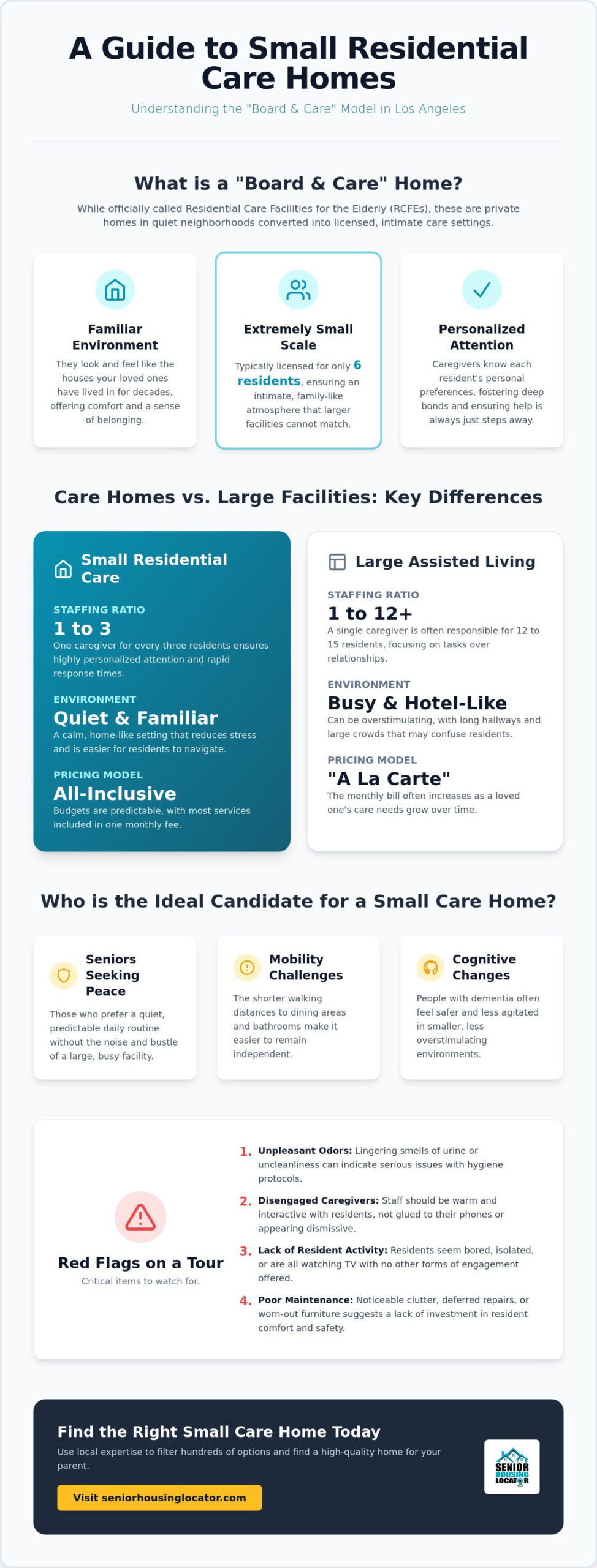
At their core, these homes offer a familiar environment. They look and feel like the houses your loved ones have lived in for decades. Because they are typically licensed for just six residents, they provide a level of intimacy that larger facilities simply can’t match. This small scale allows for a “helping hand” atmosphere where caregivers truly know each resident’s preferences, from how they take their coffee to their favorite afternoon television programs.
The high level of personal attention is a hallmark of this model. In a large community, a resident might be one of hundreds. In a board and care home, they are one of six. This setup fosters deep, family-like bonds between residents and staff. It also ensures that help is always just a few steps away, which can be incredibly reassuring for families who fear their parent might get lost in the shuffle of a massive institution.
Who is the Ideal Candidate for a Small Care Home?
Not every senior wants the “cruise ship” lifestyle of a large assisted living community. Some find the constant activity and large crowds exhausting. Small residential care homes are often the perfect fit for specific needs:
- Seniors seeking peace: Those who prefer a quiet, predictable daily routine without the noise of a busy facility.
- Individuals with mobility challenges: The shorter walking distances to dining areas and bathrooms make it easier for those with physical limitations to remain independent.
- Seniors with cognitive changes: People with advanced dementia often feel safer in smaller, less overstimulating environments where they can’t wander far.
Common Services and Amenities Included
Choosing a smaller setting doesn’t mean sacrificing professional support. These homes provide comprehensive care tailored to the individual. Most board and care homes in Los Angeles include:
- 24-hour supervision: Non-medical care is provided around the clock by dedicated live-in or shift caregivers.
- ADL Assistance: Hands-on help with activities of daily living, including bathing, dressing, and grooming.
- Family-style dining: Home-cooked meals are prepared in the kitchen and served at a central table, encouraging social connection.
Residential Care vs. Assisted Living: Which is Best for Your Family?
Deciding between a large community and small residential care homes is one of the most significant choices you’ll make. While both provide help with daily tasks, the atmosphere of each environment is worlds apart. Large assisted living facilities often resemble high-end hotels. They have grand lobbies, movie theaters, and long hallways. Small homes are intimate and familiar. They offer a sense of order and calm that can be hard to find in a building with 150 residents. If you’re struggling to weigh these differences, an expert in Assisted Living Placement can help you compare specific local options.
The most striking difference is the level of individual attention. In a large community, a single caregiver might be responsible for 12 or 15 residents at once. In a small home, that ratio typically drops to 1 caregiver for every 3 residents. This isn’t just a number on a page. It affects how quickly a call button is answered. It also determines how well the staff knows your parent’s unique personality. When caregivers have fewer residents to watch, they can focus on the person, not just the task list.
It’s also vital to understand that neither option is a nursing home. Both are social models of care designed for seniors who need help with things like bathing or medication but don’t require 24/7 medical nursing. The cost structure also varies. Large facilities often use “a la carte” pricing. This means your bill increases every time your loved one needs a little more help. Small residential care homes usually prefer an all-inclusive model. This makes it much easier for Los Angeles families to budget for the long term without worrying about hidden fees.
The Benefits of a 1:3 Staff-to-Resident Ratio
A lower ratio means your loved one is never just a face in the crowd. Caregivers in these smaller settings are highly observant. They notice the small things immediately:
- Health Awareness: Staff can spot subtle changes in health or mood, like a slight cough or a sudden lack of appetite, before they become serious issues.
- Rapid Support: Response times for assistance requests are significantly faster because the caregiver is usually only a room or two away.
- Daily Flexibility: Residents can often wake up, eat, or nap on their own schedule rather than following a rigid facility-wide timetable.
When a Larger Assisted Living Facility Might Be Better
Small homes are wonderful, but they aren’t for everyone. Some seniors thrive in a more expansive environment. A larger community might be the right fit if your loved one fits these descriptions:
- The Social Butterfly: Seniors who want a wide variety of daily clubs, guest speakers, and large-scale social events.
- The Active Lifestyle: Those who desire specific on-site amenities like swimming pools, full-scale fitness centers, or hair salons.
- The Couple’s Suite: Couples who want to live together in a large, multi-room apartment with a kitchenette rather than a single bedroom.
Understanding the Costs of Residential Care in Los Angeles
Finding the right care for your parent is an emotional journey, but the financial side often brings the most stress. In Los Angeles, the cost of senior living can feel like a moving target. Small residential care homes offer a unique advantage here because their pricing is often more transparent than large facilities. While a massive community might charge you for every extra minute of help, these smaller homes typically stick to a flat monthly rate. This simplicity helps you avoid the “bill shock” that many families experience when they see their first monthly statement.
Several factors influence the final price you’ll pay in the local market. Location is the biggest driver. A home in Beverly Hills or Santa Monica will naturally have a higher base rate than one in more suburban areas. The level of care your loved one requires also plays a role. If they need significant help with mobility or memory support, the monthly fee will reflect the extra staff time involved. To get a better sense of how these rates compare to other options, you can review our guide on Assisted Living Costs in Los Angeles.
Even with all-inclusive models, you should always ask about potential hidden fees. Some homes might charge extra for medication management, incontinence supplies, or specialized transportation to doctor appointments. It’s best to get a clear list of what is included in the base rate before you sign any agreements. This clarity allows you to compare different small residential care homes accurately and choose the one that fits your family’s financial plan.
Private vs. Shared Rooms: A Budget Decision
One of the easiest ways to manage costs is by choosing the right room type. A private room offers maximum dignity and personal space for your parent. It’s their own sanctuary. However, shared rooms are a wonderful way to access high-quality care on a tighter budget. These rooms often foster a sense of companionship, which can be helpful for seniors who feel lonely. You can find a variety of both options in Woodland Hills board and care homes, where the neighborhood setting keeps things feeling like a real community.
Financial Assistance and Paying for Care
Paying for residential care usually involves a mix of personal savings and specific benefits. Long-Term Care Insurance is a common tool that helps cover these costs, provided the policy is active. Veterans and their surviving spouses may also qualify for the Aid and Attendance benefit, which provides a monthly payment to help pay for RCFEs. It’s important to remember that Medicare doesn’t typically cover the “room and board” portion of residential care. It’s designed for medical needs, not long-term housing or daily supervision.
5 Red Flags to Watch for When Touring a Care Home
When you step through the front door of a potential care home, your senses are your best guide. While a house might look beautiful on the outside, the way it functions on the inside determines your parent’s quality of life. Touring small residential care homes allows you to see the “helping hand” atmosphere in action. It’s your opportunity to verify that the high standards you’ve read about are actually being met. If you want to skip the guesswork and focus only on vetted locations, our team provides expert Board and Care Home Referrals to ensure you only visit the highest-rated options in the San Fernando Valley.
Pay close attention to these five critical areas during your visit:
- The Smell Test: A home should smell clean and inviting. Lingering odors of urine or heavy, floral perfumes used to mask smells are signs of poor incontinence care or inadequate housekeeping.
- Caregiver Interaction: Watch the staff closely. Are they making eye contact and using residents’ names? If caregivers seem distracted by their phones or ignore residents’ requests, the benefit of a low staffing ratio is being lost.
- Safety Features: Look for practical details like sturdy grab bars in the bathrooms, clutter-free hallways, and well-lit pathways. For those with memory care needs, ensure that exits are secured and alarms are functional.
- Food Quality: Nutrition is the foundation of well-being. Ask to see a weekly menu or, better yet, visit during lunch. The food should look appetizing and be served in a way that encourages social interaction at the table.
- Licensing Transparency: Every RCFE in California must have its license clearly posted. If the administrator can’t show you a current license or seems evasive about their most recent state inspection report, it’s time to walk away.
Questions to Ask the Administrator
In 2026, staffing remains the biggest challenge for care operators. Ask the administrator about their staff turnover rate; high turnover often leads to inconsistent care for your loved one. You should also ask how they handle medical emergencies in the middle of the night and if they can provide references from current residents’ families. Hearing from another family who has already made this transition can offer immense peace of mind.
Evaluating the “Feeling” of the Home
Trust your gut instinct during the tour. Does the house feel like a warm, vibrant home or a cold, structured business? Observe the residents to see if they are dressed, groomed, and engaged in some form of activity. A sense of calm is good, but a sense of total isolation or chaos is a warning sign. You’re looking for a place where your parent feels like a member of a family, not just a number on a resident roster.
How to Find the Right Small Care Home in the San Fernando Valley
Searching for the perfect spot among the hundreds of small residential care homes in Los Angeles can feel like a full-time job. There are over 500 licensed board and care homes in the county, and many of them are concentrated right here in the San Fernando Valley. Filtering through these options requires more than just a list of addresses. It requires an understanding of local neighborhoods. Choosing a home in Encino when you live in Burbank might only be a few miles on a map, but in Los Angeles traffic, that distance can turn a quick visit into a two-hour ordeal.
This is where working with a Senior Living Advisor in Los Angeles becomes invaluable. You don’t have to spend your weekends making dozens of frustrating phone calls only to find out a home doesn’t have a vacancy or can’t meet your parent’s specific needs. A local expert acts as your guide, narrowing down the field to the three or four homes that actually fit your family’s criteria. This saves you hours of stress and ensures you’re only touring the best possible matches.
Matching Care Needs to Facility Specialties
Every home has a different specialty. Some are perfect for seniors who are still relatively independent, while others are equipped for “heavy care.” This might include the use of Hoyer lifts or providing total assistance with every daily task. If your loved one is struggling with dementia, you’ll want to focus on homes that specialize in Memory Care Placement. These facilities have staff trained specifically in redirection and cognitive support. You can also find homes that cater to specific cultural or dietary needs, such as Kosher kitchens or vegetarian menus, ensuring your parent feels respected and understood.
The Senior Housing Locator Advantage
We’ve already done the groundwork for you. Our team has personally toured and vetted small residential care homes across Woodland Hills, Northridge, and Sherman Oaks. We don’t just look at the decor; we look at the inspection history and the staff’s heart. We match your specific budget and location preferences to current vacancies in real-time. Our placement services are 100% free for families. We’re here to be your local allies during a difficult time, helping you move forward with confidence and clarity.
Finding Peace of Mind for Your Family’s Next Chapter
Choosing the right care setting is a deeply personal decision that requires both heart and research. You now know that small residential care homes offer a unique, intimate alternative to larger assisted living facilities. By focusing on personalized staffing ratios and all-inclusive pricing, these homes provide a sense of security that’s hard to find elsewhere. Remember to trust your senses during tours and ask the hard questions about staff turnover and emergency protocols. You’ve done the heavy lifting by learning what to look for; now it’s time to take the final step toward a safe transition.
You don’t have to navigate the 500+ options in the San Fernando Valley alone. As a locally owned and operated team based in Woodland Hills, we have the expert knowledge to narrow your search to the very best vetted homes. Let our local experts find the perfect care home for your loved one; start your free search today. Our placement service is completely free for Los Angeles families. We’re here to be your helping hand, ensuring your parent finds a place where they’re truly seen and cared for. You’ve got this, and we’re here to help.
Frequently Asked Questions
What is the difference between a board and care home and a residential care home?
There is no functional difference between these two terms. “Board and care” is the traditional name used by Los Angeles families, while “residential care home” or RCFE is the official licensing term used by the state of California. Both describe a private residence that has been converted and licensed to provide 24-hour care for seniors in a neighborhood setting.
Are small residential care homes regulated in California?
Yes, all care homes must be licensed and inspected by the California Department of Social Services, Community Care Licensing Division. They are required to follow strict Title 22 regulations regarding safety, nutrition, and staffing. In 2026, these regulations include mandatory annual medical visits for all residents and updated dementia care standards that apply facility-wide.
How many residents typically live in a small residential care home?
Most small residential care homes are licensed for a maximum of six residents. This specific capacity is designed to maintain a quiet, intimate environment that feels like a real family home. This small scale ensures that caregivers can provide high levels of personal attention without the distractions found in larger, high-occupancy facilities.
Is a small care home better than a nursing home for dementia patients?
A care home is often a superior choice for dementia patients who don’t require 24/7 skilled nursing procedures. Large facilities or nursing homes can be overstimulating, which often leads to increased agitation or confusion. The predictable, calm environment of a small home helps residents with memory loss feel more secure and less overwhelmed by their surroundings.
Can my parent keep their own doctor while living in a board and care home?
Yes, your parent can absolutely keep their current primary care physician and any specialists they already see. The staff at the home will work closely with your family and your doctor to coordinate medications and follow any specific care plans. Many doctors in the San Fernando Valley even offer house calls specifically for residents in these smaller settings.
What happens if my parent’s care needs increase over time?
California’s current policies are designed to help seniors “age in place” as their needs change. If a resident requires more help, the home can often coordinate with home health agencies or utilize a hospice waiver to provide higher levels of support. The facility must conduct a formal reappraisal of a resident’s needs at least every 12 months to ensure they can still be safely served.
Are there small residential care homes in Woodland Hills that offer private rooms?
Yes, many small residential care homes in Woodland Hills provide private rooms for residents who value their personal space and dignity. While shared rooms are a common way to manage costs, private suites are widely available in this neighborhood. We can help you identify which local homes currently have private room vacancies that fit your budget.
How do I know if a care home is licensed and has a good track record?
You can verify any home’s license and compliance history through the California Department of Social Services website. This public database allows you to see any recent citations, complaints, or inspection results. Checking these records is a vital part of the vetting process to ensure the home maintains the high standards your loved one deserves.