
Imagine spending fifty years waking up next to the person you love, only to be told that a change in health means you have to live apart. It’s a heartbreaking scenario that many families fear when they first start looking into senior living for couples. You’ve spent decades building a life together, and the thought of being separated by different care requirements feels like a heavy burden you shouldn’t have to carry.
We believe that your marriage shouldn’t be compromised by a need for extra support. This article will show you how to find a community in the San Fernando Valley or Greater Los Angeles where you can share a suite, even if one of you needs more help than the other. We will explain how second-occupant fees work, how to manage different care levels in one home, and how to find a local facility that keeps your family close. You’ll learn how to navigate these choices with confidence, clarity, and peace of mind.
Key Takeaways
- Learn why modern communities are designed to keep spouses together, ensuring that health changes don’t mean living apart.
- Discover how “split-care” models in Los Angeles allow one partner to receive memory care or assisted living support while the other stays independent in the same suite.
- Gain clarity on the financial side of senior living for couples, including how second-occupant fees cover shared meals, utilities, and activities.
- Find out how to locate couple-friendly vacancies in the San Fernando Valley by using local expertise to navigate communities in areas like Sherman Oaks and Encino.
Can Couples Live Together in Senior Living Communities?
The short answer is a resounding yes. Modern senior living for couples is designed to celebrate your relationship, not restrict it. In 2026, most communities recognize that your partner is your primary source of comfort and stability. There is a common myth that moving into assisted living means you must live in separate rooms or even separate wings if your health needs differ. This is simply not true. Most facilities now offer shared suites specifically tailored for pairs who want to remain side by side.
Choosing senior living for couples allows you to “age in place” together. This philosophy means that even if one person’s health changes, the community brings the care to you rather than forcing a move. Staying together reduces transition trauma, which is the stress and confusion that often follows a major life change. When you stay with your spouse, you maintain your routine, your shared history, and your emotional anchor. It makes the entire process feel less like a clinical move and more like a new chapter in your life together.
The Emotional Impact of Staying Together
Staying close helps lower daily stress and anxiety. When you share a living space, you can continue to enjoy the small moments that define a marriage, such as sharing a morning coffee or watching a favorite show before bed. These Retirement community options provide a structured environment where both of you can thrive socially and mentally. Proximity keeps you engaged, reduces the risk of isolation, and ensures that the more independent spouse doesn’t feel like a visitor in their own partner’s life. Separation of care is always a last resort, as communities prioritize keeping the marital bond intact whenever possible.
When One Spouse is a Caregiver
Many spouses in the San Fernando Valley have spent years acting as the primary caregiver. This role is physically and emotionally exhausting; it often leads to the caregiver’s own health failing over time. Moving to a professional community allows you to step back from medical tasks and return to being a supportive partner. Professional staff handle the heavy lifting, medication management, and safety checks so you can focus on your relationship again. Respite care serves as a short-term residential stay that gives couples a chance to experience community life without a long-term contract. By letting experts handle the care, you protect your own well-being while ensuring your spouse gets the exact support they need.
Senior Living Options for Couples in Los Angeles
Finding the right fit in Los Angeles requires understanding the different levels of support available. Every couple has a unique dynamic; some are still very active and simply want to shed the burdens of homeownership, while others need daily physical assistance. The Los Angeles area, particularly the San Fernando Valley, offers a diverse range of senior living for couples that caters to these varying needs. From sprawling luxury campuses to intimate residential settings, the goal is always to find a place where both partners feel at home and secure.
Independent living is a popular choice for active pairs who want a maintenance-free lifestyle. These communities focus on social engagement, fine dining, and wellness programs. If your health needs are more complex, assisted living suites offer a higher level of physical support. Thinking about these different levels is a major part of planning for long-term care, especially when you’re coordinating for two people. For those looking for long-term security, Continuing Care Retirement Communities (CCRCs) provide a “Life Plan” model that guarantees care transitions on the same campus as your needs evolve.
Residential board and care homes are often considered the hidden gems of the San Fernando Valley. These are typical houses in residential neighborhoods that have been converted into licensed care facilities, usually serving six residents or fewer. They offer a much higher caregiver-to-resident ratio than larger facilities. Many of these homes in Sherman Oaks or Encino feature private master suites that are perfect for couples who prefer a quiet, home-like environment over a large institution.
Independent vs. Assisted Living for Couples
The main difference between these two options is the level of daily “hands-on” help. Independent living provides convenience through housekeeping, transportation, and meal services. Assisted living adds support for activities of daily living, such as bathing or medication management. If one spouse is active but the other needs help, many communities allow you to live together in an assisted living suite while the independent spouse continues their lifestyle. To see how local facilities compare, you can read our Independent Living Communities in Woodland Hills 2026 guide.
Board and Care Homes: A Personalized Choice
If you find large buildings overwhelming, a board and care home might be the right answer. These settings are less clinical and more personal; the staff often feels like extended family. Because they are smaller, they can sometimes be more flexible with couple-specific requests. You can find more details on this model in our guide to Board and Care Homes in Woodland Hills. If you need help finding a specific vacancy that fits your budget and care needs, using a local placement advisor can save you hours of stressful searching.
Navigating Different Care Needs: The “Split-Care” Challenge
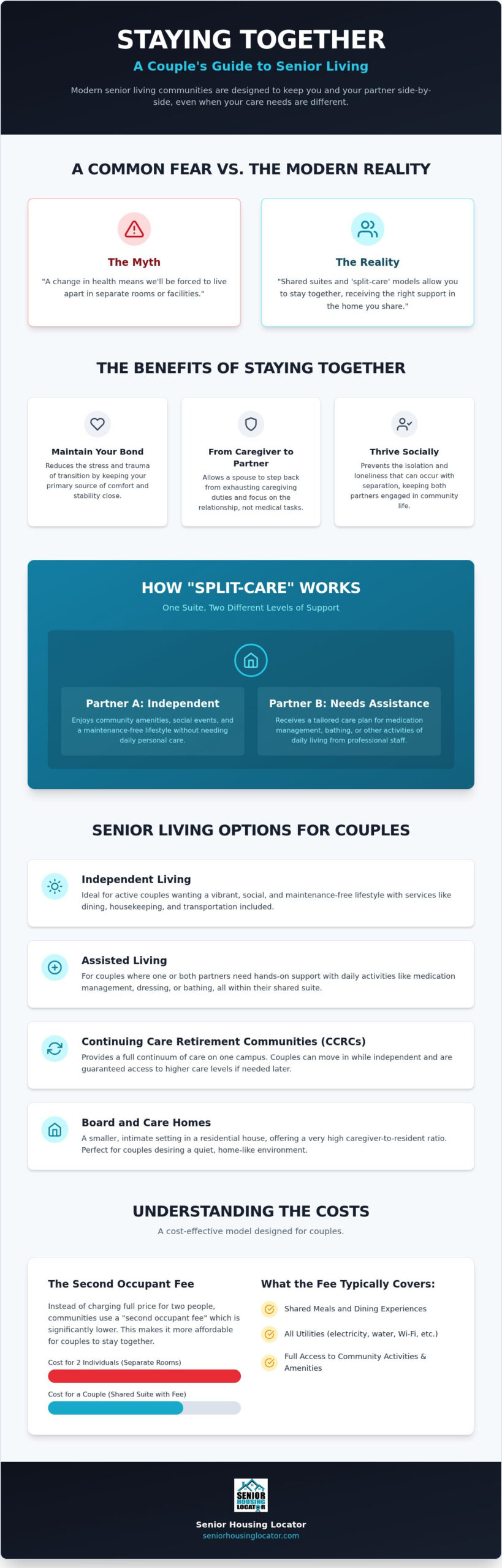
One of the biggest worries families face is what happens when one partner’s health declines faster than the other’s. This is often called the “split-care” challenge. In the past, this might have meant living in different buildings, but modern senior living for couples offers much more flexibility. Communities now create “Dual-Care Plans” that allow you to stay in the same apartment while receiving different levels of service. This approach keeps your bond strong while ensuring everyone stays safe and healthy.
In a common scenario, one spouse might be fully independent while the other requires assistance with activities of daily living (ADLs), such as dressing, bathing, or managing medications. Instead of moving the spouse who needs help to a different area, care staff come directly to your shared suite. This keeps your daily life intact. You still eat meals together, sleep in the same room, and participate in social events as a pair. The logistics are handled behind the scenes. The facility tracks two separate care assessments but manages them under one roof, prioritizing your relationship over clinical convenience.
Deciding between in-room services and moving to a specialized wing depends on the specific care required. Most facilities aim to provide as much support as possible within your private suite. However, if medical needs become intensive, they might suggest a transition to a more specialized area. Even then, the goal is to keep you connected through shared dining and common areas so you’re never truly apart.
Couples and Memory Care in 2026
If one partner develops dementia, the situation becomes more complex. However, many Los Angeles facilities now offer “Day Stay” memory programs. This allows the spouse with memory loss to participate in specialized, secure activities during the day while returning to their shared suite at night. Safety is the top priority here. Staff evaluate whether the environment remains safe for both people, especially if wandering or nighttime confusion becomes an issue. For those navigating these specific challenges, our guide on Memory Care Placement in San Fernando Valley provides deeper insights into dementia-specific support.
Addressing the Fear of Separation
What happens if one spouse needs the intensive medical support of skilled nursing? While this is a harder transition, it doesn’t have to mean a total separation. Many modern campuses use a “Neighboring Room” strategy. This places partners in rooms that are just a few steps apart, even if they are technically in different wings. This allows for frequent visits, shared meals, and constant contact without compromising medical safety. Working with a senior living advisor in Los Angeles can help you negotiate these proximity clauses before you sign a contract. They act as your advocate, ensuring the facility commits to keeping you as close as possible.
The Logistics of Moving Together: Suites, Layouts, and Costs
Transitioning into senior living for couples involves more than just picking a facility. It requires a clear look at how you’ll live and how you’ll pay for it. Most communities offer a variety of floor plans designed to accommodate two people comfortably. Whether you prefer a cozy studio, a one-bedroom, or a spacious two-bedroom suite, the goal is to create a space that feels like home. Understanding these physical layouts is the first step in making a successful move.
Financial planning is equally vital. When two people move into a community, the pricing structure changes. You typically pay a “Base Rent” for the apartment, followed by a “Second Occupant Fee.” This fee covers the additional costs of having another person in the building. It usually includes three meals a day, all utilities, and access to all community activities. By 2026, many families are also utilizing financial tools like long-term care insurance or the VA “Aid & Attendance” benefit, which can provide over $2,400 per month for eligible veterans and their spouses.
Care costs are usually billed separately from the room rent. This is beneficial because it ensures you only pay for the specific help each person needs. If one spouse is independent, their care bill might be zero. If the other needs help with medications or mobility, their care level is assessed and billed individually. This transparency helps you manage your monthly budget without paying for services you don’t use.
Choosing the Right Room Layout
A one-bedroom suite with a separate living area is often the most popular choice for couples. It provides a distinct space for sleeping and a shared area for relaxing or entertaining visitors. Some couples choose two adjacent studio apartments to maintain a higher level of privacy, though this is often more expensive. Companion Suites are a cost-effective alternative for couples on a budget who want to prioritize shared space over multiple rooms. If you’re feeling overwhelmed by these choices, you can speak with a local advisor to compare available floor plans in your area.
Understanding 2026 Pricing Structures
Pricing in Los Angeles is highly variable based on the neighborhood and the level of luxury. It’s important to distinguish between the base rent, which covers the roof over your head, and the care costs, which cover medical and physical support. All-inclusive models offer one flat fee for everything, while a-la-carte models charge only for the specific tasks performed. For a detailed look at what to expect in the current market, please see our guide on Assisted Living Costs in Los Angeles. New transparency laws effective in 2026 now require facilities to provide written disclosures about all fees and historical rate increases before you sign any contract.
Finding the Perfect Fit in the San Fernando Valley
Searching for senior living for couples in a city as large as Los Angeles can feel like a full-time job. Every neighborhood has a different personality, and vacancy rates for shared suites change by the day. Local expertise is vital because what works for a couple in Sherman Oaks might not fit the needs of a pair looking in Encino. You need an ally who knows which buildings have the best layouts for two and which ones truly welcome couples with differing care levels.
Senior Housing Locator simplifies this journey by doing the heavy lifting for you. We pre-screen facilities to find specific vacancies that accommodate couples, saving you from making dozens of frustrating phone calls. We look for communities that prioritize resident well-being, maintain high staffing ratios, and offer the split-care models we discussed earlier. As your trusted local ally, we provide transparency, efficiency, and altruism so you can focus on your family instead of logistics.
A personalized tour is the most important step in your search. When you visit a facility for two, look for wide hallways, shared dining spaces that feel social, and staff who interact warmly with residents. It’s about finding a place where both of you feel seen and supported. We help you organize these visits, ensuring you ask the right questions about pricing and care plans before making a final decision.
Neighborhood Spotlights: From Woodland Hills to Pasadena
The vibe of your community matters just as much as the care provided. Woodland Hills offers a quieter, more suburban feel with many luxury options, while Sherman Oaks and Encino are more central and active. If you prefer the charm of the east side, Pasadena has beautiful historic communities that offer a different pace of life. Proximity to medical centers in Northridge or Burbank is a major factor for many couples, as it ensures quick access to specialists if health needs change. Whether you’re looking for an affordable board and care home or a high-end assisted living campus, the San Fernando Valley has a solution for every budget.
Next Steps: Your Personalized Roadmap
Starting the conversation about moving is often the hardest part. It’s best to talk with your parents or spouse early, well before an emergency health event forces a quick decision. Being proactive allows you to choose a community you actually love rather than settling for whatever is available during a crisis. We are here to help you map out this transition with compassion, clarity, and peace of mind. Schedule a free consultation with a Senior Housing Locator advisor today to find the perfect home for your future together.
Start Your Journey Together Today
Transitioning to a new home doesn’t have to mean a loss of independence or a separation from your partner. Modern senior living for couples is built on the foundation of keeping you together. Whether you need a shared suite in Sherman Oaks or a specialized care plan in Woodland Hills, the options across Los Angeles are more flexible than ever. You can maintain your bond while professional staff handle the daily care tasks that once felt overwhelming.
Navigating the costs and layouts of these communities is a complex process. You don’t have to do it alone. We offer a no-cost placement service with expert knowledge of San Fernando Valley facilities. Our team provides compassionate, integrity-driven guidance to ensure you find a community that feels right for both of you. We handle the heavy lifting of checking vacancies and pre-screening facilities so you can focus on what matters most.
Let us help you find the perfect senior living suite for you and your spouse, completely free.
You’ve spent a lifetime building a partnership. Let’s work together to ensure your next chapter is just as strong, secure, and connected as the ones that came before it.
Frequently Asked Questions
Can a couple live together if only one person needs assisted living?
Yes, couples can share a suite even if only one person requires professional assistance. In this arrangement, the independent spouse lives as a second occupant while their partner receives help with daily tasks like medication management or mobility. This allows you to stay together in the same home while ensuring the person who needs care gets the exact support they require without a forced separation.
What is the average second occupant fee in Los Angeles senior living?
The second occupant fee is an additional monthly charge that covers the cost of meals, utilities, and housekeeping for the second person in the suite. In the Los Angeles area, this fee also includes access to all social programming and community transportation. It is added to the base rent of the apartment. You should always ask for a written disclosure of these fees during your initial tour.
Will my parents be separated if one needs to move to memory care?
Not necessarily. Many modern communities in the San Fernando Valley offer “split-care” models or “Day Stay” programs that allow couples to sleep in the same room even if one has dementia. If safety concerns eventually require a move to a secure wing, staff often use a neighboring room strategy to keep them just a few steps apart. We specialize in finding communities that prioritize keeping spouses close.
Are there two-bedroom apartments in assisted living facilities?
Yes, many larger assisted living facilities in Los Angeles offer two-bedroom floor plans. These layouts are perfect for couples who want separate sleeping areas or extra space for a home office. While one-bedroom suites are more common, two-bedroom options provide a more traditional house-like feel. These larger units are in high demand, so it’s helpful to start your search early to secure a vacancy.
Does Medicare pay for senior living for couples?
Medicare does not cover the monthly room and board or custodial care costs for senior living for couples. It is primarily designed to pay for medical services, hospital stays, and short-term rehabilitative care. Most families use private funds, long-term care insurance, or the VA Aid and Attendance benefit. For eligible veterans and their spouses, this VA benefit can provide over $2,400 per month to help cover care expenses.
What happens if one spouse passes away while living in the community?
If a spouse passes away, the surviving partner can usually stay in their current suite. The monthly cost will typically decrease because the second occupant fee and the deceased spouse’s care charges are removed from the bill. The community staff also provides emotional support and help with the transition. Some survivors eventually choose to move into a smaller studio apartment within the same building to further reduce their monthly expenses.
Can couples bring their own furniture to an assisted living suite?
Yes, we highly recommend bringing your own furniture and personal items to help the suite feel like home. Most facilities encourage you to bring your favorite bed, chairs, and family photos to make the transition easier. It’s a good idea to get a copy of the floor plan and measurements before moving day. This ensures your cherished pieces fit comfortably and the space remains safe for easy movement.
How do we find board and care homes with private rooms for couples in Woodland Hills?
Finding these specific vacancies requires checking the current licensing and availability of small residential homes in the area. Because board and care homes typically only have six beds, private suites for couples are rare and fill up quickly. We maintain a real-time database of these openings in Woodland Hills and handle the heavy lifting of calling facilities to find a couple-friendly match that fits your budget.