
Last week, a daughter in the San Fernando Valley sat in her car after a facility tour, feeling more overwhelmed than when she started. She saw the sparkling chandeliers and the gourmet menus, yet she still couldn’t tell if her mother would truly be safe and seen. It’s a heavy burden to carry. You want the best for your parent, but the fear of neglect or the guilt of moving them from their home can feel paralyzing. You are likely asking yourself how to tell if a community is actually excellent or just has a beautiful lobby.
Finding quality memory care in Los Angeles doesn’t have to be a guessing game based on aesthetics. We understand that your priority is peace of mind, professional reliability, and genuine compassion. This guide provides a clear framework for evaluating staff expertise, understanding the latest 2026 transparency laws, and identifying the specific indicators of high-quality dementia care. You’ll learn how to focus on what matters most: the daily engagement, the safety of the environment, and the specialized training of the people who will become your parent’s second family. By the end of this article, you will have the confidence to choose a local community that offers both the value you need and the dignity your loved one deserves.
Key Takeaways
- Understand that true quality goes beyond luxury, focusing instead on a therapeutic environment designed specifically for cognitive support.
- Learn why specialized staff certifications and engagement styles are more important for your parent’s well-being than simple staffing ratios.
- Discover how purposeful design features, like color-coding and memory boxes, help residents navigate their surroundings with less frustration.
- Identify immediate red flags during your tours by using simple “Smell and Engagement” tests to see past the marketing.
- Simplify the stress of finding quality memory care in the San Fernando Valley by using a local expert to narrow down your options to the best fit.
What Is Quality Memory Care? Defining the Standard in 2026
Quality memory care is far more than a locked wing in a senior community. In 2026, we define it as a specialized, therapeutic environment specifically built to support people with Alzheimer’s, dementia, or other cognitive changes. While many families start their search by looking for a safe place to prevent wandering, safety is only the foundation. Finding quality memory care means looking deeper at how a community nurtures the person behind the diagnosis. It’s about creating a day that feels meaningful, not just managed.
To understand this standard, it helps to look at the baseline of senior care. You might already be familiar with the general concept of What is Assisted Living?, which provides help with daily tasks like dressing or medication. Memory care takes this a step further by adding 24-hour supervision and structured routines that reduce confusion. The biggest difference in 2026 is the widespread adoption of Person-Centered Care. This approach treats every resident as an individual with a unique history and preferences, rather than just a patient with a set of symptoms. It shifts the focus from what a person has lost to what they can still do.
The Evolution of Dementia Care Standards
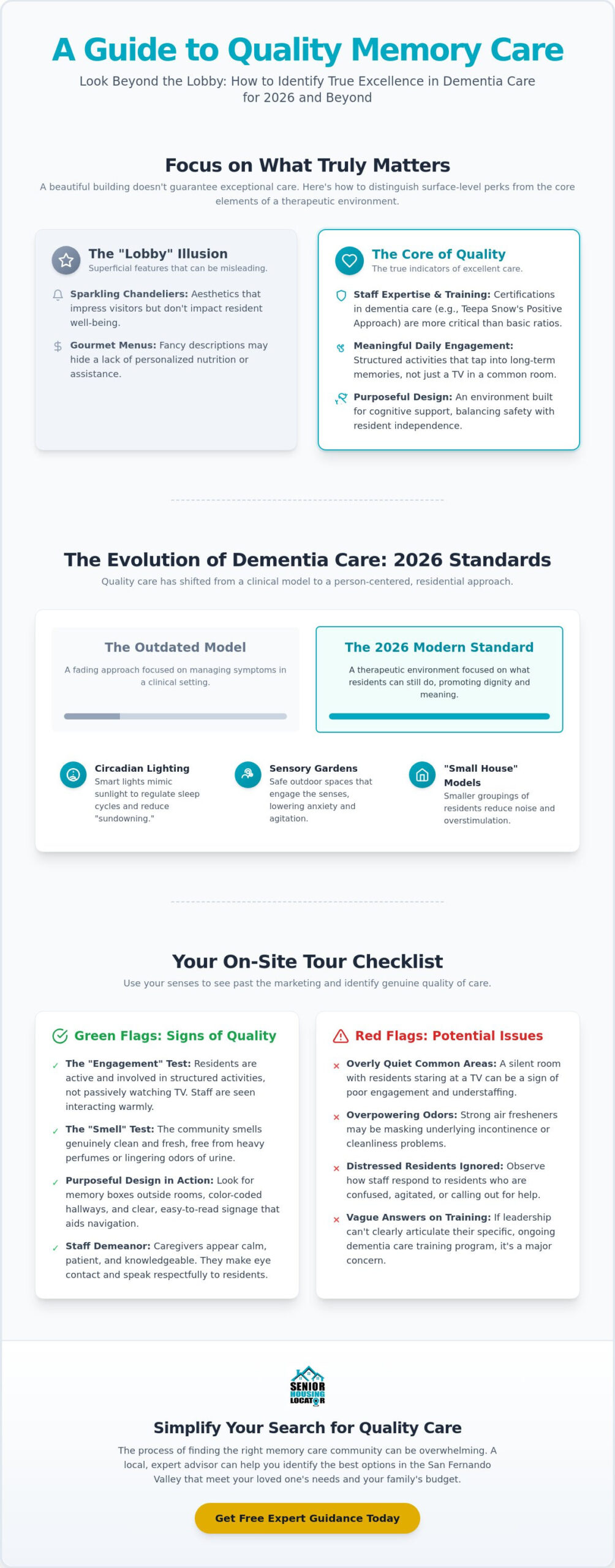
The old clinical “nursing home” model is fading away. Today, leading Los Angeles facilities prioritize residential-style environments that feel like a neighborhood. When you are finding quality memory care, look for these modern 2026 standards that improve daily life:
- Circadian lighting systems: These smart lights mimic natural sunlight patterns to help regulate sleep-wake cycles and reduce evening confusion.
- Sensory gardens: These provide safe, outdoor spaces where residents can touch, smell, and see plants, which significantly lowers anxiety.
- “Small house” models: By grouping residents into smaller “households,” facilities can lower noise levels and minimize the agitation caused by large crowds.
Why Quality Matters: Safety vs. Engagement
A secure perimeter is necessary for safety, but it shouldn’t feel like a barrier. Quality care balances the need for wandering prevention with the freedom to move and explore. True engagement isn’t just sitting in a common room with a television on; it involves structured activities that tap into a resident’s long-term memories and current abilities. Quality memory care is the intersection of safety, specialized staffing, and purposeful daily living. When these three elements meet, residents don’t just stay safe; they thrive in a community that understands their world.
Evaluating the Staff: The Heart of Quality Care
Finding quality memory care often starts with a list of numbers, specifically staff-to-resident ratios. While these numbers are important, they only tell half the story. As of July 1, 2026, California law requires assisted living facilities to provide written disclosures on staff ratios for all shifts before a contract is signed. This transparency is a great first step, but it doesn’t reveal the heart of the care. You need to know if the people at the bedside are truly equipped to handle the complexities of dementia with patience and skill.
Quality care is defined by specialized training that goes beyond the basics. While California mandates at least 8 hours of annual continuing education for direct-care staff, the best communities seek out additional certifications. Look for programs like Teepa Snow’s Positive Approach to Care. This methodology focuses on what residents can still do, teaching staff how to use specific hand-under-hand techniques and verbal cues to reduce resident distress. When staff are trained in these advanced methods, they stop “managing” residents and start connecting with them. For more guidance on what to look for in these settings, the Alzheimer’s Association offers helpful tips for choosing a memory care facility.
The Life Enrichment Director is another vital role to evaluate. This person is responsible for the community’s “soul.” They ensure that daily life isn’t just about safety, but about maintaining the resident’s dignity through tailored activities. If you feel overwhelmed by the sheer number of options, consulting with a local senior living advisor can help you identify which facilities in the San Fernando Valley have the most stable and well-trained teams.
Questions to Ask About Training and Longevity
Consistency is everything in memory care. High staff turnover can be incredibly distressing for a person with memory loss who relies on familiar faces. Ask the following questions to gauge stability:
- How often do staff receive training on specific dementia behaviors, such as exit-seeking or agitation?
- What is the turnover rate for the caregivers and the Executive Director over the last two years?
- Is there a dedicated nurse on-site 24/7, or is medical oversight handled on an on-call basis?
Observing Non-Verbal Quality Indicators
The best way to evaluate a team is through an unannounced visit. Watch the interactions in the common areas. Are staff making eye contact and using the residents’ names, or are they talking over them to other coworkers? Caregivers in high-quality settings move at the resident’s pace, never appearing rushed or impatient. Observe how they handle a resident who is experiencing “sundowning,” the increased confusion that often happens in the late afternoon. A skilled caregiver will use redirection, soft lighting, and a calm voice to provide comfort rather than reaching for a “quick fix” or showing frustration.
The Environment: Safety and Purposeful Design
The layout of a senior living community directly influences how your loved one feels every day. A well-designed space reduces the frustration of getting lost and helps maintain a sense of calm. When you are finding quality memory care, look for “wayfinding” cues. These are visual signals like contrasting carpet colors or bold signage that guide residents naturally through hallways. Many 2026 facilities now use memory boxes outside each bedroom. These small glass cases hold personal photos or mementos, helping a resident recognize their own door without needing to remember a room number or nameplate.
Safety in a modern memory care setting involves more than just locked doors. High-quality communities use fall-detection sensors and motion-activated floor lighting to prevent accidents during late-night hours. Outdoor spaces should be equally thoughtful and secure. A quality sensory garden is usually designed as a “continuous loop” path. This allows residents to walk and explore without hitting a dead end, which can often trigger anxiety or agitation. It’s helpful to use a checklist from the National Institute on Aging to ensure you don’t miss these environmental details during your tour.
California Licensing and RCFE Standards
In Los Angeles, all memory care units are licensed as Residential Care Facilities for the Elderly (RCFE). They fall under the oversight of the California Department of Social Services (CDSS). Each facility must meet strict Title 22 requirements, which cover everything from fire safety to staff training. If you are looking for a memory care placement in San Fernando Valley, you can check the CDSS public record for any recent citations. Transparency is vital. You deserve to know the regulatory history of any home you consider for your parent.
Nutrition and Dining in Memory Care
Maintaining proper nutrition is a common challenge for those with cognitive impairment. Finding quality memory care means looking for a dining program that prioritizes both health and dignity. Quality communities offer “finger food” menus for residents who find traditional utensils difficult to use; this preserves their independence at the table. Dining rooms should be calm and distraction-free, without loud televisions or clattering carts. Staff should also have a clear, documented system for tracking hydration and weight, as these are often the first indicators of a change in physical health.
Touring Checklist: Identifying Red Flags in Memory Care
Finding quality memory care requires you to look past the fresh paint and beautiful furniture. While a community might look impressive at first glance, the small, sensory details often tell the real story. When you tour a facility, you are essentially performing a reality check on their marketing claims. Trust your gut. If something feels off, it usually is. You don’t need to be a medical expert to spot the signs of a well-run home; you just need to know where to look.
Use these five sensory tests during your visit to evaluate the environment:
- The Smell Test: Does the air smell clean, or is there a heavy scent of floral perfume or industrial bleach? Overpowering fragrances are often used to mask underlying odors from poor hygiene or maintenance.
- The Engagement Test: Look at the residents in the common areas. Are they actively participating in a task, or are they simply parked in front of a television? Quality care involves active stimulation, not passive sitting.
- The Sound Test: Listen for the background noise. Constant beeping alarms or loud staff chatter can be incredibly distressing for someone with dementia. A calm, quiet atmosphere is a hallmark of a therapeutic setting.
- The Transparency Test: Ask to see the laundry room, the kitchen, or a room that isn’t a “model” unit. If an administrator hesitates to show you all areas of the community, it may suggest that their standards are inconsistent.
- The Resident Appearance Test: Are the residents well-groomed? Check for clean hair, trimmed nails, and clothes that are appropriate for the weather. Dignity is reflected in these daily personal details.
The Best Times to Visit for an Accurate Picture
Timing your visit can reveal how a team handles pressure. Mealtimes are often the most hectic part of the day. By visiting during lunch, you can see how well the staff coordinates and whether they provide the patient, one-on-one assistance residents might need. It’s also wise to visit during the late afternoon. This is when “sundowning” behaviors often peak, and you can observe if the staff remains calm and supportive during these challenging hours. We always recommend a second, unannounced visit after your initial tour to see if the high standards you first witnessed are consistent.
Reviewing the Activity Calendar
A calendar full of events doesn’t always equal quality engagement. Look for “failure-free” activities that are tailored to various cognitive stages. These are tasks where there is no “wrong” way to participate, which helps prevent resident frustration. Ensure the activities are age-appropriate rather than child-like. Many families find that assisted living costs in Los Angeles often include these premium programming options, so it’s important to verify that the value matches the investment. If you want help filtering through these options, talking to a local senior living advisor can save you hours of visiting unsuitable facilities.
Simplifying Your Search with a Los Angeles Senior Living Advisor
Searching for the right home in a city as large as Los Angeles can feel like a full-time job. With over 100 memory care facilities in the San Fernando Valley alone, the process often leads to decision fatigue. You might spend dozens of hours touring places that simply aren’t a match for your parent’s specific needs or your family’s budget. This is where a local ally makes the difference. Finding quality memory care is much simpler when you have someone who has already visited these communities, interviewed the staff, and reviewed the state records for you.
A senior living advisor acts as a compassionate facilitator during this high-stress time. Instead of you filtering through a massive list, an expert narrows the field down to a handful of options that actually fit your criteria. Most importantly, this is a free-to-the-family referral service. It allows you to move from a state of crisis management into a proactive, calm transition. You get to focus on being a daughter or a son again, while we handle the logistical heavy lifting and research.
Expert Insights into Local SFV Communities
Local knowledge is the most valuable tool in your search. A senior living advisor in Los Angeles understands the nuances of the San Fernando Valley market. We know which communities in Sherman Oaks have the most stable management teams and which facilities in Woodland Hills offer specialized support for Lewy Body dementia versus standard Alzheimer’s care. This objective expertise provides a vital buffer against the high-pressure sales tactics you might encounter when contacting facilities directly. We don’t just give you a list; we give you the “inside story” on where the care is truly exceptional.
Taking the Next Step for Your Loved One
The process begins with a simple, personalized intake. We take the time to understand your loved one’s care requirements, your preferred location, and your financial plan. Once we’ve identified the best matches, we help schedule tours and can even join you as a professional guide. We know the right questions to ask and the red flags to look for, ensuring you feel confident in your final choice. You don’t have to do this alone. Let Senior Housing Locator find the highest quality care for your family today.
Moving Forward with Confidence and Peace of Mind
You now have the framework to look past the surface and evaluate what truly matters in a senior community. By focusing on specialized staff training, purposeful environmental design, and genuine resident engagement, you’re equipped to make a choice rooted in facts rather than fear. Finding quality memory care is a journey that requires patience, but you’ve already taken the most important step by educating yourself on the latest 2026 standards. You are no longer searching in the dark; you are an informed advocate for your parent’s dignity and well-being.
You don’t have to navigate the many options in the San Fernando Valley by yourself. Our team provides personalized, full-service placement at no cost to families. With deep local expertise in Woodland Hills and the surrounding areas, we offer integrity-driven referrals based on your parent’s individual care needs. Find the Right Memory Care for Your Loved One today and let us simplify the search for you. You’re making a loving decision for your parent’s future, and you deserve a trusted ally by your side to ensure they receive the care they deserve.
Frequently Asked Questions
What is the average cost of quality memory care in Los Angeles for 2026?
Industry data for 2026 shows that monthly costs for memory care in the Los Angeles area typically range from $6,400 to $9,833. In high-demand neighborhoods like West Los Angeles, these rates can exceed $11,000 per month. These fees generally cover specialized housing, 24-hour supervision, and dementia-specific programming designed to keep residents engaged and safe.
How is memory care different from a standard nursing home?
Memory care focuses on cognitive support and safety, while a standard nursing home primarily provides high-level medical and clinical care. In a memory care setting, the environment is designed to reduce confusion through “wayfinding” and specialized activities. Nursing homes are better suited for seniors with complex, chronic medical conditions that require constant nursing intervention rather than just cognitive assistance.
Can I move my parent to memory care if they refuse to go?
You generally can’t move a parent to a secured facility against their will unless they provide consent or you have a court-appointed conservatorship. California law is very specific about protecting a senior’s rights and autonomy. It’s often helpful to work with a placement specialist to find a community that uses a “soft transition” approach, which helps your parent feel comfortable and respected during the move.
What qualifications should I look for in a Memory Care Director?
Look for a Director who holds specialized dementia certifications, such as Teepa Snow’s Positive Approach to Care or other evidence-based training. They should have several years of experience specifically in memory care management rather than just general senior living. A quality Director is visible in the community, knows every resident by name, and actively mentors their caregiving staff to ensure high standards.
How do I know if a facility is properly licensed in California?
Every memory care community in Los Angeles must be licensed as a Residential Care Facility for the Elderly (RCFE) by the California Department of Social Services. You can verify a facility’s license and check for recent citations by visiting the CDSS Community Care Licensing Division website. Properly licensed homes are required to display their license number prominently in the facility and provide their regulatory history upon request.
What are the most common red flags during a memory care tour?
Common red flags include strong “masking” scents like heavy perfumes, residents who are left staring at a television for long periods, and high noise levels from constant alarms. You should also be concerned if the staff seems rushed or if the administrator won’t let you see the kitchen or laundry areas. Finding quality memory care means choosing a place that is completely transparent about its daily operations and staff interactions.
Is it better to choose a large community or a smaller board and care home for memory care?
The best choice depends on your parent’s personality and their specific level of care. Large communities often provide more robust activity calendars and specialized amenities, while smaller board and care homes offer a quiet, residential atmosphere with a more personal feel. Many families finding quality memory care in the San Fernando Valley prefer smaller homes for residents who become easily overwhelmed by large crowds or loud environments.
How long does the placement process usually take in the San Fernando Valley?
The placement process typically takes between two and four weeks, though it can be done faster in an emergency. This timeline includes the initial assessment, touring potential communities, and completing the necessary medical paperwork required by California law. Working with a local advisor can significantly shorten this timeframe by narrowing your search to only the most suitable and available options in your area.