
What if moving into a community wasn’t about losing independence, but actually reclaiming the joy in your relationship with your mom or dad? Most families feel a heavy weight of guilt and confusion when they first start looking for senior housing for aging parents. You likely feel overwhelmed by the hundreds of options in Los Angeles, anxious about the rising 2026 costs of care, and worried about making a choice you might regret. It’s a high-stakes decision that often feels lonely, chaotic, and emotionally draining.
We understand these fears because we help local families face them every day. This guide will show you how to replace that uncertainty with a clear, compassionate plan that prioritizes your parent’s safety, social life, and comfort. You’ll learn how to find a community that feels like home while ensuring they receive the professional support they deserve. We will walk through the new July 2026 California transparency laws, explain the differences between care levels, and show you how local expertise can narrow down your search to the very best options in Southern California.
Key Takeaways
- Identify the specific physical and emotional “red flags” that signal it’s time to transition to a safer, more supportive living environment.
- Navigate the unique landscape of Los Angeles and San Fernando Valley senior living to find a community that fits your family’s lifestyle and location.
- Compare the pros and cons of intimate board and care homes versus larger, resort-style assisted living communities to see which environment suits your parent best.
- Understand the 2026 cost trends for senior care in Southern California and explore practical ways to manage these expenses effectively.
- Learn how a local placement specialist simplifies the search for senior housing for aging parents, helping you narrow down hundreds of options to the perfect match.
Recognizing the Signs: When is it Time for Senior Housing?
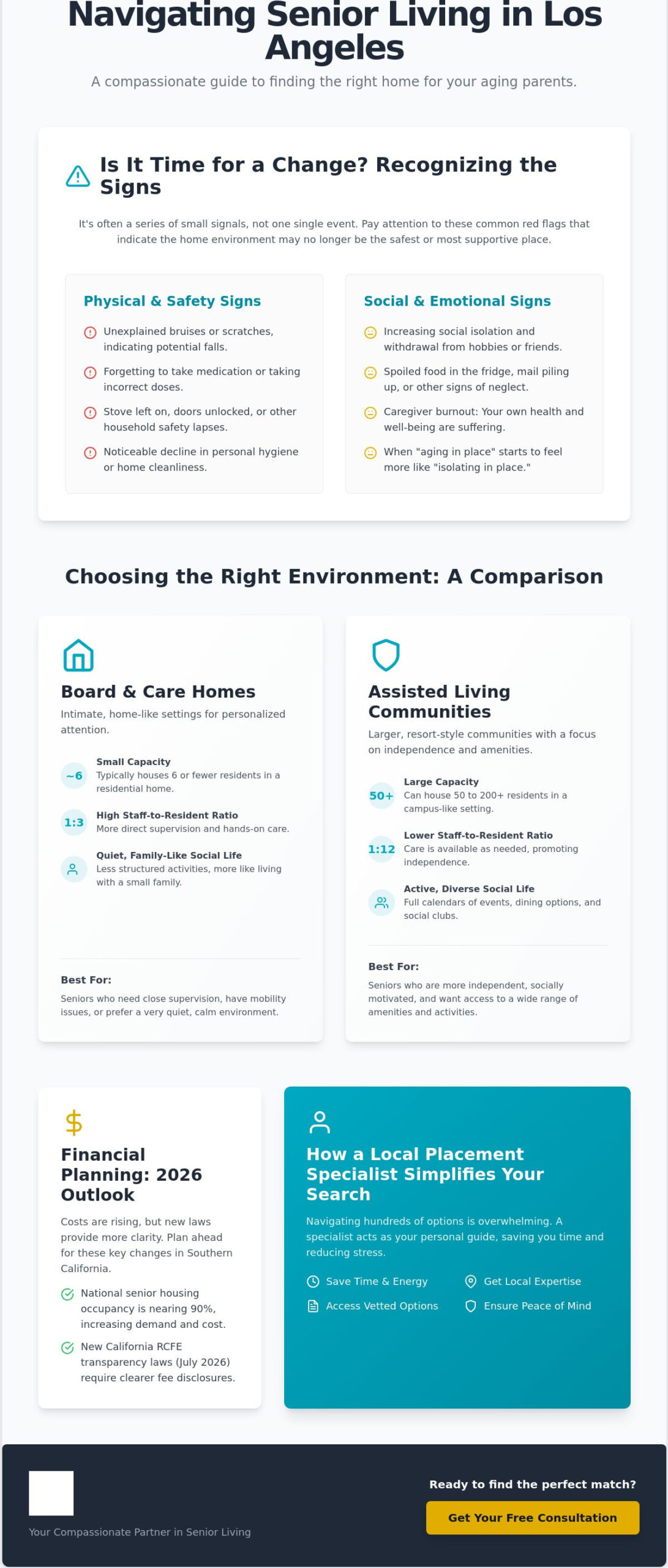
Deciding when to look for senior housing for aging parents is rarely a single, clear moment. It is usually a series of small, quiet realizations. You might notice the mail piling up on the counter, a strange dent in the car, or a lingering smell of spoiled food in the kitchen. These aren’t just quirks of aging. They are signals that the home environment is no longer the safest or most supportive place for your loved one. When “aging in place” starts to feel like “isolating in place,” it’s time to evaluate the situation with a fresh perspective.
In 2026, many families use smart home technology to keep an eye on things from a distance. AI-driven fall detection and passive health monitoring have become common tools for modern caregiving. These devices can alert you to changes in movement or sleep patterns before a major health event occurs. While these gadgets offer temporary peace of mind, they cannot solve the underlying issue of social isolation. Loneliness often leads to depression and faster cognitive decline. Exploring different retirement community options can help you understand how professional care addresses these specific red flags while bringing back a sense of belonging.
Physical and Cognitive Warning Signs
Safety is the most urgent factor in this transition. Look for unexplained bruising or scratches, which often indicate falls your parent might be too embarrassed to mention. Cognitive slips can also create immediate hazards. If you find the stove left on, doors left unlocked, or medication doses frequently missed, the risk of a domestic accident is high. Neglect of personal hygiene or a house that has become unusually cluttered are also strong indicators that daily tasks have become overwhelming. Choosing senior housing for aging parents ensures these risks are managed by trained professionals 24/7.
The Impact on the Family Caregiver
It’s easy to focus entirely on the senior, but your own well-being is a vital part of the equation. Chronic stress and caregiver burnout can sneak up on you, affecting your health and your career. When you are constantly worried about a midnight phone call, you aren’t just a son or daughter anymore; you’ve become a manager, a nurse, and a housekeeper. Moving your parent to a community isn’t “giving up” on them. It is a choice that restores your primary relationship. By letting professionals handle the logistics of care, you can go back to simply being a family again, enjoying meaningful visits or celebrating milestones in unique private spaces found through HolaPlace without the heavy burden of constant chores and safety checks.
Navigating Senior Living Options in Los Angeles and the SFV
Finding senior housing for aging parents in a city as vast as Los Angeles requires a local lens. Traffic patterns, neighborhood vibes, and facility availability vary wildly from the Westside to the San Fernando Valley. In 2026, national senior housing occupancy is approaching 90%, which means the best communities often have waitlists. Choosing the right spot involves more than just picking a pretty building. It requires matching your parent’s health needs with the right level of care while keeping them close to the family and friends they love.
The landscape is shifting toward more flexible models. We are seeing a rise in “Active Adult Plus” communities that focus on lifestyle and wellness. These hybrid models allow residents to enjoy a resort-style environment while layering in home health services only when they become necessary. This approach prioritizes independence, social connection, and physical well-being. If you feel stuck between several neighborhoods, finding a local community with the help of an advisor can save you hours of driving and dead-end tours.
Independent vs. Assisted Living
Independent living is designed for seniors who want to shed the burdens of home maintenance and cooking. It is a lifestyle choice centered on social calendars and community dining. Assisted living moves a step further by providing help with daily tasks like bathing or dressing. Under California’s RCFE (Residential Care Facility for the Elderly) licensing, these facilities must now provide even more transparent fee disclosures as of July 2026. You can learn more about how to choose an assisted living facility in Los Angeles to ensure your parent gets the exact level of support they need.
Memory Care and Skilled Nursing
When a parent experiences significant cognitive decline, specialized memory care becomes essential for their safety. These secured environments are staffed by professionals trained in dementia and Alzheimer’s care. Skilled nursing, on the other hand, is a medical-heavy setting for those with complex clinical needs. While assisted living focuses on lifestyle, skilled nursing focuses on recovery and long-term medical stability. For families in the north part of the city, exploring memory care placement in San Fernando Valley can help identify communities that specialize in these sensitive transitions.
Los Angeles geography plays a massive role in your daily life. If your parent moves to a community across town, “just dropping by” becomes a two-hour ordeal. We recommend focusing your search within a five-mile radius of the primary family caregiver. This proximity ensures you can attend social events, join for dinner, and stay involved in their care without the stress of the 405 or the 101 freeways.
Board and Care Homes vs. Assisted Living Communities
When you start exploring senior housing for aging parents, you’ll quickly find that Los Angeles offers two distinct paths. One is the large, resort-style assisted living community. The other is the intimate, residential board and care home. In the San Fernando Valley, board and care homes are a staple of the local landscape. These are traditional houses in quiet, residential neighborhoods that have been converted to care for six or fewer residents. Choosing between them isn’t about finding the “best” model. It’s about finding the best fit for your parent’s personality, health needs, and comfort level.
The primary trade-off involves the social atmosphere and the level of direct attention. Larger communities offer a bustling environment that feels like a high-end hotel. Smaller homes offer a family-style setting that feels like, well, a home. For families in Southern California, the decision often comes down to how much stimulation your parent desires versus how much hands-on help they require. Both options provide 24/7 safety and support, but the daily experience is vastly different.
The Benefits of Residential Board and Care
Residential board and care homes excel at providing personalized, high-touch care. Because these homes typically serve only a few seniors, the staff-to-resident ratios are significantly higher than in larger facilities. It’s common to see ratios of 1:3 or even 1:2. This means caregivers are often in the same room, noticing small changes in appetite or mood immediately. Residents enjoy home-cooked meals in a familiar kitchen and a much quieter, predictable routine. If you are looking for board and care homes in Woodland Hills, you’ll find these settings are ideal for seniors who find large groups overwhelming or those who need frequent physical assistance throughout the day.
The Appeal of Large Assisted Living Communities
Larger assisted living communities are built for seniors who want an active, socially vibrant lifestyle. These facilities often feel like luxury apartments with extensive amenity packages. You’ll find robust activity calendars, on-site cinemas, and well-equipped gyms. The social opportunities are endless. Your parent can join a bridge club, attend a guest lecture, or take a fitness class without leaving the building. These communities are run by professional management teams and offer a wide variety of floor plans. They are perfect for parents who value their privacy but want the security of having help nearby and a diverse group of peers to socialize with every day.
Cost is another factor to weigh. While larger communities often have a higher entry price due to their extensive amenities, residential board and care homes can be a more cost-effective choice for those who don’t need a gym or a cinema. We recommend touring at least two of each model. Seeing the difference in person helps you understand which environment will make your parent feel most at ease.
Financial Planning and the Logistics of the Move
Financial anxiety is often the biggest hurdle when families begin looking for senior housing for aging parents. It’s natural to worry about how long savings will last or whether you can afford the quality of care your parent deserves. However, it’s helpful to look at the hidden costs of staying at home. Property taxes, constant home maintenance, and the high cost of private home health aides often add up to more than the monthly fee of a community. By consolidating these expenses into one predictable payment, many families find that community living is more sustainable than they originally thought.
There are several creative ways to fund this transition. Many families utilize a “Rule of Three” approach by combining home equity from a house sale, VA Aid and Attendance benefits for veterans, and long-term care insurance policies. As of May 2026, California has also expanded family caregiver tax credits to help offset out-of-pocket expenses. If you feel overwhelmed by the numbers, you can speak with a local advisor to help clarify your budget and find options that align with your financial goals.
Understanding the Cost of Care in Los Angeles
Most senior living communities in Southern California use a tiered pricing model. You’ll typically pay a base rate for the apartment and meals, then add “care levels” based on the specific help your parent needs with daily tasks. This ensures you only pay for the support they actually use. Geography also plays a major role in pricing. Communities in the San Fernando Valley, such as Northridge or Granada Hills, often offer more accessible rates than the premium prices found in Santa Monica or the Westside. To get a better sense of the local market, explore our detailed guide on assisted living costs in Los Angeles. Don’t forget that as of July 1, 2026, California law now requires facilities to provide a three-year history of their rate increases before you sign a contract.
The Move: Downsizing with Empathy
Moving is a physical task, but it’s an emotional journey first. When you start “the talk” with your parent, focus on what they are gaining: safety, new friends, and chef-prepared meals. Involving them in the decision helps them feel in control of their future. We recommend working with senior move managers who specialize in helping seniors downsize without the stress. For families in Southern California who also need to manage the sale of a family home, County Properties provides personalized real estate guidance to help simplify this major transition. Once the move is complete, set up their new space with familiar photos, their favorite chair, and cherished mementos to help them feel comfortable immediately. Choosing the right senior housing for aging parents is about more than just a floor plan; it’s about creating a space where they feel safe and truly at home.
How a Local Placement Specialist Simplifies the Search
Searching for senior housing for aging parents in Los Angeles can quickly turn into a full-time job. With hundreds of options scattered across the basin and the Valley, the sheer volume of data is exhausting. Many families start their journey with national call centers, only to realize these services often lack personal touch. A national representative might give you a list of facilities based on a zip code, but they haven’t walked the hallways or met the caregivers. Choosing a local ally changes the dynamic from a cold transaction to a supported, neighborly experience.
The most reassuring part for many families is that this professional guidance is a free service. Placement specialists are compensated by the senior living communities, much like a traditional real estate model. This allows you to access expert advice, facility vetting, and tour coordination without adding another expense to your budget. It is a win-win situation. You get the peace of mind that comes with professional oversight, and the communities find residents who are a genuine fit for their specific culture and care level.
The Value of Local “Boots on the Ground”
Local knowledge is the secret to finding the best senior housing for aging parents in specific neighborhoods. A senior living advisor Los Angeles knows the nuances that marketing brochures won’t tell you. We know which homes in Sherman Oaks have the best staff longevity and which communities in Encino have recently updated their dining programs. We look past the fresh paint and fancy lobbies to evaluate the actual quality of care. Since the new July 1, 2026 California transparency laws went into effect, we also help you interpret the mandatory disclosures regarding staffing ratios and regulatory citations. This ensures you make a choice based on facts, not just first impressions.
Your Next Steps with Senior Housing Locator
We are here to turn your uncertainty into an organized, manageable plan. Our process starts with a simple, free assessment where we listen to your parent’s medical needs, social preferences, and financial goals. We then narrow the hundreds of Southern California options down to a curated “shortlist” of three to five communities that actually make sense for your family. We don’t just send you a list; we schedule the tours, join you on-site, and ask the tough questions about care protocols and fee structures. This high-touch approach removes the burden from your shoulders so you can focus on supporting your parent through this transition. Let us help you find the perfect home for your parent today.
Navigating this move is a major life event. You don’t have to do it alone. By partnering with a local expert, you ensure your parent is safe, social, and well-cared for in a community that feels like a true home. Whether you are looking for a small residential board and care or a large assisted living community, we have the local insights to guide you every step of the way.
Your Path to a Brighter Future
You now have the tools to recognize when a change is needed and how to distinguish between the many care models available in Los Angeles. Finding senior housing for aging parents is a journey that requires patience, research, and a lot of heart. By focusing on safety, social connection, and professional support, you’re making a choice that protects your parent’s well-being and restores your role as a son or daughter.
Our team is here to simplify every step of this process. We’re deeply rooted in Woodland Hills and the SFV, offering a personalized, full-service approach that removes the guesswork from your search. Because our service is 100% free for families, you can move forward with confidence knowing you have a trusted ally by your side. Start your free senior housing search with a local Los Angeles expert today. You’ve taken the first step by educating yourself; let’s take the next one together to find a community where your parent can truly thrive.
Frequently Asked Questions
How much does assisted living for aging parents cost in Los Angeles in 2026?
Industry data for 2026 shows that assisted living in Los Angeles County has a projected median cost of $6,281 per month. While prices generally range from $5,900 to $6,500, the final amount depends on the level of care your parent needs and the specific neighborhood you choose. These monthly fees typically cover your parent’s housing, utilities, meals, and basic care services in one consolidated payment.
What is the difference between a board and care home and assisted living?
The primary difference is the size of the community and the type of environment it provides. Assisted living facilities are larger, apartment-style communities that offer extensive social calendars, gyms, and cinemas. Board and care homes are traditional houses in residential neighborhoods that care for a small group of seniors. Smaller homes often provide more personalized attention, while larger communities offer more diverse social opportunities.
Will Medicare pay for my parents senior housing?
Medicare does not cover the cost of long-term senior housing or assisted living. It is designed to pay for clinical medical care, such as doctor visits, hospital stays, and short-term rehabilitation in a skilled nursing facility. Most families fund senior living through a combination of private savings, the sale of a home, long-term care insurance, or Veterans Affairs (VA) benefits.
How do I talk to my parent about moving to senior living when they refuse?
Start the conversation by focusing on their safety and your desire for them to thrive rather than just get by. Use “I” statements to explain how much you worry about their well-being when they are alone at home. It’s helpful to frame the move as a way to stay social and active rather than a loss of independence. Involving them in tours can help them see the benefits firsthand.
What are the best senior living options in the San Fernando Valley?
The best option depends entirely on your parent’s unique health needs, personality, and budget. The San Fernando Valley is famous for its high-quality residential board and care homes in quiet areas like Woodland Hills and Northridge. If your parent prefers a more active, resort-style environment, there are several large assisted living communities in Encino and Sherman Oaks. We help you compare these local choices to find the right fit.
How long does the senior placement process typically take?
The search for senior housing for aging parents usually takes about 30 to 60 days from the first tour to move-in day. While we can move much faster during a medical emergency, taking a few months allows your family to tour several options and downsize without feeling rushed. Starting the process before a crisis occurs gives you the most control over finding a community that your parent will truly love.
What should I look for when touring an assisted living facility?
Look past the lobby furniture and focus on the interactions between the staff and the residents. Observe if the caregivers are patient, friendly, and attentive to the seniors’ needs. You should also check the cleanliness of the common areas, taste the food, and ask to see their most recent state inspection report. It’s a good idea to visit during a social activity to see if the residents look engaged and happy.
Is a senior placement service really free for families?
Our senior placement services are 100% free for the families we help. We are compensated by the senior living communities once a successful move occurs, much like the way a real estate agent is paid. This allows us to provide expert local guidance, vet facilities for safety violations, and coordinate tours without adding any extra costs to your family’s budget. Our goal is to make your transition as smooth as possible.