You might assume that a smaller, residential setting in a quiet neighborhood would cost more than a large assisted living facility, but the reality is often the exact opposite. In many cases, family-owned residences provide a higher caregiver ratio for a fraction of the price. It’s completely normal to feel overwhelmed by the sticker shock of Southern California real estate, especially when you’re trying to secure a safe, comfortable home for a loved one. You want the best care, you want a predictable budget, and you want to avoid the stress of unexpected bills. Understanding the cost of board and care homes in Los Angeles is the first step toward finding that perfect balance of quality and affordability.
We promise to help you clear the fog and find a solution that protects both your family’s savings and your peace of mind. This 2026 pricing guide provides a data-driven breakdown of what to expect, from the base rates of shared rooms to the premium costs of private suites. We’ll walk you through the new July 2026 transparency laws, explain how to spot hidden fees for medication or incontinence care, and offer three simple tips to save on monthly expenses. By the end of this article, you’ll have a realistic budget and the confidence to choose a home that fits your needs.
Key Takeaways
- Learn why the 1:3 caregiver ratio in a small, 6-bed licensed home often provides better value than larger corporate facilities.
- Get a clear picture of the current cost of board and care homes in Los Angeles and how pricing shifts across neighborhoods like Encino and Sherman Oaks.
- Discover the financial benefits of shared rooms, which can save you thousands each month while reducing the risk of resident isolation.
- Identify the specific “Level of Care” tiers and ADL triggers that determine whether you’ll pay a base rate or an all-inclusive fee.
- Find out how a local ally helps you navigate a home’s reputation and negotiate better rates that aren’t listed in online databases.
What Determines the Cost of Board and Care Homes in Los Angeles?
A board and care home is a unique type of Residential care facility. In California, these are officially known as Residential Care Facilities for the Elderly (RCFE). Most are licensed for just six residents. This small scale is the biggest factor affecting the cost of board and care homes in Los Angeles. While the exterior looks like a standard family home in a quiet neighborhood, the interior operates as a professional healthcare environment. You aren’t just paying for a room; you’re paying for a specialized setting designed for safety and 24-hour supervision.
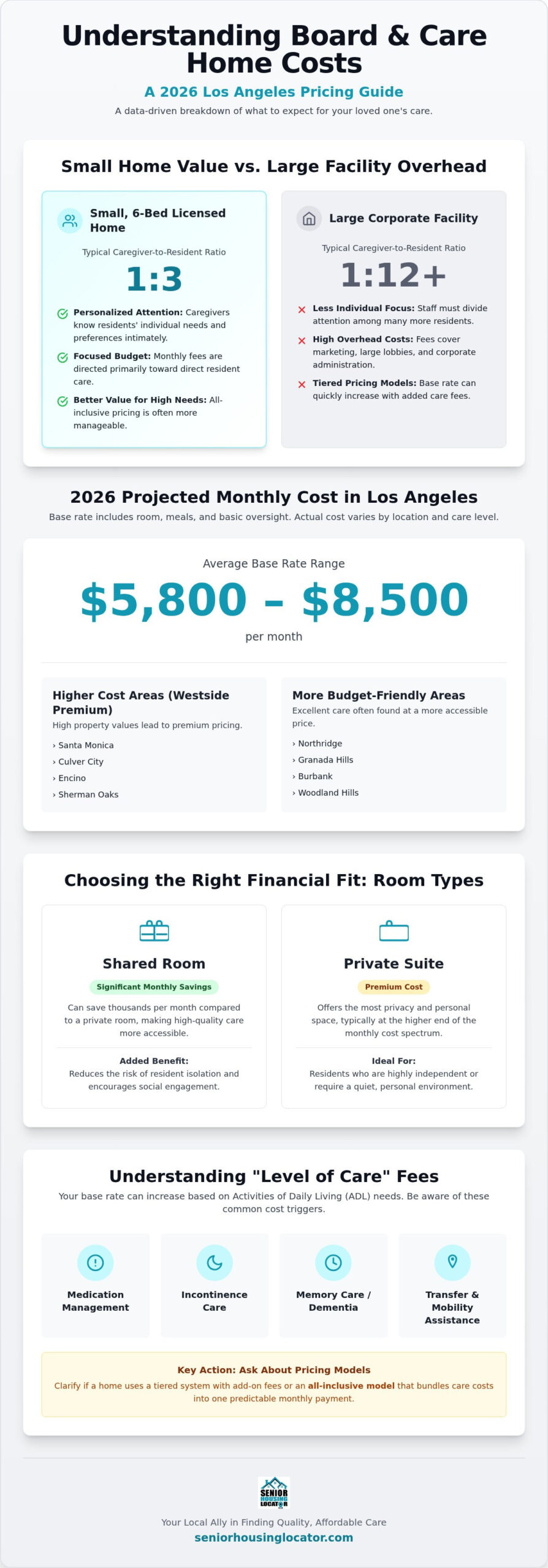
Local real estate is a major driver of pricing. A home in Santa Monica or Sherman Oaks carries higher property taxes and mortgage burdens than one in more inland areas. These overhead costs are reflected in the base rate. Then there’s the “Intimacy Premium.” Large facilities often have a 1:12 or 1:15 staffing ratio. In a board and care home, it’s usually 1:3. You’re paying for a caregiver who knows exactly how your loved one likes their coffee and when they need their medication without being distracted by dozens of other residents.
RCFE Licensing and Regulatory Compliance
Every legal board and care home must follow California Title 22 regulations. These rules are strict. They mandate everything from fire safety systems to specific staff training requirements. Maintaining a 24-hour professional team in LA County is a significant expense for providers. They must cover living wages, liability insurance, and constant regulatory updates. Choosing a licensed home is a much safer investment than an unlicensed “independent” house. Licensing provides a transparent record of safety inspections and background checks that protect your family’s well-being.
The Economy of Scale: Small vs. Large Facilities
It’s a common myth that bigger always means cheaper. In senior care, the opposite is often true for residents with high needs. Large 150-unit communities have massive overhead like marketing departments, grand lobbies, and executive chefs. A 6-bed home focuses its budget on direct, personal care. If your loved one needs help with multiple daily tasks, the cost of board and care homes in Los Angeles can be much more manageable because the care is already built into the model. You can read our detailed board and care home vs assisted living guide to see which environment fits your family’s budget and care requirements.
2026 Cost Breakdown: Los Angeles and San Fernando Valley Averages
The projected cost of board and care homes in Los Angeles for 2026 typically falls between $5,800 and $8,500 per month. This range covers the “base rate,” which is a single monthly fee that includes a resident’s room, three daily meals, and basic oversight. While this provides a helpful starting point, your actual monthly bill depends heavily on which neighborhood you choose. Los Angeles is a patchwork of micro-markets, and property values in the surrounding area directly influence what a provider must charge to keep their doors open.
Each of these homes is licensed as a Residential Care Facility for the Elderly (RCFE), ensuring they meet strict state safety standards. However, a home in a high-demand area will naturally command a higher price. If you are looking for the most budget-friendly options, we often recommend exploring pockets like Northridge, Granada Hills, or Burbank. These neighborhoods frequently offer excellent care at a more accessible price point than coastal communities. In contrast, homes in Encino or Sherman Oaks often sit at the higher end of the spectrum due to their central location and proximity to specialized medical centers.
Westside vs. Valley Pricing Dynamics
The “Westside Premium” is a real factor for families looking in Santa Monica or Culver City. In these areas, the high cost of real estate means even a shared room can approach the top of the 2026 price range. Moving over the hill into the San Fernando Valley often changes the math in your favor. Woodland Hills, for example, is known for residential care homes that offer more square footage and larger backyards for the same dollar. Some SFV neighborhoods remain more expensive than others, usually because they are located within minutes of top-tier hospitals, which is a major convenience for residents with frequent medical appointments. If you’re struggling to weigh these options, a local placement expert can help you find the best value in your preferred zip code.
Projected Inflation and Market Trends for 2026
Several factors are nudging rates upward as we head through 2026. Labor shortages in the caregiving sector mean that providers must offer more competitive wages to attract the best staff. California’s minimum wage laws also play a significant role in these pricing shifts. Since board and care homes rely on a high caregiver-to-resident ratio, staffing is their largest expense. We suggest that families budget for a 3-5% annual rate increase. This helps you stay prepared for inflation and ensures your loved one’s care remains stable and uninterrupted over the long term.
Private vs. Shared Rooms: Choosing the Right Financial Fit
Choosing between a private or shared room is one of the most significant decisions you’ll make when looking at the cost of board and care homes in Los Angeles. On average, you can expect a price gap of $1,500 to $2,500 per month between these two options. This difference often comes down to the physical layout of the house. Since many Los Angeles board and care homes are retrofitted single-family residences, the number of private rooms is limited. When you’re calculating the cost of board and care homes in Los Angeles, the presence of a private bathroom is often the single biggest factor that pushes a room into a higher price tier.
For families seeking the highest level of comfort, some premium residential settings offer “Master Suite” options. These luxury rooms often feature walk-in closets, private patios, and upgraded fixtures. While these suites carry a higher monthly rate, they provide a sense of home that larger, more clinical facilities struggle to match. However, it’s important to remember that the quality of care remains the same regardless of which room you choose. The caregivers are still just a few steps away, ensuring your loved one is safe and supported around the clock.
The Pros and Cons of Shared Living
Shared rooms aren’t just a way to save money; they can be a strategic choice for a resident’s mental health. We often see that shared living helps reduce the risk of “Quiet House” syndrome. This happens when a resident becomes too isolated in their own room and stops engaging with the community. A roommate provides built-in social interaction and an extra set of eyes for safety. From a financial perspective, a shared room makes high-quality care accessible for those on a fixed income. Modern homes manage privacy concerns by using thoughtful furniture layouts and high-quality partitions to ensure each person feels they have their own personal space.
Evaluating the Value of a Private Suite
While shared living has its perks, a private room is often the best fit for residents with specific needs. According to data on 2026 Los Angeles assisted living costs, the demand for private accommodations is at an all-time high. Residents who experience high anxiety or have specific behavioral needs usually thrive in the quiet of their own suite. When touring a private room, always check for ADA compliance in the bathroom. Ensure there’s enough space for a walker or wheelchair to turn comfortably. A private room can also simplify the “Level of Care” assessment, as staff can provide more discreet assistance with bathing or dressing without a roommate nearby.
Understanding “Level of Care” Fees and Hidden Costs
Many families are surprised to find that the advertised base rate is often just the starting point. When you’re calculating the cost of board and care homes in Los Angeles, you must account for “Level of Care” fees. Most residential homes use a tiered system, usually categorized as Level 1, 2, or 3. Level 1 is designed for seniors who are mostly independent but need a safe environment. Levels 2 and 3 apply when a resident requires frequent help with Activities of Daily Living (ADLs). This tiered approach ensures that families only pay for the specific amount of care their loved one receives.
Common triggers for price increases include incontinence care, assistance with feeding, and physical “transfers,” such as help moving from a bed to a chair. Medication management is another area where pricing varies. Some homes include this service in their base rate, while others charge an add-on fee of several hundred dollars. You should also be prepared for the “Community Fee.” This is a one-time move-in cost, often equivalent to one month’s rent, that covers the administrative effort of the admission process and room preparation.
Breaking Down the ADL Point System
Facilities typically use a point-based assessment to determine the final monthly bill. A nurse or manager will evaluate how much time a caregiver spends on specific tasks each day. For residents with cognitive decline, “Memory Care” often carries a specific surcharge because it requires higher staffing levels and specialized behavioral training. Every family should request a written care plan before signing. This document acts as your financial roadmap and prevents unexpected rate hikes shortly after moving in.
Ancillary Costs to Budget For
Beyond the care fees, there are everyday expenses that fall outside the standard agreement. You’ll need to budget for incontinence supplies, personal toiletries, and specialized medical equipment like walkers or hospital beds. Transportation is another factor, especially in the San Fernando Valley. While some homes offer a house car for local doctor visits, others may charge per trip. For a broader perspective on how these residential fees compare to larger communities, you can explore our guide on assisted living costs Los Angeles. If you aren’t sure if a quote is fair, our local experts can help you analyze your care contract to ensure your budget stays on track.
How a Local Advisor Helps You Find Value in the LA Market
Online databases often show a polished version of reality, but they can’t capture the daily atmosphere of a home. When you’re researching the cost of board and care homes in Los Angeles, you’re looking for more than a price tag. You’re looking for a reputation. A local advisor knows which homes in the San Fernando Valley have stable staffing and which ones have recently changed ownership. This “unwritten” knowledge is what helps you avoid facilities that might look good on paper but fail to provide the promised quality of life.
Saving money isn’t just about finding the lowest base rate. It’s about finding flexibility. We often help families negotiate move-in fees or find homes that offer all-inclusive pricing to prevent future “level of care” surprises. By filtering out homes that don’t match your specific care-to-budget ratio, we save you hours of wasted tours. Best of all, our referral services are completely free for families. We’re paid a commission by the facilities, which allows us to act as your altruistic guide without adding any financial burden to your search.
Vetting Homes in Woodland Hills and the SFV
Our team doesn’t just look at websites; we dig into the LIC 809 state inspection records for every home we recommend. We visit these residences in person to verify that the cost of board and care homes in Los Angeles actually reflects the level of attention your loved one will receive. Our vetting process for homes in Woodland Hills and the SFV includes:
- Reviewing recent state inspection records for safety violations or citations.
- Conducting unannounced in-person visits to check cleanliness and staff engagement.
- Interviewing current families to verify the consistency of care over time.
If a home in Woodland Hills claims to offer premium memory care, we make sure the staff training and environment back that up. You can learn more about how we work as your senior living advisor Los Angeles on our dedicated process page.
Taking the Next Step with Confidence
Starting your search doesn’t have to be a lonely process. We begin with a personalized assessment to understand your family’s unique needs and budget. Think of us as your “Tour Buddy.” We can accompany you on facility visits to ask the hard questions about staffing ratios and hidden fees that you might not think to ask. Having an expert eye by your side gives you the clarity you need to make a decision without the fear of buyer’s remorse. Contact Senior Housing Locator for a free consultation and personalized list of homes today to find a safe, high-quality residence that fits your family’s financial plan.
Secure a Future of Quality Care and Financial Peace
Finding a safe environment for your loved one doesn’t have to mean compromising your family’s financial future. We’ve explored how neighborhood location and the choice between shared or private rooms significantly impact the cost of board and care homes in Los Angeles. You now understand that “Level of Care” fees are often the most critical variable in your monthly budget. While the numbers can feel daunting, remember that you don’t have to navigate these complex contracts alone.
At Senior Housing Locator, we’re here to help families in Woodland Hills and the San Fernando Valley find peace of mind. We use our deeply rooted knowledge of local reputations and RCFE licensing to match you with top-quality, vetted facilities. Since our personalized placement services are free for families, our only goal is to find the right fit for your needs. You can move forward with the confidence that comes from having a trusted ally by your side. Let our local experts find the best board and care home for your budget today. You’ve done the hard work of researching; now let us help you take the final step with ease.
Frequently Asked Questions
Is a board and care home cheaper than assisted living in Los Angeles?
Yes, board and care homes are generally 20 to 30 percent less expensive than large assisted living communities. These smaller settings have much lower overhead costs because they don’t maintain massive common areas, movie theaters, or commercial kitchens. They provide a more affordable way to access high-quality, personal care for seniors who prefer a quiet, residential environment over a hotel-like campus.
Does Medicare or Medi-Cal pay for board and care home costs in California?
Medicare does not pay for long-term residential care. However, the Medi-Cal Assisted Living Waiver can help eligible low-income seniors cover the “care” portion of their monthly bill. It’s important to remember that room and board costs remain the resident’s responsibility. Many facilities also have long waiting lists for waiver participants, so it’s best to plan ahead for these expenses.
What is the average cost of a board and care home in the San Fernando Valley?
The average cost of board and care homes in Los Angeles neighborhoods like the San Fernando Valley typically ranges from $4,000 for a shared room to $7,500 for a private suite. Rates vary based on the specific neighborhood and the amount of daily help a resident needs. Areas like Northridge and Granada Hills often provide more budget-friendly options than coastal or West LA locations.
Are there hidden fees I should watch for in a residential care home contract?
You should watch for extra charges related to medication management, incontinence supplies, and transportation to medical appointments. A new California law that went into effect on July 1, 2026, requires all licensed homes to provide a written disclosure of their full fee schedule before you sign. Always ask for an itemized list of care triggers to ensure your monthly bill stays predictable.
How often do board and care homes in LA increase their monthly rates?
Most homes review their pricing annually to account for rising labor costs and inflation. You should budget for a 3% to 5% increase each year to be safe. California law requires facilities to give you at least 60 days’ written notice before any rate hike. This gives your family time to review the new costs and adjust your financial planning accordingly.
Is there a difference in cost between memory care and standard board and care?
Yes, memory care usually adds $2,000 to $3,000 to the monthly base rate. This higher cost of board and care homes in Los Angeles covers the specialized training and increased staffing levels required for dementia care. Because residents with cognitive decline need 24-hour supervision and specific safety measures, the operational costs for these homes are naturally higher than standard residential care.
What is a typical move-in fee for a Los Angeles board and care facility?
A typical move-in fee, also known as a community fee, usually falls between $2,500 and $5,000. This one-time payment covers the administrative work of the admission process, the initial resident assessment, and the preparation of the room. It’s a standard industry practice, but some providers may be willing to reduce this fee if they have an immediate opening they need to fill.
Can I negotiate the monthly rate of a board and care home?
Yes, you can often negotiate the move-in fee or the base rate, especially if the home has been vacant for a few weeks. Managers are sometimes flexible when they want to maintain a full house. Having a local advisor on your side is helpful because they know which homes have availability and which ones are most likely to offer a financial incentive to new residents.