
Last Tuesday, a daughter in Woodland Hills sat at her kitchen table, staring at a stack of brochures and feeling completely paralyzed. She knew her father needed more help than she could provide, but the fear of making the wrong choice felt like a heavy weight. If you feel that same pressure while choosing an assisted living facility, you aren’t alone. It’s completely normal to feel confused by care levels, anxious about Los Angeles costs, or even a bit guilty about the transition.
We’re here to replace that stress with a sense of order and peace of mind. This guide offers a clear, compassionate roadmap to help you find a community that is safe, high-quality, and perfectly suited to your family’s budget. We will walk you through the new July 2026 transparency laws, explain how to spot red flags during a tour, and help you find the right neighborhood fit within the San Fernando Valley.
Key Takeaways
- Identify the specific “Activities of Daily Living” that signal when your loved one needs the support of a professional care setting.
- Simplify the process of choosing an assisted living facility by understanding the differences between large communities and smaller board and care homes in Los Angeles.
- Use the “Rule of Three” to narrow your search, allowing you to conduct focused, high-quality tours without feeling overwhelmed.
- Navigate complex California licensing requirements and fee structures to ensure you are choosing a safe, budget-friendly environment.
- Learn how partnering with a local senior living advisor can streamline your search and provide expert neighborhood insights at no cost to your family.
Recognizing the Need: When is it Time for Assisted Living?
Deciding when a parent or spouse needs more help is rarely a single “lightbulb” moment. It’s usually a series of small, worrying realizations that happen over months or years. You might notice the mail piling up on the counter or see that the fridge is mostly empty except for a few expired items. Assisted living serves as a vital bridge for seniors who can no longer live entirely alone but don’t yet require the constant, 24/7 medical attention of a skilled nursing facility. According to Wikipedia’s overview of assisted living, these communities focus on providing personal care services in a residential setting that encourages as much independence as possible.
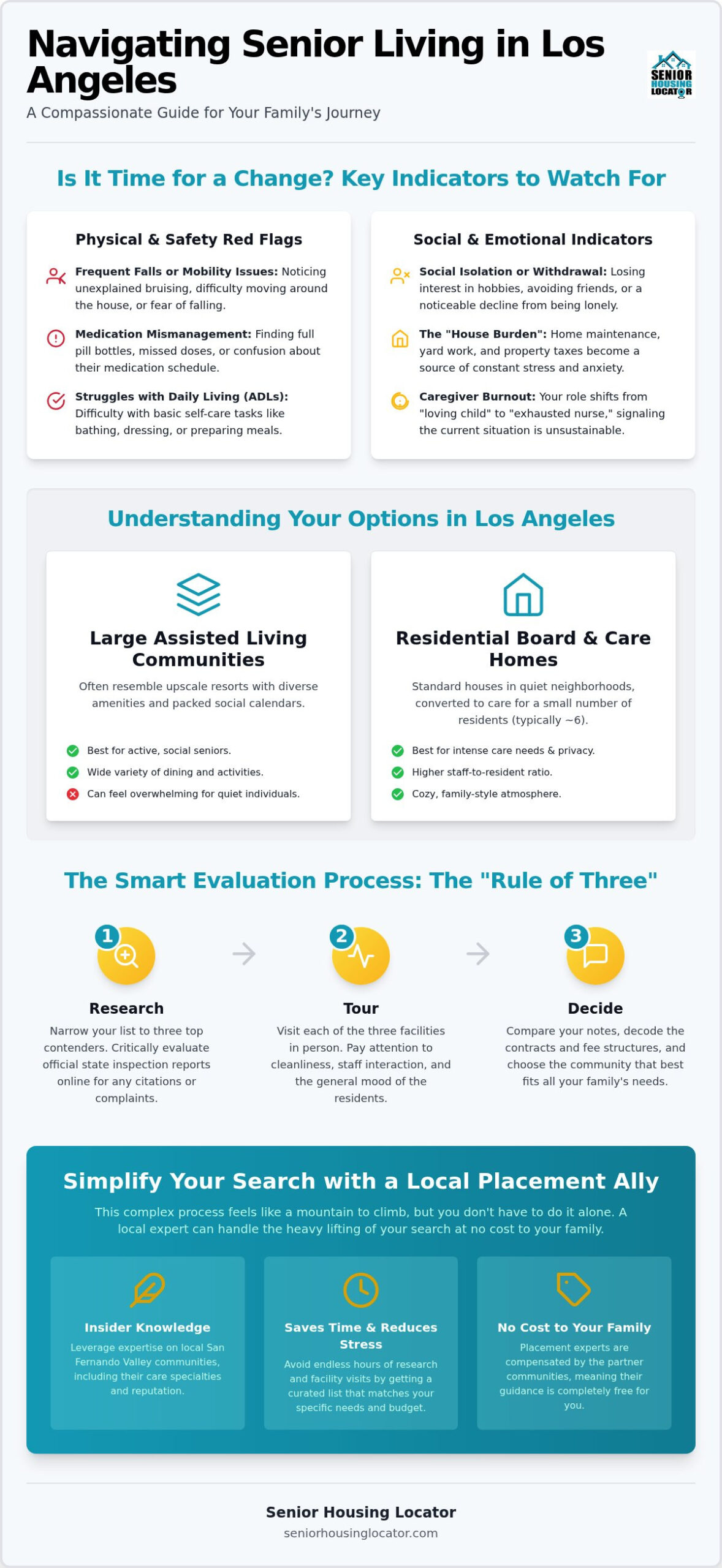
Most families start the journey of choosing an assisted living facility when “Activities of Daily Living” (ADLs) become a struggle. These are the basic self-care tasks we often take for granted, such as bathing, dressing, and moving around the house safely. Beyond these basics, we also evaluate more complex needs. Instrumental activities of daily living are the complex skills needed for independent living, including managing finances, handling transportation, and preparing meals. When these tasks begin to slip, the risks to a senior’s safety and well-being rise significantly.
It is also important to recognize the invisible toll of social isolation. If your loved one is spending most of their day alone in a quiet house, their physical and mental health can decline rapidly through a “failure to thrive.” We also need to talk about your well-being. Caregiver burnout is a real, valid reason to seek professional help. If your own health, career, or relationships are suffering under the weight of constant caregiving, the current situation is no longer sustainable for you or your parent. Finding a supportive community is often the kindest thing you can do for the whole family.
The Red Flags of Senior Safety at Home
Look for physical signs that the home environment is becoming a hazard. Unexplained bruising or frequent falls often suggest balance issues that require professional monitoring. Poor nutrition is another major sign; check for spoiled food in the kitchen or significant, unintended weight loss. Finally, watch the medicine cabinet. Mismanaging medications or missing vital doctor appointments can lead to avoidable emergency room visits and long-term health complications.
Social and Emotional Indicators for a Move
The emotional toll of isolation can be just as heavy as physical risks. Many seniors in Los Angeles begin to withdraw from long-held hobbies or social circles, which can be a precursor to depression or cognitive decline. Sometimes, the “house burden” is the primary culprit. When maintaining a large property or managing repairs becomes a source of constant anxiety rather than pride, it’s often a sign that the process of choosing an assisted living facility should begin.
Choosing an Assisted Living Facility: Defining Your Priorities
Once you’ve identified the need for more support, the next step in choosing an assisted living facility is narrowing down what matters most. In a city as sprawling as Los Angeles, the options can feel infinite. We recommend focusing on three main pillars: care levels, budget, and lifestyle. Start by assessing the specific care required. Does your loved one just need help with meals and laundry, or do they require high-acuity care like help with transfers or incontinence? Understanding these needs early prevents the stress of moving again if a facility can’t meet rising care demands later.
Setting a realistic budget is equally vital for families in the San Fernando Valley. While Los Angeles County averages around $6,281 per month in 2026, costs vary significantly by neighborhood and the level of assistance needed. New California laws effective in July 2026 now require facilities to provide written disclosures about pricing and historical rate increases before you sign a contract. This transparency helps you plan for the long term without unexpected financial surprises. Beyond the numbers, think about what makes your parent feel at home. Do they have a small dog they can’t part with? Is a specific religious affiliation important? These social preferences are just as critical as the medical ones for a happy transition.
Residential Board and Care vs. Assisted Living Communities
The “Board and Care” model is a unique and essential part of the Los Angeles senior living landscape. These are smaller, 6-bed residential homes tucked into quiet neighborhoods like Woodland Hills. They offer a cozy, familiar atmosphere and a high staff-to-resident ratio that larger communities can’t always match. On the other hand, large assisted living communities feel like resort-style social hubs. They provide robust social calendars, diverse dining options, and fitness centers. Matching your parent’s personality to the facility size is one of the most important steps in choosing an assisted living facility that feels like home.
Location Logistics: Staying Close in Los Angeles
We always suggest the “visitation rule” when picking a location. Proximity to the primary caregiver is often the most important factor in long-term success. If you live or work in the San Fernando Valley, you’ll likely want to focus on neighborhoods like Encino, Sherman Oaks, or Northridge to keep travel time manageable. For more specific details on local options, check out our Assisted Living Placement in Woodland Hills guide. If you feel overwhelmed by the sheer volume of choices in these neighborhoods, you can always reach out to a trusted senior living advisor who knows the local market inside and out.
The Evaluation Process: How to Research and Tour Facilities
Researching online is a great starting point, but reviews only tell half the story. While a five-star rating on a local directory is encouraging, you must verify safety by looking at state inspection reports. In California, the Community Care Licensing Division provides public records of citations and how a facility resolved past issues. We suggest using the Rule of Three when choosing an assisted living facility: select three communities that fit your criteria to compare them side-by-side. This keeps the process manageable and prevents “tour fatigue” from clouding your judgment.
When you step onto a campus, look past the “glossy brochure” aesthetic. A beautiful lobby is nice, but the quality of life happens in the hallways and dining rooms. Watch how the residents spend their time. Are they engaged in activities, or are they sitting alone in common areas? Try to speak with a few residents or their visiting family members. They are often the best source of honest information regarding the daily experience and the consistency of the food and care. For many families, high-quality dining is a non-negotiable priority; just as you might seek out the authentic flavors of an Indian buffet Hayward for a special weekend meal, you should ensure the facility provides a menu that is both nutritious and culturally satisfying. These peer insights provide a level of detail that a marketing presentation simply cannot match.
The Unannounced Visit and “Vibe” Check
Your first tour is usually a scheduled event with a marketing director. It’s meant to impress. However, your second visit should be unannounced or scheduled for a weekend. This allows you to see the community in its natural state when the full management team isn’t on-site. Pay close attention to staff interactions. Do caregivers address residents by name? Is there a sense of warmth, or do they seem hurried? Use your senses during the walk-through. A clean facility shouldn’t just look tidy; it should smell fresh. Check the cleanliness of the baseboards and corners in both common areas and private rooms.
Questions to Ask the Executive Director
When you sit down with leadership, ask direct questions about community stability. High staff turnover is a significant indicator of potential care issues. Ask for their specific staff-to-resident ratios for all shifts, which is a disclosure now required under California’s 2026 transparency laws. You should also understand their emergency protocols for medical crises or local power outages. Finally, ask how often they re-evaluate care plans. You need to know how the facility adjusts its support as your loved one’s needs change and how those adjustments will impact your monthly costs.
Navigating the Logistics: Contracts, Costs, and California Regulations
Moving from the touring phase to the paperwork phase can feel like learning a new language. When you are choosing an assisted living facility, you’ll likely encounter a two-part fee structure. First, there is the base rent, which covers your loved one’s apartment, meals, and basic housekeeping. Second, most communities use a “levels of care” or points system. This means the cost of personal assistance, like help with bathing or medication, is added to the rent based on the specific amount of time or staff support required. This tiered approach ensures you only pay for the help your parent actually uses.
It’s also important to watch for one-time or variable costs that can impact your monthly budget. Many communities in the San Fernando Valley charge a “community fee” or “admission fee” upon move-in, which covers the administrative cost of processing the resident and preparing the room. You should also ask about fees for medication management, scheduled transportation to doctor appointments, or even basic laundry services. Before you sign any document, we strongly recommend a professional contract review. Having a second pair of eyes ensures you understand the terms for annual rate increases and the facility’s move-out notice requirements.
How to Pay for Care in Southern California
Families often piece together a “financial quilt” to cover the monthly costs of care. Common threads include long-term care insurance policies, VA benefits like the Aid and Attendance pension, and personal savings. You can explore the reality of assisted living costs in Los Angeles to help you plan your 2026 budget with confidence. If you’re waiting for a home to sell or a benefit to be approved, a bridge loan or a life insurance conversion might provide the short-term liquidity you need to make the move happen sooner.
Verifying Safety and Licensing
In California, assisted living facilities are officially known as Residential Care Facilities for the Elderly (RCFE). You can verify a community’s standing by using the California Department of Social Services (CDSS) website to check for recent citations or complaints. If you have concerns about a specific facility, the Long-Term Care Ombudsman serves as a free advocate for residents and their families. To interpret the state’s findings, remember that a “Type A” violation represents an immediate risk to the health, safety, or personal rights of residents, while a “Type B” violation indicates a condition that could become a risk if not corrected. If you need help filtering through these reports to find a safe home, contact our local advisors today for expert, neighborhood-specific guidance at no cost to your family.
Simplifying the Search with a Local Placement Ally
The journey of choosing an assisted living facility doesn’t have to be a solo mission. In a market as dense and complex as Los Angeles, the sheer volume of choices often leads to decision fatigue. This is where a senior living advisor becomes your most valuable resource. We act as a professional filter, removing the communities that don’t fit your criteria so you can focus only on the best matches. Our model is built on a “Free to Families” approach. We are compensated by the senior living providers, which means our expert guidance, tours, and neighborhood insights come at zero cost to your family.
Beyond the financial ease, an advisor provides access to “off-market” information that you won’t find on a standard website. We know which facilities have immediate openings, which ones just had a change in management, and which ones are currently offering move-in incentives. Perhaps most importantly, we serve as a neutral third party. When siblings or parents disagree on the best path forward, we provide objective data and a calm perspective. This helps the family reach a consensus without the added weight of emotional conflict or guilt.
The Senior Housing Locator Advantage
We pride ourselves on our deep roots in the San Fernando Valley. Whether you are looking in Burbank, Santa Monica, or Woodland Hills, our team knows the unique personality of every neighborhood. We don’t just provide a generic list of names. We tailor every recommendation to your parent’s specific care requirements, whether that involves specialized memory care or the intimacy of a residential board and care home. Our commitment to integrity is simple: we only refer families to facilities that meet our high safety and licensing standards.
Taking the Next Step with Confidence
You can take the next step toward choosing an assisted living facility by booking a free consultation to start your personalized search. We help you prepare for the move by providing resource referrals for transition specialists, long-distance experts such as southernelitevanlines.com, and other local services. Our goal is to reduce your search time from months of stressful research to just a few days of focused, guided decision-making. By letting a local ally do the heavy lifting, you can go back to being a supportive family member again, rather than a full-time researcher. We are here to help you navigate this transition with clarity, order, and peace of mind.
Taking the Next Step Toward Your Loved One’s Safety
You now have the tools to move from a place of worry to a position of strength. By identifying red flags early, comparing local care models, and understanding California’s new transparency laws, you have already done the hardest part of the work. Remember that choosing an assisted living facility is not just about finding a building. It’s about finding a neighborhood community that supports your parent’s dignity and your own peace of mind. You have learned how to look past the lobby aesthetic and focus on the quality of staff interactions and long-term care stability.
You don’t have to navigate these complex Los Angeles neighborhoods alone. We provide a free placement service for families across the San Fernando Valley, offering personalized referrals for assisted living, memory care, and intimate board and care homes. Find the perfect assisted living home for your loved one today; schedule your free consultation with Senior Housing Locator.
This transition is a major milestone, but it is also an opportunity for a higher quality of life. You are taking a brave and loving step toward a safer, more supported future for your family. We are here to help you every step of the way.
Frequently Asked Questions
What is the average cost of assisted living in Los Angeles in 2026?
In 2026, the average cost for assisted living in Los Angeles County is approximately $6,281 per month. This figure can change based on the specific neighborhood you choose and the level of daily help your loved one needs. Communities in more affluent areas or those providing high-acuity care will generally fall on the higher end of the local price range.
Does Medicare cover the cost of choosing an assisted living facility?
Medicare does not pay for the room, board, or personal care costs associated with choosing an assisted living facility. It is designed to cover acute medical expenses like hospital stays, doctor visits, and short-term rehabilitation. Most families use a combination of private savings, long-term care insurance, or VA Aid and Attendance benefits to bridge the financial gap.
What is the difference between assisted living and a board and care home?
Assisted living communities are typically larger, apartment-style complexes that offer resort-style amenities and robust social calendars. Board and care homes are traditional residential houses located in quiet neighborhoods that typically serve only six residents. These smaller homes offer a much higher staff-to-resident ratio and a more intimate, family-like environment for seniors who prefer a slower pace.
How do I check if a facility in Woodland Hills has had safety violations?
You can check the safety record of any facility by visiting the California Department of Social Services (CDSS) website. Their “Care Facility Search” tool allows you to view the licensing history and any recent citations for homes in Woodland Hills or the San Fernando Valley. Looking for “Type A” or “Type B” violations will tell you if there have been immediate risks to resident safety in the past.
Can I move my parent into assisted living if they have dementia?
Yes, most assisted living communities in Los Angeles offer specialized memory care wings or integrated support for those with cognitive decline. New California Title 22 regulations that took effect in 2025 now require all residential care facilities to maintain dementia-informed care standards. If your parent tends to wander or needs 24/7 supervision, a secured memory care unit is often the safest choice.
What should I look for when touring an assisted living facility in the San Fernando Valley?
Focus on three specific areas: cleanliness, staff culture, and resident happiness. A quality home should smell fresh and look tidy even in the corners and baseboards. Observe whether the staff members seem hurried or if they take the time to greet residents by name with a smile. Finally, look at the residents themselves; they should appear well-groomed and actively engaged in their surroundings.
How long does the placement process usually take?
The timeline varies significantly depending on whether you are working alone or with a professional. Families who handle the search themselves often spend three to six months researching and touring before making a decision. When you work with a local advisor, that timeline can often be compressed into just a few days because the expert has already vetted the options for you.
Are pets allowed in most Los Angeles assisted living communities?
Many assisted living communities in the Los Angeles area are pet-friendly and welcome small dogs or cats. Each facility has its own specific pet policy, which may include weight limits or breed restrictions. You should always ask about “pet fees” and whether the staff can assist with pet care, such as dog walking, if your loved one’s mobility changes over time.