
What if the most impressive “resort-style” lobby in the San Fernando Valley isn’t actually the best indicator of the care your loved one will receive? It’s easy to feel overwhelmed when searching for assisted living woodland hills, especially when you’re staring at dozens of glossy brochures and complex price sheets. You likely feel the heavy weight of this decision every time you close a browser tab full of conflicting reviews. It’s completely normal to feel anxious about balancing a family budget with the high-quality, dignified care your parent deserves.
We’re here to help you lower the stakes and find a clear path forward. This guide simplifies your search by providing expert local insights into the 2026 senior living landscape. We’ve done the hard work of vetting providers so you don’t have to. You’ll learn the real differences between large communities and intimate board and care homes. We also break down the latest 2026 transparency laws and share the best strategies for a smooth, stress-free transition. Our goal is to move you from uncertainty to a curated shortlist of homes that feel like the right fit.
Key Takeaways
- Discover why assisted living woodland hills is a premier choice due to its unique balance of high-end housing and proximity to world-class healthcare like West Hills Hospital.
- Learn the essential differences between large resort-style communities and intimate 6-bed residential homes to find the environment where your loved one will truly thrive.
- Get a clear breakdown of the 2026 cost components, including base rent and care tiers, so you can plan your family’s finances with total confidence.
- Master the art of the facility tour with our expert checklist for reviewing state licensing reports and observing resident life during meal times.
- See how a local senior living advisor offers a personalized, free service that uses “insider knowledge” to guide you toward the highest-quality placement options.
Understanding the Senior Living Landscape in Woodland Hills
Choosing a new home for a parent is one of the most significant decisions your family will face. In our community, this choice isn’t just about finding a room; it’s about finding a lifestyle that balances independence with safety. By Understanding Assisted Living, you’ll see it is a unique blend of private housing, personalized support, and 24-hour care. When you look for assisted living woodland hills, you’re looking for a place where your loved one can age with dignity while receiving the exact level of help they need. This transition from a long-time family home to a supportive community can feel heavy, but it often opens the door to a more vibrant, worry-free chapter of life.
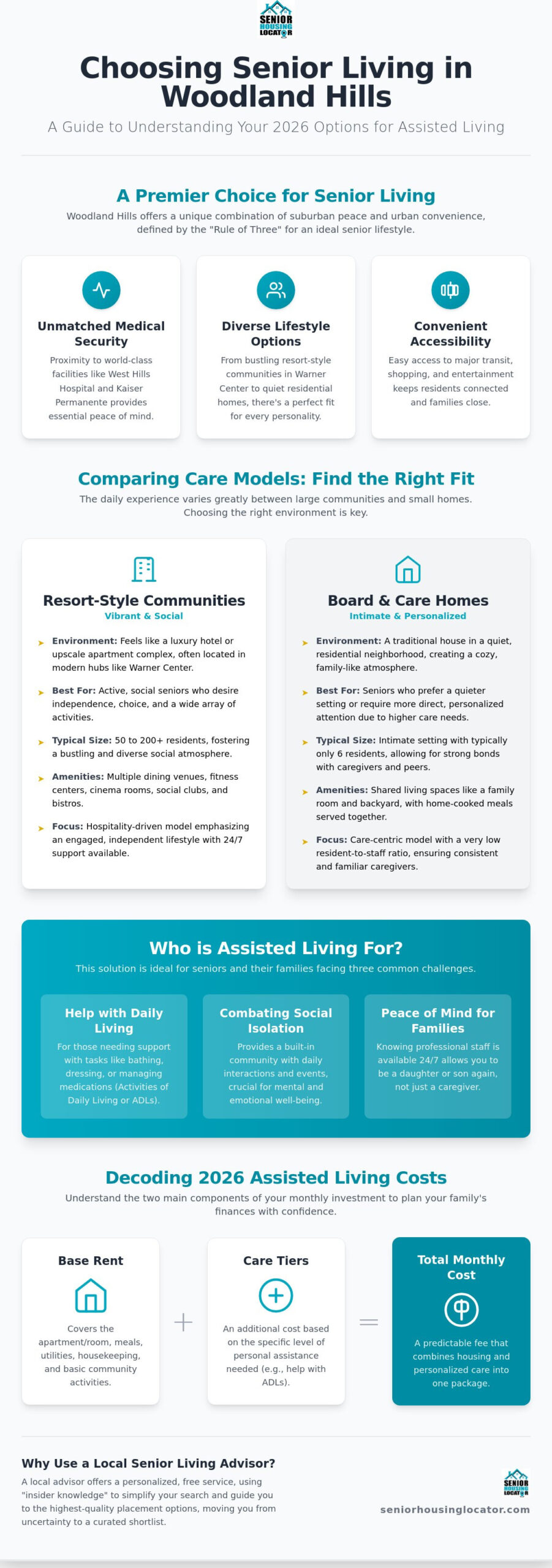
Woodland Hills stands out as a premier choice for seniors in the San Fernando Valley for several reasons. It offers a rare combination of suburban peace and urban convenience. The area is anchored by world-class healthcare providers, including Kaiser Permanente Woodland Hills Medical Center and West Hills Hospital and Medical Center. Having these facilities just minutes away provides a layer of medical security that’s hard to match elsewhere in Los Angeles. We often describe the local landscape using a simple “Rule of Three” that defines why families choose this area: accessibility to major transit and shopping, a wide variety of lifestyle options, and unmatched medical security.
Woodland Hills Neighborhoods and Senior Living
The local landscape is divided into two distinct vibes. Warner Center is the modern hub of the neighborhood. Here, you’ll find high-rise, resort-style communities that feel like luxury apartments, complete with multiple dining rooms and fitness centers. If your loved one prefers a quieter setting, the areas South of the Boulevard offer a different experience. This residential region is home to many boutique “Board and Care” facilities. These are traditional houses converted into 6-bed care homes, offering a cozy, family-like atmosphere. Staying local in the Valley means you can visit often without fighting cross-town traffic, keeping family bonds strong.
Who is Assisted Living For?
Determining if it’s the right time for a move usually comes down to three main factors. First, many residents need help with “Activities of Daily Living,” or ADLs. This includes simple tasks like bathing, dressing, or managing medications. Second, assisted living woodland hills is an excellent solution for seniors experiencing social isolation. Living alone can lead to depression, while a community provides daily interaction and events. Finally, it’s for families who need peace of mind. Knowing that professional staff is available 24/7 to handle emergencies allows you to go back to being a daughter or son, rather than a full-time caregiver.
Comparing Care Models: Large Communities vs. Board and Care Homes
Do you feel like you’re comparing apples to oranges as you browse options for assisted living woodland hills? You aren’t alone. While every facility we discuss falls under the legal umbrella of Residential Care Facilities for the Elderly (RCFEs), the daily experience varies wildly between a high-rise complex and a neighborhood home. Choosing the right model depends on your loved one’s personality, their physical needs, and how they prefer to spend their afternoons. It’s about matching the environment to the person, not just the care to the diagnosis.
Resort-Style Assisted Living Communities
If your parent is social, active, and enjoys having choices, a larger community in the Warner Center area might be the perfect fit. These facilities are designed to feel like luxury hotels or contemporary apartments. They offer a vibrant lifestyle built around three main pillars: diverse social clubs, multiple dining venues, and high-end amenities. Residents can catch a film in an on-site cinema room, join a morning yoga class in a professional fitness center, or meet friends for a glass of wine in a bistro. These communities are ideal for seniors who want to trade the burdens of homeownership for a bustling, hospitality-driven environment. They provide 24/7 security and support, but the focus is heavily on maintaining an engaged, independent lifestyle.
Residential Board and Care Homes
For many families, the best solution isn’t a large building, but a quiet house on a tree-lined street. We often suggest Board and Care homes in Woodland Hills as a more intimate, personalized alternative. These are traditional residential houses converted to care for six to ten residents. Because the setting is smaller, the caregiver-to-resident ratio is typically much higher than in a large complex. This model is often best for seniors who:
- Have higher physical care needs or mobility challenges.
- Experience confusion or anxiety in large, busy environments.
- Prefer a calm, family-style dining experience over a restaurant setting.
In these homes, the staff often feels like family. They know exactly how a resident likes their coffee or which chair is their favorite. While you won’t find a cinema room or a gym, you will find a level of watchful, hands-on attention that is difficult to replicate in a 100-unit building. If you’re feeling stuck between these two choices, finding a placement service can help you tour both styles to see which one feels like home. We believe that clarity comes from seeing these spaces in person and imagining your loved one’s daily routine within them.
Assisted Living Costs in Woodland Hills for 2026
Talking about money is often the hardest part of the senior living journey. It’s the point where emotions meet reality. If you’re looking for assisted living woodland hills, you’ve likely noticed that prices aren’t always listed clearly on every website. However, as of July 1, 2026, a new California law requires facilities to provide written disclosures about all fees, staffing ratios, and rate increase histories before you sign a contract. This transparency is a huge win for families. It helps you understand exactly what you’re paying for before making a high-stakes commitment.
Most monthly bills are made up of three main parts. First, there’s the base rent for the apartment or room. Second, you’ll see care tiers or levels. These are additional charges for help with things like medication management or dressing. Finally, there are one-time community fees. When you look at the average assisted living costs in Los Angeles, Woodland Hills often sits at the higher end of the spectrum. You can expect to find a wide price gap in the neighborhood. Some basic care options start around $4,500, while luxury penthouses in the Warner Center area can exceed $9,000 per month. As your loved one’s needs change, these care levels can increase the monthly bill, so it’s vital to plan for future adjustments.
Factors Influencing Price in the Valley
Why does one facility cost so much more than another just a mile away? It usually comes down to three things: privacy, care intensity, and location. Choosing a shared room instead of a private studio can significantly lower your monthly budget. Specialized care needs, such as memory care or diabetic management, also add to the bill. Memory care services often increase the price by 20% to 30% due to higher staffing requirements. Additionally, Woodland Hills carries a location premium. Because it’s close to high-end shopping and elite medical centers like Kaiser Permanente, it’s often more expensive than other parts of the San Fernando Valley.
Financial Planning and Subsidies
Paying for care requires a strategic approach. Many families use a combination of private savings, Long-Term Care Insurance, and Veterans Benefits like “Aid and Attendance.” It’s a common misconception that Medicare covers these costs. In reality, Medicare generally does not pay for the “room and board” portion of assisted living. For those with limited assets, the Assisted Living Waiver (ALW) program in Los Angeles County may help. In 2026, reimbursement rates for this program have increased to reflect the new $16.90 state minimum wage. Working with an advisor is the best way to identify which facilities offer the best value for your specific budget. We help you look past the chandeliers to find the care that truly fits your family’s financial reality.
How to Evaluate and Tour Woodland Hills Facilities
Stepping into a potential new home for your loved one is an emotional experience. You aren’t just looking at floorplans or paint colors; you’re looking for peace of mind. To find the best assisted living woodland hills offers, you need a plan that goes beyond the sales pitch. A facility might look beautiful on the surface, but the real story is often hidden in the details of daily life. We recommend a four-step evaluation process to help you see past the chandeliers and focus on the quality of care.
Your first step begins before you even leave your house. Conduct an initial digital screening by reviewing state licensing reports. In 2023, Woodland Hills facilities had an average of 11.62 citations, which is higher than the Los Angeles County average. Knowing this history allows you to ask targeted questions during your visit. Next, schedule your tours during meal times. This is the best way to observe resident interaction, food quality, and how staff handles busy periods. Don’t be afraid to linger. Third, ask the tough questions about staff turnover and emergency protocols. Finally, perform a “vibe check.” Look at the residents. Do they look engaged, well-groomed, and genuinely cared for? If you want a second set of eyes during this process, you can speak with a local advisor who has already visited these homes multiple times.
Top 3 Questions for Woodland Hills Administrators
- What is your staff-to-resident ratio during the night shift? Daytime staffing is usually robust, but care needs don’t stop when the sun goes down. Ensure there are enough hands on deck for 24-hour safety.
- How do you handle transitions to memory care placement in the San Fernando Valley if dementia progresses? It’s vital to know if your loved one can stay in the same community if their medical needs become more complex.
- Can you provide the most recent state inspection (DSS) report? Transparency is a hallmark of a great facility. A reputable administrator will be happy to share their records and explain how they’ve corrected any past issues.
Red Flags to Watch For
While every home has an occasional “off” day, certain signs should give you pause. Trust your senses. Unpleasant odors or poor lighting in common areas often signal a lack of attention to detail. Watch the staff closely. If they seem rushed, stressed, or unresponsive to resident calls, it may indicate a staffing shortage. Lastly, be wary of any facility that isn’t transparent about their fees. Under the 2026 California disclosure laws, you have a right to know about every potential cost and rate increase history before you sign. If an administrator dodges these questions, it’s time to look elsewhere.
Why Use a Local Senior Living Advisor for Placement?
Do you feel exhausted by the endless scrolling through national directory sites? It’s easy to get lost in a sea of generic photos and outdated pricing. Searching for assisted living woodland hills shouldn’t feel like a part-time job, yet the average family spends over 20 hours on initial research alone. We’re here to change that. By working with a Senior Living Advisor Los Angeles, you gain a neighborly guide who knows the San Fernando Valley inside and out. We act as the bridge between your current state of overwhelm and a future where your loved one is placed with total confidence.
The biggest benefit of a local ally is “insider knowledge.” National websites use static data, but we visit these communities every week. We know which “hidden gem” board and care homes have the most compassionate staff. We also know which large facilities recently went through a management change that might affect daily operations. This real-time information is something a computer algorithm simply can’t provide. Our approach follows a simple Rule of Three: our service is personalized, local, and completely free for your family. Because our commissions are paid by the providers, you get expert advocacy without adding another expense to your budget.
The Placement Process: From Call to Move-In
We’ve streamlined the journey into three manageable phases. First, we start with an Initial Discovery. We sit down with you to assess medical needs, social preferences, and financial realities. Second, we provide a Curated Shortlist. Instead of dozens of random links, you receive three to five vetted options for assisted living woodland hills that actually fit your criteria. Finally, we offer Touring Support. We can accompany you on tours to ask the questions you might not think of, ensuring you have a professional advocate by your side until the day of move-in. For families who want to ensure these tours or the transition day itself are as comfortable as possible, LuxPro® USA provides premium, professional transportation services throughout the region.
Integrity and Values in Senior Placement
Families often ask how a free service stays objective. Our commitment is to the senior, not the facility. We believe a successful placement matches a person’s psychological and social needs just as much as their medical ones. If a resident loves gardening, we find a home with a yard. If they crave quiet, we avoid the busiest high-rises. Our goal is a smooth, permanent transition that brings peace to the whole family. If you’re ready to stop searching and start finding, Contact Senior Housing Locator for your free Woodland Hills consultation today. Let’s find the right home together.
Finding Peace of Mind in Your Senior Living Journey
You now have the essential tools to navigate the complex landscape of senior care with total confidence. We’ve simplified the process by comparing large resort-style communities with intimate residential homes. You also have a clear understanding of 2026 cost structures and the specific red flags to watch for during your tours. Finding the right assisted living woodland hills is no longer an overwhelming mystery; it’s a manageable process with a clear path forward.
Our team of compassionate, integrity-driven advisors is ready to stand by your side as a trusted local ally. We offer a free local placement service for families, drawing on our expert knowledge of more than 50 Woodland Hills communities. We focus on matching your loved one’s medical, social, and financial needs so you don’t have to guess. You deserve to feel certain that your parent is in a safe, vibrant, and supportive environment. Start Your Free Woodland Hills Senior Care Search Today and let us help you turn this high-stakes decision into a smooth transition. Your family’s peace of mind is just a conversation away.
Frequently Asked Questions
How much does assisted living cost in Woodland Hills for 2026?
Prices depend on the size of the room and the level of care required. As of July 2026, California law requires all facilities to provide clear, written disclosures of their fees and rate increase history before you sign a contract. This transparency helps you plan for base rent, care tiers, and community fees without any hidden surprises. While Woodland Hills is a premium area, a local specialist can help you find options that fit your specific family budget.
Is there a difference between assisted living and a board and care home in Woodland Hills?
The main difference lies in the size and the setting of the facility. Assisted living typically refers to larger, apartment-style communities that offer many social activities and amenities. Board and care homes are traditional residential houses that care for six to ten residents in a cozy, family-like environment. Both models provide 24-hour supervision and help with daily tasks, so the choice often comes down to which environment feels more like home.
Do Woodland Hills assisted living facilities accept Medicare or Medicaid?
Medicare does not pay for the room and board costs associated with assisted living woodland hills. However, California’s Medi-Cal program offers the Assisted Living Waiver (ALW) for those who qualify financially and medically. This waiver is available in Los Angeles County and can help cover costs at participating facilities. Many families also use long-term care insurance or Veterans Aid and Attendance benefits to bridge the gap.
How do I know if my parent needs memory care instead of assisted living?
Memory care is designed for seniors with Alzheimer’s or other forms of dementia who require a more secure environment. If your parent is prone to wandering, experiencing high levels of anxiety, or struggling with significant memory loss, a specialized unit is often the safest choice. These programs offer higher staffing ratios and activities specifically designed for cognitive support. We can help you assess your loved one’s needs to determine which level of care is appropriate.
What is the best way to find a board and care home with private rooms in the Valley?
The most efficient way to find a private room is to work with a local advisor who tracks real-time vacancies. While many residential homes offer shared rooms to keep costs lower, private rooms are a common option in the San Fernando Valley. Because these homes are small, vacancies fill up quickly. A local expert can provide a curated list of homes that currently have private spaces available, saving you hours of phone calls and driving.
How does Senior Housing Locator provide a free service to families?
Our placement service is free for families because the senior living communities and board and care homes pay us a referral fee. This model allows us to offer professional guidance, touring support, and expert advocacy at no out-of-pocket cost to you. Our priority is always finding the best match for the senior’s medical, social, and financial needs. We operate with total transparency to ensure you feel confident in the placement decision.
Can an assisted living facility in Woodland Hills handle residents with dementia?
Yes, many assisted living facilities are licensed to provide dementia care. Some have dedicated “memory care” wings with secured exits, while others provide support within the general population for those in the early stages of cognitive decline. Under updated Title 22 regulations, facilities must follow specific standards for dementia care. We can help you identify which local communities have the best track record for managing these specific health challenges.
What happens if my parent’s care needs increase after they move in?
Facilities perform regular reappraisals to ensure the care plan stays current with your loved one’s health status. If your parent needs more help with bathing, dressing, or medication, the facility will move them to a higher care tier. This ensures they receive the necessary attention without having to move to a new building. If their needs become too high for assisted living, we can help you transition them to a skilled nursing environment or a specialized care home.