What if the best way to care for your aging parent in a city of millions was actually inside a quiet, single-family house on a tree-lined street? Searching for board and care homes los angeles can feel overwhelming when you’re faced with over 2,000 different options. It’s completely natural to feel anxious about finding a space that is safe, professional, and truly “homey.” You want to ensure your loved one receives personalized attention without the institutional feel of a large facility.
We understand that you’re looking for clarity, safety, and peace of mind. This 2026 guide is designed to help you find the perfect residential setting with expert local guidance on costs, private rooms, and quality of care. You’ll learn how to identify high staff-to-resident ratios, understand the new 2026 transparency laws, and filter the best local options. We’ll walk you through the RCFE licensing process, explain how to secure a quiet private room, and show you how to simplify this complex journey.
Key Takeaways
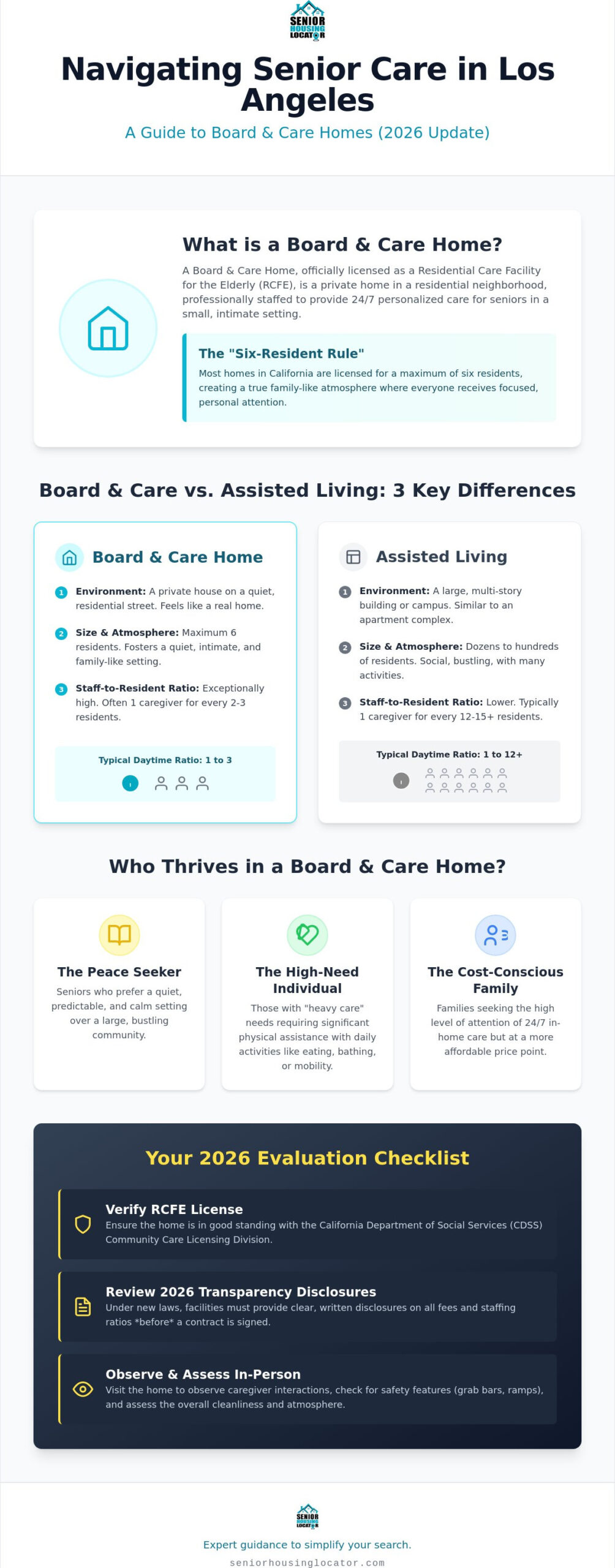
- Understand how the California “Six-Resident Rule” creates a supportive, family-like environment that feels like a true home.
- Learn the vital differences between board and care homes los angeles and assisted living to choose the right level of intimacy.
- Get 2026 cost insights and learn how to secure a private room in quiet, desirable residential neighborhoods.
- Discover the essential steps to evaluate a facility by verifying RCFE licenses and observing real-time caregiver interactions.
- Find out how professional placement assistance can help you filter through thousands of local options to find a perfect match.
What is a Board and Care Home in Los Angeles?
A board and care home is a specialized type of Residential Care facility that offers a small, intimate living environment for seniors. Unlike large assisted living communities that can feel like busy hotels, board and care homes los angeles are typically located in traditional houses. They sit on quiet streets in local neighborhoods, often looking indistinguishable from the other homes on the block. Inside, however, they are fully equipped and professionally staffed to provide 24-hour support. In California, these settings are officially licensed as Residential Care Facilities for the Elderly (RCFEs).
The most defining characteristic of these homes is the “Six-Resident Rule.” Most board and care facilities in California are licensed to care for a maximum of six residents at a time. This small scale creates a family-like atmosphere where caregivers truly know each resident’s preferences, history, and daily needs. It is a setting where care is deeply personal; the staff often eats meals with the residents, fostering a sense of belonging that is hard to replicate in larger institutions. Oversight is provided by the California Department of Social Services, ensuring every home meets strict standards for safety and well-being. For those looking to understand the investment and ownership side of this sector, you can explore RCFE Sales (Residential Care Facilities for the Elderly) to view the current market for these specialized residential properties.
The Licensing and Safety of RCFEs
Safety and transparency have reached new levels in 2026. Under new state laws, every RCFE must provide clear written disclosures about their fees and staffing ratios before a contract is signed. These homes are designed for safety without sacrificing comfort. You’ll find modifications like walk-in showers, sturdy grab bars, and wheelchair-accessible ramps that blend into the residential design. Because the environment is so small, staffing ratios are incredibly high. It is common to have two caregivers for just six residents, which means help is always seconds away. This 24-hour supervision provides a vital safety net for seniors who may be at risk for falls or confusion.
Who is a Good Fit for Board and Care?
Not every senior wants a large social calendar or a massive dining hall. Many people thrive in a quieter, more predictable environment. Board and care homes are often the best choice for:
- Seniors who prefer a peaceful, home-like setting over a large, bustling campus.
- Individuals with “heavy care” needs, such as those who require significant physical assistance with eating, bathing, or transferring.
- Families who want the high level of attention found in 24/7 in-home care but need a more cost-effective solution.
If your loved one feels overwhelmed by crowds or needs a caregiver who can spot subtle changes in their health immediately, the smaller scale of a board and care home is often the perfect fit. It offers a balance of professional reliability and the warmth of a real home.
Board and Care vs. Assisted Living: Three Key Differences
Choosing between these two options is often the first big hurdle for families. While both provide essential help with daily tasks, they offer vastly different lifestyles. Assisted living communities are usually large, multi-story buildings with dozens or even hundreds of residents. In contrast, board and care homes los angeles are intimate settings that prioritize a slow, steady pace of life. One isn’t necessarily better than the other, but one will definitely be a better fit for your loved one’s personality.
The physical environment is the most immediate difference. In assisted living, your parent typically has a private studio or one-bedroom apartment with a small kitchenette. It feels like living in a high-end senior apartment complex. A board and care home is a house. Residents have a private or shared bedroom, but the kitchen, living room, and backyard are shared spaces. This layout eliminates long hallways and elevators, making it much easier for seniors with mobility challenges to get around safely.
Staffing Ratios and Personalized Care
In a large community, a single caregiver might be responsible for 12 to 15 residents at once. In top-tier Los Angeles board and care homes, you’ll frequently find ratios of 1:3 or even 1:2 during the day. This means caregivers aren’t just checking boxes. They’re noticing if a resident didn’t finish their soup or if they seem a bit more confused than they were yesterday. This level of oversight is supported by California’s official licensing regulations, which ensure that every RCFE maintains high safety standards. Smaller settings make it much easier to manage complex medication schedules and specific nutritional needs without anything slipping through the cracks. If you’re feeling stuck on which environment fits your family best, you can find personalized guidance on local options to help narrow down the search.
Social Environment and Community Feel
The social atmosphere is where the two options diverge most. Assisted living is great for seniors who want a “cruise ship” lifestyle with full activity calendars and large groups. However, introverted seniors or those with cognitive decline often feel lost in those crowds. A board and care home offers a neighborly vibe on a familiar residential street. Instead of a massive dining hall, residents gather around a single family-style table. This fosters deep, genuine connections between the six residents and their caregivers. Activities are also more tailored. Instead of a generic movie night for a crowd, a caregiver might put on a resident’s favorite classic film or spend the afternoon gardening with them in the backyard. It’s a quieter, more customized way to spend the day.
Understanding Costs and the Search for Private Rooms
Planning for the future involves looking at the numbers with a clear head. In 2026, the monthly cost for board and care homes los angeles typically ranges from $4,750 to over $8,000. These figures depend on three main factors: the neighborhood you choose, the level of daily care required, and whether your loved one needs a private room. While these costs might seem high at first glance, they often include all meals, laundry, and 24-hour supervision. When you compare these figures to assisted living costs in Los Angeles, you’ll see that board and care settings can be a very competitive option, especially for those needing high levels of personal attention.
Private vs. Shared Rooms: What to Expect
In the San Fernando Valley, particularly in neighborhoods like Woodland Hills and Northridge, private rooms are the most requested feature. Families often want their loved ones to have a sanctuary of their own where they can surround themselves with familiar furniture and memories. If you’re looking in competitive markets like Santa Monica or West LA, securing a private room requires acting quickly. With high occupancy rates across the city in early 2026, the best rooms often fill up fast. You’ll find two main types of layouts. Some homes are “purpose-built” with private bathrooms attached to every bedroom. Others are “retrofitted” residential houses where residents might share a hallway bathroom. If budget is a primary concern, a shared room can significantly lower the monthly rate while still providing the same high quality of care and social connection.
How to Pay for Board and Care in California
Most families use “private pay” to cover these residential expenses. This usually involves a combination of Social Security, pensions, and personal savings or home equity. If your loved one has a Long-Term Care Insurance policy, it’s a good idea to review it early. Many policies cover RCFE settings, but they often require a specific “trigger,” such as the need for help with two or more daily activities. It’s also vital to know that Medicare does not typically cover the cost of room and board in these facilities. It’s designed for short-term medical stays rather than long-term residential support. Focusing on these financial details now will help prevent surprises later and ensure a smoother transition for everyone involved. Being organized with your budget allows you to focus on what matters most: the comfort and happiness of your family member.
How to Evaluate Board and Care Homes in Los Angeles
Evaluating board and care homes los angeles requires a balance of objective research and your own intuition. Start by checking the RCFE license status through the California Department of Social Services. You should look at the most recent state inspection reports to see if there have been any serious violations or recurring issues. Once you arrive for a tour, pay close attention to how caregivers interact with current residents. Do they speak with kindness and patience, or do they seem rushed? A homey environment depends entirely on the people providing the care.
You should also trust your senses. Perform a “smell test” as soon as you walk in. A clean home shouldn’t smell like heavy perfume or cleaning chemicals; it should just smell like a normal house. Look at the common areas for visible maintenance issues like peeling paint or worn carpets. Next, ask to see the weekly meal plan. Fresh, varied meals are a sign of a well-run home, while a reliance on frozen or processed foods can be a warning sign. Finally, ask about their “aging in place” policy. It’s important to know if they have a hospice waiver, which allows your loved one to stay in the home even if their medical needs increase significantly.
Red Flags to Watch For During Your Tour
- Overwhelmed Caregivers: If staff members seem distracted or stressed despite the 6-resident limit, it may indicate poor management.
- Lack of Transparency: Be wary if the manager is hesitant to discuss the ownership or history of the facility.
- Persistent Odors: Unpleasant smells in common areas often signal a lack of attention to hygiene and detail.
Questions to Ask the Home Manager
Getting specific answers will help you feel more confident in your choice. Don’t be afraid to ask:
- What is the staff turnover rate in this specific home? Long-term staff usually means better care.
- How do you handle medical emergencies or nighttime wandering?
- Can we see a copy of the most recent LIC 802 (Resident Roster)? This shows the current occupancy and care levels.
If you need help vetting these details, you can request a list of pre-screened homes that meet our high standards for safety and quality.
Finding the Right Home with Senior Housing Locator
Trying to visit every licensed facility in the city would take months. Finding the right fit among the thousands of board and care homes los angeles has to offer isn’t just about reading reviews online. It’s about knowing which homes have a stable staff, which ones specialize in memory care, and which ones are truly well-managed. With over 2,000 licensed facilities across the county, it’s easy for families to feel paralyzed by choice. We act as your local ally, using our deep roots in the community to filter through the noise. Whether you are specifically looking for board and care homes in Woodland Hills or need a quiet setting in the wider San Fernando Valley, we help you find a place that feels like home.
Every family has a unique set of priorities. For some, a private bathroom is a non-negotiable requirement. For others, the priority is finding a home that can manage specific medical needs like diabetes or high-acuity physical assistance. We match your loved one’s care requirements, your financial plan, and your preferred neighborhood to find the perfect residential setting. This personalized approach ensures you don’t waste time touring homes that aren’t a good fit. By focusing on your specific goals, we transform a stressful search into a manageable, step-by-step process.
A Compassionate Facilitator for Your Search
We do the heavy lifting so you don’t have to. Our process involves vetting homes for licensing compliance, checking recent state reports, and visiting the facilities in person to see the care in action. We only refer families to high-quality RCFEs that meet our strict standards for safety and integrity. From the tree-lined streets of Sherman Oaks to the quiet cul-de-sacs of Encino, we’ve done the groundwork across Los Angeles to give you total peace of mind. Our goal is to simplify your search, protect your budget, and secure the highest quality of care for your parent.
Next Steps: Your Personalized Care Plan
Starting the process is simple and requires no long-term commitment. It begins with a no-pressure phone consultation where we listen to your specific needs, budget, and location preferences. If you’re in an urgent situation, we can often provide a curated list of available openings in just a few days. We’re here to guide you through every tour and contract detail until you feel confident in your decision. We believe that every senior deserves to live in a setting where they are known, respected, and truly cared for. Let us help you find the perfect board and care home today.
Take the Next Step Toward Peace of Mind
Finding the right environment for a loved one is one of the most significant decisions a family can make. You now understand how the intimate scale of board and care homes los angeles provides a level of personalized attention that larger facilities often struggle to match. By focusing on licensed RCFE settings, checking for high staffing ratios, and prioritizing private rooms in quiet neighborhoods, you’ve already started the journey toward a safer, more comfortable future. These small steps lead to a much larger sense of security for your parent’s daily life.
You don’t have to navigate the 2,000 plus residential care options in Los Angeles alone. Our personalized referral service specializes in the San Fernando Valley and the greater LA area, ensuring every placement meets strict quality standards. We’ve done the heavy lifting of vetting homes so you can focus on your family’s well-being. Find the perfect board and care home in Los Angeles with our free local service. We’re here to walk beside you through every step of this process. You’re making a brave choice for your family, and we’re ready to help.
Frequently Asked Questions
What is the average cost of board and care homes in Los Angeles for 2026?
Monthly costs for board and care homes los angeles typically range from $4,750 to over $8,000 in 2026. These rates depend on the specific neighborhood, the level of daily care your loved one requires, and whether you choose a private or shared room. Most homes include all meals, laundry, and round the clock supervision in this single monthly fee, making it easier to manage your budget.
Do board and care homes in LA provide medical care or nursing services?
Board and care homes are non medical facilities and do not provide 24 hour skilled nursing care. While they offer high levels of assistance with daily activities like bathing and medication management, they are not clinical settings. If your loved one needs daily injections from a nurse or complex wound care, a skilled nursing facility might be a more appropriate choice for their health needs.
Can I find a board and care home with a private room in the San Fernando Valley?
Yes, private rooms are a very common feature in the San Fernando Valley. Neighborhoods like Woodland Hills and Northridge have many purpose built homes that offer private bedrooms and even private bathrooms. Because these rooms are the most requested option, it is helpful to start your search early to secure the best layout in your preferred neighborhood.
How is a board and care home different from a nursing home?
The main difference lies in the level of medical support and the overall environment. Nursing homes are clinical facilities for people with complex medical needs who require constant nursing supervision. Board and care homes are residential houses that focus on personal care and social support. They offer a much more intimate, family like setting that feels like a real home.
Are board and care homes in California licensed and regulated?
All board and care homes in California must be licensed as Residential Care Facilities for the Elderly (RCFEs). They are strictly regulated by the California Department of Social Services, Community Care Licensing Division. This agency performs regular inspections to ensure every home meets state standards for safety, staffing, and resident rights, providing you with an extra layer of protection.
Is memory care available in a board and care home setting?
Many board and care homes offer specialized memory care for residents living with Alzheimer’s or dementia. These facilities often have specific waivers to manage wandering and ensure resident safety. The small resident to staff ratio in these homes is particularly beneficial for seniors who need a calm environment, a predictable routine, and frequent redirection from familiar caregivers.
How do I know if my parent is a better fit for assisted living or a board and care home?
It often comes down to your parent’s personality and their physical needs. If they enjoy large social events and want a private apartment, assisted living is a great fit. If they prefer a quiet, predictable routine or require significant physical help with heavy care, the smaller scale of a board and care home usually provides a more supportive experience.
Does Senior Housing Locator charge families for their referral services?
We do not charge families for our referral and placement services. Our goal is to serve as a trusted local ally to help you find the best care settings without adding to your financial stress. We are compensated by the providers in our network, which allows us to offer expert guidance and vetting at no cost to you.