
You’re sitting at your kitchen table with several brochures open, yet the choice between assisted living vs nursing home care still feels like a puzzle you can’t solve. It’s a heavy moment when you realize a parent needs more help than you can provide at home. You want them to be safe, social, and respected, but the fear of choosing the wrong facility can feel paralyzing. It is natural to feel a sense of guilt or worry during this transition, but taking this step is an act of love.
We understand that the process is emotional and the technical jargon only makes it harder. You aren’t alone in this search, and the confusion you’re feeling about California’s 2026 cost updates is something many local families share. This guide will give you the clarity you need by breaking down the key differences in medical support, daily lifestyle, and monthly expenses. We will look at how new state regulations affect your options and help you build a manageable plan of action. You can find a solution that offers your loved one a vibrant life and gives your family total peace of mind.
Key Takeaways
- Learn the fundamental differences between social-focused support for daily activities and 24/7 clinical medical supervision.
- Compare lifestyles, staffing ratios, and living arrangements to understand the daily experience of assisted living vs nursing home care.
- Get a clear picture of the 2026 cost landscape for senior care in Los Angeles and the San Fernando Valley.
- Recognize critical warning signs, such as frequent falls or missed medications, that indicate it is time to consider professional placement.
- Discover how a local advisor can simplify your search by providing a personalized shortlist of vetted communities in your neighborhood.
Assisted Living vs. Nursing Home: Understanding the Core Differences
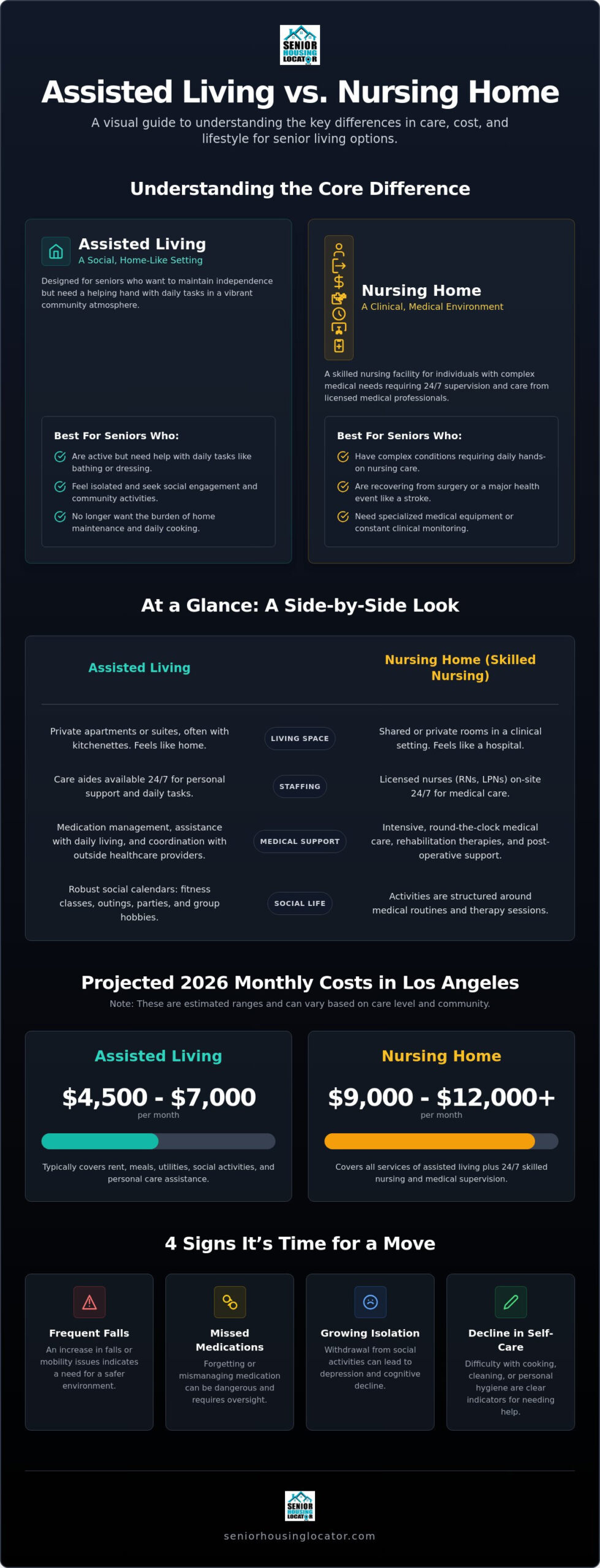
Choosing between an assisted living vs nursing home often comes down to one vital question: how much medical help does your loved one need every single day? While both options provide a safe, secure environment, they serve very different purposes in the journey of aging. Assisted living is designed for seniors who want to maintain their independence but need a helping hand with daily tasks. Think of it as a residential community where chores like cooking and cleaning are off your plate. On the other hand, a nursing home, also known as a skilled nursing facility, is a clinical setting for those with complex medical needs that require 24/7 supervision from licensed medical professionals.
To get a better sense of the foundational concepts, you can explore this overview of What is Assisted Living? which details how these communities prioritize social well-being alongside physical support. Understanding these definitions is the first step toward finding a place where your parent can truly thrive.
When comparing assisted living vs nursing home care, one of the easiest ways to visualize the difference is the “Hospital vs. Home” analogy. An assisted living community feels like a home or a comfortable apartment complex. It is filled with social calendars, dining rooms, and private living spaces that encourage a vibrant lifestyle. A nursing home feels more like a hospital environment because the focus is strictly on medical stabilization and intensive care. Before you make a final decision, a formal physician’s assessment is usually required. This professional evaluation determines exactly what level of care is medically necessary. It ensures your loved one isn’t in a place that offers too little support or, conversely, one that is overly clinical for their actual needs.
Who is Assisted Living Best For?
This option is often the perfect fit for seniors who value their autonomy but face challenges with specific daily routines. It is ideal for:
- Seniors who are generally active but struggle with bathing, dressing, or managing their daily medications.
- Individuals who feel isolated at home and are looking for social engagement, new friends, and organized community activities.
- Those who no longer want the physical or mental burden of home maintenance, yard work, and daily meal preparation.
Who Needs a Skilled Nursing Facility?
A nursing home is the right choice when medical needs become the primary concern of daily life. This includes:
- Seniors with complex medical conditions that require daily, hands-on intervention from a registered nurse or therapist.
- Individuals recovering from a major health event like a stroke or surgery who need intensive, short-term rehabilitation.
- Patients with advanced chronic illnesses that require specialized medical equipment or constant clinical monitoring to stay safe.
Services, Staffing, and Living Arrangements: A Side-by-Side Look
When you compare assisted living vs nursing home care, the difference in the daily environment is often the first thing you’ll notice. Assisted living communities are built for comfort and independence. They offer private apartments with kitchenettes and living rooms that feel like a true home. In contrast, nursing homes are clinical environments designed for medical stabilization. If you’re looking for a detailed breakdown, this government resource on long-term care options provides a helpful look at these distinctions.
- Staffing: Assisted living uses care aides for daily help, while nursing homes have licensed nurses on duty 24/7.
- Living Spaces: Residents in assisted living enjoy private suites; nursing home residents often share clinical rooms.
- Safety: Assisted living relies on emergency pull cords, whereas nursing homes utilize hospital-grade monitoring.
Socializing is a priority in assisted living. You’ll see robust calendars filled with fitness classes, movie nights, and local outings that keep residents engaged with their peers. Nursing homes follow a more medically-focused routine. Residents spend their time on therapy sessions and clinical check-ups rather than group hobbies. Choosing between assisted living vs nursing home options often depends on whether your loved one needs a social lifestyle or intensive medical oversight to stay safe.
Medical Support and Therapy Services
Care levels vary significantly between these two settings. In assisted living, staff provides medication management, which means they remind residents to take their pills. Skilled nursing facilities handle medication administration, where nurses physically give the medication and monitor the patient’s reaction. Both options often provide on-site access to physical, occupational, and speech therapy. Skilled nursing is defined as the highest level of non-hospital care available for seniors.
The California Hybrid: Board and Care Homes
For many families in the San Fernando Valley, the choice isn’t just between a large facility and a hospital-like setting. Many choose board and care homes in Woodland Hills as a middle ground. These are residential houses converted into senior care environments. While a large assisted living community might have a higher staff-to-resident ratio, a board and care home often provides a 1:3 care ratio. This intimate setting bridges the gap between social living and high-level care.
Finding the right balance can be overwhelming, but you don’t have to do it alone. You can speak with a local advisor to see which of these settings fits your parent’s unique personality and needs.
Comparing Costs in Los Angeles: What to Expect in 2026
Financial planning for senior care in Southern California requires a realistic look at local market rates rather than national averages. In 2026, the projected median cost for standard assisted living in Los Angeles County is approximately $6,281 per month. However, families looking at high-quality communities in the San Fernando Valley should expect a range between $6,500 and $9,500 per month. Nursing home care represents a much higher financial commitment. A semi-private room in a Los Angeles nursing home now averages about $12,524 per month, which is roughly 44% higher than the national average. To see how these numbers stack up against other factors, you can review the key differences in care, environment, and cost that define each option.
When you evaluate the price of an assisted living vs nursing home, it’s vital to look past the base monthly rate. Many families are surprised by community entrance fees or tiered pricing based on “levels of care.” These levels are determined by how much help a resident needs with daily tasks like bathing or mobility. You should also ask about medication fees and annual cost-of-living increases. While some communities claim to be “all-inclusive,” most charge extra for specialized services. For a deeper dive into these numbers, see our assisted living costs in Los Angeles guide.
How Families Pay for Care in Southern California
Most families use a combination of private savings and long-term care insurance to cover these expenses. It’s a common misconception that Medicare pays for long-term care; in reality, it only covers short-term clinical stays or rehab. For those with limited assets, Medi-Cal is a critical resource, though new 2026 regulations have reinstated a 30-month look-back period and specific asset limits. Veterans may also qualify for Aid and Attendance benefits to help offset monthly costs.
The Value of Professional Placement
Trying to find a budget-friendly match on your own can lead to expensive mistakes. A senior living advisor in Los Angeles acts as a local expert who has already vetted the facilities in neighborhoods like Encino or Sherman Oaks. They help you find a community that fits your current budget and can accommodate your loved one as their care needs grow. Because this is a free referral service for families, it removes the financial barrier to getting expert, local advice during a stressful time.
Making the Transition: 4 Signs It’s Time for a Move
Deciding when to move a loved one into an assisted living vs nursing home is rarely a single, clear moment. It’s often a series of small, worrying events that build up over time. Many families wait for a crisis to act, but recognizing the warning signs early can prevent a hospital visit and make the transition much smoother. If you’re noticing these changes, it may be time to look at professional care options.
- Frequent Falls: Physical safety is the most immediate concern. Even “near misses” or a growing fear of falling can lead a senior to stop moving, which quickly reduces their strength and independence.
- Nutrition and Medication: Unintentional weight loss or an empty fridge are red flags. Similarly, if you find unopened pill bottles or missed doses, the risk of a medical emergency increases significantly.
- Social Withdrawal: Isolation is a quiet danger. When a senior stops visiting friends or engaging in hobbies, it often leads to depression or a faster decline in cognitive health.
- Caregiver Exhaustion: You can’t pour from an empty cup. When a family member’s own health, career, or marriage begins to suffer under the weight of caregiving, the current situation is no longer sustainable.
Assessing the Current Care Needs
To get a clear picture of what’s happening, try conducting a simple audit of Activities of Daily Living. Can your parent safely bathe, dress, and use the restroom without help? There is a big difference between a parent wanting to stay home and them being able to safely stay home. There often comes a tipping point where the high hourly rates of 24/7 in-home care actually exceed the monthly cost of an all-inclusive assisted living community. If the home environment requires constant modifications and professional visits, a residential setting often provides more value and better safety.
Navigating the Emotional Journey
Starting the conversation is the hardest part. When you talk to your parent about moving to assisted living in Woodland Hills, focus on the benefits of community and safety rather than what they are “losing.” This move allows you to stop being a full-time caregiver and go back to being a supportive son or daughter. We always recommend visiting at least three different communities to find the right “feel” for your loved one’s personality. Every facility has a different social energy, and finding a match is key to a successful transition.
If you’re feeling overwhelmed by the choices, we can help you narrow down the best local options. You can request a personalized care plan to see which communities in the San Fernando Valley match your family’s needs and budget.
How a Local Advisor Simplifies Your Search in the San Fernando Valley
Deciding between an assisted living vs nursing home is a massive undertaking, but you don’t have to carry that weight alone. While the internet provides plenty of general data, it can’t tell you how a specific community actually feels on a Tuesday afternoon. That is where a Trusted Local Ally becomes your most valuable resource. We don’t just look at brochures; we have personally toured the facilities, met the staff, and seen the care in action. We help you cut through the noise by providing three core benefits: personal insight, customized shortlists, and expert advocacy.
Instead of calling dozens of places yourself, we provide a tailored list of options in neighborhoods like Encino or Sherman Oaks that match your parent’s care needs and your family’s budget. We understand that every senior has a unique personality. Some thrive in large, social environments, while others feel more at home in a smaller setting. By matching these preferences early, we save you hours of wasted tours and emotional exhaustion. Our goal is to move you from a state of uncertainty toward a clear, confident resolution.
We also guide you through the technical side of the transition. This includes explaining the paperwork, coordinating with doctors for medical assessments, and advocating for your family during the negotiation phase. When it is time to choose between an assisted living vs nursing home, having an expert in your corner ensures that no detail is overlooked. We stay by your side until your loved one is safely settled and comfortable in their new home.
Why Local Expertise Matters
Boots-on-the-ground knowledge is irreplaceable in the Los Angeles market. We know which facilities in Burbank or Pasadena have the best specialized care programs and which ones have recently changed directors. This “off-market” information is vital because a community’s reputation can change quickly based on its leadership. We also keep a pulse on current vacancies, helping you find a high-quality spot even when the local market feels crowded.
Your Next Steps to Peace of Mind
Finding the right care starts with a simple, stress-free conversation. During your first discovery call, we will listen to your concerns, review your loved one’s medical needs, and discuss your budget. There is no pressure and no sales pitch; just a helping hand to get you organized. This free service is designed to remove the burdens of the search so you can focus on being there for your family.
Ready to find the perfect fit? Schedule your free senior living consultation today and let us help you find the peace of mind your family deserves.
Finding the Right Path for Your Loved One
You now have the tools to distinguish between assisted living vs nursing home care, from the clinical focus of skilled nursing to the social independence found in assisted living. You understand the 2026 cost landscape in Los Angeles and recognize the warning signs that indicate a change is necessary. This knowledge is your first step toward ensuring your parent is safe, respected, and well-cared for in a community that truly feels like home.
You don’t have to navigate this complex journey alone. As your local experts in Woodland Hills and the San Fernando Valley, we offer a free placement service to take the weight off your shoulders. We provide 100% personalized care assessments to match your loved one with a community that fits their budget, health needs, and social personality. Let us help you find the right care—start your free search now. You are doing a wonderful thing by planning for their future, and we are here to support you every step of the way.
Frequently Asked Questions
Is assisted living cheaper than a nursing home?
Yes, assisted living is almost always more affordable than a nursing home. In Los Angeles, the monthly median cost for assisted living is approximately $6,281, while a semi-private room in a nursing home averages over $12,524. This price gap exists because nursing homes provide 24/7 medical supervision and clinical care, which requires higher staffing costs. Assisted living focuses more on social support and daily help, making it a more cost-effective choice for seniors who are medically stable.
Does Medicare pay for assisted living in California?
No, Medicare doesn’t pay for the long-term room and board costs of assisted living in California. It’s designed to cover clinical medical expenses, such as doctor visits, hospital stays, and short-term rehabilitation. While Medicare might pay for certain medical services provided to a resident, the monthly rent and care fees are typically paid out-of-pocket. Many families use long-term care insurance or specific state waiver programs to help manage these monthly expenses.
Can a person with dementia live in assisted living?
Yes, many assisted living communities have specialized memory care wings designed specifically for people with dementia or Alzheimer’s. These areas provide a secure environment, higher staffing ratios, and activities tailored to cognitive health. If your loved one is prone to wandering or needs more intensive emotional support, a memory care placement within an assisted living community is often a safer and more social alternative to a clinical nursing home setting.
What is the difference between skilled nursing and a nursing home?
Skilled nursing and a nursing home are essentially different names for the same level of clinical care. Both terms refer to facilities that provide 24/7 medical supervision from licensed nurses and therapists. The main difference lies in the duration of the stay. Skilled nursing is often used to describe short-term rehabilitation after a surgery or stroke. Nursing home typically refers to long-term residential care for seniors with chronic medical conditions who can’t live safely on their own.
How do I know if my parent needs a nursing home instead of assisted living?
The main indicator is the level of medical care required. If your parent needs daily injections, complex wound care, or constant clinical monitoring, they likely need a nursing home. If they primarily need help with daily tasks like bathing, dressing, or meal prep, assisted living is usually sufficient. Deciding between an assisted living vs nursing home depends on a physician’s assessment, which is the most reliable way to determine the appropriate level of care.
Are board and care homes the same as assisted living?
Board and care homes provide the same level of support as assisted living but in a much smaller, residential setting. These are typically traditional houses in neighborhoods like Woodland Hills that have been converted to care for six or fewer seniors. While a large assisted living community offers more amenities and social events, a board and care home provides a higher staff-to-resident ratio. This makes them an excellent choice for seniors who prefer a quiet, home-like environment.
Can couples stay together if one needs more care than the other?
Yes, many assisted living communities allow couples to live together in the same apartment, even if their care needs differ. This is a significant benefit of the assisted living vs nursing home comparison, as nursing homes are often less flexible with shared clinical rooms. In an assisted living community, one spouse can receive help with daily tasks while the other lives independently. This allows couples to remain together while ensuring both receive the right level of support.
How long does the placement process usually take in Los Angeles?
The placement process in Los Angeles typically takes between two and four weeks, though it can be done faster in an emergency. This timeline includes touring communities, completing medical assessments, and finalizing paperwork. Working with a local advisor can significantly speed up this process. We help you skip the research phase by providing a vetted shortlist of communities that have immediate vacancies and match your family’s specific care needs and budget.