
Imagine sitting at your kitchen table in Woodland Hills, surrounded by dozens of brochures and open browser tabs, yet feeling no closer to a decision than when you started. It’s a common scene for families in the San Fernando Valley who are trying to weigh the benefits of assisted living vs nursing home care. You want your parent to be safe, happy, and well-supported, but the fear of making the “wrong” choice often leads to a sense of total overwhelm. It’s perfectly normal to feel this way when faced with complex medical jargon and confusing payment structures.
We believe that finding the right care shouldn’t feel like a second job. This guide is designed to clear the confusion by explaining the “Care Gap” between these two environments. You’ll learn exactly how to match your loved one’s medical needs with the right social setting while keeping your budget in mind. We will walk you through the updated 2026 California regulations, clarify the differences between Medicare and private pay, and provide a curated look at facilities right here in our local community. By the end, you’ll have the clarity you need to move forward with confidence and peace of mind.
Key Takeaways
- Learn the fundamental difference between social-focused environments and medical-heavy settings to ensure your loved one gets the right level of support.
- Discover how the “ADL litmus test” helps you decide between assisted living vs nursing home care by evaluating daily needs like dressing and medication management.
- Explore local San Fernando Valley options, including the popular “Board and Care” homes that offer a smaller, more intimate residential setting.
- Get up to speed on 2026 California licensing updates that prioritize resident safety and pricing transparency for families.
- Find out how a trusted local ally can streamline your search by vetting facilities for you, allowing you to focus on your family’s emotional well-being.
Understanding the Core Differences: Assisted Living vs. Nursing Homes
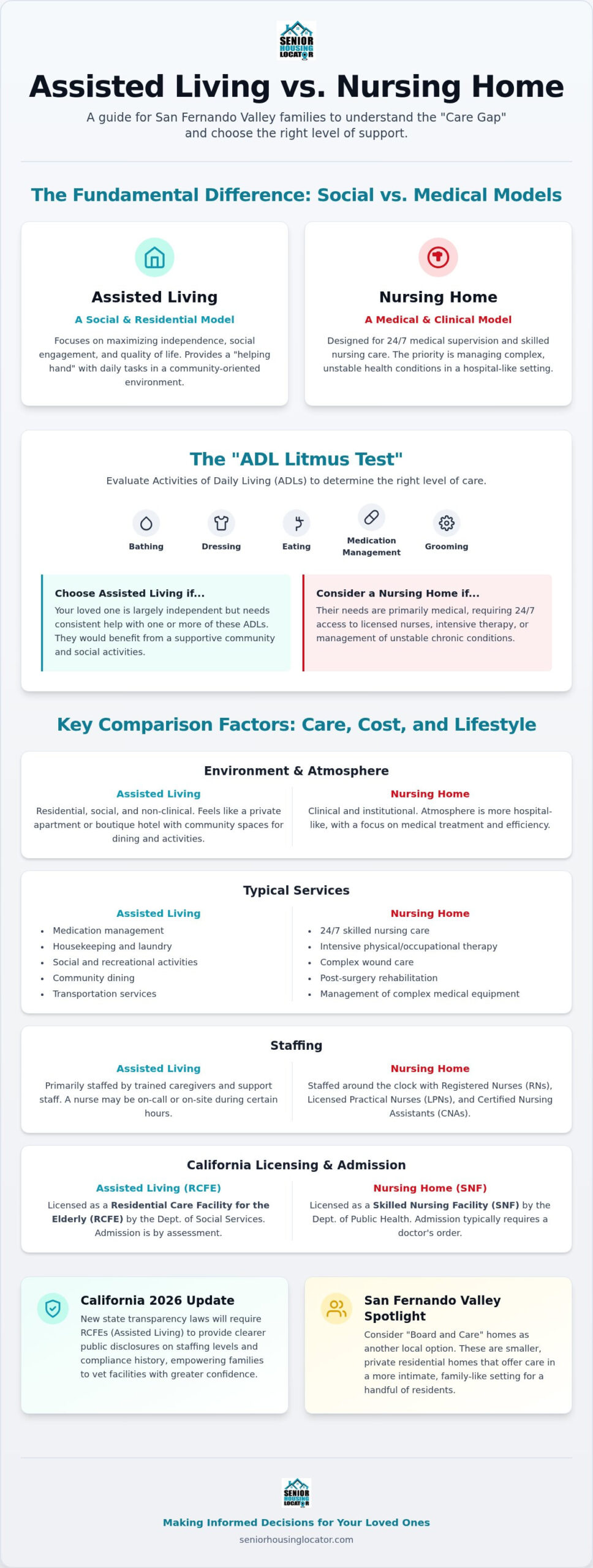
Does your parent simply need help getting dressed, or do they require around-the-clock medical monitoring? This is the central question families face when weighing assisted living vs nursing home care. The decision often feels heavy, but it becomes much clearer when you focus on the primary goal of the environment. We look at this through a simple framework we call the Rule of Three: safety, socialization, and specialized care. By identifying which of these is the most urgent priority, you can narrow down your search quickly.
To find the right fit, we use the “ADL litmus test.” ADLs, or Activities of Daily Living, are the basic tasks your loved one performs every day. These include bathing, dressing, grooming, eating, and managing medications. If your parent is mostly independent but finds these specific tasks difficult, they are likely a candidate for assisted living. However, if their needs involve complex medical issues that require a licensed nurse at all times, a different level of care is necessary.
In California, these facilities fall under different regulatory umbrellas. Most assisted living communities are licensed as a Residential Care Facility for the Elderly (RCFE). These are overseen by the Department of Social Services. Starting in July 2026, new California transparency laws require these facilities to provide even clearer disclosures about their staffing and history, making it easier for you to vet them with confidence.
What is Assisted Living?
Assisted living is a residential social model that provides supportive services while encouraging as much independence as possible. It’s the ideal choice for seniors who want to maintain their own rhythm but need a “helping hand” nearby for daily chores or personal care. Residents typically live in private or semi-private apartments and enjoy community dining and social events. This model focuses on quality of life and active engagement. If you want to learn more about the philosophy behind this care level, you can read more about What is Assisted Living and how it differs from institutional settings.
What is a Nursing Home (Skilled Nursing)?
A nursing home, or Skilled Nursing Facility (SNF), is a clinical setting designed for 24/7 medical supervision. The atmosphere here is more “hospital-like” because the priority is medical intervention rather than social lifestyle. These facilities are licensed by the California Department of Public Health. A doctor’s order is usually required for admission. You might consider an SNF if your loved one requires intensive physical therapy, complex wound care, or long-term management of a chronic, unstable medical condition.
Assisted Living: Prioritizing Independence and Social Engagement
Imagine waking up in a sun-drenched apartment in Woodland Hills. You aren’t rushing to prepare a meal or worrying about the yard. Instead, you’re heading to a morning yoga class in a landscaped courtyard. This is the daily reality for many seniors in the San Fernando Valley. It focuses on life rather than limitations. While the debate of assisted living vs nursing home often centers on medical needs, the social benefits are just as vital to overall health.
Community living acts as a powerful shield against the “loneliness epidemic” that affects many seniors living alone. Social calendars are often packed with outings to the Getty Center, local theater nights, and fitness programs tailored for mobility. These activities aren’t just for fun. They keep the mind sharp and the body moving. Even medication management is handled discreetly. Staff ensure residents take the right doses at the right time, but without the sterile feel of a hospital ward. Understanding these key differences in senior care options helps you see that assisted living is about adding support where it’s needed most.
Lifestyle and Amenities in Los Angeles
Los Angeles communities often feel more like boutique hotels than care facilities. In the San Fernando Valley, you’ll find pet-friendly suites, gourmet dining rooms, and lush outdoor spaces. These amenities allow seniors to maintain their personal style while accessing help. It’s a balance of total privacy in a personal suite and vibrant activity in common areas. This environment supports “aging in place.” Residents can stay in their familiar community even as their needs evolve over time.
Is Assisted Living Right for Your Parent?
Knowing when to make the move is a deeply personal decision. You might notice your parent is skipping meals or their refrigerator is empty. Perhaps they’ve become socially isolated or have experienced minor “near-miss” falls. These are clear signals that a little extra help could go a long way. Having 24-hour staff available for non-medical emergencies provides an immediate sense of relief for both the senior and their family.
If you’re ready to explore local options, our Assisted Living Placement in Woodland Hills: Your 2026 Local Guide offers a deeper look at what to expect. Finding the right fit doesn’t have to be a solo journey. You can reach out to a local senior housing advisor who knows the local facilities inside and out. It’s about finding that perfect match for your parent’s personality and health needs.
Nursing Homes: When Skilled Medical Care is the Priority
If your loved one’s needs have moved beyond help with daily chores and into the territory of complex medical care, a nursing home is likely the necessary choice. In Los Angeles hospitals like Cedars-Sinai or West Hills, doctors often use the term “Skilled Nursing Facility” or SNF. This isn’t just a fancy name. It signifies a shift from a social model to a clinical one. While the debate of assisted living vs nursing home usually centers on lifestyle, skilled nursing is strictly about medical intervention and safety.
Medical triggers often dictate this transition. If your parent requires advanced wound care, ventilator support, or intensive physical therapy after a stroke, they need the expertise of Registered Nurses (RNs) and Licensed Vocational Nurses (LVNs). These professionals are on-site 24/7 to monitor vital signs, manage IVs, and coordinate with physicians. It’s helpful to understand the core differences between assisted living and nursing homes before the pressure of a hospital discharge begins. You should also distinguish between short-term rehab, which focuses on recovery after surgery, and long-term custodial care for those with chronic medical needs.
The Clinical Environment Explained
Nursing homes are designed for efficiency and medical access. You’ll notice wider hallways for gurneys, specialized hospital beds, and advanced equipment like oxygen concentrators or dialysis support stations. The staff-to-resident ratios are much higher than in assisted living because every resident requires frequent medical check-ins. It’s a structured, supervised, and sterile environment built to prioritize health above all else. This focus ensures that emergencies are handled immediately and chronic conditions are managed with precision.
Transitioning from Hospital to Skilled Nursing
Many families first encounter these facilities during a hospital stay. The “discharge to SNF” process can feel rushed and overwhelming. A social worker might hand you a list of local options and ask for a choice within hours. This is where evaluating quality becomes vital. Look past the lobby and focus on staffing levels, cleanliness, and the attentiveness of the nurses. We recommend checking for recent health inspections and speaking with current families if possible.
We understand that this is a high-stress moment for your family. Senior Housing Locator provides expert referrals for these facilities throughout the San Fernando Valley. We help you find a place that offers the right specialized care, focuses on recovery, and provides peace of mind. Our goal is to ensure your parent is safe and well-advised during this transition. If you’re feeling stuck, don’t hesitate to reach out to a trusted local ally who can simplify the search for you.
Key Comparison Factors: Care, Cost, and Lifestyle
Choosing between assisted living vs nursing home care often comes down to finding the “least restrictive environment.” This means selecting a setting that provides the highest level of safety without stripping away a senior’s independence. It’s a delicate balance. We look at three main factors: the level of daily care required, the long-term financial impact, and the social atmosphere that best fits your parent’s personality. If they can still engage in hobbies but struggle with buttons and zippers, a social model is likely best. If they require medical monitoring every few hours, a clinical setting is the safer bet.
The financial side of this decision is often the most stressful part for families. In California, most assisted living is private pay. This means families use savings, home equity, or long-term care insurance. While the Assisted Living Waiver (ALW) program exists in 2026 to help those on Medi-Cal, waitlists can be long and rates have shifted to match the current minimum wage. Nursing homes, by contrast, are often covered by Medi-Cal for those who qualify financially, or by Medicare for short-term stays following a hospital visit. Understanding these layers helps you plan for the years ahead without unexpected surprises.
Assisted Living vs. Nursing Home Cost Comparison
Pricing models vary significantly between these two levels. Assisted living usually operates on a “Base Rate + Care Level” system. You pay for the apartment suite, and then add “tiers” of service based on how much help is needed. Skilled nursing is typically much more expensive. The higher cost reflects the 24/7 presence of licensed medical professionals and specialized clinical equipment. For a deeper dive into what families are seeing in our area, you can view our Assisted Living Costs in Los Angeles: Your Complete 2026 Pricing Guide.
The Board and Care Middle Ground
In neighborhoods like Sherman Oaks, Encino, and Woodland Hills, many families choose a “Board and Care” home. These are standard residential houses in quiet neighborhoods that have been converted to care for six seniors. This model offers a middle ground. It provides the high staff-to-resident ratio of a nursing home but keeps the warm, “home-like” feel of assisted living. It’s often the best choice for seniors who find large communities overwhelming or who need a higher level of physical assistance. Learn more in our Board and Care Homes in Woodland Hills: A Complete Guide for Families.
We know that every family’s situation is unique. If you’re feeling stuck between these options, you don’t have to figure it out alone. You can contact Senior Housing Locator today for a free, personalized consultation. We’ve already vetted the facilities in the San Fernando Valley, so we can help you find a safe, supportive environment that fits your budget and your parent’s needs.
Making the Transition: How a Local Expert Simplifies the Choice
The emotional weight of this transition can’t be overstated. You aren’t just looking for a building; you’re looking for a new home where your parent will be treated with dignity and respect. Whether you are choosing assisted living vs nursing home care, the process often feels like a full-time job you didn’t apply for. This is where a local expert steps in to act as a “Compassionate Facilitator.” We’ve spent years visiting facilities in Sherman Oaks, Encino, and Woodland Hills, so we know which ones have stable management and which ones might be going through a rough patch. We look for staff longevity because a happy team usually means happy residents.
Our goal is to move you from a state of uncertainty toward a clear resolution. We follow a logical, step-by-step progression to ensure no detail is missed. First, we listen to your parent’s unique story and medical needs. Next, we filter through dozens of local options to find the perfect match for your budget. Finally, we help you schedule tours and ask the hard questions that facilities might not volunteer. This methodical approach turns an overwhelming journey into a series of manageable phases.
The Benefits of a Free Placement Service
Our referral model is designed to lower your stress. The service is completely free to families because we are compensated by the communities. This allows us to focus entirely on an integrity-first approach to matching care needs. National call centers often provide generic lists based on who pays the most for leads. As a local ally, we provide recommendations based on what we’ve seen with our own eyes in the San Fernando Valley. We prioritize your peace of mind and your parent’s safety above everything else.
Next Steps for Your Family
Ready to start the conversation? You can book a free assessment with a Senior Living Advisor in Los Angeles. During this session, we’ll listen to your concerns and help you prepare for facility tours. When you visit a community, remember to use your senses. Look for clean common areas, smell for fresh air rather than heavy perfumes, and listen to how the staff speaks to the residents. You don’t have to carry this burden alone. We are here to guide you every step of the way until your loved one is safe, supported, and settled.
Clarity and Peace of Mind for Your Family
Deciding between assisted living vs nursing home care is one of the most significant choices you’ll make for your loved one. By understanding the “Care Gap,” you’ve already taken the biggest step toward ensuring their safety and happiness. You now know that assisted living focuses on social engagement and independence, while nursing homes provide the 24/7 medical supervision required for complex health needs. This distinction allows you to match your parent’s daily requirements with the environment that best supports their well-being.
You don’t have to navigate the overwhelming options in the San Fernando Valley alone. Our team provides a free personalized service for families, offering expert knowledge of facilities in Woodland Hills, Sherman Oaks, and Encino. We bring compassionate, integrity-driven guidance to every conversation, helping you find the right fit for your budget and care requirements. Find the right care for your loved one—schedule your free local consultation today.
You have the tools and the support needed to move forward with confidence. Your parent’s comfort and safety are within reach, and we are honored to be your trusted local ally during this important transition.
Frequently Asked Questions
Is assisted living cheaper than a nursing home in Los Angeles?
Assisted living is generally much more affordable than a nursing home in Los Angeles. While a typical assisted living community in the San Fernando Valley focuses on social support and basic help, nursing homes provide 24/7 clinical care which drives up the cost. In many cases, skilled nursing facilities are nearly double the price of residential care due to the high ratio of licensed medical staff required for safety.
Does Medicare pay for assisted living in California?
Medicare does not pay for the long-term room and board or personal care provided in assisted living. It is designed for short-term medical needs and rehabilitation. In California, families often use private funds or long-term care insurance. Some eligible seniors may access the Assisted Living Waiver through Medi-Cal, but this is separate from standard Medicare coverage and often involves specific participation requirements and waitlists.
Can my parent stay in assisted living if their health declines?
Many seniors can stay in assisted living as their needs increase, provided the facility is licensed to handle their specific condition. California RCFE regulations allow for “aging in place” with hospice waivers or additional care tiers. However, if a resident requires continuous skilled nursing care, such as complex ventilator support or daily injections that staff cannot legally manage, a transition to a higher care level may be necessary for safety.
What is the difference between a board and care home and assisted living?
The main difference lies in the size and environment of the facility. A board and care home is typically a traditional house in a residential neighborhood like Encino that cares for six seniors. Assisted living facilities are larger, apartment-style communities with more extensive social calendars and amenities. Both operate under the same state licensing, but board and care homes often provide a higher staff-to-resident ratio in a quieter setting.
How do I know if my parent needs a nursing home or just more help at home?
Determining the right level of care depends on your parent’s medical stability. If they only need help with bathing, meals, or medication reminders, home care or assisted living is usually sufficient. A nursing home becomes necessary when they require 24/7 monitoring by a licensed nurse for complex medical issues. If you are debating assisted living vs nursing home care, we recommend a professional assessment to evaluate their safety and clinical needs.
Are there memory care options within assisted living facilities in the SFV?
Yes, many assisted living communities in the San Fernando Valley offer dedicated memory care wings. These areas are secured to prevent wandering and feature staff trained in dementia-specific communication and safety. Under 2026 California updates, even general assisted living facilities are increasing their dementia-aware practices. This allows residents to transition into a specialized memory care program without leaving the community they have grown to love and trust.
How long does the placement process typically take with Senior Housing Locator?
Our placement process is designed to be efficient yet thorough. While every family’s timeline is unique, we can often provide a curated shortlist of facilities within 24 to 48 hours of your initial consultation. We move at your pace, whether you need an emergency placement this week or are planning for a move next month. Our goal is to streamline the search so you can focus on your loved one’s comfort during the transition.