
Did you know that up to 81 percent of seniors with Alzheimer’s aren’t just being stubborn, but actually have a brain condition called anosognosia that prevents them from recognizing their own needs? If you feel like every conversation about safety turns into a shouting match, you’re not alone. The process of finding assisted living for a difficult parent is one of the most emotionally exhausting challenges a family can face in Los Angeles. You’re likely dealing with deep caregiver burnout, constant arguments, and the heavy weight of guilt.
We understand that you want a solution that respects your parent’s dignity while ensuring they stay safe. It’s a high-stakes decision, but you don’t have to navigate it by yourself. This guide offers compassionate strategies and local LA resources to help you manage even the most resistant transition. You’ll discover how to use professional mediation to lower the temperature, why small board-and-care homes in the San Fernando Valley often work best for strong personalities, and how 2026 California regulations protect your family during this move. Let’s find a path toward peace of mind for you and safety for your parent.
Key Takeaways
- Identify the root cause of resistance to move away from logical debates and toward emotional validation and peace.
- Master the “Ask, Don’t Tell” technique and learn why the timing of your conversation is critical for a successful outcome.
- Discover why finding assisted living for a difficult parent often points toward intimate board and care homes in Woodland Hills rather than large communities.
- Implement a step-by-step transition plan that uses temporary trial stays to help your parent maintain their dignity and sense of control.
- Learn how local placement specialists match strong personalities to specific facility cultures across the San Fernando Valley.
Understanding Why Your Parent is Resisting Care
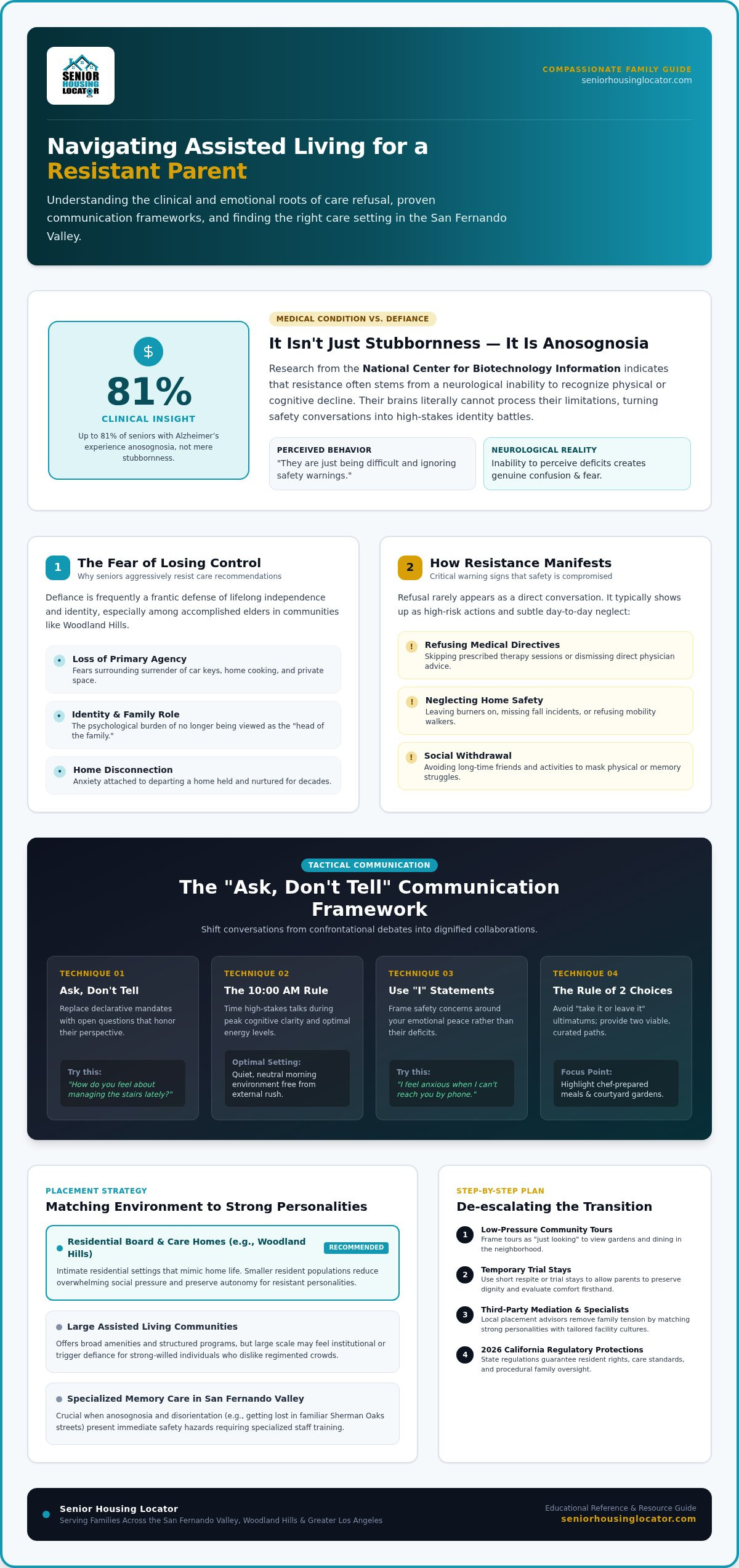
A difficult parent in the context of senior care is someone whose fear of losing control manifests as refusal of necessary assistance. When you’re finding assisted living for a difficult parent, it’s easy to label their behavior as mere stubbornness. What looks like defiance is often a frantic attempt to hold onto their identity. In neighborhoods like Woodland Hills, where many seniors have spent decades building successful, independent lives, the idea of needing help feels like a betrayal of their legacy. They aren’t just fighting you; they’re fighting for their sense of self. Understanding this distinction is the first step toward a more peaceful resolution.
The Fear of Losing Independence
Many parents view the move to a structured environment as a final loss of agency. They worry about losing their car keys, their kitchen, and their privacy. In the San Fernando Valley, where the culture prizes self-reliance, these fears are amplified. Common triggers for resistance include the anxiety of leaving a long-time family home or the fear of no longer being the “head of the family.” You can validate these feelings by acknowledging that their desire for control is natural. It’s helpful to discuss various assisted living care models that prioritize resident choice. This shifts the focus from what they’re losing to the support they’re gaining.
Resistance often shows up in specific ways:
- Refusing medical advice: Ignoring doctor recommendations or skipping physical therapy sessions.
- Neglecting home safety: Leaving the stove on or refusing to use a walker despite falls.
- Social withdrawal: Avoiding friends in the community to hide their physical or cognitive struggles.
When Cognitive Decline Mimics Stubbornness
It’s vital to distinguish between a lifelong strong personality and a medical condition. Research from the National Center for Biotechnology Information shows that up to 81 percent of seniors with Alzheimer’s experience anosognosia. This is a neurological inability to recognize their own impairments. They aren’t lying to you. Their brains literally cannot process their physical or cognitive limitations. If your parent gets lost in familiar Sherman Oaks streets but insists they’re fine, finding assisted living for a difficult parent becomes a medical navigation task. A professional evaluation can determine if memory care placement in San Fernando Valley is a safer, more appropriate choice than traditional assisted living.
Communication Strategies for Difficult Conversations
Talking to a resistant parent about senior living often feels like walking through a minefield. One wrong word can trigger a defensive reaction that shuts down communication for weeks. When you are finding assisted living for a difficult parent, the goal isn’t to win an argument; it’s to plant a seed of safety. Success starts with a shift in technique. Instead of issuing mandates, try the “Ask, Don’t Tell” method. By asking, “How do you feel about the stairs lately?” rather than saying, “You can’t handle the stairs,” you allow them to keep their dignity.
Timing is equally important. Experts recommend holding these discussions around 10:00 AM in a neutral, quiet setting. This is typically when energy levels are highest and cognitive clarity is at its peak. Use “I” statements to frame the issue around your own feelings. Saying, “I feel anxious when I can’t reach you,” is much harder to argue with than, “You never answer your phone.” The process of finding assisted living for a difficult parent requires patience and a specific set of communication tools.
The Power of Choice and Autonomy
Control is the primary currency for a resistant parent. If you present only one “take it or leave it” option, they will likely choose to leave it. Instead, offer two viable choices. This simple shift gives them the final say in the matter. When discussing these options, lead with lifestyle benefits. Focus on the chef-prepared meals, the local social outings, or the beautiful courtyard gardens. You can find more details on how to evaluate these features in the National Institute on Aging’s guide to residential facilities. If they agree to a tour, keep it low-pressure. Frame it as “just looking” at a community to see what’s available in the neighborhood.
Bringing in a Third-Party Expert
Sometimes, the parent-child dynamic is too loaded with history to allow for a productive talk. In these cases, a senior living advisor in Los Angeles can serve as a neutral mediator. Parents often respond better to a professional’s objective assessment than to their own children’s pleas. This third-party presence removes the “villain” role from you. It transforms the situation from a family feud into a professional consultation. If you’re feeling overwhelmed by the conflict, reaching out to Senior Housing Locator can help you find a calm, structured path forward.
Selecting the Right Environment for Strong Personalities
Finding assisted living for a difficult parent involves more than just checking boxes for medical needs. It requires a deep understanding of how their personality interacts with their physical surroundings. In Los Angeles, families must decide between expansive communities and intimate residential homes. This choice often determines whether a parent settles in or continues to fight the move. California’s “Board and Care” model typically offers a 1:3 or 1:6 staff-to-resident ratio, which is ideal for providing the personalized attention a demanding personality often requires.
Large Communities: Pros and Cons for the Socially Difficult
Large-scale communities often feel like high-end resorts. They offer a steady stream of social events, diverse dining options, and specialized fitness programs. For a parent who resists care because they fear boredom, these amenities provide a vital sense of purpose. The larger social pool also means that a single personality clash won’t ruin their experience. However, the sheer scale can be a double-edged sword. For a parent who values privacy or feels threatened by change, the “institutional” atmosphere of a 100-unit building can trigger anxiety. If they feel like just another number in a large system, their resistance may actually increase.
Board and Care Homes: The Intimate Alternative
For many families in the San Fernando Valley, a board and care home in Woodland Hills offers a much gentler transition. These are standard residential houses located in quiet neighborhoods, licensed to care for a small group of seniors. This setting feels familiar and safe rather than clinical. It’s much easier for a stubborn parent to accept help when it’s delivered in a living room rather than a facility wing.
These homes are the “hidden gems” of the local care market. The high staff-to-resident ratio means that caregivers can adapt to your parent’s specific routine. If your father insists on a specific brand of tea or your mother refuses to join group activities, the staff has the time to accommodate those preferences. This level of flexibility reduces the power struggles that often occur in larger settings. By minimizing the “institutional” triggers, you create an environment where even the most difficult parent can finally feel at ease.
A Step-by-Step Transition Plan for 2026
Transitioning a resistant parent is a delicate operation. It requires a blend of strategy, empathy, and professional distance. When you are finding assisted living for a difficult parent, your goal for moving day is to minimize friction and preserve your relationship. A structured plan helps you move from a state of constant conflict toward a safe, sustainable resolution. By focusing on small, manageable steps, you can lower the emotional temperature for everyone involved.
The ‘Trial Stay’ and Respite Care
Many Los Angeles families find success by framing the move as a temporary experiment. A 30-day “trial stay” or respite care period feels much less threatening than a permanent commitment. You might suggest the move is necessary while the house is being painted, during a plumbing repair, or as a short-term “vacation” with professional support. This approach lowers the stakes. It allows your parent to experience the benefits of social interaction and chef-prepared meals without feeling like they have lost their home forever. Once the initial 30 days pass, many seniors choose to stay because the new routine has become comfortable and safe.
Managing Moving Day Stress
Moving day is often the most volatile part of the journey. To reduce conflict, consider hiring professional senior movers who specialize in high-stress transitions. One critical rule is that you should not be the one driving the car. A neutral third party or a professional transport service can help keep the atmosphere calm. When you are finding assisted living for a difficult parent, the logistics of the first hour are vital. Once you arrive at the community, focus on these three steps:
- Set up a “familiar corner” with their favorite chair, photos, and a beloved quilt immediately.
- Avoid unpacking every box on day one to prevent overwhelming their senses.
- Leave the facility within an hour of arrival so the staff can begin the bonding process.
After the move, follow the “two-week rule.” Resist the urge to visit every day during this period. Your parent needs time to rely on the staff for their needs rather than looking to you to “rescue” them. Constant communication with the facility director is essential during this adjustment phase. They can provide objective updates on how your parent is truly settling in. If you need help organizing these logistics, you can reach out to a local advisor to help streamline the entire process.
How a Local Placement Specialist Solves the Dilemma
While national hotlines might offer thousands of generic listings, they often lack the “boots-on-the-ground” knowledge required for a successful move. Finding assisted living for a difficult parent is about more than just finding a vacancy; it’s about finding the right cultural fit. Our team spends every day inside Woodland Hills and Sherman Oaks facilities. We know which staff members have the patience for “strong” personalities and which buildings have high staff turnover. This local insight allows us to act as a neutral mediator. By positioning ourselves as the experts, we help remove you from the center of the family conflict.
Our service is 100 percent free to Los Angeles families. We are supported by a network of high-quality providers, which allows us to focus entirely on your parent’s social and psychological needs. We bridge the gap between your budget and the high-quality care available in the San Fernando Valley. You don’t have to spend weeks touring the wrong places; we narrow the search to the few that truly understand your family’s unique situation.
Personalized Matching Beyond the Checklist
We look for facilities where the Executive Director has a proven track record of managing resistant residents with grace. It isn’t just about the care level; it’s about the social chemistry of the building. We evaluate whether your parent will fit in with the current residents or if the environment will trigger more resistance. We also use our insider knowledge of assisted living costs in Los Angeles to find value. This helps you secure a placement that offers premium attention without the premium price tag often found in West LA.
Your Next Steps for Peace of Mind
The process of finding assisted living for a difficult parent shouldn’t feel like a solo battle. When you schedule a free consultation with Senior Housing Locator, we start by listening to the “difficult” details others might ignore. We want to hear about the arguments, the specific triggers, and the personality traits that make this move feel impossible. During our first call, we will create a clear roadmap designed to lower the stakes and restore your peace of mind. We have already done the hard work of vetting the local options, so you can focus on being a supportive child again. Let us help you navigate this transition with integrity and find a place where your parent can safely settle in.
Moving Forward with Confidence and Clarity
Transitioning a resistant parent is one of the most emotional journeys a family can take. By shifting your approach from logical debate to empathetic validation, you can lower the stakes and preserve your relationship. Remember that finding assisted living for a difficult parent doesn’t have to be a solo battle. Whether you choose a vibrant community or an intimate board and care home in the San Fernando Valley, the right environment will prioritize your parent’s dignity while ensuring their safety.
You deserve peace of mind, and your parent deserves a setting where their personality is understood and respected. Our team is here to act as your trusted local ally, offering deep knowledge of Woodland Hills and Sherman Oaks facilities. We provide a 100 percent free service to families, matching seniors to homes based on their specific social and psychological needs. Our integrity-driven process ensures you find a placement that truly fits.
Start your stress-free search with a local expert today. You have already done the hard work of caring for your loved one; now let us help you find the professional support you both need to thrive.
Frequently Asked Questions
Can an assisted living facility kick my parent out for being difficult?
Yes, but California law provides specific protections for residents. A facility must give at least 30 days’ prior written notice for an eviction, which is only allowed for reasons like nonpayment or care needs that exceed the community’s license. If the facility is closing, they must provide 60 days’ notice. In cases of aggressive behavior, the facility often works with the family to find a safer, more specialized setting like memory care.
How do I deal with the guilt of moving my parent against their will?
Guilt is a natural part of this process, but it’s helpful to reframe the move as an act of protection. You aren’t “forcing” a move; you’re ensuring their safety and dignity. Many families find that their relationship with their parent improves significantly once the daily stress of caregiving is removed. Focus on the professional support they will receive in a secure environment in the San Fernando Valley rather than the initial resistance.
What if my parent refuses to tour any senior living communities?
If your parent refuses to visit, consider involving a neutral third-party advisor. Resistant parents often respond better to a professional’s recommendation than a child’s plea. You might also frame the visit as a casual lunch or a quick stop to gather information for a friend. If a traditional tour is impossible, a 30-day respite stay can serve as a low-pressure way for them to experience the benefits of the community firsthand.
Is there a difference between a ‘difficult’ parent and one with dementia?
There is a major difference between a stubborn personality and a medical condition. Many seniors with dementia suffer from anosognosia, a neurological condition that prevents them from recognizing their own decline. If you are struggling with finding assisted living for a difficult parent, a medical evaluation is essential. Understanding whether the behavior is a lifelong trait or a symptom of cognitive decline helps you choose the right level of care and communication strategy.
How much does a senior placement advisor cost in Los Angeles?
At Senior Housing Locator, our placement and referral services are 100 percent free for families. We receive a referral fee from the participating communities and board and care homes only after a successful placement is made. This allows us to provide personalized, full-service support throughout the San Fernando Valley and Los Angeles area without adding any financial burden to your family during an already stressful time.
What are the best board and care homes in the San Fernando Valley for stubborn seniors?
Smaller, licensed 6-bed residential care facilities in neighborhoods like Woodland Hills or Sherman Oaks are often the best fit for resistant seniors. These homes offer a high staff-to-resident ratio, typically 1:3, which allows for personalized attention and a calmer atmosphere. The familiar, house-like setting feels less “institutional” than a large community, which can significantly reduce the anxiety and power struggles that often trigger stubborn behavior.
How can I pay for assisted living if my parent is resistant to selling their home?
If your parent refuses to sell their home, you can explore options like long-term care insurance or using rental income from the property to cover monthly fees. While we don’t provide financial planning, we can help you identify high-quality care options in Northridge or Burbank that fit your current budget. This allows you to secure the necessary care while your family takes the time to make long-term financial decisions together.
What happens if my parent stays in their room and refuses to socialize?
It’s common for seniors to isolate themselves during the first few weeks of a transition. Most Los Angeles facilities have social directors who use “gentle persistence” to encourage participation in activities. If your parent is naturally introverted, a smaller board and care home might be more comfortable than a large community. In these smaller settings, caregivers can bring social engagement directly to your parent’s room to build trust at a comfortable pace.