Imagine a couple who has shared every morning coffee for fifty years suddenly facing the prospect of living in separate buildings because one spouse needs memory care and the other does not. This heart-wrenching scenario is a reality for many families in Los Angeles today. You shouldn’t have to choose between your spouse’s safety and your marriage. The process of finding senior housing for couples with different needs is often clouded by a fear of forced separation and confusion over complex California licensing rules. It is completely normal to feel a heavy sense of guilt when one partner needs more help than the other can provide at home.
We’re here to help you move from uncertainty toward a clear resolution. You’ll discover how couples with diverging health requirements can remain together in Los Angeles senior living communities without compromising on care. This guide breaks down the latest 2026 options for dual-occupancy, including how new California laws like SB 1406 provide better fee transparency with 90 day notice requirements. We will explore how campus connectivity models keep partners close while ensuring each person receives the right level of support. You will gain the peace of mind that comes from knowing both of your needs are met under one roof.
Key Takeaways
- Discover the difference between unified care and campus connectivity to find the right balance of independence and support for both partners.
- Learn how the second-person fee structure works in Los Angeles to help you plan for long-term care costs more effectively.
- Identify specific floor plan features and staff-to-resident ratios that are essential for couples with varying mobility or cognitive levels.
- Simplify the process of finding senior housing for couples with different needs by understanding California’s unique dual-occupancy licensing rules.
- See how a local senior living advisor can match you with specific communities in the San Fernando Valley that specialize in keeping couples together.
The Challenge of Finding Senior Housing for Couples with Different Needs
For many couples in Los Angeles, the golden years bring a shift in health that doesn’t happen at the same pace for both partners. One person might remain active and independent while the other begins to struggle with mobility, chronic illness, or cognitive decline. Historically, the senior living industry defaulted to separating these spouses. One partner would stay in independent living while the other was moved to a specialized care wing or an entirely different facility. This forced separation often leads to a rapid decline in health and a deep sense of isolation for both people. Finding senior housing for couples with different needs is about preventing that heartbreak.
In 2026, we’re seeing a welcome shift toward unified care models across the San Fernando Valley. Modern communities now recognize that partnership is a vital part of wellness. Many families explore continuing care retirement communities because these campuses are specifically designed to offer a full spectrum of support on a single property. This allows couples to stay close, even as their individual requirements change over time. It’s no longer a choice between safety and staying together; it’s about finding a layout that supports both.
Identifying Your Specific Care Tier Mix
The first step is assessing the “care gap” between you and your spouse. You might find that one partner needs help with medication and dressing while the other is still driving and socially active. When memory care requirements enter the picture, the residency dynamic changes because security and specialized programming become the top priority. Under California RCFE licensing, care tiers are defined as specific levels of assistance that determine the staffing and cost required to meet a resident’s daily health and safety needs. Understanding your specific mix helps you target communities with the right licenses to keep you in the same room.
The Emotional Hurdle: Moving as a Unit
The decision to move is often triggered by caregiver burnout. The healthier spouse often carries the weight of daily chores, medical appointments, and physical care, which leads to exhaustion and health problems of their own. Moving as a unit provides the caregiver spouse with respite and support. It allows you to return to being a partner rather than just a provider. Finding senior housing for couples with different needs ensures you can maintain your shared life, your morning routines, and your social bonds. You’re preserving your partnership while gaining the professional help you both deserve.
Options for Staying Together: Unified Care vs. Campus Connectivity
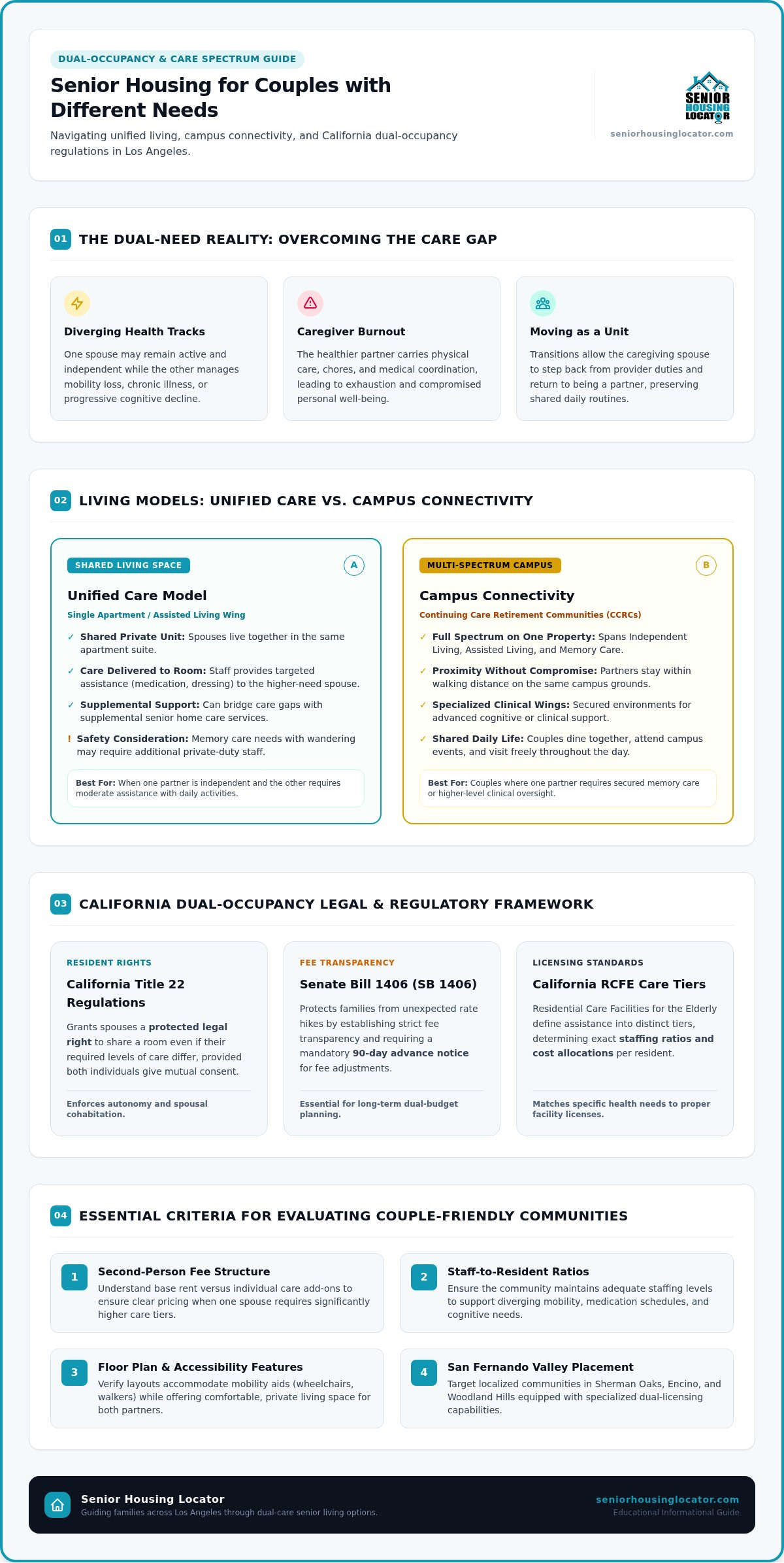
Finding senior housing for couples with different needs doesn’t mean you have to live in separate buildings. You have choices that balance intimacy with medical necessity. Most Los Angeles families choose between a unified unit or a campus connectivity model. Both options allow you to remain a central part of each other’s lives while ensuring the partner with higher needs gets professional support. This AARP report on long-term care for couples highlights how modern communities are adapting to these diverging medical conditions to prevent premature separation.
The Single Unit Strategy: Bringing Care to You
In a unified care model, you and your spouse live in the same apartment, usually within an assisted living wing. This works well when one spouse is mostly independent and the other needs help with daily tasks. You can often supplement facility care with senior home care to bridge specific gaps in support. This keeps the couple together in a familiar, private space. Under California Title 22 regulations, residents have a protected right to share a room with their spouse even if care levels differ, provided both consent. However, if one partner requires a secured memory care environment for safety, staying in a general assisted living unit might require additional private-duty staffing to manage wandering or nighttime safety.
Campus Connectivity: Proximity Without Compromise
For couples where one partner needs specialized clinical care, campus connectivity is often the best fit. In areas like Sherman Oaks or Encino, large communities often feature tiered buildings on a single lot. One spouse lives in an independent living apartment while the other resides in a dedicated memory care or skilled nursing wing just a short walk away. This model protects the independent spouse’s social life. They can attend fitness classes, social clubs, and dining events without the constant physical and emotional strain of 24-hour caregiving. You can spend your days together in common areas or share meals, then return to separate spaces that meet your individual health requirements.
For a more intimate setting, many families look at board and care homes in Woodland Hills. These six-bed residential homes offer a high staff-to-resident ratio, making it easier for a couple to stay in one room while receiving highly personalized attention. Finding senior housing for couples with different needs requires looking at how a facility handles these transitions over time. If you’re feeling overwhelmed by these logistical choices, reaching out for expert placement guidance can help you identify which local facilities truly support aging in place as a couple.
Navigating Costs and Logistics for Dual-Need Placements in Los Angeles
Money is often the primary source of stress when families begin the process of finding senior housing for couples with different needs. You aren’t just looking at one monthly bill; you’re balancing two distinct sets of requirements. In the Los Angeles market, communities typically use a “base plus care” model. This means you pay for the apartment itself, a second-person fee, and then individual care charges based on each partner’s health. Understanding this structure helps you avoid surprises and ensures your long-term budget remains sustainable.
One way to offset these costs is through the VA Aid and Attendance benefit. For the 2026 cycle, a married veteran may qualify for up to $2,874 per month to help cover assisted living expenses. If both spouses are veterans, that amount can reach up to $3,845 per month. The net worth limit for this benefit is currently $163,699. We often help families determine if these subsidies, combined with long-term care insurance, make a dual-need community more accessible than staying at home with private help.
The ‘Second Person Fee’ Explained
The second person fee is a standard charge in most Southern California communities. It covers the additional spouse’s meals, utilities, and access to campus programming. While the first person’s base rent covers the physical apartment, this fee ensures the community can support two residents in one unit. When you compare this to the cost of two separate studio apartments, staying together is almost always the more affordable path. It allows you to share a larger one-bedroom or two-bedroom suite while pooling your resources for the specific care tiers you each require.
Los Angeles Specific Financial Considerations
Location plays a huge role in your monthly budget. You’ll find that assisted living costs Los Angeles vary significantly between neighborhoods like Woodland Hills and the Westside. Beyond the rent, you must account for “care points.” Facilities assign points for tasks like medication management, bathing assistance, or escorting a spouse to meals. These points determine your care tier, and these tiers can change as health needs evolve. Under California law SB 1406, facilities must now provide you with a 90 day written notice before any general rate increase, giving you more time to adjust your financial plan. We recommend looking for communities that offer:
- Transparent, itemized care point systems
- Locked-in base rent periods
- Predictable transition paths between care levels
Planning for these escalations now prevents a financial crisis later.
Key Criteria for Evaluating Couple-Friendly Communities in the San Fernando Valley
When you begin touring facilities in the San Fernando Valley, look beyond the lobby decor. Evaluating the physical layout and social culture is vital when finding senior housing for couples with different needs. You need a space that accommodates medical equipment like walkers or hospital beds while still feeling like a home for the active partner. Pay attention to the floor plans during your visit. Are there wide doorways and zero-entry showers? Does the unit have a kitchenette for the independent spouse to make coffee, or a full kitchen if they still enjoy cooking? Proximity to local medical hubs is also a top priority. Communities near Providence Cedars-Sinai Tarzana Medical Center or West Hills Hospital provide quick access to specialists, which reduces the travel burden for the healthier spouse.
Check if the dining room allows for mixed-care seating. It’s a significant red flag if a community forces a memory care resident to eat separately from their independent spouse. High-quality communities encourage shared meals to maintain your connection. You should also ask about staff-to-resident ratios. Look for teams who have specific experience managing the social dynamics of dual-need households where one partner might be providing a significant amount of informal care. This balance ensures that neither person feels like a patient or a full-time nurse.
The ‘Independent Spouse’ Audit
It’s easy to focus entirely on the partner who needs care, but the independent spouse’s quality of life is just as important. Does the community offer transportation to the Village at Westfield Topanga or social clubs in Woodland Hills? You want the active partner to remain engaged in the local community. Guest policies should be flexible, allowing you to host family in a way that feels natural. A local advisor can help you in finding senior housing for couples with different needs that prioritizes the happiness of both partners. A supportive environment ensures the healthier partner doesn’t become isolated while living in a care-focused setting. Ask about social integration programs that allow mixed-need households to participate in events together, such as movie nights or holiday parties.
Safety and Accessibility Checklist
Shared living spaces must be ADA compliant to ensure safety for the partner with mobility challenges. This includes grab bars that are integrated into the design rather than looking clinical. Emergency response systems should be sophisticated enough to distinguish between the two residents, ensuring the right help arrives for the person in need. In the San Fernando Valley, a continuum of care refers to a senior living model where independent living, assisted living, and memory care are offered on one campus to allow residents to transition between levels of support without leaving the property. These features provide a safety net that adapts as your health requirements shift.
If you’re ready to see these communities in person, book a guided tour with a local advisor who knows the ins and outs of every building in the Valley.
How a Senior Living Advisor Simplifies the Search for Woodland Hills Couples
A simple Google search for senior living often leads to a sea of generic results that don’t address your specific family dynamic. When you’re finding senior housing for couples with different needs, the stakes are much higher than a standard move. You need to know which buildings in the San Fernando Valley have the specific “unified” licenses required to keep an independent spouse and a memory care resident in the same suite. Online directories rarely highlight these nuances. A local advisor acts as your eyes and ears on the ground, using deep community knowledge to filter out facilities that can’t meet your dual requirements.
We’ve spent years building relationships with community directors in Granada Hills, Northridge, and Woodland Hills. This local expertise allows us to quickly identify which homes have a culture of supporting couples and which ones might struggle with a mixed-needs residency. Our goal is to reduce the time from “crisis” to “placement” for families who are feeling the weight of caregiver burnout. Because our service is a free referral resource for families, you gain a professional advocate without adding any extra financial burden to your search.
Personalized Matching for Complex Needs
Every couple has a unique “care mix” that requires a tailored approach. A senior living advisor Los Angeles can help you navigate these care options by filtering choices based on your specific budget, care levels, and preferred neighborhood. We look for communities that offer the right balance of stimulation for the independent partner and safety for the spouse needing help. This personalized matching includes:
- Reviewing current RCFE licensing for room-sharing compliance
- Negotiating move-in terms that reflect your dual-occupancy status
- Identifying floor plans that support varying mobility levels
This structured approach ensures you only tour buildings that are a genuine fit for your shared life.
Taking the Next Step Together
Moving into a new community is a major life transition, but you don’t have to manage it alone. When you schedule a free consultation with Senior Housing Locator, we start by listening to your story and understanding your daily routines. To make your first meeting most productive, it’s helpful to bring a list of current medications and any recent medical assessments for the partner requiring care. We’ll walk you through the entire placement process, from the initial screening to the final move-in day. Our role is to provide the calm, orderly guidance you need to find a community where you can both thrive. We handle the logistical heavy lifting so you can focus on being a supportive partner during this new chapter.
Protecting Your Partnership in Senior Living
Finding senior housing for couples with different needs is a journey you don’t have to take alone. You’ve discovered that modern Los Angeles communities now offer flexible solutions like campus connectivity and unified care to keep you and your spouse together. By leveraging local financial benefits and understanding your rights under California’s latest transparency laws, you can secure a future that prioritizes both safety and companionship. You don’t have to compromise on care to stay by each other’s side.
Our team at Senior Housing Locator provides expert local knowledge of San Fernando Valley facilities to help you navigate this transition with ease. We offer compassionate guidance for complex family situations through our free referral service. There are no hidden fees or high-pressure tactics; just a neighborly helping hand to ensure your peace of mind. If you’re ready to explore your options, contact our local experts for a free senior living consultation. We’ll help you find a community where you can both thrive without having to say goodbye to the life you’ve built together. You deserve a solution that honors your marriage and your health.
Frequently Asked Questions
Can a couple live together in assisted living if only one spouse needs help?
Yes, couples can live together in the same assisted living apartment even if only one partner requires daily assistance. California regulations protect your right to share a room with your spouse as long as both people consent. This arrangement allows the independent partner to enjoy the community’s social life while the other receives professional help with tasks like bathing or medication. It is a common solution for finding senior housing for couples with different needs.
What happens if one spouse needs memory care and the other doesn’t?
If one spouse requires a secure memory care environment, you typically have two options. You can choose a campus connectivity model where one partner lives in assisted living while the other resides in a nearby memory care wing. Alternatively, some Los Angeles communities offer mezzanine programs that allow couples to stay together in a standard apartment while receiving extra cognitive support. We help you identify which local buildings have the specific licenses to support these arrangements.
Is it more expensive for a couple to live in senior housing than a single person?
Living as a couple in a senior community involves higher costs than a single person, but it is generally more affordable than paying for two separate apartments. You will typically pay a base rent for the unit plus a second person fee that covers additional meals and utilities. Any specific care services are added on top of that base for the individual. This tiered approach ensures you only pay for the exact support each partner requires.
Are there board and care homes in Woodland Hills that accept couples?
Woodland Hills and the surrounding San Fernando Valley are home to many licensed six-bed board and care homes that specifically cater to couples. These residential settings offer a more intimate, home-like atmosphere compared to larger facilities. Because of the high staff-to-resident ratio, these homes are often very flexible in managing mixed care needs. We can help you find a private room in a local home that allows you to remain together while receiving highly personalized attention.
How do we handle different care levels in the same apartment?
Communities handle diverging health requirements by creating two separate, itemized care plans. Each person is assessed individually to determine their care points or tier level. One spouse might have a plan that includes zero care hours, while the other receives extensive help with mobility or dressing. This ensures that the independent partner isn’t paying for services they don’t use. It also guarantees the higher-needs partner gets the specific clinical support they require to stay safe.
Can we move from independent living to assisted living without changing rooms?
Whether you can stay in the same room depends on the specific community’s licensing and aging in place policies. Many modern facilities in the San Fernando Valley are licensed for both independent and assisted living in the same units. This allows you to transition smoothly between care levels without the stress of a physical move. When finding senior housing for couples with different needs, we prioritize communities that offer this long-term stability to avoid future disruptions.
Do Los Angeles senior living facilities offer ‘second person’ discounts?
Most facilities don’t offer a traditional discount, but the second person fee structure is designed to be more cost-effective than renting two separate units. This fee is significantly lower than the primary resident’s base rent because it only covers the additional cost of meals, housekeeping, and amenities. It is a structured way to keep couples together without doubling the housing budget. We can help you compare these fee schedules across different Los Angeles neighborhoods to find the best value.
What if my spouse’s care needs increase significantly after we move in?
If care needs increase, the community will conduct a new assessment to adjust the care tier and associated fees. Under California law SB 1406, you must receive a 90 day notice for general rate increases, though changes based on a sudden health decline are handled quickly. If the needs become too high for a shared apartment, we can help you transition to a campus connectivity model within the same community to keep you close while ensuring safety.