The most expensive senior living community in Los Angeles isn’t always the safest choice for your parent. While large facilities often feature grand lobbies and resort-style amenities, they can sometimes feel overwhelming for a senior who needs constant, watchful eyes. For many families, the smaller, more intimate board and care homes san fernando valley offers provide a much better fit. These residential settings prioritize a high caregiver-to-resident ratio, ensuring your loved one is never just a number in a crowded hallway.
Moving a parent out of their long-time home is an emotional journey, and it’s completely normal to feel a mix of guilt and anxiety about the costs. We understand that you want a place that feels like home, provides expert care, and fits your budget. This 2026 guide will help you understand the latest California licensing transparency laws, current SFV pricing trends, and how to vet a home for safety. You’ll learn how to find a peaceful environment where your parent receives the personalized attention they deserve.
Key Takeaways
- Understand why residential homes with six or fewer residents often provide a safer, more attentive environment than large facilities.
- Learn how to compare the intimate family-style atmosphere of board and care homes san fernando valley against larger hotel-style assisted living.
- Discover the essential “sensory tour” checklist and how to access state records to verify a home’s safety and citation history.
- Get a clear overview of the 2026 care landscape in the Valley, including new transparency laws and typical high-end amenities.
- Save time and reduce stress by using a free local placement service to filter through the thousands of care options in Los Angeles.
Understanding Board and Care Homes in the San Fernando Valley
Many families feel overwhelmed by the scale of large assisted living facilities. In the San Fernando Valley, a more intimate option exists that feels much closer to home. These are Residential care settings, specifically known as board and care homes san fernando valley seniors often prefer for their personal touch. Unlike high-rise buildings that can feel like hotels, these are actual houses located on quiet, familiar residential streets. They offer a sense of continuity for a parent who has spent decades living in a traditional neighborhood.
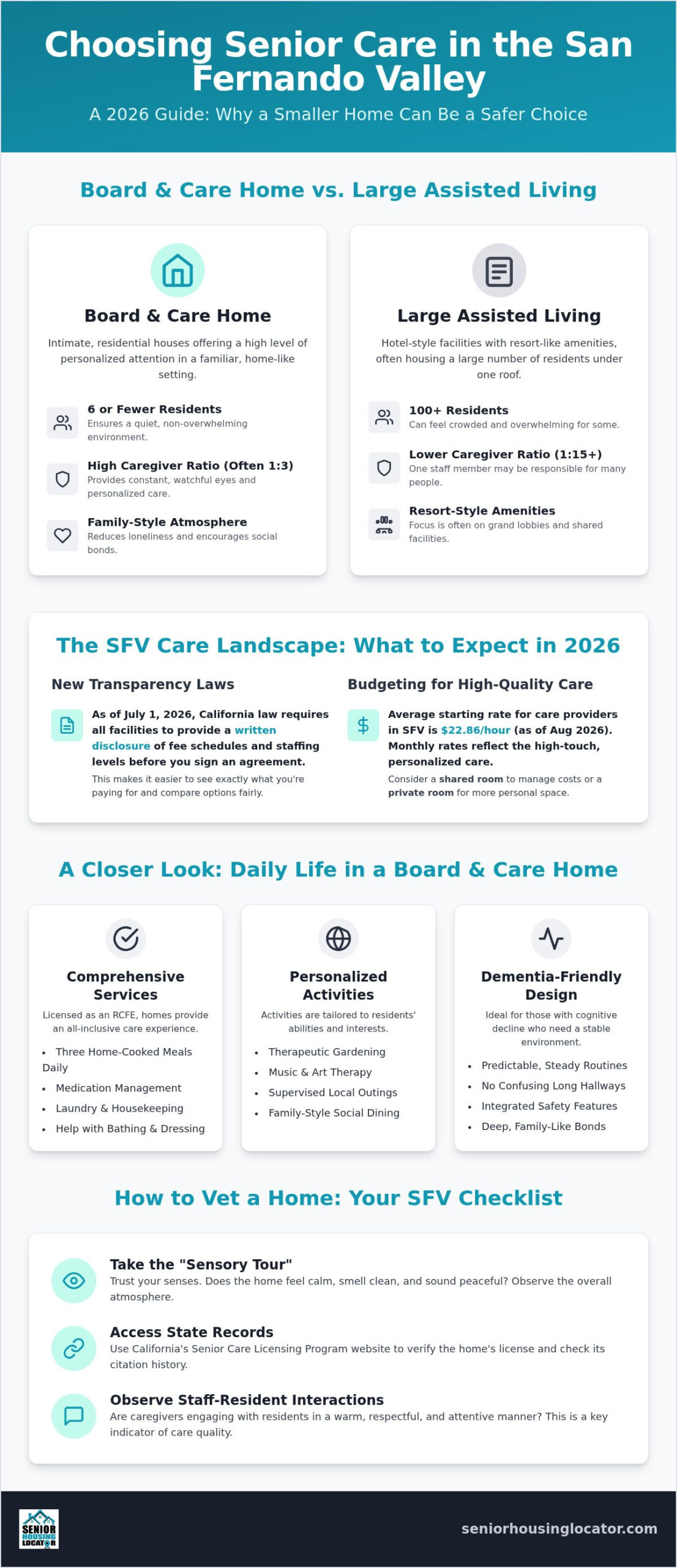
The most significant difference is the size. Most of these homes are licensed for six or fewer residents. This small scale allows for a caregiver-to-resident ratio that is often 1:3. In a large facility, one staff member might be responsible for fifteen or twenty people. In a board and care setting, the caregivers know exactly how your parent likes their coffee or which blanket they prefer for their afternoon nap. This level of attention provides immense emotional relief. It replaces the heavy weight of guilt with the peace of mind that comes from knowing your loved one isn’t just a number in a crowded hallway.
What Defines a ‘Board and Care’ in California?
In California, these homes operate under a Residential Care Facility for the Elderly (RCFE) license. They provide a comprehensive suite of services designed to make life easier and safer. This includes three home-cooked meals a day, laundry services, and medication management. They also help with activities of daily living, such as bathing, dressing, and grooming. Because these are real houses in local neighborhoods, the physical environment remains recognizable and comforting. It’s a setting that encourages dignity rather than clinical isolation.
Why Valley Families Choose Residential Care
Seniors living with dementia or cognitive decline often find large buildings confusing. Long hallways and crowded dining rooms can trigger anxiety or wandering. A small home offers a predictable, steady environment where everything is within reach. You’ll find that caregivers often stay for years, creating deep, family-like bonds with the residents. This model is very similar to the board and care homes in Woodland Hills that prioritize a high-touch care experience. For families, the transition is much smoother when the new environment looks and feels like the home their parent just left.
The SFV Care Landscape: What to Expect in 2026
The 2026 landscape for board and care homes san fernando valley is defined by a shift toward radical transparency. As of July 1, 2026, California law requires all residential facilities to provide a written disclosure of fee schedules and staffing levels before you sign an agreement. This change makes it much easier for families to see exactly what they’re paying for. While the market remains competitive, the focus has shifted from simple room and board to high-quality, person-centered care. All these homes are monitored by California’s Senior Care Licensing Program, ensuring they meet strict safety and operational standards.
Amenities and Daily Life in the Valley
In a high-end Valley board and care home, daily life looks very different from a clinical setting. You won’t find a sterile cafeteria. Instead, residents enjoy home-cooked meals served around a shared dining table. This family-style approach encourages social interaction and helps prevent the loneliness often found in larger facilities. Activities are also more personalized. Many homes offer therapeutic gardening in backyard spaces, music therapy, and supervised outings to local Valley parks. Safety features like grab bars and non-slip flooring are integrated into the home’s design so they don’t feel like hospital equipment.
Budgeting for Care in the San Fernando Valley
Planning for 2026 requires an understanding of how staffing costs influence monthly rates. As of August 2026, the average starting rate for care providers in San Fernando is $22.86 per hour. This labor cost, combined with inflation, means that rates are reflective of the high-touch, 1:3 caregiver ratio found in these homes. You’ll also need to decide between a private or shared room. A shared room is a practical way to manage costs, while a private room offers more dignity and space for personal belongings. Many families find that board and care homes san fernando valley offers provide a higher value of care per dollar than larger institutions.
When comparing options, you might find that prices in the Valley are more manageable than in areas like Santa Monica or West LA. For a broader look at the market, you can review our guide on assisted living costs in Los Angeles. If you feel overwhelmed by these numbers, our team can provide a personalized list of homes that fit your specific financial goals. We’re here to help you find a setting that balances high-quality care with your family’s budget.
Board and Care vs. Assisted Living: Which is Right for You?
Choosing between a large facility and a small residential home is a major decision for any family. The National Institute on Aging’s guide highlights that the best choice depends on the specific level of care and social interaction your parent needs. In the board and care homes san fernando valley families trust, the scale is radically different. Instead of a building with 100 residents or more, you’re looking at a private home with exactly six residents. This difference in size changes everything about the daily experience.
Large assisted living facilities often feel like hotels. They have grand lobbies, busy elevators, and packed activity calendars. However, for a senior who feels overwhelmed by crowds, this “hotel-style” life can actually be quite isolating. Board and care homes offer an intimate, family-style atmosphere. Everyone eats together at one kitchen table. There’s no need to navigate long, confusing hallways just to find a friend or get a glass of water. It’s a setting that prioritizes comfort over corporate polish.
Care intensity is another vital factor to consider. In a large facility, care is often reactive. A senior pushes a call button and waits for a staff member to arrive from another floor or wing. In a small home, care is proactive. Because the caregivers are always just a few feet away, they notice subtle changes before a button is ever pushed. They see if a resident didn’t finish their lunch or if they’re walking a bit more slowly today. This constant, watchful eye provides a level of safety that’s hard to replicate in a massive building.
Don’t be fooled by the “activity myth.” While large facilities might list ten different clubs on their calendar, many residents only attend one or two. In board and care homes san fernando valley, the focus is on the quality of engagement rather than the quantity of events. It’s about a meaningful one-on-one conversation, a shared game of cards in the living room, or simply sitting together in a sunny backyard. It’s about being seen and heard every day.
The Social Environment and Engagement
Introverted seniors or those living with dementia often thrive in smaller groups. Large crowds and loud dining rooms can cause “sundowning” or agitation for those with cognitive decline. A smaller group provides a sense of safety and predictability that lowers stress. You might trade a movie theater room or a hair salon for more one-on-one time with a caregiver who truly knows your parent’s life story and preferences.
Staffing and Care Continuity
Staff turnover is a common challenge in corporate senior living. In contrast, many board and care homes are owner-operated. The people providing the care are often the ones who own the property and have a personal stake in your parent’s well-being. This continuity means your parent sees the same familiar faces every single day. If you’re still weighing your options, learning how to choose an assisted living facility can help you decide if the larger corporate model or the intimate residential model fits your family best.
Evaluating a Board and Care Home: A Step-by-Step SFV Checklist
Vetting board and care homes san fernando valley families are considering requires more than a quick walkthrough. You need to use your senses to truly understand the daily environment. When you first enter, pay attention to the smell. It should smell like home-cooked food or fresh laundry, not heavy chemicals or neglect. Listen to the background noise. Is it a peaceful environment with quiet conversation, or is a television blaring in an empty room? Finally, look at the physical space. A well-maintained home has plenty of natural light, clean common areas, and residents who are dressed and groomed for the day. These small details tell you a lot about the quality of life inside.
The ‘Deep Dive’ into Licensing and Records
Before you visit in person, do your homework online. The California Department of Social Services (CDSS) maintains a public database where you can search for a facility’s inspection history. Look for “Type A” citations, which are the most serious violations. Common red flags include medication management errors, inadequate staffing, or safety hazards. While reading these reports can be stressful, a senior living advisor in Los Angeles can help you interpret these documents. We know which homes have a history of excellence and which ones have recently corrected their issues. We can help you filter out facilities that don’t meet our strict safety standards.
Questions to Ask During the Tour
When you meet the owner or administrator, ask about their staff longevity. High turnover is often a sign of a struggling home, so ask how long the current caregivers have been with the facility. You should also ask these three specific questions to ensure the home can handle your loved one’s future needs:
- What happens if my parent’s care needs increase significantly over time?
- Is there ‘awake’ staff available at night, or does the caregiver sleep in a nearby room?
- How do you coordinate doctor appointments and handle medical emergencies?
Watch how the staff interacts with the current residents during your visit. Are they patient, kind, and attentive? Happy residents who are engaged in their surroundings are the best indicator of a healthy home. If you want a second opinion on a specific facility you’ve visited, you can request a free consultation with our local team to discuss your findings and verify the home’s reputation.
Simplifying Your SFV Search with Senior Housing Locator
Finding the right fit among the many board and care homes san fernando valley offers shouldn’t feel like a full-time job. With over 2,000 options across the Greater Los Angeles area, the sheer volume of choices often leads to decision fatigue and deep anxiety. You don’t have to do this alone. We act as your trusted local ally, streamlining the process so you can focus on being a supportive family member rather than a full-time researcher. Our goal is to lower the emotional stakes of this transition by providing a clear, organized path forward.
We follow a simple, three-step method to find the right home for your loved one. First, we conduct a thorough assessment of your parent’s medical needs, social preferences, and financial goals. Second, we provide curated referrals to homes we’ve personally vetted for safety and quality. Third, we join you for guided tours to ensure you know exactly what to look for and which questions to ask. This methodical approach removes the guesswork and replaces confusion with a sense of order. Because our placement service is free for families, there is no financial barrier to receiving expert, local guidance.
Expertise Across San Fernando Valley Neighborhoods
The Valley isn’t a monolith. The atmosphere and pricing can vary significantly between Northridge, Granada Hills, and Sherman Oaks. For instance, some families prefer the quiet, suburban feel of Granada Hills, while others need the proximity to major medical centers found in Northridge or the central access of Sherman Oaks. We help you match your budget to the right neighborhood profile without sacrificing the quality of care. Our commitment to integrity means we only recommend homes that we would trust for our own family members. We take pride in finding those “hidden gems,” which are small, owner-operated homes that provide exceptional care but don’t have large corporate marketing budgets.
Taking the Next Step Toward Peace of Mind
Starting your search is as simple as a phone call. When you’re ready to begin, we’ll schedule a consultation to discuss your family’s unique situation. During your first assessment meeting, it’s helpful to have a few things ready: a list of your parent’s current medications, their primary care physician’s contact information, and a general idea of your monthly budget. We’ll handle the logistics, the initial screening, and the scheduling. This allows you to move at a steady, reassuring pace toward a final decision. You can contact Senior Housing Locator for free SFV placement help today to begin this journey with a knowledgeable guide by your side.
Finding the Right Home for Your Family’s Future
Choosing among the many board and care homes san fernando valley offers is a significant step toward ensuring your parent’s safety and happiness. You now understand how to identify the high caregiver-to-resident ratios and intimate settings that make these residential homes so effective. You also have the tools to vet facilities using state records and our sensory tour checklist. This knowledge replaces uncertainty with a clear plan for your loved one’s care.
You don’t have to manage this complex search by yourself. As a locally owned and operated team in the Valley, we maintain a vetted network of high-quality care homes. We’re here to remove the stress of the unknown and provide a clear path to a confident decision. Let our SFV experts help you find the perfect board and care home, at no cost to you. Our free personalized placement service ensures your loved one receives the attention they deserve in a place that truly feels like home. You’ve done the hard work of starting the search; now let us handle the logistics so you can focus on being there for your family.
Frequently Asked Questions
What is the average cost of board and care homes in the San Fernando Valley in 2026?
Pricing in 2026 depends on the level of care required and the specific neighborhood within the Valley. Generally, these homes offer an all-inclusive rate that covers housing, meals, and 24-hour supervision. While prices vary between private and shared rooms, the San Fernando Valley often provides a more affordable alternative to coastal Los Angeles neighborhoods. We help families navigate these costs by providing a clear breakdown of available options that match their specific financial resources.
Are board and care homes in the Valley licensed for memory care or dementia?
Yes, many board and care homes san fernando valley offers are licensed to provide memory care. California law requires these facilities to follow specific dementia care regulations that focus on resident-centered support and behavioral interventions. We prioritize homes where the staff has extensive experience with cognitive decline and wandering. These smaller settings are often ideal for seniors with dementia because the predictable, quiet environment reduces the overstimulation and confusion frequently found in larger institutions.
Do board and care homes in SFV offer private rooms?
Most residential homes in the Valley provide a mix of private and semi-private rooms. A private room allows your loved one to bring their own familiar furniture and maintain a higher sense of independence. Shared rooms are a practical choice for families looking to manage costs while still receiving a high level of personalized care. During our initial assessment, we’ll discuss which option is best for your parent’s comfort and your family’s long-term financial planning.
How do board and care homes handle medical emergencies?
Staff members are trained to recognize early warning signs of medical distress and will call 911 immediately during a crisis. They also maintain detailed resident reappraisals, as required by 2026 California law, to track significant changes in health. Because these homes are situated in established San Fernando Valley neighborhoods, they are usually just minutes away from emergency services. The caregivers also coordinate with your parent’s primary doctors to ensure all medical records and medication lists are current.
Is there a difference between a board and care home and a residential care facility (RCFE)?
Both terms refer to the same type of licensed facility in California. A Residential Care Facility for the Elderly (RCFE) is the official licensing category used by the state. “Board and care” is simply the common name for an RCFE that is located in a traditional house with six or fewer residents. Whether you choose a small home or a large community, the state monitors both to ensure they meet the same essential safety and care standards.
Can I use Medicare or Medi-Cal to pay for board and care in California?
Medicare typically does not pay for the room, board, or custodial care provided in these homes. It only covers specific medical services like doctor visits or physical therapy. While Medi-Cal has some programs that might assist with costs, they are very limited and difficult to access for residential care. Most families use private funds, long-term care insurance, or veterans’ benefits. We can help you explore these different payment avenues to determine what is sustainable for your family.
What should I look for in a board and care home’s state inspection report?
You should focus on “Type A” citations, which represent the most serious violations of state safety regulations. These reports reveal if a home has struggled with medication errors, inadequate staffing, or physical safety hazards. It’s also vital to check if the facility has a history of recurring citations over the past three years. We regularly review these public records to ensure that the homes we recommend maintain a high standard of integrity and resident safety.
Why is Senior Housing Locator’s placement service free for families?
Our service is free because we are paid a referral fee by the senior living communities and board and care homes san fernando valley families eventually choose. This allows us to provide expert, local guidance without charging the families we serve. We remain an objective ally, focusing entirely on finding the safest and most comfortable environment for your parent. Our goal is to remove the financial barrier to expert advice, making a difficult transition much more manageable.