
Have you spent another night awake, listening for the sound of a front door opening or a confused footstep in the hallway? It’s physically and emotionally draining to provide constant care while worrying about your parent’s safety every single minute. You aren’t alone in feeling overwhelmed by the search for memory care san fernando valley, especially when you’re facing high Los Angeles costs and over 50 different local options.
We understand that you want more than just a room. You want peace of mind and a place where your loved one is treated with genuine dignity. This guide simplifies the search by providing expert local insights into the best facilities from Woodland Hills to Northridge. You’ll learn how to distinguish between standard assisted living and specialized dementia care while managing the financial stress of the 2026 market.
We’ll walk through the latest California safety regulations, compare costs across the valley, and show you how professional guidance can narrow your choices down to the top three matches for your family’s needs. Let’s find a solution that restores your role as a daughter or son, rather than just a tired caregiver.
Key Takeaways
- Learn why the San Fernando Valley is a premier destination for specialized dementia care and what sets these communities apart from standard senior living.
- Identify the essential safety protocols and life enrichment activities, like music therapy, that define high-quality memory care san fernando valley communities.
- Compare different local neighborhoods to find the right environment, whether you prefer the luxury amenities of Sherman Oaks or the campus-style settings in Northridge.
- Get a practical checklist for your facility tours, including how to assess resident well-being and facility cleanliness beyond the surface level.
- Discover how a local placement specialist can save you time and stress by narrowing down dozens of options to the three best matches for your parent’s needs.
Understanding Memory Care in the San Fernando Valley
Memory care is a specialized form of senior living tailored specifically for individuals living with Alzheimer’s, vascular dementia, or other cognitive impairments. It goes beyond the basic assistance with daily tasks found in standard senior housing. Instead, it provides a structured environment where every detail, from the layout of the hallways to the timing of meals, is designed to support cognitive health. Choosing memory care san fernando valley means accessing a network of communities that prioritize safety without sacrificing the resident’s sense of self-worth.
The San Fernando Valley has grown into a significant hub for these services in Southern California. Families often choose this area because it offers a balance of high-quality clinical care and a suburban feel that is less congested than central Los Angeles. The primary goal of these communities is to provide a secure setting that prevents wandering while promoting a life of dignity. This transition is rarely easy. Moving a parent from their longtime home into a professional community involves a complex mix of grief and relief. It’s a significant shift in family dynamics that requires both patience and understanding dementia care principles.
Memory Care vs. Assisted Living: What is the Difference?
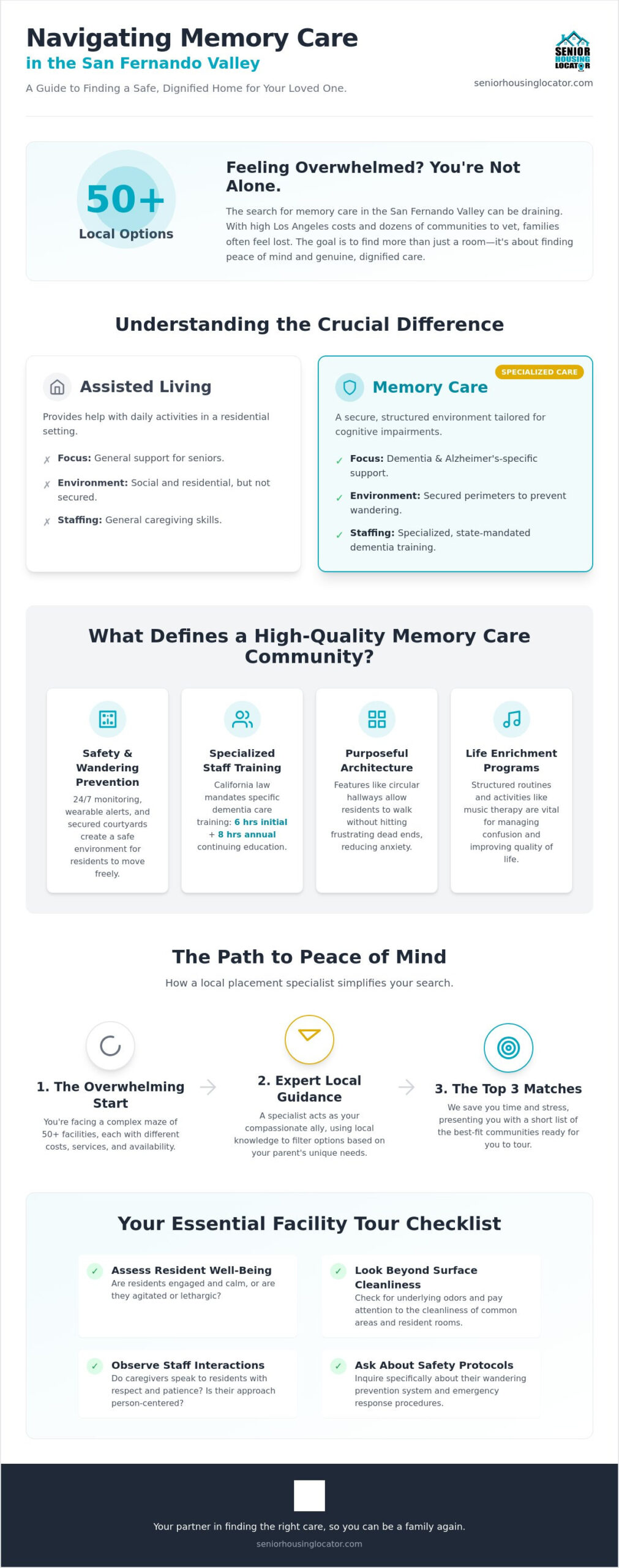
The most immediate difference lies in the level of security and specialized oversight. Memory care wings, which are licensed as Residential Care Facilities for the Elderly (RCFE), use delayed-egress doors and secured outdoor courtyards to ensure residents stay safe. Staff members in these units receive specific training mandated by California law. This includes at least 6 hours of initial training and 8 hours of annual continuing education focused on dementia behaviors. Finally, the daily rhythm is much more structured. These routines are vital for reducing anxiety and managing “sundowning,” a period of increased confusion that often occurs in the late afternoon.
The “Helping Hand” Approach to Care Transitions
If you feel guilty about seeking outside help, please know your feelings are valid. Caring for a loved one 24/7 is an exhausting task that can lead to burnout. Using a local advisor helps lower the emotional stakes of this decision. Instead of feeling like you’re “giving up,” you can view this as gaining a trusted local ally who understands the local landscape. At Senior Housing Locator, we act as a compassionate facilitator. We help you move from a state of high-stress uncertainty toward a clear, organized plan for your parent’s future. Our goal is to handle the heavy lifting so you can focus on being a supportive family member again.
Key Features of Top San Fernando Valley Memory Care Communities
When you begin comparing options for memory care san fernando valley, you’ll notice that the best communities prioritize specialized architecture and specific care philosophies over simple luxury. A high-quality environment is built to reduce the agitation and confusion that often accompany dementia. One of the most effective design features you should look for is the use of circular or “continuous” hallways. These paths allow residents to walk freely without ever hitting a frustrating dead end, which significantly lowers anxiety levels and prevents the feeling of being trapped.
Staffing levels also set premier facilities apart from standard options. In the Valley’s top-tier communities, staff-to-resident ratios are intentionally kept low to ensure that caregivers can provide personalized attention. This isn’t just about safety; it’s about knowing each resident’s history and preferences. If a resident becomes upset, a caregiver who knows their past can use that information to redirect them effectively. For families needing more intensive medical oversight, these communities often maintain strong relationships with local providers for skilled nursing facility referrals when advanced care becomes necessary.
Safety and Wandering Prevention
Safety is the foundation of any reputable memory care program. Most San Fernando Valley facilities manage elopement risk through a combination of 24/7 monitoring and wearable technology, such as pendants that alert staff if a resident nears an exit. These systems provide freedom of movement within a secure environment. Under California Title 22 regulations, a secured perimeter is defined as a building or grounds where exits are restricted to protect residents with dementia who lack safety awareness. This allows for beautiful, secured outdoor courtyards where residents can enjoy the California sunshine and fresh air without the risk of wandering away from the property.
Cognitive Engagement and Social Needs
Engagement goes far beyond basic activities. Top communities use Life Enrichment programs that incorporate music and art therapy to stimulate memory and emotional expression. You might see sensory rooms designed with soft lighting and textures to calm residents, or memory boxes outside each room filled with personal photos and mementos to help with room recognition. Local caregivers often use Validation Therapy, a technique that involves acknowledging a resident’s current reality rather than correcting them. For more resources on these techniques, the Alzheimer’s Association California Southland Chapter offers excellent guidance for families in our community.
Finding the right balance of safety and engagement can feel like a full-time job. If you’re feeling overwhelmed by the choices, a personalized placement advisor can help you filter through the data to find the community that best fits your parent’s specific stage of dementia.
Comparing SFV Memory Care Options: Finding the Right Neighborhood
Choosing the right location for memory care san fernando valley is about more than just a convenient zip code. It’s about finding a community that mirrors the lifestyle your loved one enjoyed before their diagnosis. The Valley is geographically diverse, and each pocket offers a different atmosphere. For example, the Sherman Oaks and Encino corridor is known for its luxury, full-service communities. These facilities often feel like high-end boutique hotels, offering fine dining and robust social calendars. Being centrally located near the 101 and 405 freeways makes these spots ideal for families who commute from various parts of Los Angeles.
If your priority is space and a quieter environment, you might look toward Northridge and Granada Hills. These areas often feature campus-style facilities with expansive grounds and walking paths. This extra room can be incredibly beneficial for residents who find comfort in the outdoors. When making your choice, consider the proximity to major medical centers like Cedars-Sinai Providence Tarzana. Having a top-tier hospital nearby provides an extra layer of security during health emergencies. We recommend mapping out the drive from your home to the facility during peak traffic hours to ensure you can visit as often as you’d like.
Large Communities vs. Residential Board and Care Homes
One of the most important decisions you’ll make is choosing between a large, multi-story facility and a residential board and care home. Large facilities offer a vibrant social atmosphere with dozens of daily activities and various room types. However, for residents with high sensory sensitivity, the noise and bustle of a large community can sometimes trigger agitation. In these cases, a 6-bed residential board and care home is often a better fit. These homes provide a quiet, intimate setting that feels like a standard family house. In the SFV market, these smaller homes are often a more budget-friendly option while still providing high staff-to-resident ratios.
Neighborhood Spotlight: From Woodland Hills to Burbank
Woodland Hills offers a serene, residential feel that many families find comforting. The neighborhoods are leafy and quiet, which is perfect for seniors who prefer a slower pace of life. You can find many excellent board and care homes in Woodland Hills that prioritize a neighborly approach to care. On the other side of the Valley, Burbank and Glendale are fantastic choices for families who value medical proximity. These areas are close to major healthcare hubs and offer easy accessibility for relatives living in the tri-city area. Each neighborhood has its own personality, and we can help you determine which one aligns best with your parent’s unique needs.
Evaluation Framework: What to Look for During a Memory Care Tour
Touring a community is the most revealing part of your search for memory care san fernando valley. While brochures show beautiful gardens and luxury common areas, your “boots on the ground” visit tells the real story of daily life. You aren’t just looking at the building; you’re looking for a culture of care that will protect your parent’s safety and dignity. We recommend visiting at least three different locations to get a true sense of the local standards.
To make your visits more productive, follow this five-step evaluation framework:
- Observe the residents: Look for people who are clean, engaged, and calm. If you see residents sitting in hallways for long periods without interaction, it may indicate a lack of engagement.
- The smell test: Trust your nose. While no facility is perfect, a persistent scent of urine or heavy industrial cleaners often masks underlying hygiene issues in the memory wing.
- Interview the staff: Ask about their specific dementia training and how long they have been with the company. High staff longevity is one of the strongest indicators of a stable, supportive environment.
- Observe a mealtime: Review the menu and watch how staff assists residents. Caregivers should provide help with patience and respect, ensuring that mealtime remains a dignified social experience.
- Plan for the future: Ask about their “aging in place” policy. You need to know exactly what level of physical or cognitive change would trigger a move to a higher level of care.
Questions to Ask the Executive Director
Don’t be afraid to ask the tough questions. You should know exactly how the community handles nocturnal wandering or aggressive behaviors. Ask about their communication plan: how often will they call you, and who is your primary point of contact? It is also vital to understand that discharge policies in memory care contracts must be clearly defined so you aren’t surprised by a forced move if your loved one’s needs increase. A transparent director will be happy to walk you through these scenarios in detail.
Red Flags to Watch For
While every community has “off” days, certain signs are immediate causes for concern. Watch for unanswered call lights or residents left entirely alone in common areas. A lack of personalized items, such as family photos or “memory boxes” outside resident rooms, suggests a clinical rather than a human-centric approach. Finally, the absence of a dedicated Memory Care Director often leads to a lack of specialized programming and oversight. If you see these signs, it may be time to look at other options.
If you want a second pair of eyes to help you spot these subtle details, our team can help you evaluate your top choices. Schedule a guided tour with a local advisor to ensure you find a community that truly meets your family’s standards.
Finding the Perfect Placement with a San Fernando Valley Specialist
Trying to find the right memory care san fernando valley on your own often feels like a second full-time job. With dozens of options scattered from Burbank to Woodland Hills, the sheer volume of choices can lead to “decision paralysis.” This is where a local specialist becomes your most valuable resource. We don’t just provide a list of addresses; we provide a curated path forward based on years of personal facility tours and resident feedback. Because our service is free for families, you can access professional expertise without adding to the financial weight of your care decision.
An advisor saves you dozens of hours of fruitlessly touring facilities that don’t meet your budget or care requirements. We know which communities have waitlists, which ones have recently changed management, and which ones have the best staff-to-resident ratios for your parent’s specific stage of dementia. Our “integrity-first” approach ensures that every recommendation is tailored to your family’s unique social and medical needs. We focus on removing the guesswork so you can make a decision rooted in facts rather than fear.
The Personalized Placement Process
Our process begins by assessing the psychological and social needs of the senior. We look beyond the clinical diagnosis to understand who your parent is as a person. Do they thrive in a bustling, social environment, or do they prefer the quiet intimacy of a 6-bed home? Matching the facility’s culture to the resident’s personality is the key to a successful transition. Working with a Senior living advisor in Los Angeles allows you to tap into deep community roots that generic online directories simply can’t offer. We help you find a place where your loved one isn’t just safe, but truly known by the staff.
Your Next Steps Toward Peace of Mind
You don’t have to carry this burden alone. As your “Compassionate Facilitator,” we handle the logistical heavy lifting so you can focus on your family. We provide expert referrals for memory care, board and care homes, and skilled nursing facilities. Our goal is to move you from a place of exhaustion to a place of confidence. We follow a logical, three-step progression to help you find the right fit: assessment, curation, and placement. This structured approach ensures that no detail is overlooked and no question goes unanswered.
To begin the search, your next step is simple. Reach out for a consultation where we’ll discuss your parent’s care needs, your preferred neighborhoods, and your budget. We’ll then present you with the top three options that truly fit your criteria. You’ve spent so much time caring for others; it’s time to let a trusted local ally care for you. Let’s start this journey together and find the dignity and safety your parent deserves.
Secure a Brighter Future for Your Loved One Today
Choosing the right path for a parent with dementia is one of the most significant decisions your family will ever make. By understanding the differences between large communities and intimate board and care homes, you’ve already taken a vital step toward ensuring their safety. You now have a framework to evaluate facilities from Sherman Oaks to Woodland Hills with confidence and clarity. Finding high-quality memory care san fernando valley doesn’t have to be a journey you take in isolation.
Since our inception, we’ve served families throughout the entire Valley, providing deep local expertise to match seniors with the right environment. Whether your loved one needs the social vibrancy of a large campus or the quiet care of a residential home, we’re here to help you filter through the dozens of local options. Our personalized placement service is 100% free for families, removing the financial barrier to professional advice.
We’ll help you narrow down the choices to the best three matches for your budget, location, and lifestyle. Let our expert advisors find the right memory care for your family—for free. You’ve worked hard to care for your loved one; now, let us help you find the peace of mind you deserve.
Frequently Asked Questions
What is the average cost of memory care in the San Fernando Valley for 2026?
Costs for memory care san fernando valley vary significantly based on the neighborhood and the specific level of care your loved one requires. Generally, residential board and care homes offer a different price point than large, resort-style communities with extensive amenities. It is best to consult with a local advisor who can provide current price ranges for specific facilities that align with your family’s financial plan.
Does Medicare or Medi-Cal pay for memory care in California?
Medicare typically does not cover the cost of room and board for long-term residential memory care. It is primarily designed for short-term medical needs or rehabilitation. Medi-Cal may provide some assistance through the Assisted Living Waiver program, but these spots are often limited and come with specific eligibility requirements. Most families rely on private savings, long-term care insurance, or Veterans benefits to fund care.
How do I know if my parent needs memory care or just assisted living?
The main difference lies in safety and the level of specialized cognitive support provided. If your parent is prone to wandering, experiences frequent confusion, or struggles with “sundowning,” the secured environment of memory care is likely necessary. Assisted living is a wonderful option for seniors who need help with physical tasks but don’t require a locked perimeter or specialized dementia programming.
Are there memory care facilities in the San Fernando Valley that allow pets?
Several communities in the Valley recognize that pets provide immense emotional comfort and reduce anxiety for those with dementia. Some facilities allow residents to bring a small, well-behaved pet if the resident or family can manage the pet’s daily needs. Other communities feature “house pets” like resident dogs or birds, allowing everyone to enjoy animal companionship without the responsibility of individual pet ownership.
What happens if my loved one outlives their funds in a memory care community?
This is a common worry, and it’s best to address it by asking about “aging in place” policies during your initial tours. Some communities may require a move if private funds are exhausted, while others might have programs to help residents stay. We often help families transition to more affordable board and care homes that provide high-quality care at a lower monthly cost when budgets become a primary concern.
Is there a difference between a “Dementia Care” unit and a “Memory Care” community?
In California, both types of settings are licensed as Residential Care Facilities for the Elderly. The difference is usually in the building’s layout. A dementia care unit is typically a secured wing within a larger assisted living building. A memory care community is a standalone facility where every resident has some form of cognitive impairment. Both are required to provide specialized staff training and secured perimeters.
How do I handle the transition and the “first day” move-in stress?
Preparation is the key to a smooth first day. We suggest decorating the new room with familiar furniture, photos, and a favorite bedspread before your loved one arrives. It’s often helpful to let the facility’s staff take the lead on the first day while you step back. This allows the resident to begin building trust with their new caregivers and settling into the community’s daily rhythm.
Can I move my parent from a board and care home to a larger memory care community later?
You always have the flexibility to change your parent’s living situation if their needs evolve. Some families find that the intimate setting of a board and care home is perfect for the early stages, but they may eventually want the more robust social activities found in a larger community. We can help you navigate these transitions to ensure the move is handled with the least amount of stress possible.