
The fastest path to emergency assisted living placement Los Angeles may begin with one question: Is your loved one facing a medical emergency, or an urgent need for a safer place to live? If there’s immediate danger or a sudden health crisis, contact emergency services or a medical professional first. A housing search can wait until urgent medical needs are addressed.
It’s understandable to feel pressure to find a local option quickly, especially when home no longer feels safe. But a quick opening is only useful if the setting can meet your loved one’s current needs. Start by clarifying what support they need, which care settings may be appropriate, and what each provider can confirm directly.
This guide explains whom to contact first, what information can help avoid delays, and how to compare assisted living with memory care, board and care, skilled nursing, or other possibilities. It also covers how a placement referral service can help organize a time-sensitive search. Senior Housing Locator’s referral service is free to families. Facilities or providers pay referral commissions after a successful placement. The goal is to help you move forward with clarity, not pressure.
Key Takeaways
- Separate urgent medical concerns from a housing need. Contact 911 or emergency medical care for immediate danger, serious injury, or acute symptoms.
- For emergency assisted living placement Los Angeles, match the senior’s support needs to a suitable care setting instead of choosing the first available opening.
- When screening local options, confirm current availability, care capabilities, admission requirements, and next steps directly with each provider.
- Before a move, organize key information and wait for the receiving provider to confirm fit and admission.
- Senior Housing Locator can help identify relevant local options. Its referral service is free to families, and providers pay referral commissions after a successful placement.
Emergency Assisted Living Placement Los Angeles: First Steps
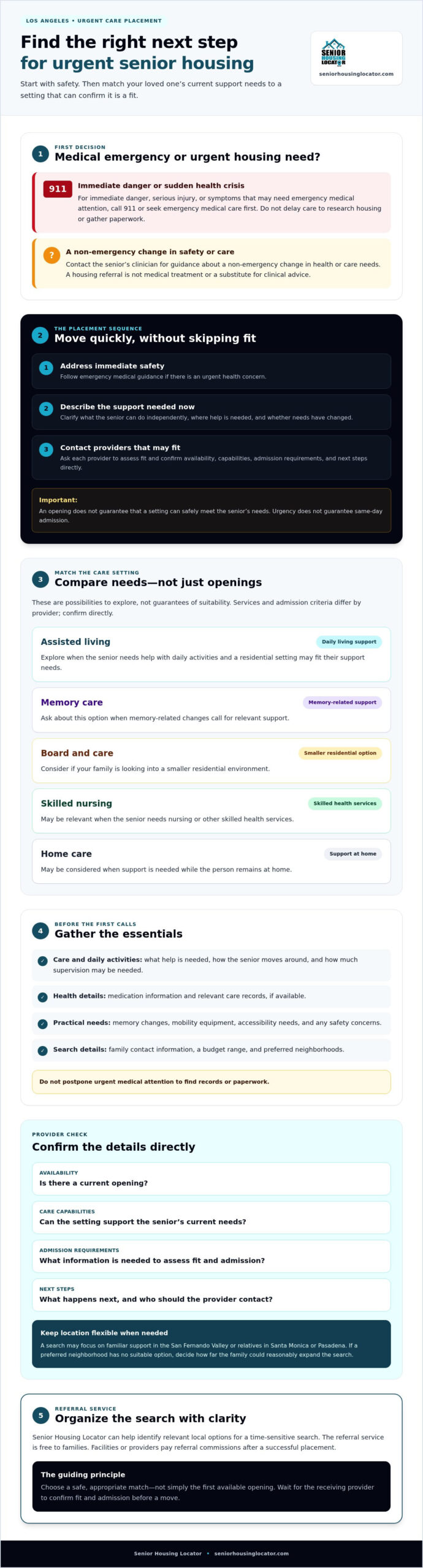
A sudden change in a loved one’s safety can leave your family trying to solve several problems at once. Use this sequence: address immediate danger, describe the support your loved one needs, then contact providers that may be able to meet those needs. An emergency assisted living placement Los Angeles search can move quickly, but urgency does not guarantee same-day admission. The receiving provider must confirm both availability and whether the setting is appropriate.
Is this a medical emergency or an urgent housing need?
If your loved one is in immediate danger, has a serious injury, or shows symptoms that may need emergency medical attention, call 911. Don’t delay emergency care to research housing or gather paperwork. For a non-emergency change in health or care needs, contact the senior’s clinician for guidance. Assisted living placement is a housing and care referral process, not medical treatment or a substitute for clinical advice.
If you’re unfamiliar with the setting, this What is Assisted Living overview offers background on common terminology and the general approach to care. A provider still needs to confirm directly whether it can support your loved one’s specific needs.
What information should families gather before making calls?
Note what your loved one needs help with, how they move around, whether memory changes affect daily life, and how much supervision they may need. Gather medication information and relevant care records if available, but don’t postpone urgent medical attention to find them. Also note who providers should contact and any accessibility needs, such as space for mobility equipment.
Use this checklist to guide your first calls:
- Secure immediate safety. Follow medical guidance if there’s an urgent health concern. If the senior is unsafe at home but not experiencing a medical emergency, identify what support is needed right now.
- Gather the essentials. Keep care needs, medication details, available records, family contact information, a budget range, and preferred neighborhoods together.
- Contact suitable providers. Explain the senior’s current needs and ask whether the provider can assess fit, what information it needs, and what happens next.
Location can shape a time-sensitive search. Your family may want to stay near familiar support in the San Fernando Valley or look closer to relatives in Santa Monica or Pasadena. If your first-choice neighborhood has no suitable option, decide how far the family could reasonably expand the search. Keep the focus on a safe, appropriate match, and confirm each provider’s availability and admission requirements directly.
Match the Urgent Placement to the Senior’s Actual Care Needs
Under pressure, it can be tempting to call the first place with an opening. But urgency doesn’t determine whether assisted living can safely meet someone’s needs. Before comparing locations, describe what your loved one can do independently, where they need help, and whether their needs have changed. Clear details help providers assess the situation and help your family explore appropriate options instead of relying on a setting’s name alone.
Which care setting may fit the situation?
Assisted living may be worth exploring when a senior needs help with daily activities and a residential setting may fit their support needs. Memory care may be worth asking about when memory-related changes call for relevant support. A board and care home is another option if your family is considering a smaller residential environment. Services and admission criteria differ by provider, so confirm details directly.
Skilled nursing and home care serve different needs. Skilled nursing may be relevant when a senior needs nursing or other skilled health services. Home care may be considered when support is needed while the person remains at home. Ask qualified providers what services they offer and whether those services fit the senior’s situation. For a broader local overview, see the Los Angeles assisted living placement guide.
How do health, memory, mobility, and supervision needs affect fit?
Give practical examples, not just labels. Can your loved one get dressed, use the bathroom, eat, and move around without help? Do they use a walker or wheelchair, need medication reminders, or require someone nearby to reduce safety risks? If health or care needs are unclear or changing, ask the senior’s clinician for guidance rather than trying to diagnose the situation yourself.
Use the same short summary each time you call. It makes responses easier to compare and gaps easier to spot. Ask:
- What mobility support and help with daily activities can you provide?
- Can you assist with medications, and what are the limits of that support?
- What supervision is available for the needs we’ve described?
- What health or care needs would mean this setting isn’t a fit?
Be direct about concerns such as falls, confusion, or help needed overnight. Don’t assume a provider can meet a need until its staff confirms that directly. Families searching for emergency assisted living placement Los Angeles can also ask for help organizing referrals across care settings. Learn about local senior care placement support as one resource while you confirm care fit and admission details with providers.
How to Screen Los Angeles Assisted Living Options Quickly and Carefully
Under time pressure, a consistent screening process helps you compare options without treating an opening as proof of a good fit. Keep a page of notes for each provider. Record what staff say about availability, care support, assessment, admission, and next steps. For emergency assisted living placement Los Angeles, confirm these details directly with each provider because services and admission requirements can vary.
What should families confirm on the first call?
Describe the senior’s current support needs, then ask whether the provider has availability and what information it needs to assess fit. Be specific about daily activities, mobility, memory concerns, medication assistance, and supervision. Ask what the setting can and cannot support, and whether an assessment is part of its admission process.
- Availability: Is there a current opening that may suit the senior’s needs?
- Assessment and admission: Who assesses fit, who makes the admission decision, and what steps come next?
- Preparation: What records or documents should the family provide, and what should be ready before a move?
Write down the name and contact details of the person you speak with, along with any follow-up steps. Ask for clarification if an answer is vague. A brief, direct conversation can help you decide whether to arrange a tour or continue screening other options.
How can families check transparency and local fit?
Ask the provider to explain which services and support are included, what may involve additional charges, and how those details are documented. For broader cost context, consult this Los Angeles assisted living cost guide. It offers cost information, not a facility question checklist, so verify each provider’s current charges directly.
You can also check current licensing information through California’s Community Care Licensing Division, part of the Department of Social Services. Confirm provider details using official records, and ask the provider to clarify anything you don’t understand.
Location matters for family visits and familiar routines. Compare options in Woodland Hills, Encino, Northridge, Sherman Oaks, and nearby areas based on travel time and access for the people who will stay involved. If practical, arrange a tour or live conversation with staff. If an in-person visit isn’t feasible, ask how else you can learn about the setting and speak with the people responsible for care.
Senior Housing Locator can help families identify local care options based on needs, budget, and preferred location. Its referral service is free to families, and providers pay referral commissions after a successful placement. Explore senior care placement support, then confirm availability, services, and admission directly with each provider.
Prepare for a Safe Move Without Rushing Past Important Details
Finding a possible opening is a meaningful step, but it doesn’t confirm that the move can go ahead. Before making plans, get confirmation from the receiving provider that it has assessed your loved one’s needs, can accommodate them, and has approved admission. In an emergency assisted living placement Los Angeles search, this check can help prevent a rushed move to a setting that may not be the right fit.
What should families clarify before agreeing to move in?
Ask for the provider’s written terms and review them with the senior and appropriate decision-makers as circumstances allow. Make sure you understand what support is included, which needs the provider can’t meet, what charges may apply, and what requirements must be completed before move-in. If anything is unclear, ask for an explanation before signing or setting a move date.
Ask who the family should contact with concerns or if needs change after arrival. Knowing the right point of contact can make communication less confusing during a difficult transition. For broader guidance on comparing care options and working with an advisor, see the Los Angeles senior living advisor guide.
What should families bring and coordinate?
Follow the provider’s instructions rather than guessing what it needs. Gather available health information and medication details for review, and ask how medication arrangements should be handled. Confirm transportation with the provider and the person responsible for the trip, especially if mobility aids or other access needs require planning.
- Pack the essentials: Choose comfortable clothing, personal care items, familiar belongings, and any mobility aids the provider has agreed can be used there.
- Coordinate the handoff: Share relevant updates with involved relatives and care professionals, including the confirmed move plan and the provider’s contact person.
- Respect the senior’s preferences: Include your loved one in decisions and packing where possible, and bring familiar items that matter to them.
Keep a written list of what’s packed, what still needs attention, and who is responsible for each task. This reduces last-minute confusion without turning the transition into a race. If you’d like help identifying local placement options based on care needs and preferred location, contact Senior Housing Locator about placement support. Its referral service is free to families, and providers pay referral commissions after a successful placement.
How Senior Housing Locator Can Help With Emergency Placement in Los Angeles
A time-sensitive search can involve several care settings, family preferences, and provider calls. Senior Housing Locator helps families organize those details and identify relevant local options to explore. For emergency assisted living placement Los Angeles, a referral service can help focus the search, but it can’t replace medical guidance or a provider’s decision about fit and admission.
What support can a placement referral service provide?
The search can be shaped around the senior’s care needs, budget, social needs, and preferred location. Depending on the situation, families may explore assisted living, memory care, board and care, independent living, skilled nursing, or home care referrals. The goal is to identify potentially relevant options, not assume that every setting can meet every need.
Senior Housing Locator serves families in greater Los Angeles, including Los Angeles, Woodland Hills, Burbank, Santa Monica, and Pasadena. Families can share what support is needed and which locations are practical, then consider options with those priorities in mind.
The referral service is free to families. Facilities or providers pay referral commissions after a successful placement. Senior Housing Locator does not provide medical assessment or direct caregiving, and it can’t guarantee an opening or facility admission. Contact each provider directly to confirm current availability, services, admission requirements, and whether it can meet the senior’s needs before making plans.
What happens when a family reaches out?
An initial conversation can help organize the situation: what has changed, what support the senior needs, where the family hopes to look, and which preferences or budget considerations matter. Sharing clear, practical details can help narrow the types of referrals that may be relevant. If there’s a medical concern, contact a clinician or emergency services as appropriate. A placement referral is not a substitute for medical advice.
Possible referrals depend on the senior’s needs and providers’ current availability. The provider remains responsible for confirming its services, assessing fit, and deciding whether it can admit the senior. Ask what information to prepare and what steps to take next, then review each option with your family and the provider.
If a guided search would help your family sort through local possibilities, Talk with Senior Housing Locator about the situation and ask what next steps may be appropriate.
Take the Next Step With Clarity
An urgent care transition can feel overwhelming, but you don’t have to make every decision at once. For emergency assisted living placement Los Angeles, focus on two essentials: choose a care setting that matches your loved one’s needs, and confirm availability, services, and admission directly with the provider.
Senior Housing Locator helps families explore care options across greater Los Angeles, guided by individual needs, budget, and preferred location. Its placement referral service is free to families, and facilities or providers pay a referral commission after a successful placement. It can help organize your search, but it isn’t a substitute for medical advice or a guarantee of admission.
If you’re ready to discuss possible next steps, talk with Senior Housing Locator about your next step. Share what’s happening and what matters most to your family. One clear conversation can help you approach the search with more direction and confidence.
Frequently Asked Questions
What should I do first if my parent needs assisted living urgently in Los Angeles?
First, decide whether there’s an immediate medical emergency. Call 911 for immediate danger, serious injury, or symptoms needing emergency medical care. Contact your parent’s clinician about non-emergency health or care changes. If the concern is that home is no longer safe, describe your parent’s daily support, mobility, memory, and supervision needs before contacting providers. Gather available medication details and care records, but don’t delay urgent medical attention to find paperwork.
Can someone be placed in assisted living the same day?
Same-day admission may be possible in some circumstances, but it shouldn’t be assumed or promised. Timing depends on current availability, the senior’s needs, the provider’s assessment, and its admission requirements. Ask the provider directly whether it has an opening, what steps remain, and whether the setting can meet the senior’s needs. A quick move is appropriate only after the receiving provider confirms fit and admission.
How do I know whether my loved one needs assisted living or skilled nursing?
The right setting depends on the support and health services your loved one needs, not just how urgently a move is needed. Assisted living may be worth exploring when help with daily activities is needed in a residential setting. Skilled nursing serves different needs and may be relevant when nursing or other skilled health services are required. Describe the situation to the senior’s clinician and ask providers to clarify their services and limits.
Is a senior living placement referral service free for families?
Senior Housing Locator’s placement referral service is free to families. Facilities or care providers pay referral commissions after a successful placement. Families can share care needs, budget, social preferences, and preferred location to help focus the search on relevant senior living options. A referral can help organize possibilities, but confirm each provider’s current availability, services, admission requirements, and fit directly.
What information do Los Angeles assisted living facilities need before admission?
Requirements vary by provider, so ask what it needs to assess fit and make an admission decision. Be ready to describe daily support needs, mobility, memory concerns, supervision, and medication assistance. Providers may also request relevant health information, medication details, and care records. Ask about assessment steps, written terms, move-in requirements, and who makes the admission decision. Share available information accurately, and contact the senior’s clinician if care needs are unclear.
Can a placement advisor guarantee an assisted living opening?
No. A placement advisor can help identify options to explore, but can’t guarantee a facility opening, admission, or a specific placement timeline. Availability changes, and each provider must assess the senior’s needs and decide whether it can provide appropriate support. Ask what options may be relevant, then contact providers directly to verify availability, services, admission criteria, and next steps before making move plans.
What if my loved one needs memory care rather than assisted living?
Ask about memory care if changes in memory or thinking affect daily routines, safety, or supervision needs. Share specific examples with the senior’s clinician and providers, such as getting lost or needing frequent reminders, without trying to diagnose the cause yourself. Memory care services and admission criteria vary, so ask providers how they support the needs you describe and confirm whether they can assess your loved one.
Which Los Angeles areas can families consider for urgent senior placement?
Families can explore options across greater Los Angeles based on care needs, provider availability, and how practical the location is for visits. Senior Housing Locator’s service area includes Woodland Hills, Granada Hills, Northridge, Sherman Oaks, Encino, Burbank, Los Angeles, Santa Monica, and Pasadena. If the closest area has no suitable option, consider whether nearby communities could work, then confirm current availability and fit directly with each provider.