
Imagine the relief of seeing your loved one survive a stroke, only to feel a sudden wave of panic when the hospital discharge planner asks for a facility choice by tomorrow morning. You are likely exhausted, worried about safety, and confused by the difference between a clinical nursing home and a residential community. It is a heavy burden to carry alone. You want a place that feels like home but still offers the rigorous physical and speech therapy needed for a real recovery.
Finding the right assisted living for stroke survivors Pasadena offers doesn’t have to be a crisis. We understand that you need a local ally who knows which communities have the best neuro-rehab equipment and specialized staff. This guide is designed to give you total peace of mind by showing you exactly how to find and evaluate care standards in 2026. You will learn how to spot a truly supportive environment, ensure continued therapy access, and move through the placement process without the stress. Let’s look at how to find a safe, local home that prioritizes both comfort and progress.
Key Takeaways
- Learn why the first 90 days after a stroke are the most critical time for choosing a supportive environment and leveraging Pasadena’s medical resources.
- Discover the essential safety features and therapy options you should look for when evaluating assisted living for stroke survivors Pasadena to ensure ongoing recovery.
- Understand the key differences between assisted living and skilled nursing to determine which level of medical support best fits your loved one’s current health status.
- Get a step-by-step checklist for touring communities, including how to verify their experience with neuro-rehabilitation and resident mobility aids.
- Find out how a local senior living advisor can streamline the urgent placement process and find “hidden gem” communities at no cost to your family.
Navigating the Post-Stroke Transition in Pasadena
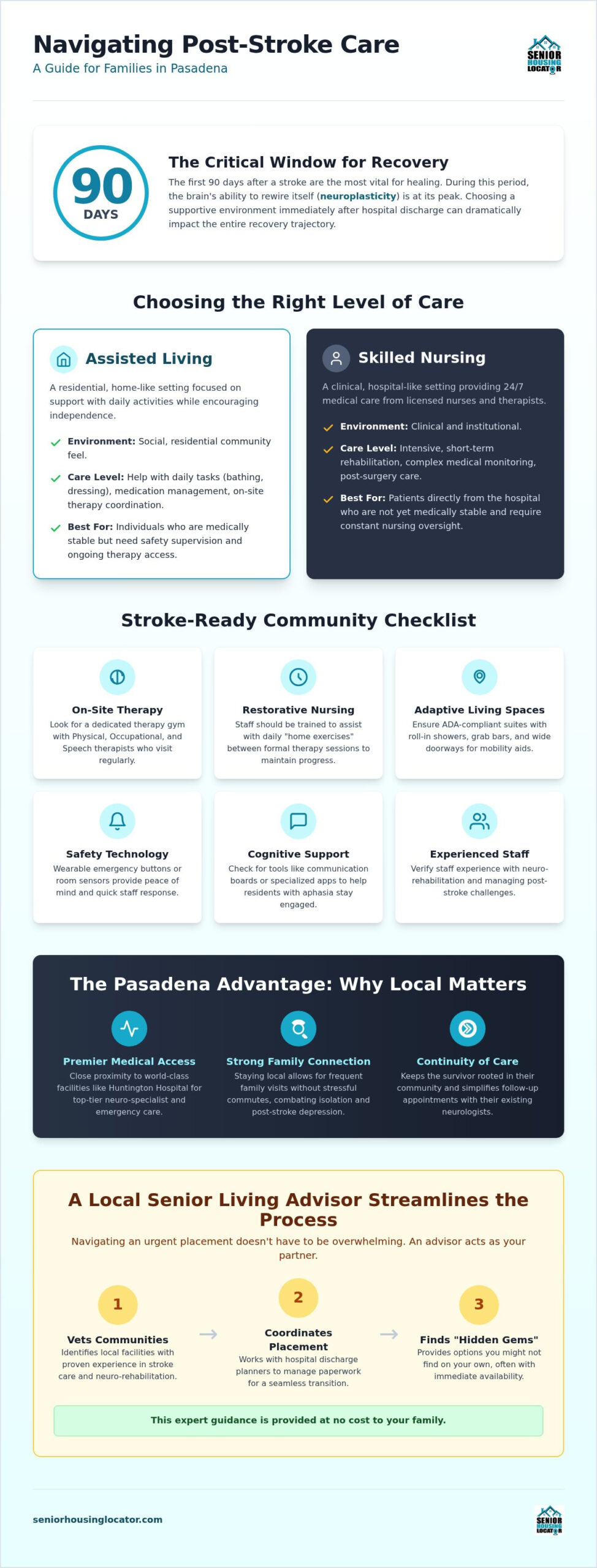
The first three months after a stroke are often the most intense. This 90-day window is when the brain has its highest potential for neuroplasticity and regaining lost functions. Because this period is so vital, the decisions you make regarding placement can change the entire trajectory of the stroke recovery process. Many families in the San Gabriel Valley initially try to bring their loved one home, but they quickly reach a tipping point. When the physical demands of lifting, 24-hour supervision, and transportation to daily therapy sessions become overwhelming, finding specialized assisted living for stroke survivors Pasadena becomes the safest next step.
Pasadena serves as a premier medical hub, anchored by world-class institutions like Huntington Hospital. Being close to these facilities means your loved one remains in the care loop of top-tier neuro-specialists and emergency services. A local ally helps bridge the gap between a temporary rehab wing and a permanent community. This ensures the transition is smooth rather than a frantic scramble. It allows you to focus on being a supportive family member instead of a full-time coordinator.
From Hospital to Assisted Living: The 2026 Timeline
By 2026, hospital discharge protocols have become increasingly complex. You aren’t just looking for an available bed; you’re looking for a true partner in care. Coordinating with discharge planners in the San Gabriel Valley requires quick action and clear communication. It’s essential to ensure that every medical record, medication list, and therapy note follows the survivor to their new home. Managing the gap between acute rehab and long-term care is where a senior living advisor in Los Angeles proves invaluable. They help you navigate the paperwork and find a community that can immediately pick up the baton of physical and speech therapy. They know which facilities have the strongest relationships with local hospitals and can facilitate a move in days, not weeks.
Why Local Pasadena Proximity Matters for Families
Staying local isn’t just about convenience; it’s about emotional health. Stroke recovery is exhausting, and isolation can often lead to post-stroke depression. When a survivor is placed in a Pasadena community, family members can visit frequently without the stress of a long commute. This proximity allows for easier follow-up appointments with local neurologists and specialists. Most importantly, it keeps the survivor connected to the neighborhood feel they know. Transitioning to assisted living for stroke survivors Pasadena allows your loved one to stay rooted in the community they love while receiving the professional support they need to thrive. This sense of familiarity is often the best medicine for long-term well-being and mental clarity.
Essential Features of Stroke-Ready Assisted Living
Not all residential care facilities are equipped to handle the unique hurdles of post-stroke life. When you visit a community, you should look for specific clinical features that support both safety and ongoing progress. The best assisted living for stroke survivors Pasadena offers will integrate medical oversight with a warm, residential feel. This balance is crucial for preventing secondary strokes and ensuring your loved one doesn’t lose the gains they made in the hospital. You want a place that prioritizes recovery, safety, and dignity.
Therapy Integration in a Residential Setting
A high-quality community should offer a “Therapy Gym” that feels professional and inviting. During your tour, ask if physical, occupational, and speech therapists come on-site regularly. It’s often better for survivors to receive care in their own environment rather than traveling to a clinic. Staff should also be trained to help with daily “home exercises” between formal sessions. This consistency is a core recommendation of the American Stroke Association for maximizing recovery. For those dealing with aphasia, look for communities that use communication boards or specialized cognitive apps to keep residents socially engaged.
Adaptive Living and Personal Care
Daily life changes after a stroke, especially for those dealing with hemiparesis or one-sided weakness. You want a facility with ADA-compliant suites that include roll-in showers, grab bars, and wide doorways. Safety technology like floor sensors or wearable emergency buttons can provide peace of mind. Beyond the physical space, ask about restorative nursing programs. Restorative nursing serves as a bridge between active therapy and maintenance. It ensures that residents keep moving and don’t lose their hard-won mobility gains through inactivity.
Medication management is another non-negotiable feature for any assisted living for stroke survivors Pasadena. Many survivors take anticoagulants or blood thinners, which require strict timing and monitoring to prevent complications. Additionally, if your loved one has dysphagia, or difficulty swallowing, the kitchen must be able to provide specialized meal textures. A community that understands these nuances will have a clear protocol for dietary safety and medication oversight. If you feel overwhelmed by these technical details, talking to a local advisor can help you filter through Pasadena options to find the most stroke-ready homes.
Choosing Care Levels: Assisted Living vs. Skilled Nursing
One of the most confusing parts of the placement process is deciding how much medical care your loved one actually needs. Hospitals often use clinical terms that leave families feeling lost. In the San Gabriel Valley, the choice usually falls between a Skilled Nursing Facility (SNF) and a residential community. If your loved one requires 24/7 nursing oversight, complex wound care, or a feeding tube, a skilled nursing facility is the appropriate medical environment. However, if they are medically stable but need help with daily physical tasks, assisted living for stroke survivors Pasadena is often the better, more comfortable choice.
The decision isn’t just about medical needs; it’s about the quality of daily life. Assisted living provides a social atmosphere that can spark cognitive recovery in ways a clinical hospital setting cannot. Because the level of care determines your monthly investment, understanding these distinctions is the first step in estimating assisted living costs in Los Angeles. Choosing the right level ensures you aren’t paying for medical services you don’t need while still keeping your loved one safe.
When Assisted Living is the Right Choice
Assisted living is ideal for survivors who have completed their initial acute rehab but still struggle with one-sided weakness or mobility. To be considered “medically stable,” a resident shouldn’t have active, unpredictable medical crises that require a doctor’s immediate presence. These communities excel at providing help with bathing, dressing, and walking. When you tour, look closely at the caregiver-to-resident ratio. A lower ratio means more eyes on your loved one, which is vital for preventing falls during those first few months of recovery. The social interaction found in these dining rooms and activity halls also helps fight the isolation that often slows down progress.
The Board and Care Alternative in Pasadena
For some survivors, a large community with 100+ residents feels overwhelming or noisy. This is where a board and care home can be a lifesaver. These are standard residential houses licensed for six residents, offering a much more intimate environment. Just like a board and care home in Woodland Hills, a Pasadena-based home offers a “family-style” feel that many seniors find comforting. These smaller settings are particularly helpful for survivors with sensory processing issues or aphasia who might struggle in a busy, loud facility. You get the same level of care as a larger assisted living for stroke survivors Pasadena community, but with a staff that feels like a second family. It’s an excellent middle ground for those who value personalized attention and a quiet, predictable routine.
How to Evaluate Pasadena Communities for Stroke Care
Walking into a senior living community can feel overwhelming. You might be impressed by a beautiful lobby or a landscaped courtyard, but for a stroke survivor, the clinical details matter much more than the decor. Evaluating assisted living for stroke survivors Pasadena requires a keen eye for both safety and rehabilitative support. You aren’t just looking for a room; you’re looking for a partner in your loved one’s ongoing recovery. Taking a methodical approach to your tours will help you separate the “nice” facilities from the truly “stroke-ready” ones.
- Verify neuro-rehabilitation experience: Ask the staff how many residents they currently serve who are recovering from a stroke. Experience breeds competence in handling specific challenges like hemiparesis or aphasia.
- Observe staff interactions: Watch how caregivers assist residents using walkers, wheelchairs, or speech aids. Do they offer patient, encouraging support, or do they seem to be in a rush?
- Inquire about care plan reassessments: Stroke recovery is fluid. A care plan created on day one may be obsolete by day thirty. Ensure the facility reassesses needs at least monthly to reflect physical gains.
- Check for specialized equipment: Look for sit-to-stand lifts, gait trainers, and sturdy grab bars in common areas. These tools are essential for maintaining safety while encouraging movement.
Questions to Ask the Admissions Director
A transparent director will welcome detailed questions about medical coordination. You should ask how the facility communicates with your loved one’s existing Pasadena neurologist to ensure care remains consistent. Safety is also a top priority. What is their specific protocol if a resident shows signs of a secondary stroke? Finally, talk about the budget. While assisted living is a residential model, many communities allow outside therapists to come in. Ask if physical or speech therapy can be billed through Medicare while your loved one lives there. This can significantly lower your out-of-pocket costs.
The ‘Vibe’ Check: Cognitive and Social Stimulation
Recovery isn’t just physical; it’s emotional. When you visit the dining room, look for adaptive utensils that encourage independence during meals. Check the activity calendar for programs designed for residents with physical limitations, such as seated yoga or cognitive games. Does the community offer support groups for stroke survivors or their families? A “neighborly” atmosphere that promotes social connection can be the best defense against post-stroke isolation. If you find yourself unsure about which community truly fits these criteria, contact us today for a personalized evaluation of the best assisted living for stroke survivors Pasadena has to offer.
Finding the Right Care with a Pasadena Senior Living Advisor
When a medical crisis like a stroke occurs, your family is suddenly forced to make life-altering decisions in a matter of hours. You shouldn’t have to spend this precious time scrolling through endless websites or cold-calling facilities that might not even have the right therapy equipment. A senior living advisor in Los Angeles acts as your local ally. We step in to handle the heavy lifting, ensuring that you can focus on being present for your loved one’s recovery rather than acting as a logistical coordinator. Our deep roots in the community allow us to identify the “hidden gem” communities in Pasadena that specifically cater to neuro-rehabilitation needs.
Our free referral service is designed to save you dozens of hours of frustrating research. We already know which facilities have high staff-to-resident ratios, which ones have the best therapy gyms, and which ones are currently accepting new residents for 2026. By narrowing the field to the top three or four options that truly fit your criteria, we make the process manageable. We don’t just give you a list; we walk you through the 2026 admissions process, help you book tours, and ensure you’re asking the right questions to secure the best assisted living for stroke survivors Pasadena has to offer.
Personalized Matching Based on Medical Needs
Every stroke survivor has a different path to recovery. Some may need intensive speech therapy for aphasia, while others require specialized equipment like sit-to-stand lifts for physical mobility. We filter Pasadena communities by their specific nursing and therapy capabilities to ensure a perfect clinical match. We also understand the importance of balancing a family budget with long-term care requirements. Whether you’re transitioning a loved one from a hospital in Woodland Hills or looking to move them closer to family in the San Gabriel Valley, we streamline the entire relocation. Our goal is to find a home that provides the right level of care without unnecessary financial strain.
A Stress-Free Path to Placement
Choosing a care community is an emotional journey, and it’s easy to feel overwhelmed by guilt or fear. Our commitment to integrity means we only refer families to top-quality communities that we have personally vetted for safety and care standards. By acting as your “compassionate facilitator,” we reduce the emotional burden on the primary caregiver. You don’t have to guess if a facility is safe; we provide the transparency you need to feel confident in your choice. If you’re ready to find a supportive, high-quality home for your loved one, contact Senior Housing Locator for a free Pasadena care consultation. We’re here to provide the helping hand your family needs during this transition.
Securing Your Loved One’s Future in Pasadena
Finding the right assisted living for stroke survivors Pasadena is about more than just a safe room; it’s about building a foundation for continued recovery. You now have the tools to spot essential safety features, distinguish between care levels, and ask the right questions during a facility tour. The 2026 care landscape is complex, but it is also full of opportunities for progress. Choosing a community that prioritizes neuro-rehabilitation and social engagement can make all the difference in your loved one’s long-term independence and happiness.
You don’t have to carry the weight of this decision by yourself. We take pride in being your local ally, offering tailored matching for complex medical needs at no cost to your family. Our team uses expert knowledge of the Pasadena and Los Angeles senior care market to find “hidden gem” communities that fit your specific budget and care requirements. We are here to streamline the research, coordinate the tours, and handle the logistics so you can focus on your family. Let our Pasadena experts find the perfect stroke-supportive home for your loved one—at no cost to you.
Better days are ahead, and we are here to help you reach them with confidence and peace of mind.
Frequently Asked Questions
Is assisted living appropriate for a stroke survivor who cannot walk?
Yes, assisted living can be a safe option for residents who cannot walk as long as they are medically stable and don’t need 24/7 clinical nursing. Most Pasadena facilities are equipped to help with “pivot transfers” or use specialized lifts to move survivors from a bed to a wheelchair. When you are looking for assisted living for stroke survivors Pasadena, it’s essential to confirm that the staff has specific training in high-acuity physical assistance and fall prevention.
How much does assisted living for stroke survivors cost in Pasadena for 2026?
For 2026, the average monthly cost for assisted living in the Pasadena area is approximately $6,338. However, the price can vary based on the level of care your loved one needs, with a range typically falling between $2,895 and $9,050. These costs generally cover your room, meals, and basic assistance; however, specialized stroke support or frequent therapy sessions may result in additional care fees.
Does Medicare pay for assisted living after a stroke in California?
Medicare does not pay for the room and board portion of assisted living in California. It is designed to cover medical expenses, so it may pay for specific physical, occupational, or speech therapy sessions that happen within the community. Most families use private funds, long-term care insurance, or VA benefits to cover the monthly residential costs of a stroke-supportive community.
What is the difference between a board and care home and assisted living for a stroke survivor?
The primary difference is the size of the environment and the level of social activity. A board and care home is a standard house licensed for six residents, offering a quiet, intimate setting with very high caregiver-to-resident ratios. Assisted living communities are larger, apartment-style facilities that offer more amenities and social programs. Both provide help with daily tasks, but board and care is often better for those who feel overwhelmed by crowds.
How do I know if a Pasadena facility has good physical therapy?
You can evaluate the quality of therapy by asking if the therapists are on-site employees or outside contractors. During your tour, look for a dedicated therapy gym with modern equipment like gait trainers or parallel bars. A high-quality assisted living for stroke survivors Pasadena community will also have a clear system for communicating with your loved one’s neurologist to ensure the rehab plan stays consistent.
Can a stroke survivor move from skilled nursing to assisted living later?
Yes, it’s very common for survivors to move to assisted living once they no longer require 24/7 clinical monitoring or complex wound care. If your loved one is medically stable but still needs help with bathing, dressing, or walking, assisted living offers a much more “home-like” and social atmosphere. This transition is often a great sign of progress in the recovery journey.
What happens if my loved one has another stroke while in assisted living?
Facilities have strict emergency protocols in place and will call 911 immediately if a resident shows signs of a secondary stroke. Because assisted living follows a non-medical model, they rely on emergency responders for acute medical crises. Once the survivor is stabilized at a hospital like Huntington Hospital, the facility will work with the doctors to see if the resident’s care needs can still be met at the community.
Are there Pasadena-specific resources for stroke family caregivers?
Pasadena has several wonderful resources, including support groups at Huntington Hospital and local senior centers. These groups allow you to connect with other families who are navigating similar challenges. Many local assisted living communities also offer family education sessions to help you understand the recovery process and reduce the stress of caregiving.