
What if a complaint on a facility’s record doesn’t mean the concern was proven, but still deserves a closer look? If you’re researching how to check assisted living complaints in California, it’s understandable to feel unsure where to start. Official records can be difficult to find, and a complaint, citation, or substantiated finding may each mean something different.
This guide walks you through checking reliable sources, understanding what records can and can’t tell you, and choosing a next step that fits your concern. You’ll learn how to search California facility records, where to request complaint information, and why it’s useful to look for patterns or unresolved issues instead of relying on one entry. We’ll also explain which agency oversees assisted living facilities, known in California as Residential Care Facilities for the Elderly, and what to do if someone may be in immediate danger. With a clear process, you can weigh the record alongside your loved one’s needs and make a more informed decision.
Key Takeaways
- Learn how to check assisted living complaints in California using official facility records and the details that help you identify the right location.
- Compare complaints, citations, inspection findings, and correction status without treating them as interchangeable.
- Check dates and recurring concerns to put a facility’s record in context and identify questions that may need follow-up.
- Choose an appropriate next step, from contacting the licensing agency about a non-emergency concern to calling emergency services for immediate danger.
- Use a simple comparison sheet to weigh relevant findings alongside care needs, location, and the facility’s answers.
Before You Search: What an Assisted Living Complaint in California Can Tell You
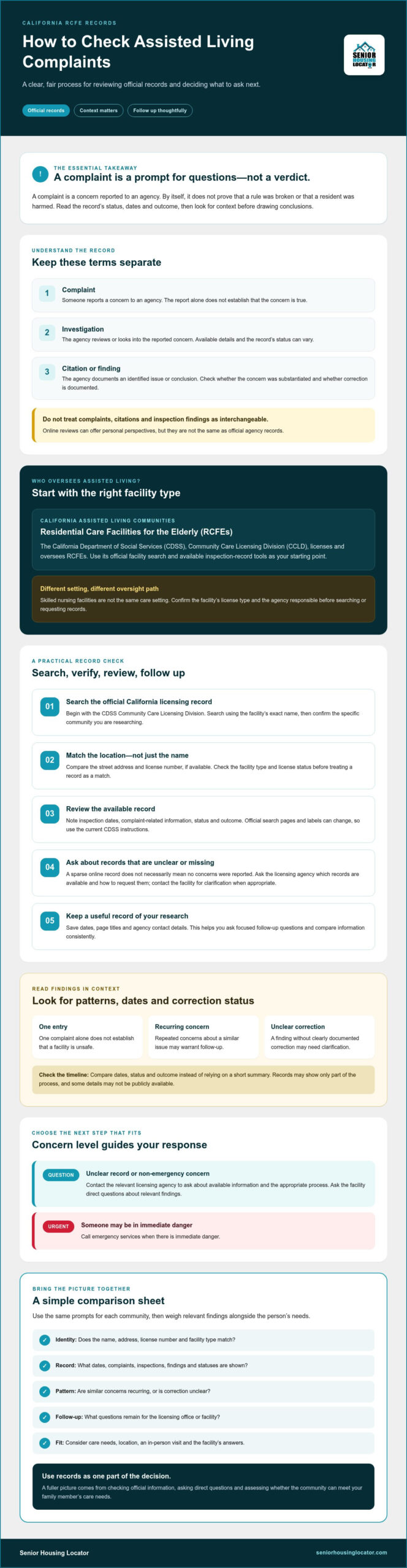
Before searching, understand what a complaint record can and can’t establish. A complaint is a concern reported to a government agency. By itself, it doesn’t prove that a facility broke a rule or that a resident was harmed. The agency may investigate the concern, but the record’s status and level of detail can vary.
Treat a complaint as a prompt for questions, not a verdict. An agency review may lead to a citation or another documented finding, or it may not substantiate the reported concern. Records may show only part of the process, and some details may not be publicly available. One complaint alone doesn’t establish that a facility is unsafe. However, repeated concerns about a similar issue, or a finding without clearly documented correction, may warrant follow-up.
What does an assisted living complaint mean?
Keep these terms separate as you review records:
- Complaint: Someone reports a concern to an agency.
- Investigation: The agency reviews or looks into the concern.
- Citation or finding: The agency documents an identified issue or conclusion.
Labels and available details can differ between records. Check the dates, status, and outcome rather than relying on a short summary. Online reviews can provide personal perspectives, but they aren’t the same as official agency records. If an entry is unclear, note what you don’t know and ask the relevant licensing office or facility for clarification.
Which California facilities and agencies are involved?
In California, assisted living communities are generally licensed as Residential Care Facilities for the Elderly (RCFEs). The California Department of Social Services’ Community Care Licensing Division (CCLD) is the starting point for checking an RCFE’s licensing and oversight information. The term assisted living is used broadly, so confirm the facility’s actual license type before searching.
Skilled nursing facilities are a different care setting with a different oversight path. Don’t assume an RCFE search will provide a complete record for a skilled nursing facility. Confirm the facility’s license type and the agency responsible for it before making a request. If you’re unsure, ask the agency which office handles that facility.
As you learn how to check assisted living complaints in California, treat records as one part of your decision. Pair them with an in-person visit, direct questions about relevant findings, and an honest assessment of whether the community can meet your family member’s care needs. That fuller picture is more useful than relying on a single complaint, review, or inspection entry.
How to Check Assisted Living Complaints in California Records
Start with the California Department of Social Services (CDSS) Community Care Licensing Division (CCLD), the state agency that licenses and oversees Residential Care Facilities for the Elderly (RCFEs). Use the official facility search and available inspection-record tools as your first step. Search by the facility’s exact name, then compare the street address and license number, if available. A matching name alone may not confirm that you’ve found the right location.
Find the facility’s official California licensing record
Once you find a likely match, confirm that the record is for the specific community your family is considering. Check the listed facility type and license status, then look for inspection history and any complaint-related records the state makes available. Official search pages and their labels can change, so follow the current instructions on the CDSS site rather than relying on an old screenshot or a third-party directory.
- Match the location: Compare the street address and license number, not just the facility name.
- Review the record: Note the license status, facility type, inspection dates, and any complaint information shown.
- Save your findings: Record dates, page titles, and agency contact details so you can ask focused follow-up questions.
If the online record is sparse, that doesn’t necessarily mean no concerns were reported. Public information may be limited or presented in different places. Use the regulator’s current contact details to ask which records are available and how to request them. For a complaint or licensing concern, CDSS provides current options on its How to Report a Concern page. Ask the agency to clarify an unclear entry or direct you to the office responsible for that facility.
Request more information when online records are incomplete
When you contact the regulator, provide the facility’s exact name, address, and license number. Ask which public records or inspection documents are available for the dates you’re reviewing. Keep a note of whom you contacted and any next steps they suggest. If you’re comparing nearby communities, this assisted living placement guide for Woodland Hills offers local context to consider alongside official records.
Checking official records is one part of how to check assisted living complaints in California. Families comparing care needs, location, and community options may also explore senior living placement guidance from Senior Housing Locator. Its referral service is free to families; providers pay referral commissions after a successful placement.
How to Read Complaints, Citations, and Inspection Findings Fairly
Record labels tell you what kind of information you’re looking at, but the details and outcome matter just as much. A report that someone raised a concern isn’t the same as an agency finding that a rule was violated. Use the distinctions below as a guide, and check the wording and status shown in the official record.
| Record type | What it generally indicates | What to check |
|---|---|---|
| Complaint | A concern was reported to the regulator. | What was reported, when it happened, and whether an outcome is listed. |
| Investigation | The agency reviewed or looked into a concern. | Whether the review is complete and what conclusion, if any, is recorded. |
| Citation | The regulator documented a cited violation or deficiency. | The cited issue, date, and any recorded follow-up. |
| Inspection finding | An inspection record documents an observation or identified issue. | The inspection date, details, and whether it relates to a recurring concern. |
| Correction status | The record may indicate whether action was documented after an issue. | What action is described, when it was recorded, and whether follow-up appears. |
A single record is a clue to investigate, not a complete picture of a facility’s safety or care today. An allegation, an unsubstantiated complaint, and a cited violation aren’t interchangeable. Read the agency’s actual description rather than treating every entry as proof of wrongdoing or dismissing it because it’s brief.
Look for patterns, dates, and documented follow-up
Compare records over time. Note whether similar concerns appear more than once, whether later inspections revisit the issue, and whether corrective action is documented. A concern from an earlier period may not describe current conditions, while a newer record may not show the full history. Dates and follow-up help you frame specific questions, but they don’t replace current information from the regulator or facility.
Balance official records with other sources
Online reviews can help you understand what residents or families say about their experiences, but they’re personal accounts, not verified regulatory findings. Treat them as prompts for questions, not confirmation of a violation. Ask the facility how it responds to relevant concerns and whether it can explain documented corrective action. During a visit, consider whether its answers are clear and consistent with what you observe.
This balanced approach is central to how to check assisted living complaints in California: compare the record, its timeline, and the facility’s response before drawing a conclusion. If information remains unclear, write down the unanswered question and seek clarification from the regulator or facility.
How to Report a Concern About a California Assisted Living Facility
If someone is in immediate danger or needs urgent medical help, contact emergency services. Don’t wait for a website form or licensing office to respond. For a concern that isn’t an emergency, first confirm the facility’s license type and which agency handles the issue. The correct reporting route can differ for an RCFE, a skilled nursing facility, or another care setting.
Choose the right reporting route for the concern
For non-emergency licensing concerns about an RCFE, check the California Department of Social Services’ current Community Care Licensing Division (CCLD) complaint instructions and regional office contacts. The CDSS Centralized Complaint and Information Bureau is also listed as a reporting route at 1-844-538-8766 and letusno@dss.ca.gov. Confirm the current contact details and process on the official CDSS site before submitting information.
The Long-Term Care Ombudsman may also be a resource for residents and families with concerns about care or residents’ rights. Its role and coverage depend on the facility and issue, so verify that the relevant Ombudsman program serves the resident’s facility. If you’re unsure whether to contact CCLD, the Ombudsman, or another authority, ask the agency which office handles that facility type and concern. Don’t assume a report will be anonymous, receive a particular response time, or lead to a specific outcome.
Prepare a clear, factual report
Before contacting an agency, write down what you directly observed and when. Separate firsthand details from what someone else told you. A concise report helps the agency understand the concern and ask useful follow-up questions.
- Record the basics: Facility name, address, license number if available, dates, times, and names or roles of people involved.
- Describe what happened: Stick to specific observations and avoid guessing about causes or intent.
- Keep relevant materials: Note any related documents, messages, or earlier contacts, and ask the agency how to submit them.
Protect the resident’s privacy. Share only information the agency needs, and ask how it handles personal details and provides updates. Keep a copy of your report and note the date, contact method, and any instructions you receive. These notes can also help you follow up if the concern continues.
Understanding how to check assisted living complaints in California can help you ask clearer questions, but reporting a concern and comparing future care options are separate steps. For families weighing local choices, see this Los Angeles senior living advisor guide. If you’re ready to compare care options based on needs, location, and preferences, explore senior living placement guidance from Senior Housing Locator. The referral service is free to families; providers pay referral commissions after a successful placement.
Use Complaint Checks to Compare Care Options and Plan Your Next Step
Records can help you identify questions, but they can’t decide whether a community is right for your family member. Consider what you’ve learned alongside the person’s care needs, preferences, location, and the facility’s answers. A concern may call for follow-up, but it doesn’t automatically mean a move is needed. The right next step depends on the concern and whether the current setting can meet the resident’s needs safely and appropriately.
Turn record checks into useful facility questions
Ask the facility to explain any relevant finding in plain language. What steps were taken afterward? What, if anything, changed? During a conversation or visit, consider whether its answers address the concern directly. You can also ask how its current staffing, supervision, and services match your family member’s care needs. Compare what you hear with what you observe, and write down any questions that remain unanswered.
A simple comparison sheet can keep the process manageable. Use the same prompts for each community:
- License: Facility type and current license status.
- Records: Relevant findings, dates, outcomes, and any documented follow-up.
- Care fit: Whether the services and supervision appear to match the senior’s needs.
- Location: Distance from family, familiar surroundings, and preferred area.
- Questions: What you asked, the facility’s response, and anything still to clarify.
Using the same prompts helps you compare communities fairly instead of letting one detail dominate the decision. If a concern is unclear, ask the facility for its explanation and check with the regulator when needed. An in-person visit adds useful context, but it doesn’t replace official records or resolve unanswered questions on its own.
Get support comparing local senior living choices
Care needs can point toward different options, including assisted living, memory care, a board and care home, independent living, skilled nursing, or senior home care. A complaint check alone doesn’t determine which option is appropriate. Consider the person’s needs and preferences alongside the services each setting can provide, the location, and your family’s budget.
Senior Housing Locator offers free, personalized senior living referrals to help families compare options by fit, care needs, location, and budget. Families in Woodland Hills, Granada Hills, Northridge, Sherman Oaks, Encino, Burbank, Los Angeles, Santa Monica, and Pasadena can compare local senior care options through the service. It isn’t a regulator or complaint investigator, and referrals don’t guarantee a facility’s quality or a particular placement outcome. Providers pay referral commissions after a successful placement.
Take Your Next Step With Confidence
Checking records can help you ask better questions, but a complaint isn’t automatically a proven violation, and one entry can’t show the full picture. As you learn how to check assisted living complaints in California, compare dates, outcomes, and any documented follow-up. Then weigh those details alongside current conversations with the facility, an in-person visit, and your loved one’s care needs.
If you’re comparing communities, Senior Housing Locator offers personalized referrals at no cost to families in Woodland Hills, the San Fernando Valley, and greater Los Angeles. Referral options include assisted living, memory care, board and care, and other senior care settings. Providers pay referral commissions after a successful placement. The service helps families compare options; it doesn’t investigate complaints or guarantee facility quality.
Get free help comparing senior living options. You’ve taken a thoughtful first step. With reliable information and the right questions, you can move forward with greater clarity.
Frequently Asked Questions
How do I check complaints against an assisted living facility in California?
To learn how to check assisted living complaints in California, start with the California Department of Social Services Community Care Licensing Division (CCLD) facility search and available inspection records. Search the facility’s exact name, then confirm the street address and license number so you’re reviewing the right location. Note the dates and outcomes shown. If the online information is limited, contact the responsible CCLD regional office and ask what additional public records may be available.
Are assisted living complaints public in California?
Some complaint-related information may be available through California’s online facility and inspection-record tools, but the amount of detail and public access can vary. An online search may not show every record or explain the full outcome. If you can’t find information about a specific concern, contact the licensing office responsible for the facility. Ask which records are public and how to request them, using the facility’s name, address, and license number if you have it.
What agency handles assisted living complaints in California?
The California Department of Social Services’ Community Care Licensing Division (CCLD) oversees Residential Care Facilities for the Elderly, the license type generally used by California assisted living communities. Skilled nursing facilities have a different oversight path. Confirm the facility’s license type and ask the appropriate regulator which office handles your concern. The correct agency can depend on the facility and issue, so don’t assume that an assisted living complaint route applies to every senior care setting.
Does a complaint mean an assisted living facility violated the law?
No. A complaint means someone reported a concern; it doesn’t automatically establish that the facility violated a rule. An agency may investigate and record an outcome, and a citation or documented finding is different from an allegation or an unsubstantiated complaint. Read the record’s status, dates, and details carefully. If corrective action is mentioned, check what the record says was done and whether later information documents follow-up.
Can I report an assisted living facility anonymously in California?
Don’t assume a complaint can be made anonymously or that your identity will remain confidential. Before submitting a report, check the current instructions from the agency responsible for the facility and ask what information it requires, whether anonymous reports are accepted, and how personal details are handled. Prepare a factual account of what you observed, including dates and location, and ask what supporting information would be useful.
Who can help if I am worried about a resident’s safety?
If someone is in immediate danger or needs urgent medical help, contact emergency services rather than waiting for an online complaint process. For a non-emergency licensing concern at an RCFE, contact CCLD using its current reporting instructions. The Long-Term Care Ombudsman may help with concerns involving residents’ rights or care, but verify that it serves the resident’s facility type and issue. If you’re unsure, ask the regulator which authority to contact.
Should I rule out a facility because it has a complaint?
Not automatically. Review the complaint’s outcome and date, look for similar concerns over time, and check whether follow-up is documented. Ask the facility how it responded, then consider its answers during an in-person visit alongside your loved one’s care needs. Families comparing options in Woodland Hills, the San Fernando Valley, and greater Los Angeles can also weigh location and care fit. Senior Housing Locator offers free personalized referrals; providers pay commissions after successful placement.