
What if the promise you made to never “put” your parent in a home is actually the one thing standing in the way of their safety? It’s a question that keeps many adult children awake at 2:00 a.m. in Los Angeles, listening for a fall that feels inevitable. You want to provide everything they need, but the weight of caregiver burnout is heavy. Dealing with guilt moving parent to senior living doesn’t mean you’re giving up. It means you’re prioritizing their well-being over a promise made in a different season of life.
We know you’re struggling with caregiver burnout, the fear of resentment, and those long, sleepless nights. You believe you should do it all, but professional care is often the highest form of protection. This article will help you work through these complex emotions while ensuring your parent’s safety and your own peace of mind. We’ll explore how to process the guilt, choose the right care level, and reclaim your role as a loving family member. You’ll find a clear path to a happier, safer, and more connected future for your family.
Key Takeaways
- Understand that caregiver guilt is a natural emotional response to role reversal, not a sign of failure or a broken promise.
- Learn effective strategies for dealing with guilt moving parent to senior living by shifting your focus from abandonment to advocacy for their safety.
- Compare local San Fernando Valley options like board and care homes to find a supportive environment that reduces social isolation.
- Discover how setting healthy boundaries and focusing on meaningful visits can help you reclaim your role as a loving family member.
- Find out how a local advisor simplifies the search process and provides objective guidance so you don’t have to make this decision alone.
Understanding Why We Feel Guilt During the Senior Living Transition
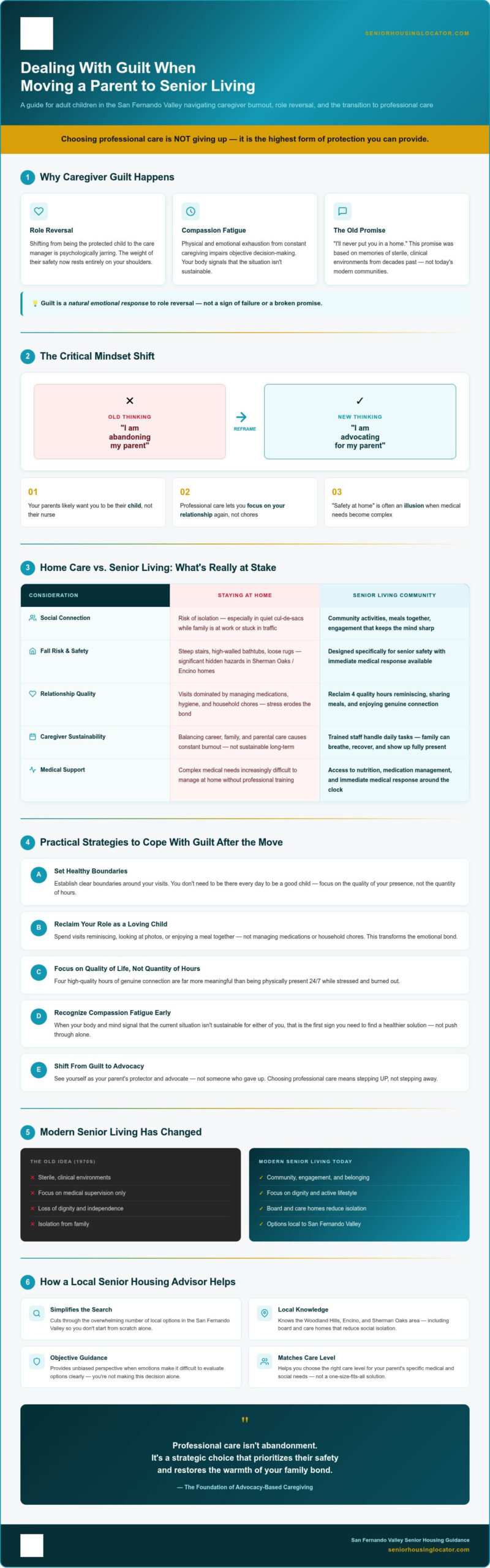
Caregiver guilt is a conflict between your desire to provide care and the reality of your parent’s medical needs. It’s a heavy emotional weight that often stems from a deep sense of responsibility. When you’re dealing with guilt moving parent to senior living, you’re experiencing a natural response to a profound role reversal. You’ve spent your life being protected by them; now, the roles have flipped, and the weight of their safety rests entirely on your shoulders. This transition isn’t just a logistics change; it’s a fundamental shift in your family dynamic.
This emotional burden is frequently compounded by compassion fatigue. When you’re physically and emotionally exhausted from constant caregiving, your ability to make objective decisions can suffer. You might feel like you’re failing, but in reality, your body and mind are signaling that the current situation isn’t sustainable for either of you. Recognizing this fatigue is the first step toward finding a healthier solution for everyone involved.
The Burden of the Unspoken Promise
Many families in Los Angeles carry the weight of a promise made years ago: “I’ll never put you in a home.” This phrase often stems from memories of sterile, clinical environments from decades past. However, modern assisted living facilities are a far cry from the nursing homes of the 1970s. They focus on community, engagement, and dignity rather than just medical supervision. Promising to provide 24/7 care at home is often promising the impossible. As medical needs increase, a private home can become a place of isolation rather than comfort. Recognizing that you can’t fulfill a promise based on outdated information isn’t a failure of character; it’s an act of honesty and love.
Role Reversal and Emotional Discomfort
The shift from being the child to the care manager is psychologically jarring. In the fast-paced San Fernando Valley, the pressure to balance a career, a family, and parental care can make you feel constantly behind. You might feel like you’re rushing through visits just to check off a list of chores. It’s helpful to remember three things: your parents likely want you to be their child rather than their nurse; professional care allows you to focus on your relationship again; and safety at home is often an illusion when medical needs become complex. Dealing with guilt moving parent to senior living becomes easier when you realize that professional help isn’t abandonment. It’s a strategic choice that prioritizes their safety and restores the warmth of your family bond.
Reframing the Decision: From Abandonment to Advocacy
Changing your mindset is the most powerful tool for dealing with guilt moving parent to senior living. Instead of viewing this transition as “putting them away,” look at it as securing their safety and future. In suburban Los Angeles neighborhoods like Woodland Hills or Encino, large family homes often become cages of isolation as mobility decreases. When a parent is stuck at home alone while you’re at work or stuck in 405 traffic, they lose the vital social connections that keep the mind sharp. Advocacy means recognizing when their current environment no longer serves their best interests.
By choosing professional Assisted Living Placement in Woodland Hills, you aren’t stepping back; you’re stepping up as their protector. You’re ensuring they have access to a community that offers engagement, nutrition, and immediate medical response. Dealing with guilt moving parent to senior living becomes much easier when you see the smile on their face during a community lunch or a local outing. You’re providing them with a lifestyle that a single family home in a quiet cul-de-sac simply cannot match.
Choosing Quality of Life Over Quantity of Hours
Many family caregivers believe that being physically present 24/7 is the gold standard of care. However, if those hours are filled with the stress of managing medications, hygiene, and household chores, the relationship suffers. Professional care removes this friction. When trained staff handle the daily tasks, your visits transform. You can spend four high-quality hours reminiscing, looking at photos, or enjoying a meal together. This shift allows you to reclaim your role as a loving child rather than a stressed-out nurse, which ultimately strengthens your emotional bond.
The Safety Comparison
We often overlook the “hidden dangers” in the homes we grew up in. Multi-story houses in Sherman Oaks or Encino with steep stairs, high-walled bathtubs, and loose rugs are significant fall risks. Professional communities are designed specifically for senior safety, featuring grab bars, wide hallways, and zero-threshold showers. You can compare senior care facilities using Medicare’s official tool to see how different locations rank in safety and quality metrics. Safety is the foundation of love, and professional environments prioritize that foundation. Reaching out to a trusted local advisor can help you identify which local options offer the highest safety standards for your parent’s specific needs.
Comparing Home Care vs. Senior Living Options in the San Fernando Valley
Deciding between bringing care into the home or moving to a community is one of the hardest parts of this journey. Many families in the San Fernando Valley start with private home care, but they soon find that the costs for 24/7 assistance can quickly surpass the monthly fees of a dedicated senior living community. Beyond the finances, there is the human element of engagement. While a home caregiver provides physical assistance, they cannot replace the social ecosystem found in a community. Dealing with guilt moving parent to senior living often lessens when you see your parent participating in group activities rather than sitting alone in a quiet house.
The San Fernando Valley offers a wide spectrum of care levels tailored to different needs. Independent living is ideal for those who want a social lifestyle without the burden of home maintenance. Assisted living provides a middle ground, offering help with daily tasks like dressing or medication management. For many, the choice isn’t about “better” or “worse” care, but about finding the environment that offers the most dignity. Professional placement ensures your parent has access to a community where they are seen, safe, and supported throughout the day.
When is a Board and Care Home the Right Choice?
In California, we have a unique model known as the residential care facility for the elderly. Board and Care Homes in Woodland Hills are actual houses in quiet residential neighborhoods that have been converted to care for a small group of seniors. These settings often feel less institutional and more like a traditional family home. With a high staff-to-resident ratio, your parent receives personalized attention in a familiar, intimate environment. This smaller setting often reduces the internal conflict families feel when they worry about their parent getting lost in a larger, corporate facility.
Assisted Living vs. Memory Care
If your parent is living with dementia or Alzheimer’s, their needs go beyond basic physical assistance. Memory Care in the San Fernando Valley provides a secure environment designed to reduce “wandering” anxiety and confusion. These communities offer specialized programming that focuses on cognitive health and sensory engagement. Choosing a secure memory care unit provides freedom within a safe perimeter, allowing your parent to move around without the risks present in a standard home. Dealing with guilt moving parent to senior living is easier when you know that a specialized team is managing the complex behavioral and safety needs that are nearly impossible to handle alone at home.
Practical Strategies to Cope with Guilt After the Move
Once the move is complete, the emotional work truly begins. Dealing with guilt moving parent to senior living often intensifies during the first few weeks when the house feels too quiet or the phone rings at odd hours. You might feel a sudden sense of relief followed by immediate shame. It’s helpful to have a structured plan to manage these waves of emotion so you can remain a strong advocate for your parent. First, establish a consistent visiting schedule that respects your own boundaries. It’s better to visit twice a week with full energy than to visit every day while feeling resentful or exhausted.
Second, focus on “Meaningful Moments.” Now that professional staff are handling the medication and meals, you can spend your time doing things you both enjoy. Bring a favorite local treat, look at family albums, or simply listen to music together. Third, stay in close contact with the facility team. They see the social progress your parent makes when you aren’t there. Fourth, look for a local support group in Los Angeles or Santa Monica. Sharing your experience with others who understand the unique stress of the SFV lifestyle provides immense relief. Finally, give everyone a 30-day “adjustment window.” Transitioning to a new environment is a major life event, and the first few weeks are rarely a reflection of the long-term outcome.
Handling the “Take Me Home” Plea
Hearing your parent ask to leave is one of the hardest things a child can endure. This is often a symptom of “transfer trauma,” a temporary period of stress and confusion that occurs during a move. When these pleas happen, acknowledge their feelings without making false promises. You can say, “I know this is a big change, and it’s okay to feel upset.” Avoid arguing or listing all the reasons why they can’t go home. If the requests persist, involve the community director. They have helped hundreds of families through this phase and can suggest specific activities or social introductions to help your parent feel more at home.
Self-Care for the Adult Child
Your health is essential to your parent’s well-being. If you are physically and emotionally depleted, you cannot be the supportive presence they need. Reclaiming your identity outside of being a primary caregiver is a vital part of dealing with guilt moving parent to senior living. Seek out San Fernando Valley resources for caregiver therapy to help process the role reversal. Remember that you are still a devoted son or daughter; you’ve simply delegated the tasks of a nurse so you can return to being a child. If you’re still feeling unsure about the transition, you can consult with a local senior housing expert to ensure your parent is in the best possible environment for their needs.
How a Local Senior Housing Advisor Can Ease Your Burden
The process of searching for the right facility often adds another layer of stress to an already emotional time. You might spend hours scrolling through websites, reading conflicting reviews, and wondering if you’re making a mistake. A Senior Living Advisor in Los Angeles acts as your objective third party, cutting through the noise to provide clarity. Dealing with guilt moving parent to senior living is much easier when you have a professional who can confirm that your choice is based on safety, quality, and your parent’s specific medical needs. This expert guidance removes the “guesswork” that often keeps adult children awake at night.
At Senior Housing Locator, we pride ourselves on being a trusted local ally for families across the San Fernando Valley. Our service is completely free for families, which helps reduce financial stress during this transition. We handle the heavy lifting by conducting the research, vetting local facilities for safety records, and narrowing down options that fit your budget and location. This streamlined approach allows you to focus on supporting your parent emotionally rather than getting bogged down by logistics. We know the nuances of local neighborhoods, from the quiet streets of Woodland Hills to the vibrant communities in Burbank, ensuring your parent finds a place that feels like home.
The Benefit of an Objective Perspective
Guilt often thrives on uncertainty. You might wonder if your parent truly needs professional help or if you’re simply “giving up.” An advisor provides a professional assessment that shifts the focus from your personal feelings to your parent’s actual requirements. It changes the internal dialogue from “I think they need help” to “The experts recommend this level of care for their safety.” This validation provides the emotional permission many adult children need to step back from the role of primary caregiver. An advisor also advocates for your family’s specific preferences, ensuring that the chosen community aligns with your parent’s lifestyle and your family’s values.
Starting the Conversation with Senior Housing Locator
Our process is designed to be simple, supportive, and entirely no-pressure. It starts with a conversation where we listen to your concerns, understand your parent’s health needs, and discuss your goals for their care. From there, we provide a personalized referral list of communities that have already been vetted for quality. We can help you schedule tours and even accompany you to ask the right questions. Whether you are just beginning to explore options in Woodland Hills or need an immediate placement in Burbank, we are here to guide you every step of the way. Let us help you find the peace of mind your family deserves.
Finding Peace and Safety for Your Family
You’ve taken a significant step toward healing by acknowledging that your parent’s safety is the ultimate priority. Dealing with guilt moving parent to senior living is a journey that requires patience, self-compassion, and the right support. Remember that professional care isn’t about stepping back; it’s about stepping up to ensure your loved one thrives in a secure environment. By reframing your role from primary caregiver to devoted advocate, you can reclaim the joy in your relationship. You deserve to feel confident in the care they receive.
You don’t have to navigate these complex emotions or the vast Los Angeles care landscape alone. Senior Housing Locator offers a free placement referral service for LA families, providing expert knowledge of San Fernando Valley care homes. Our transition specialists offer personalized support to help you find the perfect fit without the stress of endless research. Talk to a Compassionate Local Advisor Today. You’ve done the hard work of caring; let us help you find the peace of mind your family deserves.
Frequently Asked Questions
Is it normal to feel guilty about moving a parent to assisted living?
Yes, feeling guilty is a nearly universal experience for adult children in Los Angeles. Dealing with guilt moving parent to senior living is a natural reaction to the role reversal that occurs as parents age. You are transitioning from being the one cared for to the one making life-altering decisions. This emotional weight is a sign of your deep love and commitment. It doesn’t mean you’ve made the wrong choice; it means you care deeply about their future.
How do I tell my parent they need to move to a senior living community?
Start the conversation early and use “I” statements to express your concerns about their safety in their current home. Focus on the benefits of a community, such as social engagement in Woodland Hills or 24/7 support. It’s helpful to present the move as a way to maintain their independence rather than take it away. Listen to their fears, acknowledge their feelings, and reassure them that your primary goal is their long-term health and safety.
What if my parent refuses to move even though they aren’t safe at home?
If a parent refuses a move despite safety risks like falls or medication errors, it’s often best to involve an objective third party. A doctor or a local senior living advisor can provide a professional assessment that feels less personal than a child’s request. Sometimes, starting with a short-term respite stay in a San Fernando Valley community allows them to experience the benefits of professional care. This helps them feel safe without feeling like they’ve made a permanent commitment.
How long does it typically take for a senior to adjust to their new home?
Most seniors require between 30 and 90 days to fully adjust to their new environment. The first few weeks are often the most challenging as they learn new routines and meet new neighbors in their Sherman Oaks or Encino community. Consistency is key during this time. Encourage them to participate in at least one social activity daily, visit regularly, and also respect their need for quiet time as they process the significant change in their daily life.
Does moving a parent to senior living mean I’ve failed them?
Moving a parent to professional care is a sign of success as an advocate, not a failure as a caregiver. Dealing with guilt moving parent to senior living often stems from the false belief that you should be able to do it all alone. In reality, providing a safe environment with professional medical oversight is the highest form of love. You are ensuring they have the resources they need to live with dignity, security, and professional support.
How often should I visit my parent after they move to senior living?
Focus on the quality of your visits rather than the frequency. For families in Santa Monica or Burbank, visiting two or three times a week with a positive attitude is often more beneficial than daily visits that leave you feeling drained. Establish a consistent schedule so your parent has something to look forward to. This approach allows you to step back from being a nurse, focus on meaningful connection, and return to being a supportive child.
Can a senior living advisor help if my family is disagreeing about the move?
Yes, a senior living advisor acts as a knowledgeable, objective mediator when siblings or family members disagree on the best path forward. We provide factual information about local care options in the San Fernando Valley and help families align on safety requirements, budget, and location. Having an expert’s perspective often lowers the emotional temperature of the conversation. This allows everyone to focus on what is truly best for the parent’s health, safety, and overall happiness.
What are the signs that my caregiver guilt is becoming unhealthy?
Caregiver guilt becomes unhealthy when it leads to chronic physical exhaustion, social isolation, or clinical depression. If you find yourself unable to sleep, neglecting your own health, or feeling constant resentment, it’s time to seek professional support. Healthy guilt motivates you to find better solutions; unhealthy guilt paralyzes you. Reaching out to a local advisor can help remove the burden of research, provide validation, and help you find a community where your parent can thrive safely.