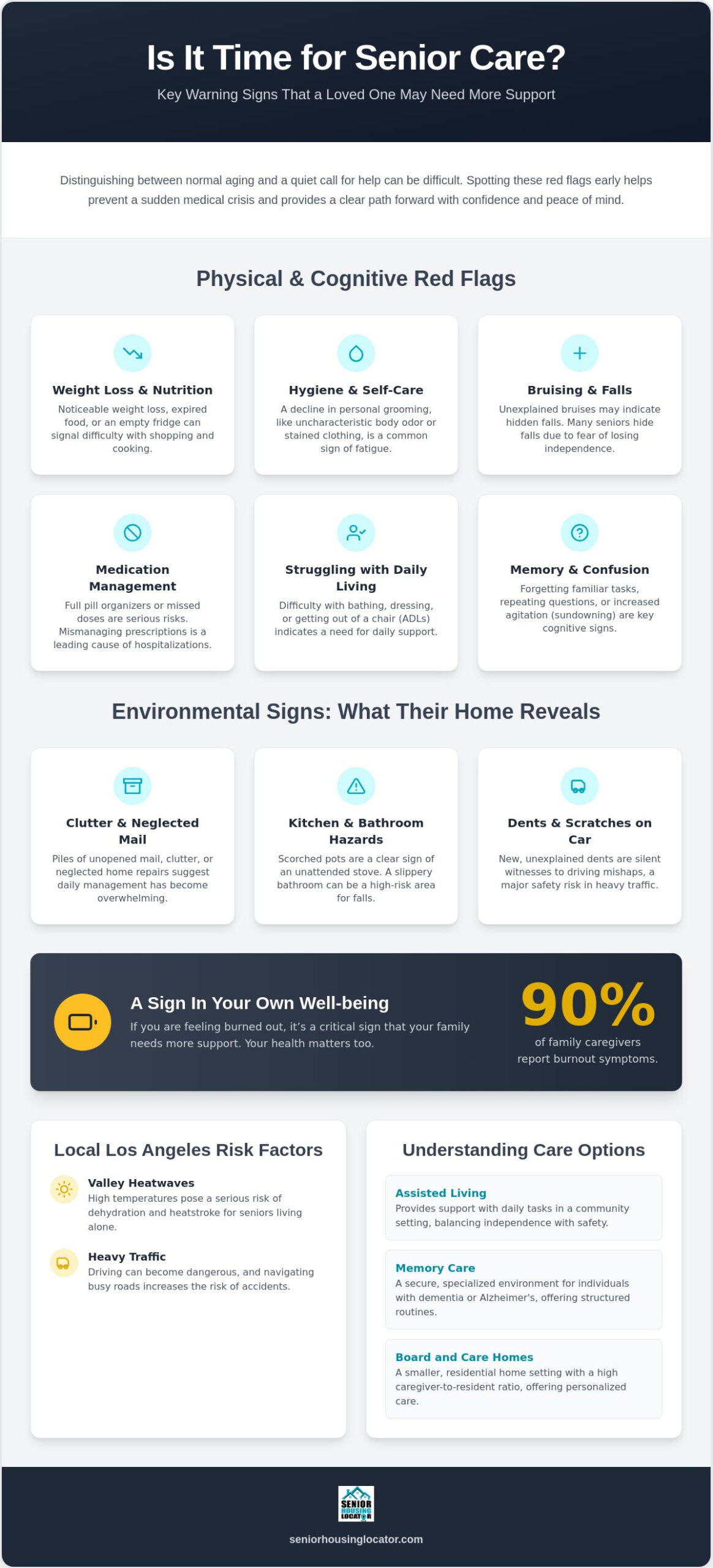
What if the subtle changes you’re seeing in your mom or dad aren’t just “part of getting older,” but actually a quiet call for support? It’s common to feel a heavy sense of dread when you first notice the signs parents need senior care. You want to respect their independence, yet the fear of a sudden medical crisis or a fall keeps you up at night. In a 2026 survey, 90% of family caregivers reported symptoms of burnout. You are likely juggling a career, your own children, and the growing needs of your parents right here in the San Fernando Valley.
We understand that this process feels overwhelming, confusing, and deeply emotional. This guide will help you identify 10 critical red flags, offer you the clarity you need to move forward, and provide permission to seek professional support. We will explore a clear checklist of warning signs, explain the differences between local housing options, and show you how to protect your parent’s well-being. By the end of this article, you’ll have a simple, step-by-step plan to navigate senior living in Los Angeles with confidence and peace of mind.
Key Takeaways
- Learn to distinguish between normal aging and specific physical changes that require professional attention. Spotting these red flags early helps you prevent a sudden medical crisis.
- Discover how a messy kitchen or unopened mail can signal that your loved one is struggling with daily tasks. These environmental clues often tell a story that your parents might not share.
- Recognize the emotional signs parents need senior care by checking in on your own well-being. If you’re feeling burned out, it’s often a sign that your family needs more support.
- Understand how Los Angeles factors like Valley heatwaves and heavy traffic can make living alone more dangerous for seniors.
- Get a simple breakdown of local care options to help you choose between assisted living, memory care, or board and care homes.
Physical and Cognitive Red Flags: Is It Normal Aging?
It’s natural to wonder if your parent is simply having a “senior moment” or if their safety is at risk. You might visit their home in Encino or Sherman Oaks and notice things feel slightly off. Perhaps the house is warmer than usual, or your mother seems more tired than her normal self. These small changes are frequently the earliest signs parents need senior care and a more structured environment. Catching these red flags early allows you to be proactive rather than waiting for an emergency room visit to force your hand.
Physical changes are often the most visible indicators that your loved one needs a helping hand. Pay close attention to these specific areas during your next visit:
- Weight Loss and Nutrition: Take a look inside the refrigerator. Is it filled with expired milk or moldy produce? Noticeable weight loss often happens because a senior finds it too difficult to shop for groceries or cook balanced meals.
- Hygiene and Self-Care: If your father was always meticulous about his appearance but now has uncharacteristic body odor or wears the same stained shirt for days, it’s a signal. Neglecting basic grooming is a common sign of physical or cognitive fatigue.
- Medication Management: Are pill organizers still full on a Wednesday afternoon? Mismanaging prescriptions is a leading cause of hospitalizations. If they can’t track their doses, they likely need professional oversight.
Struggling with Activities of Daily Living (ADLs)
Activities of Daily Living, or ADLs, are the basic tasks we all do to care for ourselves, and they serve as the primary baseline for assisted living eligibility. When these tasks become a struggle, it’s time to explore Elderly care options that provide daily support. This includes difficulty with bathing safely, grooming, or “transferring,” which is the ability to get in and out of a bed or chair without help. If your parent is avoiding the shower because they’re afraid of slipping, they aren’t just “getting old”; they’re telling you they need a safer environment.
Early Cognitive Warning Signs
Cognitive decline often starts with small, frustrating moments that are easy to dismiss. Your mom might suddenly forget how to use the microwave she’s owned for a decade. She might ask you the same question about your children three times in a single conversation. These moments aren’t just forgetfulness. They are signs parents need senior care that specifically addresses memory health.
Watch for increased agitation or “sundowning,” which is a state of confusion that begins in the late afternoon as the sun sets over the San Fernando Valley. If they are getting lost in familiar neighborhoods or struggling with the TV remote, their brain is working harder than it should have to. Providing them with a professional care setting can lower their stress and yours.
Environmental Signs: What Their Home is Telling You
A parent’s home often tells a story they aren’t quite ready to put into words. If you walk into a house that was once spotless but now feels chaotic, take a moment to look closer. These environmental shifts are often the most reliable signs parents need senior care because they represent a breakdown in daily management. It isn’t just about a few dusty shelves or a sink full of dishes. It is about a fundamental change in how they interact with their surroundings.
Look for an uncharacteristic accumulation of clutter or trash that seems to have no place. When home repairs like a leaky faucet or a broken microwave are neglected for months, it suggests the mental load of maintenance has become overwhelming. Don’t forget to check the driveway, too. Strange dents or scratches on the car are often silent witnesses to recent driving mishaps. In our busy Los Angeles traffic, these “minor” scrapes can be an early warning of a much larger safety risk. If you see these signs, it’s a signal that their current living situation may no longer be sustainable.
The Kitchen and Bathroom Safety Audit
The kitchen and bathroom are the highest-risk areas in any home. Start by checking the pantry for expired food or a total lack of fresh groceries. Look specifically for scorched pots and pans. This is a clear sign that a stove was left unattended, which creates a major fire hazard. In the bathroom, check for a lack of grab bars or slip-resistant mats in the tub. If you find yourself constantly worrying about these hazards, you may be feeling the weight of Caregiver burnout. It’s difficult to be everywhere at once.
Financial Red Flags and Scams
Money management requires high-level cognitive function. Have you noticed a sudden interest in “sweepstakes” or unusual charitable donations? Seniors are frequently targeted by predatory scams that can drain their savings quickly. You might also see them struggle with simple tasks, like calculating a tip at a restaurant or managing a checkbook. Financial confusion is often the first measurable sign of a decline in Instrumental Activities of Daily Living (IADLs). These are the complex skills required to live independently without professional support.
If these environmental changes are making it hard for your loved one to stay safe at home, it may be helpful to view local senior living communities that offer a more supportive environment. Finding the right fit now can prevent a crisis later.
Caregiver Burnout: When Your Health Becomes a Sign
We often focus entirely on the senior’s well-being. However, your own physical and mental state is one of the most significant signs parents need senior care. If you find yourself feeling constant resentment or flashes of anger toward your aging parent, don’t feel guilty. It’s a sign you’ve reached your limit. You might be neglecting your own health, losing sleep, or falling behind at work. When you stop seeing your friends and start withdrawing from the life you built in Los Angeles, the current caregiving arrangement is no longer working. In a 2026 survey, 20% of family caregivers described their burnout as severe. You can’t provide quality care when you’re running on empty.
Are you living in a “reactionary” mode? This means you only act when something goes wrong, like a sudden fall or a missed medication dose. Proactive care is different. It involves setting up a support system before a crisis occurs. If your daily life is a series of emergency phone calls, you are likely burned out. This state of constant high alert is unsustainable for you and unsafe for your parent. Recognizing that you need help is the first step toward a more stable future for your entire family.
The Emotional Toll of Role Reversal
Parenting your parent is an exhausting shift in dynamics. You shouldn’t have to spend every visit checking their fridge or managing their bathroom habits. When this role reversal becomes unsustainable, it strains the bond you share. Professional care isn’t about “giving up.” It’s about restoring your relationship. By moving to a supportive community, you can return to being a son or daughter again. You can enjoy a meal together without the stress of caregiving duties. There is a tipping point where home care is no longer enough to ensure their safety or your sanity.
Safety Risks of Solo Caregiving
There are physical dangers to caring for a loved one alone. Attempting to lift or move a parent without professional training can lead to serious back injuries for you and falls for them. Think about what would happen if you had a medical emergency. Who would be there to step in immediately? This is why seeking senior care transition help Los Angeles is essential for long-term family stability. An organized transition ensures that your parent is safe even when you can’t be there. It protects your health and theirs simultaneously while providing a clear path forward.
Local Los Angeles Triggers: Environmental and Safety Factors
Living in Southern California offers a beautiful lifestyle, but it also presents unique environmental risks for aging adults. These geographic challenges are often the most overlooked signs parents need senior care. For a senior living in the hills of Encino or Sherman Oaks, the very features that make a home beautiful can become barriers to safety. Narrow, winding roads and steep driveways make it difficult for emergency services to reach them. It makes it even harder for the senior to leave for basic needs if they are feeling unwell or unsteady.
Wildfires are another reality for Los Angeles families. If your parent has limited mobility, a sudden evacuation order is no longer just an inconvenience. It is a high-stakes crisis. Could they get out of the house, into a car, and navigate through smoke and traffic on their own? If the answer is “no,” their current home is no longer the safest place for them. Professional care settings have established, practiced emergency protocols that remove this terrifying burden from your shoulders and ensure your loved one is never left behind during a natural disaster.
Heat and Hydration in the San Fernando Valley
The San Fernando Valley is known for its intense summer heat. In neighborhoods like Woodland Hills, temperatures can stay in the triple digits for days at a time. We often find that seniors living alone hesitate to use their air conditioning because they worry about high utility bills. This choice leads to a dangerous risk of heat stroke and dehydration in unmonitored environments. In a supervised care setting, climate control is a standard part of the environment. This ensures your loved one stays cool and hydrated without the stress of managing a thermostat or a bill.
Transportation and Social Isolation
Los Angeles is famously car-dependent. When a parent begins to struggle with the 101 or the 405, they often stop going to doctor appointments, grocery stores, and social gatherings. This “driving retirement” is a major life transition that many seniors resist. Unfortunately, the loss of a driver’s license often triggers a rapid spiral into depression and cognitive decline because of the resulting isolation.
You can help them maintain their independence and social life by exploring independent living communities in Woodland Hills. These settings offer built-in transportation and daily activities, so they never have to worry about LA traffic again. If you’re noticing these local triggers affecting your family, it’s time to speak with a local advisor who can help you evaluate the safest options for your specific neighborhood.
The Next Step: Finding the Right Care in Los Angeles
Once you’ve recognized the signs parents need senior care, the next phase is finding a place where they can truly thrive. Los Angeles offers a massive landscape of options, which can feel like another full-time job to navigate. You aren’t just looking for a room. You’re looking for a community that aligns with their medical needs, your family’s budget, and a convenient location. Making the right choice now prevents the stress of a second move later on.
Generic online lists often provide outdated information or lead to endless sales calls. A personalized referral service is far superior because it accounts for the nuances of your parent’s personality and specific health requirements. We focus on matching care needs with the right environment, whether that is a vibrant social community or a quiet, residential home. Taking a proactive approach ensures your parent stays safe while you regain your peace of mind.
Assisted Living vs. Board and Care Homes
Many families in Southern California aren’t aware of the “Board and Care” model, which is a popular local alternative to traditional assisted living. These are typically smaller, residential homes located in quiet neighborhoods. They usually house only six residents, providing a much higher staff-to-resident ratio than larger facilities. While a large assisted living community offers a social atmosphere with movie theaters and bistros, a board and care home provides an intimate, family-like setting. This is often better for seniors who feel overwhelmed by crowds or have high physical care needs. If your loved one is struggling with advanced dementia, you might specifically need memory care placement in San Fernando Valley to ensure they have specialized security and cognitive support.
Working with a Senior Living Advisor
Senior Housing Locator provides a free, high-touch service designed to simplify the search for LA families. We have deep roots in communities like Woodland Hills, Burbank, and Santa Monica. We’ve walked the halls of these facilities, met the caregivers, and reviewed state citations firsthand. Instead of you spending hours on the phone, we do the heavy lifting by narrowing down dozens of options to the two or three that actually make sense for your parent. We help you schedule tours, ask the right questions, and understand the fee structures before you sign a contract.
You don’t have to handle this transition alone. Moving a parent is one of the most significant decisions you’ll ever make, and having a knowledgeable guide can lower the emotional stakes. Let us handle the research so you can focus on supporting your loved one. Take the first step toward a safer future and schedule a consultation with a senior living advisor in Los Angeles today.
Take the First Step Toward Peace of Mind
Noticing a decline in your loved one’s safety is a heavy burden, but it’s also an opportunity to provide them with the professional support they deserve. You now know how to spot subtle shifts in hygiene, home maintenance, and the unique environmental risks that come with living in the San Fernando Valley. Identifying these signs parents need senior care allows you to act before a medical emergency forces a rushed decision. By staying proactive, you protect their dignity and your own well-being.
You don’t have to navigate the complex world of local facilities alone. Our team provides a free placement service for families, using our expert knowledge of Woodland Hills and San Fernando Valley facilities to find the perfect fit. We offer tailored options for Memory Care, Assisted Living, and Board and Care homes that match your budget and location. Get Free Personalized Help Finding the Right Senior Care in Los Angeles today. Better days for your family are just one conversation away.
Frequently Asked Questions
What are the first signs that a parent shouldn’t live alone anymore?
The first indicators often involve a breakdown in safety or basic self-care routines. You might notice they are skipping meals, forgetting to bathe, or struggling to manage their home in the San Fernando Valley. These are common signs parents need senior care that suggest living alone is no longer the safest option. If they can no longer manage their medications or navigate their home without a high risk of falling, it’s time to look at other options.
How do I tell the difference between normal forgetfulness and dementia?
Normal aging involves occasionally forgetting a name or where you put your glasses. Dementia is different because it interferes with daily functioning, such as getting lost in your own neighborhood or forgetting how to perform familiar tasks like using a microwave. If the forgetfulness leads to safety risks, personality changes, or high levels of daily stress, it is likely more than just a “senior moment.” A professional assessment can provide the clarity your family needs.
Is it cheaper to have home care or move to an assisted living facility in Los Angeles?
While it depends on the specific level of support, 24/7 in-home care in Southern California is generally much more expensive than a residential facility. Assisted living provides a bundled cost that includes housing, utilities, meals, and 24-hour staff. For many families, moving to a community offers more predictable monthly expenses and better social engagement than paying for around-the-clock private caregivers. It also removes the burden of home maintenance and property taxes.
What should I do if my parent refuses to move to senior care?
Start the conversation early and focus on their safety rather than the idea of “placement.” It often helps to involve a neutral third party, like a primary care physician or a senior living advisor, to lower the emotional tension between you and your parent. Sometimes, framing the move as a way to stay social and active can help ease the transition. Listen to their fears, but remain firm about the safety risks you’ve observed in their current home.
How many falls are considered a “red flag” for moving to assisted living?
Even a single significant fall is a major red flag, especially if it results in an injury that limits their mobility. Research shows that one fall often leads to a fear of falling, which causes seniors to become less active and more frail over time. If they are tripping on rugs, struggling with stairs, or having “near misses,” a more accessible environment is necessary. In cases where a fall is caused by negligence or unsafe conditions, the Law Offices of Michael D. Payne can provide the legal expertise needed to protect your loved one’s interests. Proactive moves help prevent the hip fractures that often lead to a permanent decline in health.
What is the average cost of senior care in the San Fernando Valley for 2026?
In 2026, costs for care in the Valley vary based on the level of daily assistance and the type of room selected. You generally pay for a combination of monthly rent and a service fee for personal care. We recommend reviewing the new 2026 California transparency disclosures to see a facility’s three-year rate increase history before you sign any contracts. This helps you plan for future costs and ensures there are no hidden fees for basic services.
Can I move my parent to memory care if they only have mild cognitive impairment?
Yes, you can move a parent with mild cognitive impairment to memory care if safety is a growing concern. Many communities offer transitional wings for those who don’t yet need full-scale dementia care but require extra oversight. This allows them to get used to the environment and the staff while they are still able to socialize easily. It is often better to move while they can still participate in the transition process and build new routines.
How does a senior placement agency like Senior Housing Locator actually work?
We start by meeting with you to understand your parent’s specific health needs, budget, and preferred location in Los Angeles. Our team then provides a curated list of vetted facilities, schedules your tours, and helps you ask the right questions during visits. This service is completely free for families because the communities pay us a referral fee once a successful placement is made. We act as your local advocate to ensure you find the best possible fit.